
String Care
String Care
Stretching Guitar Strings: A Dealer’s Retuning and Handover Guide
A dealer process for checking newly installed strings, routing retuning concerns and preparing customer instructions.
Introduction
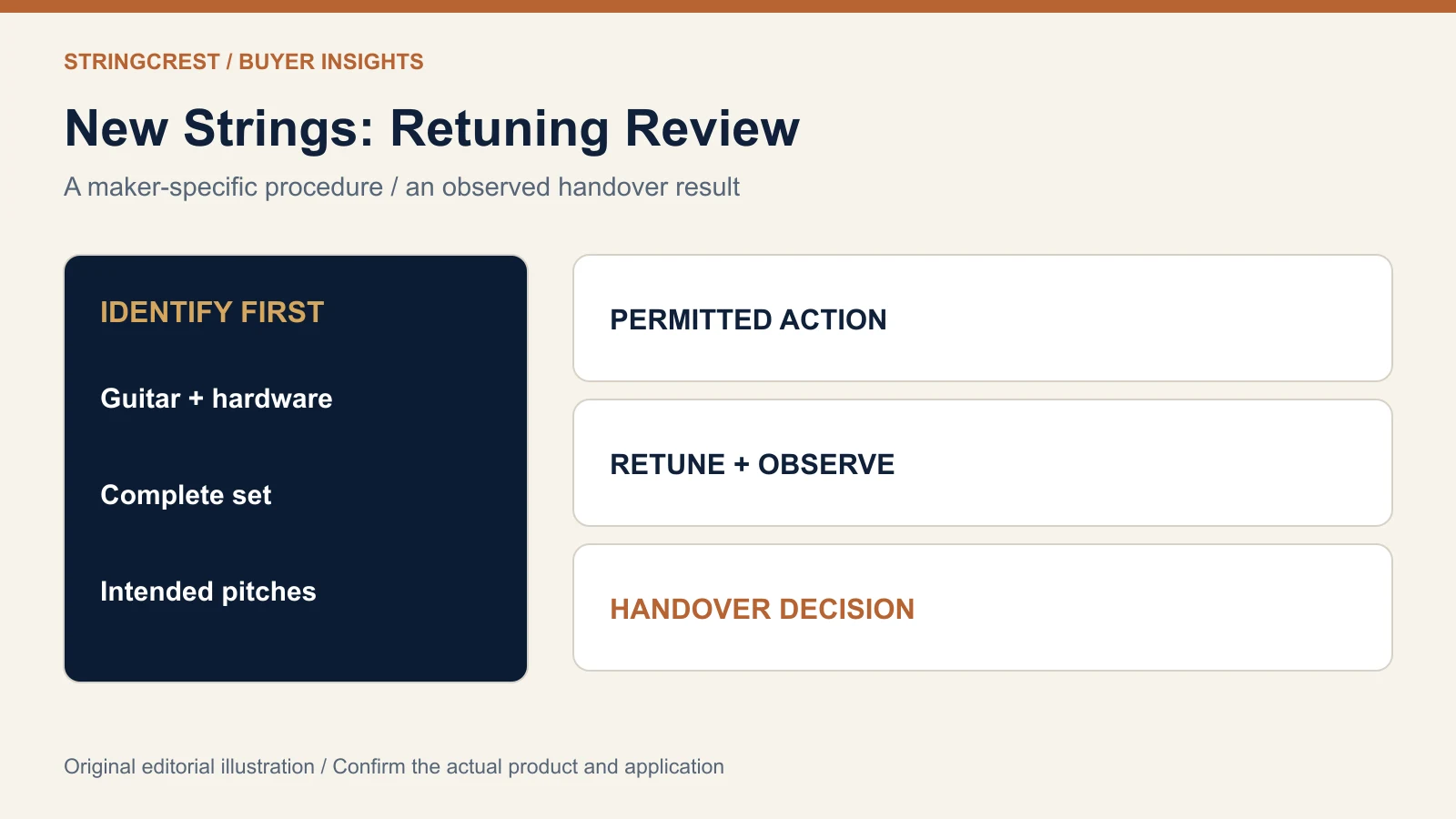
To prepare newly installed guitar strings for use, follow the string and hardware makers’ installation instructions, tune to the intended pitch, carry out any permitted gentle settling procedure and retune. Check the result under a defined playing task. Increasing the pulling force is not a reliable response to continuing pitch movement or an uncertain attachment.
The service manager needs to decide when the guitar is ready to hand over and what the customer should do next. A new set that needs retuning presents a different question from a slipping attachment, an unidentified replacement specification or a guitar needing setup assessment. Staff should be able to distinguish those questions before describing the strings as defective.
This guide focuses on a controlled retuning and customer-support process for identified instruments. Procedures and records below are suggested shop practices. They are not reports of StringCrest testing, measured tuning improvements or completed customer repairs.
Confirm the installed set and hardware first
Record the complete set, instrument model, intended tuning and attachment method. Confirm that the installation followed the applicable instructions before evaluating what happens afterward. A settling procedure cannot establish that the wrong set or an uncertain attachment is suitable.
The hardware matters. Conventional posts, locking posts and split posts can have different instructions. A retailer should not apply one wrapping method to every tuner or add extra turns automatically when a customer reports pitch movement. Check the method for the actual hardware.
The electric string length and tuner-fit guide separates supplied length from the installed path and attachment allowance. Resolve that fit question before comparing retuning observations. A product that reaches a post still needs the correct installation method.
Keep the previous and new specifications together if the customer changed gauges or construction. That information helps the technician determine which installation and setup questions deserve attention. It also prevents a changed configuration from being treated as a direct comparison with the previous set.
Understand the scope of a maker’s stretching procedure
Fender’s Stratocaster setup guidance describes light handling of installed, tuned strings, followed by retuning and repetition. It also distinguishes tuner procedures. That guidance belongs to its instrument context; it does not supply a universal force specification for every guitar or construction.
In that Stratocaster example, Fender describes supporting the string at the first fret and using a light tug on each installed string before retuning. Read the full procedure for the actual model before demonstrating it. The supported position and light handling are part of the method; they should not disappear from a shortened instruction that simply tells the customer to pull harder.
A shop can use the example to organize the right questions: is a settling procedure permitted, how should the string be supported, which installed condition is required and what should be checked afterward? Use the applicable maker instructions for the actual demonstration rather than converting a general description into an arbitrary pulling target.
Avoid promising a fixed number of repetitions or a guaranteed settling time without relevant evidence. A string that continues to move does not automatically need another stronger pull. The next step may be an installation review or an instrument assessment.
Use the actual instructions at the bench
Keep the current instructions available with the service record. Where the method is unclear or staff lack the necessary competence, use a qualified technician. A short video watched for another guitar is not a complete installation specification for the instrument on the bench.
Describe the task precisely
“Stretch the strings” is a loose instruction. Staff should explain the permitted handling and retuning sequence in the maker’s terms, then show the customer which observation they are checking. Avoid language that encourages pulling until the string appears permanently unchanged.
Follow a repeatable retuning sequence
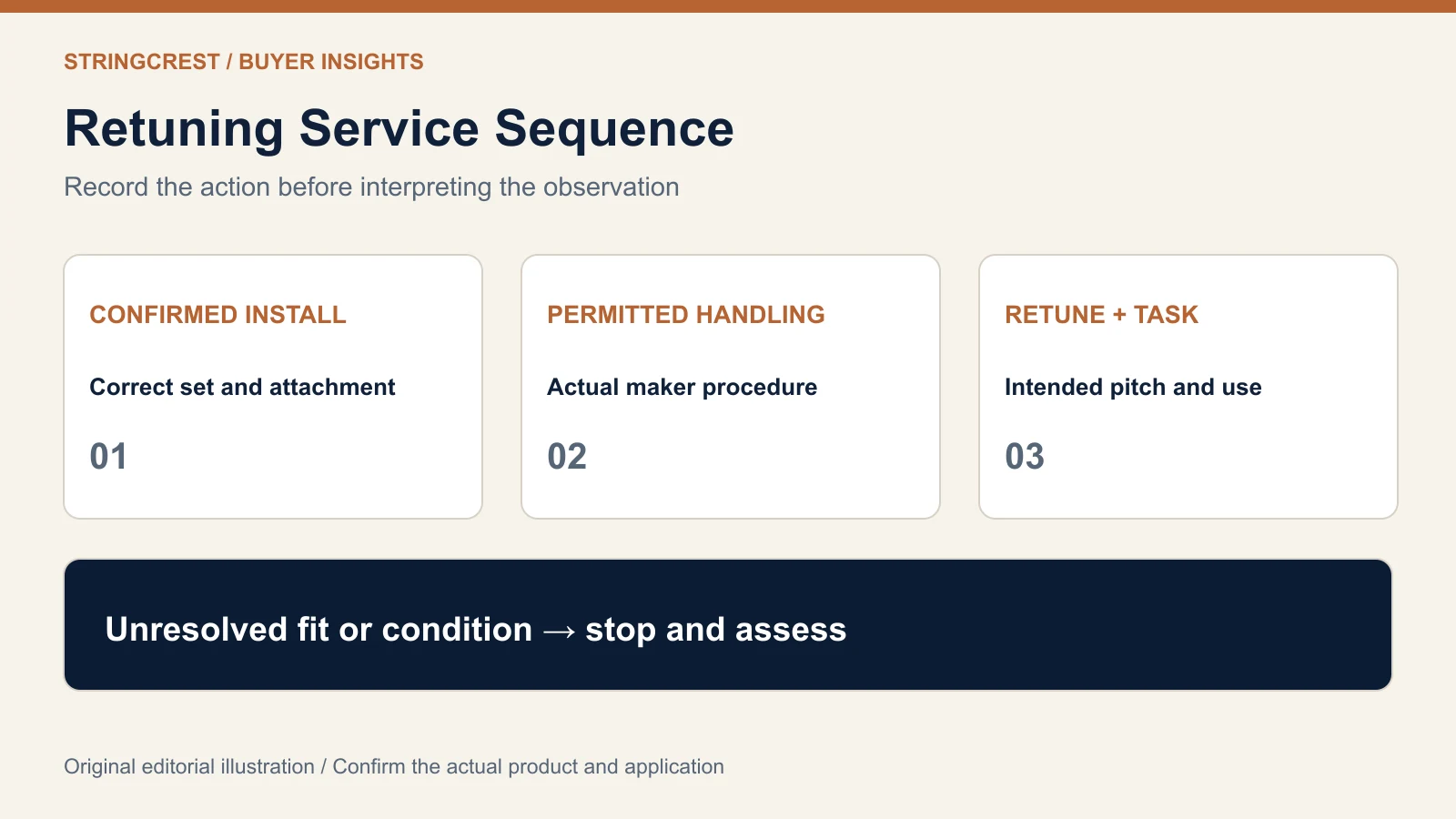
A general shop sequence should establish identity and permitted action before testing the result. It can be used as an intake or handover checklist without prescribing a universal mechanical technique.
- Confirm the guitar, complete installed set and intended pitches against the applicable requirements.
- Check the installation and attachments using the relevant hardware instructions.
- Tune the correctly installed set and carry out the maker’s permitted gentle settling method, where applicable.
- Retune, perform the agreed playing task and record the observation. Stop for an unresolved fit or condition concern.
The procedure should leave a clear record of which action preceded the observation. If a technician adjusts the instrument, add that intervention before comparing results. A later change in pitch behavior may then be interpreted in the context of the work performed.
Keep the playing task reasonable for the intended use and identical enough to compare observations. Staff cannot evaluate one candidate with ordinary chord playing and another with a markedly different task, then attribute the difference only to the string construction.
Decide what the tuning observation actually shows
Record the string position and the task that preceded the reading. A report that “the guitar went flat” needs clarification: which positions changed, when were they last tuned and what happened in between? Use the same tuner settings and intended pitches when comparing readings.
A useful observation can be qualitative when the instrument and conditions are clear. If numerical readings are required, agree how the tuner is used and what the recorded values mean. Do not invent a pass threshold merely to make the worksheet look technical.
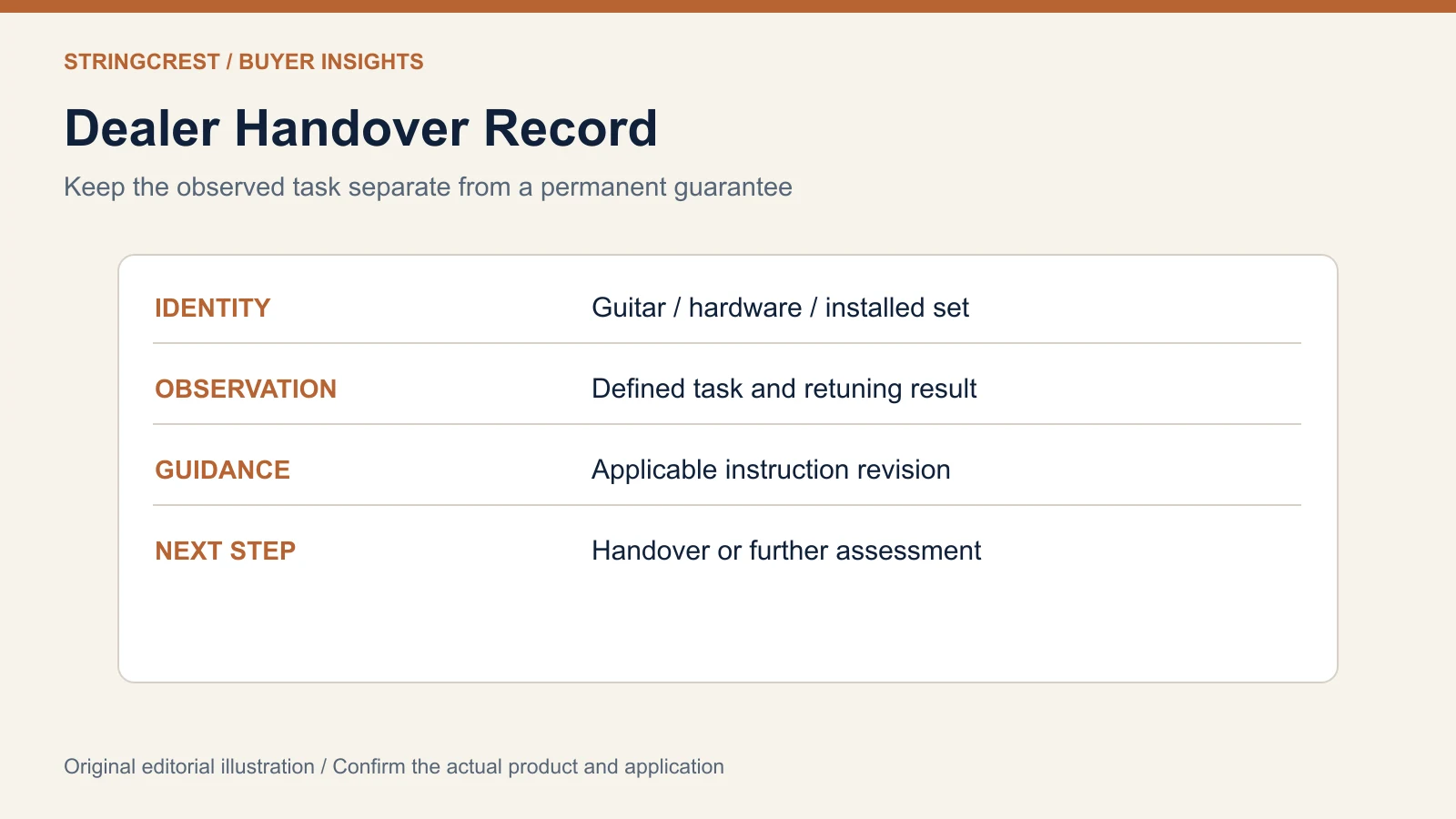
| Record field | What staff enter | Why it helps |
|---|---|---|
| Installed identity | Set, position and guitar | Identifies the component under review |
| Intended pitch | The agreed note and register | Prevents tuning to an ambiguous target |
| Previous action | Installation, permitted handling or playing | Makes the sequence interpretable |
| Observation | Which position changed and under what task | Directs the next check |
| Intervention | Any relevant technician work | Preserves the comparison context |
A proposed service record can route observations as follows: when the approved installation and intended task give an acceptable observed result, record that result for the handover decision. When repeatable pitch movement remains unresolved, request the relevant installation or instrument assessment. When the product identity or attachment is uncertain, resolve that prerequisite before extending the handling sequence. These are suggested decisions, not measured pass rates or a substitute for a technician's judgment.
The handover explanation should name the observation in ordinary language. For example, staff can identify the installed set, the task performed and what was observed afterward, then explain the applicable retuning guidance. They should avoid describing that limited check as a guarantee covering every performance, storage condition or future string change. If a customer needs a different task evaluated, preserve it as another request.
A repeatable observation describes this guitar under these conditions. It does not establish lifetime tuning stability or prove that every guitar using the same set will behave identically.
Stop when the attachment or condition is uncertain
A moving attachment, catching winding, damaged component or doubtful installation deserves assessment before further handling. Preserve the observation and product identity. Continuing the stretching sequence can change the evidence without resolving the original concern.
For an instrument requiring hardware or setup work, route the question to a competent technician. This guide does not prescribe nut filing, bridge adjustment or a new winding method as an automatic remedy. The post-change buzz guide addresses a different symptom and shows why changed configurations need careful interpretation.
If a string breaks, keep the event separate from the original retuning complaint. Record what was done immediately before the break and retain the relevant product information. The breakage review guide explains how to preserve useful evidence without assigning a cause from timing alone.
A customer’s account remains valuable even when staff cannot reproduce it. Identify what is known, what needs clarification and the appropriate next assessment rather than dismissing the report because the guitar behaved differently in the shop.
Keep nylon-string advice separate
New nylon and steel strings should not be assigned the same settling expectation automatically. Fender’s instructor guidance notes that new nylon strings may take longer to settle than steel strings. That is a material-level direction, not a fixed promise of hours or days for a particular StringCrest set.
Classical and ukulele instructions must match the actual synthetic construction and attachment. The approved StringCrest nylon direction uses plain or tie ends, without metal ball-end hardware. Keep that distinction clear in staff demonstrations, images and customer wording.
Do not transfer a steel-string pulling routine, tuner wrap count or attachment picture into a nylon care card without applicable guidance. If the customer’s instrument or string material is uncertain, establish it first. Different synthetic constructions also deserve their own instructions.
For a classical project, use the tie-end compatibility guide. For a ukulele project, review the string length and plain-end fit guide. Neither category name alone supplies a universal settling procedure.
Set a clear handover decision
A shop should define what it needs to observe before returning the guitar to the customer. The decision can include confirmed installation, an appropriate tuning check and satisfactory behavior under the intended task. If a question remains unresolved, explain it and agree the next action rather than presenting the demonstration as complete.
Write the handover record around the actual work: installed product, guitar, tuning, relevant procedure, task checked and any remaining advice. Avoid a generic “fully stable” stamp that sales staff might interpret as a permanent guarantee.
An illustrative service decision is a guitar that was restrung, checked by the technician and demonstrated under the customer’s usual chord task. Staff record the observed result and explain the permitted retuning instructions. If the customer instead needs an upcoming performance condition evaluated, that becomes a separate question with its own requirements. This example describes a proposed process, not a completed repair case.
Give customers instructions they can use at home
The customer needs to recognize the installed set, the intended tuning and where to find the applicable procedure. Keep the instructions short enough to consult while retuning, with clear advice about when to stop and ask for help.
Do not assume that every customer is comfortable handling strings or checking hardware. Offer a demonstration within the shop’s competence and provide the relevant maker information. If the customer cannot identify the procedure, a return visit or technician appointment may be more useful than an ambiguous instruction to “stretch more.”
For an online replacement purchase, show the installation context before the order is completed. A packet suitable for the customer’s guitar still needs appropriate fitting. Staff can explain that distinction without blaming the player or promising a particular tuning result.
If the product or instrument changes later, the old instruction card needs another check. A recognizable product code and instruction revision help the customer and retailer identify when the guidance no longer describes the current installation.
Investigate repeated concerns as a defined service question
When several reports reach a dealer, preserve the actual number of reports and their scope. Check whether they concern the same product revision, hardware or installation procedure. Do not calculate a defect rate from an incomplete collection of enquiries.
A useful review distinguishes an instruction problem from a fit concern and a possible product discrepancy. The supplier may need the accepted specification and sample identity; the technician may need the actual guitar and installation history. Give each reviewer the information relevant to their role.
Factory testing can help only when the product question and method are defined. A bench measurement cannot reproduce every customer’s attachment, guitar or playing task. This guide claims no StringCrest test result, cycle endurance or measured improvement in tuning stability.
If additional samples are proposed, agree which variable changes and what the comparison should answer. Replacing several components at once can produce a useful finished configuration while leaving the cause of the original observation unresolved.
Connect installation information to private-label approval
A private-label buyer can request installation guidance with the product development brief. Ask what construction and hardware contexts the instructions cover, which conditions are required and whether a new product revision needs different wording.
StringCrest makes strings to customer specifications agreed for the order, and packaging specifications can be customized to customer requirements. Those confirmed facts support a private-label discussion. They do not establish that a particular stretching procedure, stability claim or accessory is approved for every proposed construction.
Review the actual packet text and any linked guidance before printing. A brief that names the instrument application and intended customer task is more useful than asking for a universal “no retuning” claim. Keep the accepted instructions with the product revision.
During shipment inspection, compare the supplied product and instruction identity with the approved artwork. That check establishes whether the agreed information is present. It does not independently validate a playing result or create a new handover guarantee.
FAQ
Should all new guitar strings be stretched the same way?
Use the procedure for the actual string construction and instrument hardware. Maker guidance for one electric model is not a universal pulling method. Identify the installed set and attachments before giving advice.
How hard should a player pull a string?
Follow the applicable maker’s handling instructions. This guide does not specify a force or encourage progressively stronger pulling. An insecure attachment or damaged string needs assessment before more handling.
Does retuning mean the strings are defective?
A retuning observation alone does not establish a defect. Check the complete installed configuration, permitted procedure and task. Preserve unresolved observations for the relevant installation, instrument or product review.
Will locking tuners remove the need for a tuning check?
Use their maker’s installation method and evaluate the actual result. The hardware name is not proof that every possible string, installation and playing task will remain at pitch without further checking.
Do nylon strings settle on the same schedule as steel?
Do not assume a shared schedule. Fender’s instructor guidance describes a longer settling direction for new nylon strings, but it supplies no universal duration for the constructions discussed here. Keep nylon attachment and care advice specific.
What should a dealer send with a tuning concern?
Send the installed set identity, guitar and hardware details, intended pitches, installation method and observed sequence. Include relevant interventions and clarify what remains unknown. Avoid assigning a product cause before the applicable review.
Conclusion
A useful post-restring process joins correct installation, permitted handling, retuning and a defined playing observation. The handover decision should describe what was checked on the actual guitar and what the customer should do if a question remains.
For dealers and private-label buyers, preserve the product and instruction identity through samples, packaging and after-sales records. That gives a tuning enquiry a clear next step without an unsupported promise of permanent stability.
Sources and interpretation limits
Fender’s Stratocaster setup guidance and Fender’s instructor guide were checked on 12 October 2026. Use their stated contexts and the instructions for the actual instrument. Service scenarios and worksheets here are suggested practices, not StringCrest laboratory results or completed customer repairs.
FROM GUIDE TO PRODUCT
Connect this guide to StringCrest product ranges.
Review the relevant range, then bring the instrument, complete specification and open questions into one project brief.
YOUR PRODUCT · YOUR BRAND
Discuss your next string project with Frank.
Share your instrument category, target market, gauge or material direction and private-label packaging requirements.

ABOUT THE AUTHOR
Frank Zou
Frank works directly with musical-instrument brands, importers and distributors on string specifications, product selection and private-label project requirements.
Meet Frank