
String Care
Quality Control
Guitar String Buzz After a String Change: A Dealer Triage Guide
A dealer intake process that distinguishes noise, configuration changes, installation and instrument assessment before assigning a string defect.
Introduction
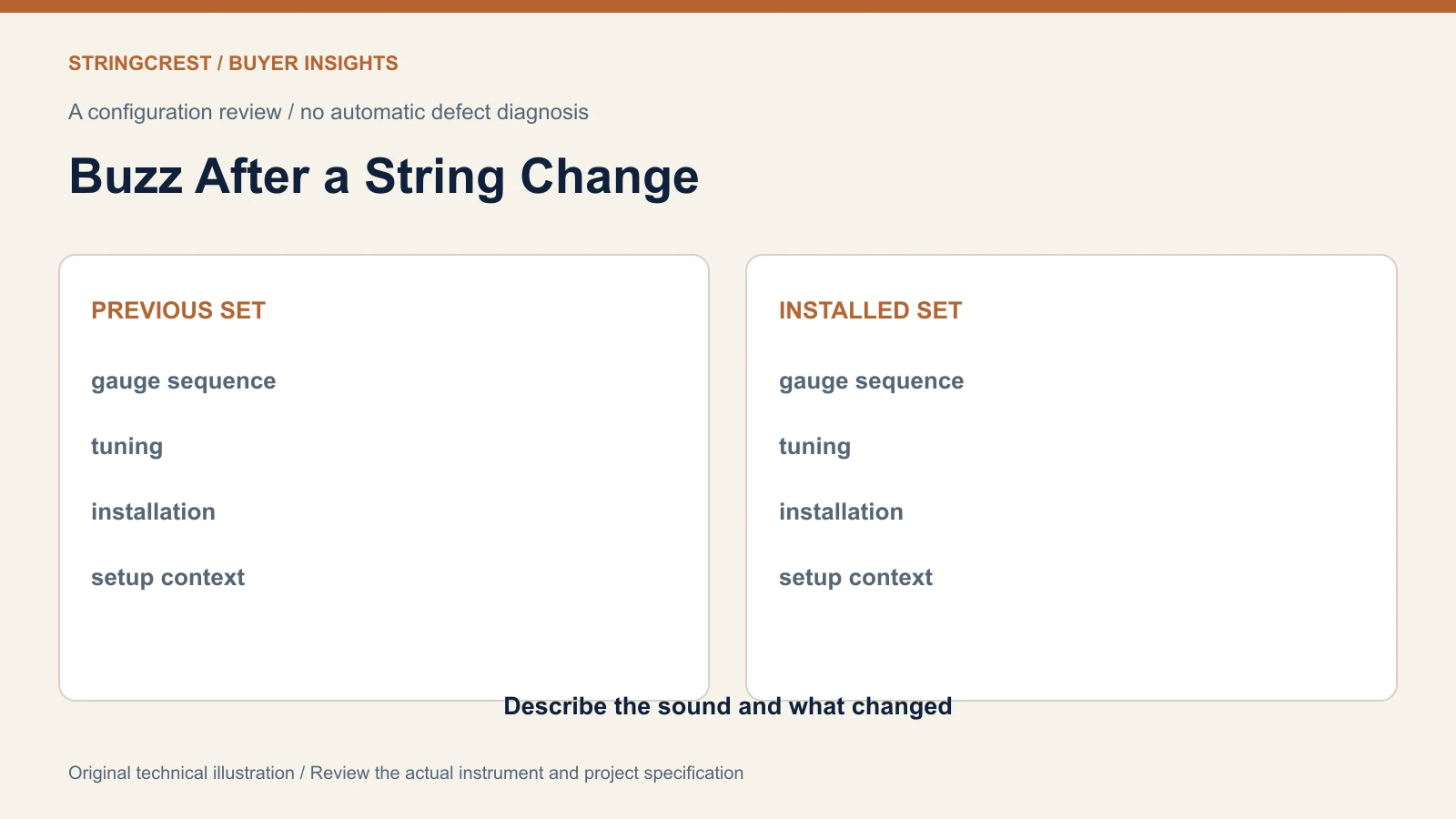
When a customer reports buzz after changing guitar strings, first identify the sound and check what changed. Compare the old and new complete sets, confirm the installation, and note whether the noise occurs on open notes, fretted notes or only under a stronger attack. Route unresolved setup questions to a qualified technician before recommending another gauge.
Fret buzz is contact between a vibrating string and a fret. Customers may also call loose-hardware noise or electronic hum “buzz.” The date the noise was noticed helps establish the sequence of events, but it does not establish that the replacement strings were defective.
For a dealer service desk, the goal is a useful next step: correct a product-identity problem, review installation, request instrument service or send a defined concern to the supplier. Keep the customer's description and the dealer's observations distinct.
Start with the applicable string category. The checks below are observations and intake suggestions; model-specific fret, nut and truss-rod work belongs with a competent instrument assessment.
Identify what the customer means by buzz
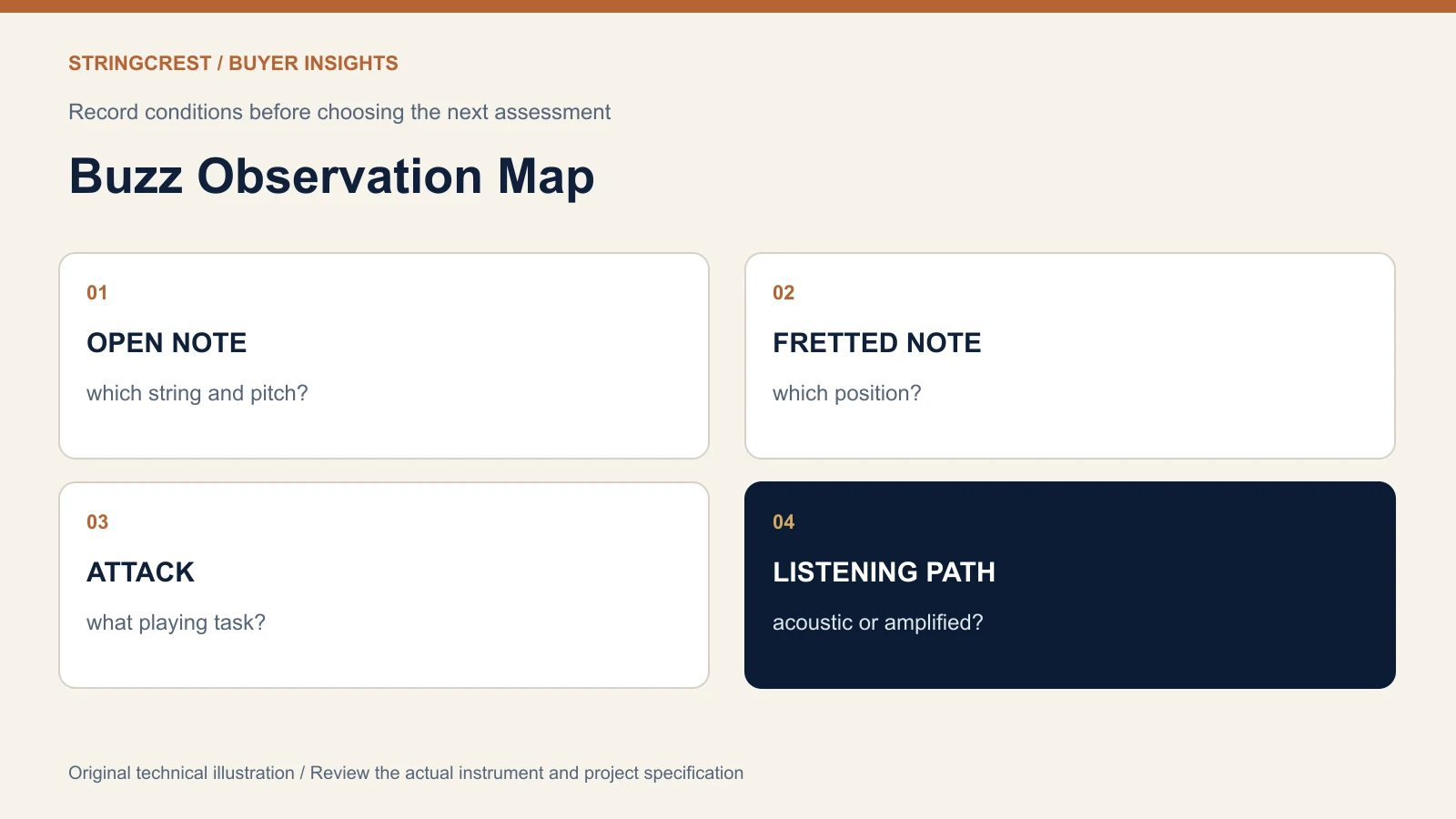
Ask the customer to demonstrate the sound with the instrument and replacement packet available. Start in the listening context where the complaint arose: acoustic sound, amplification or a recording. A short message saying “the new strings are noisy” leaves all of those questions open.
If the noise is audible while no string is being played, note that fact and arrange an appropriate hardware or signal-path review. If it occurs during a particular note, identify the string, fret or open position and playing task. Describe what was heard before assigning a cause.
Use a short observation sequence when the instrument appears safe to play: the reported task, the same task with an ordinary reference attack, then an open or fretted comparison as relevant. Keep the listening path consistent. The sequence should clarify the report without demanding repeated forceful playing or changing several parts of the setup.
Write the first summary in plain language. “Noise reported on the open low string after installing the replacement; old gauge sequence not available” is an illustrative intake entry. It gives the next reviewer something to check and preserves the missing information.
Keep the original customer account with that entry. If the dealer cannot reproduce the sound, say so and retain the demonstration if supplied. A failed reproduction leaves the cause unresolved; it is not a reason to rewrite the customer's account as a false complaint.
Compare the old and new configurations
The previous set
Record the full gauge sequence, product identity, tuning and condition where known. If the old packet is unavailable, describe the information as uncertain. A customer's memory of “light strings” may not identify the individual components.
The installed replacement
Check its packet, six positions and intended instrument category. Record plain or wound differences, end construction and other relevant variations. Confirm that the contents correspond to the specification rather than assuming the outer label proves the installation was correct.
The changes made at the same time
Ask whether tuning, hardware, setup, bridge routing or another component changed. Multiple simultaneous changes limit the conclusion that can be drawn from a before-and-after report. A new string packet may be the most visible change while another intervention matters to the sound.
This comparison is particularly useful when a dealer proposes a private-label substitute for an existing set. Similar first and last gauges do not establish an identical construction or installation result.
Understand why a gauge change can require a setup review
An altered set can change the installed forces and the way the instrument behaves. The actual result depends on the components, scale and intended pitch. Avoid a universal statement that every smaller printed gauge produces the same setup change on every guitar.
Fender's fret-buzz guidance includes gauge changes, playing technique and setup among the relevant questions. The buyer lesson is to check the system rather than treating a new set as independent of the guitar it was installed on.
If the replacement requires a competent setup assessment, record that intervention. Do not compare the previous adjusted configuration with an unsuitable replacement installation and present the difference as a material defect.
Equally, do not use “needs a setup” as a blanket dismissal of a product concern. Correct component identity, fit and the agreed specification still need checking. The process should keep both instrument and string questions visible until evidence resolves them.
Observe open and fretted notes separately
Identify the string position and location of each observation. For an open-note complaint, compare an appropriate fretted task on the same string. For a localized complaint, note the affected fret positions. Use a comparable attack so a change in playing does not obscure the difference.
| What the dealer observes | Useful next step | What remains unresolved |
|---|---|---|
| Noise on an open note, absent in the chosen fretted comparison | Give the pattern to the instrument technician | Which contact or setup condition explains it |
| Noise concentrated around particular frets | Record those positions for a fret and setup assessment | The actual condition of the instrument |
| Noise across several positions after a different set was fitted | Check complete set identity, tuning and installation; request setup review | Whether a product discrepancy also exists |
| Noise only under a stronger attack | Compare the intended playing task consistently | Whether that task falls within the proposed recommendation |
These are routing suggestions, not diagnoses. A pattern can help a technician choose an examination without proving that a particular part should be filed, replaced or adjusted.
Stop the observation sequence if an attachment is uncertain, a component appears damaged or the guitar needs service. Preserve the packet and initial condition before further intervention. Another reviewer should be able to see both the recorded pattern and why testing stopped.
Distinguish playing conditions from product identity
Fretting location, applied pressure and attack can influence the observation. A dealer or teacher may be able to clarify those factors without changing the instrument. Frame the conversation constructively rather than assigning fault to an inexperienced player.
If the sound appears only under a markedly stronger attack, record that condition. Do not quietly change the task between candidate sets and then describe one as universally buzz-free. The comparison needs to address the use expected from the intended customer segment.
For a recorded example, keep gain, amplification and processing visible in the notes. A sound that is prominent in one monitoring arrangement may be interpreted differently in another. Record the difference rather than erasing an observation because one recording makes it less obvious.
Check instrument condition through an appropriate referral
Fender's setup-oriented buzz article discusses action, fret condition, nut considerations and neck relief. These are useful categories for a qualified assessment, not a universal remote repair recipe for retail staff.
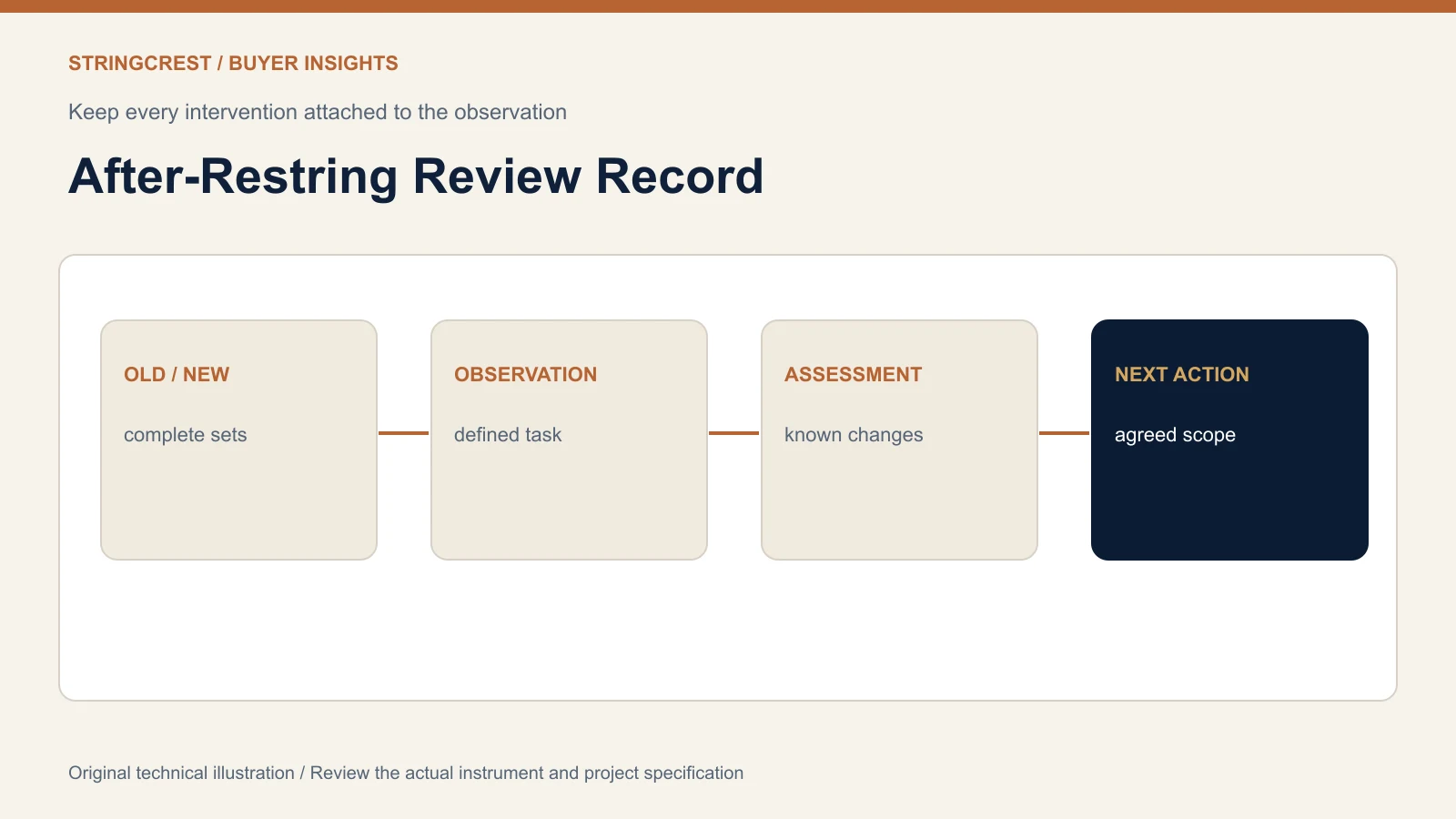
Ask the technician to document the relevant condition and any work performed. The dealer should preserve the original string and configuration references. If the instrument is adjusted, the later playing result describes the adjusted system, not an untouched repeat of the initial report.
Do not adopt another model's published dimensions as the correct setting for the customer's guitar. The applicable instrument information, technician assessment and intended playing use should guide that decision.
Keep installation and hardware observations in the record
Check the intended attachment method and whether the components were seated and secured according to the relevant instructions. A packet can contain the correct category while the installation still needs review. Record unusual bends, loose attachments or uncertain preparation without assuming a cause.
Hardware or another part of the guitar can also produce a sound described as a string buzz. An appropriate inspection should establish what was heard before a complaint is assigned to a string production lot. Keep the observations separate if more than one source is suspected.
For tuner and supplied-length questions, the electric string length guide offers a distinct fit record. Do not merge a reach problem, a loose component and fret contact into one vague complaint about “bad strings.”
Build an intake sheet staff will actually use
| Intake item | Record | Reason for the field |
|---|---|---|
| Instrument and category | Model, hardware and intended string system | Establishes the application scope |
| Old and new set | Full positions, gauge information and product codes | Identifies the actual change |
| Intended tuning | Pitch information and known alterations | Defines installed conditions |
| Noise pattern | Open/fretted position and playing task | Makes the report repeatable |
| Listening path | Acoustic, amplified or recorded context | Separates different observations |
| Interventions | Installation checks, setup work and replacements | Preserves what changed during review |
Use “unknown” for missing evidence. A short honest record is more useful than a complete-looking sheet built from guesses. The customer's account and the technician's later findings should remain identifiable as separate parts of the review.
Do not use a heavier set as an automatic cure
Changing gauge again can alter the instrument conditions and playing experience. It may be appropriate within a reviewed specification, but it should not be used to hide an unresolved installation or hardware issue. The remedy needs to answer the identified question.
A dealer should explain why an alternative is being proposed and which differences it introduces. Preserve the original packet and the complete replacement identity. Do not describe a different set as an equivalent substitute solely because it removes a sound in one short trial.
The same caution applies to changing material or construction. A customer preference for the alternative may be commercially useful, but it does not establish that the previous product was outside specification. Keep those outcomes distinct in the support record.
Use controlled comparisons when product review is justified
Choose a comparison that corresponds to the concern. If the question is whether an identified component behaves differently on an appropriately assessed reference guitar, define the instrument, tuning, preparation and task before installing samples.
If several variables change together, describe the exercise as a complete-system or whole-set comparison. It cannot isolate an alloy, gauge or manufacturing process as the cause. The record should state what the comparison can and cannot demonstrate.
Use independently identified samples and preserve their packaging. If components are cut, altered or removed, note the handling. A later photograph of a modified sample should not be presented as evidence of its original delivered condition.
Factory testing can contribute when a defined product question remains. Ask for a relevant method and record, not just a general statement that strings were inspected. An appropriate dimensional or construction check answers a different question from a player's sound preference.
Prepare a supplier report without premature blame
Product and scope
Provide the order reference, string positions, product codes and supplied lot information where available. State how many installations or incoming components were actually reviewed. A report about one guitar should remain a report about that guitar until further evidence establishes a wider problem.
Observed conditions
Attach the old/new specification comparison, tuning, instrument reference and demonstration. List installation checks and technician work in the order performed. Identify which recording represents the initial complaint and which represents the later condition.
Requested review
Ask the supplier a question it can investigate, such as whether the identified component matches the approved gauge and construction. Where instrument service is still pending, say which application question remains open. Handle a replacement request separately from the evidence needed to determine a cause.
An illustrative report could say: “The supplied packet is retained. The dealer observed the reported noise on the named string during the customer's task. The previous set is unidentified. Please compare this component with the agreed specification while the technician assesses the instrument.” This requests a product review without presenting an unverified cause.
Add the technician's finding when available, including any adjustment made before a repeat demonstration. Purchasing can then distinguish a confirmed component discrepancy from an installation or service outcome and decide whether the launch brief needs a change.
Turn a resolved case into a clearer launch brief
If the review reveals an incorrect product identity, improve the packet or picking record. If a substitution created new setup needs, clarify the dealer's compatibility and handover information. If a component discrepancy is confirmed, define the relevant corrective action with the supplier.
Update only the controlled requirement that the evidence supports. Changing gauges, labeling, installation instructions and supplier construction at once can make the next evaluation difficult to interpret. Keep revisions traceable.
For a private-label launch, agree the intended instrument scope and sample conditions before approving a commercial description. “Suitable for this confirmed configuration” is more useful than an unsupported promise that no guitar will buzz after restringing.
Communicate a practical next step to the player
Tell the customer what was observed and who will act next. “We have identified the replacement set, and the technician will assess the noise at the reported positions” is a suggested service-desk wording pattern. Use it only when those steps have actually been completed or arranged; do not present it as a StringCrest service promise.
When the packet or contents are incorrect, explain the relevant difference and select the correct product for the instrument. When the identity is correct but the setup is unresolved, explain why the instrument needs assessment. A list of speculative faults gives the customer less useful direction than a named next step.
If a replacement is supplied as a commercial resolution, record its complete specification and any changes in gauge or construction. Keep the technical question open until it is resolved. Prompt service can settle the customer's immediate need without establishing a cause for the original sound.
For beginner channels, the beginner acoustic selection guide connects packet choice with the instrument and teaching setting. Use that recommendation process for the next purchase, while the complaint record stays attached to the current case.
FAQ
Does buzzing after a string change prove the new set is defective?
No. Identify the sound and compare the actual configurations first. Installation, setup, playing conditions and another noise source can be relevant. Product identity and specification still require checking.
What is the difference between fret buzz and electronic hum?
Fret buzz concerns string contact with a fret, while a customer may use the same word for an amplified noise of another origin. Establish how and when the sound is heard before assigning a string-quality complaint.
Can a lighter gauge change require a setup assessment?
It can change installed conditions, but the result depends on the actual string and instrument. Use applicable information and competent assessment rather than assuming an identical change for every guitar.
Should a dealer adjust the truss rod from a recording?
An unfamiliar instrument should receive an appropriate assessment. A recording can support the intake, but it does not supply all the information needed for a safe, model-specific adjustment.
Does switching to heavier strings establish the original cause?
No. It changes the system and may change the observation. Record the alternative and any setup interventions instead of treating one successful trial as proof that the original product was defective.
What belongs in an OEM sample approval plan?
Identify complete sets, instruments, tuning, installation method and playing tasks. Separate fit, construction and application observations, and record which conditions the final recommendation describes.
Conclusion
A useful response to guitar string buzz after a change starts with an identified sound and a complete old/new configuration record. Non-destructive observations help route the issue to product review, installation advice or competent setup assessment.
For dealers and wholesale brands, this approach produces better evidence and more specific communication. Preserve interventions, qualify comparisons and avoid a universal gauge remedy. The next order or launch brief should reflect what the review actually established.
Explore electric guitar string requirements or acoustic string options, then Send Your Requirements with your reference instruments and complete specification. A clear sample brief helps distinguish fit and application questions before bulk approval.
Sources and interpretation limits
- Fender: five ways to address fret buzz provides technique and setup context.
- Fender: setup-related fret-buzz considerations identifies instrument-assessment categories; its repair suggestions are not universal instructions for dealer staff.
The intake sheet and comparison process are proposed buyer practices. This article does not diagnose a customer's guitar, report a company defect rate or claim a verified buzz-free StringCrest product.
FROM GUIDE TO PRODUCT
Connect this guide to StringCrest product ranges.
Review the relevant range, then bring the instrument, complete specification and open questions into one project brief.
YOUR PRODUCT · YOUR BRAND
Discuss your next string project with Frank.
Share your instrument category, target market, gauge or material direction and private-label packaging requirements.

ABOUT THE AUTHOR
Frank Zou
Frank works directly with musical-instrument brands, importers and distributors on string specifications, product selection and private-label project requirements.
Meet Frank