
Quality Control
Quality Control
Why Do Guitar Strings Break? A Dealer and OEM Fault-Review Guide
A dealer intake and supplier-review framework that separates installation, instrument contact, service history and product identity.
Introduction
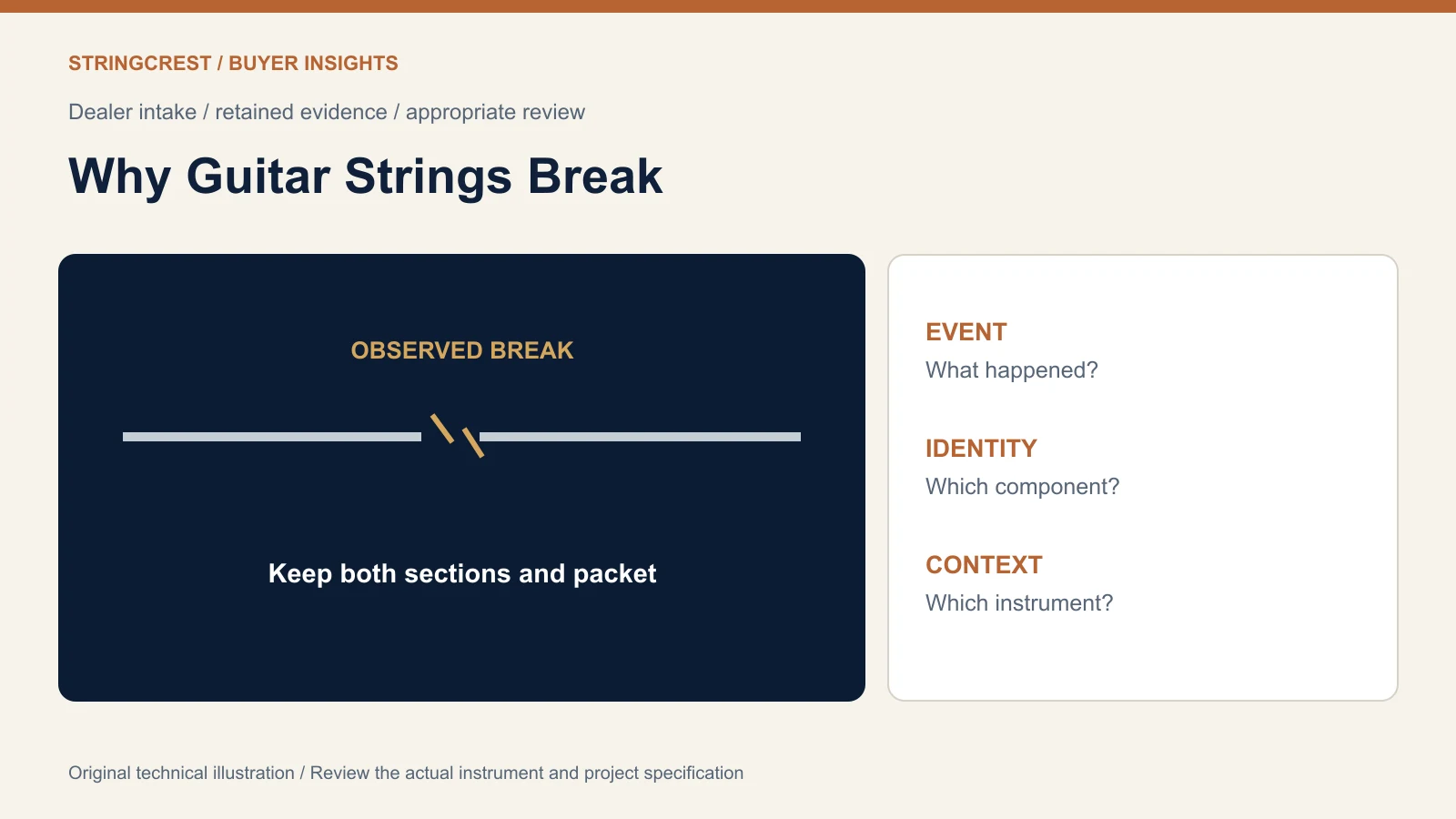
Guitar strings can break because of wear, corrosion, damaging contact points, installation problems, an unsuitable specification or unusually demanding use. The break location and the history of the installed string help direct an investigation, but neither identifies the cause by itself. A dealer should preserve the broken component, packet and relevant observations before recommending another set or assigning a manufacturing defect.
For an importer or private-label brand, this is a recurring support question with several different business implications. An installation error needs different communication from a repeat problem at a particular saddle. A mixed-up gauge requires a labeling review. A concern affecting unopened stock may require a supplier examination. Combining these cases into one “strings are weak” complaint makes useful action harder.
This guide explains a practical fault-review process for wholesale buyers and retail partners. It connects a customer's report to an instrument reference, complete set specification, failure location and review record. It does not diagnose a component remotely or recommend that untrained staff modify bridges, nuts or tuning machines.
The starting point is a clear product identity. Review the relevant StringCrest string category and confirm the set, tuning and installation requirements before comparing alternatives. A stronger-sounding marketing label is not a substitute for understanding the observed failure.
Begin with the event, not a presumed cause
Ask what was happening when the string broke: first installation, tuning, a bend, normal playing, a bridge movement or storage between sessions. Record the customer's description in its own words. “Broke while tuning” should not automatically become “overtuned,” and “broke after a week” does not describe how many hours it was played.
Identify the string position, instrument, intended tuning and set code. Keep the actual pitch separate from a vague phrase such as “standard tuning.” If the instrument was retuned or the gauge changed, record those changes and whether its setup was assessed.
Establish which facts are known and which are missing. The dealer may know the packet and guitar but not the installation method. A distributor may receive a photograph without the broken ends. These are limitations in the record, not reasons to create a confident explanation from an incomplete story.
Avoid repeated installation attempts on the same questionable component. A failed experiment can alter the evidence and create additional contact damage. Where a hardware or setup concern is suspected, arrange a competent instrument assessment before testing another string under the same uncertain conditions.
Map the break location accurately
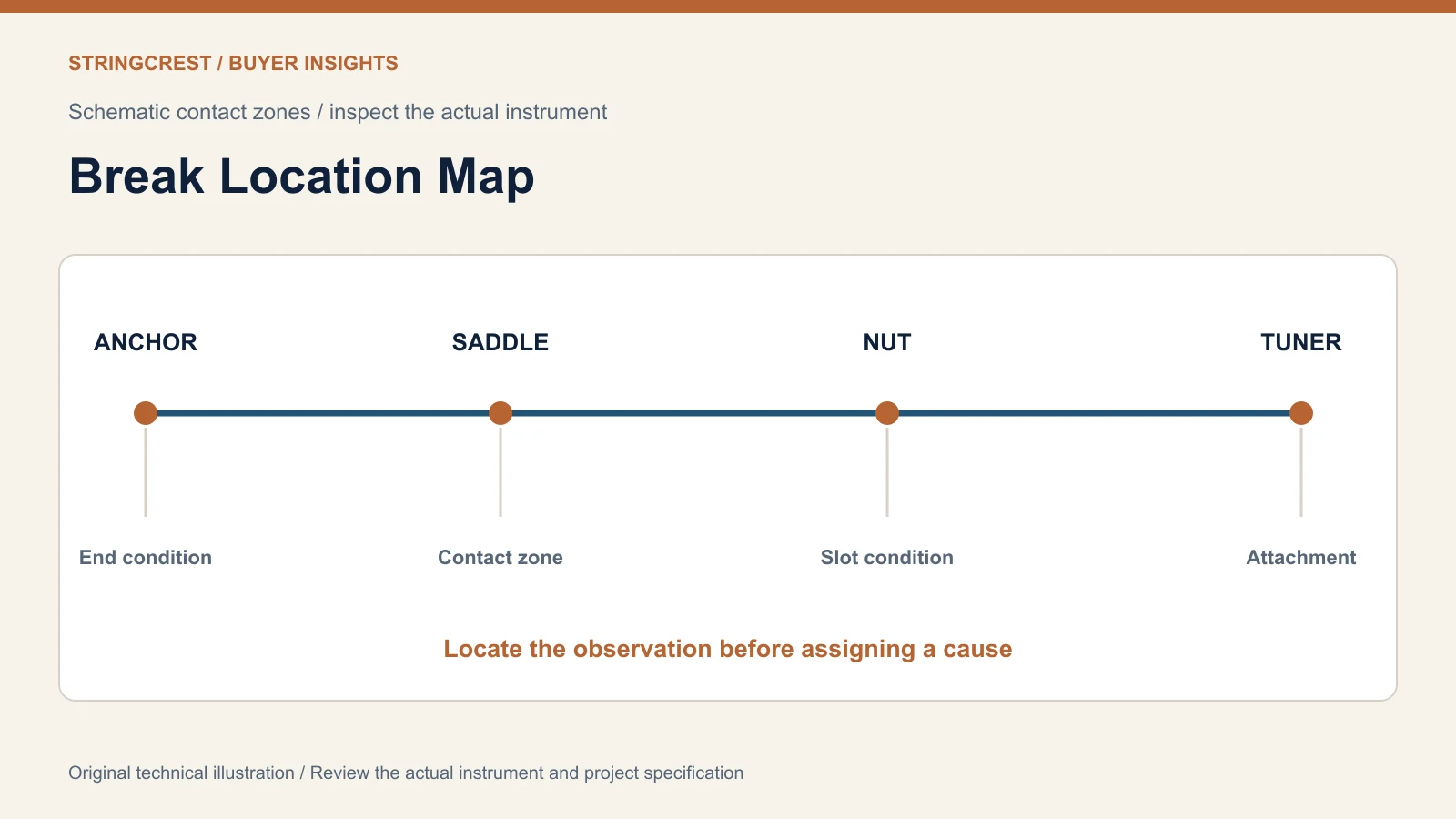
At the bridge or anchor
Record whether the fracture is at a contact point, near the anchor attachment or some distance away. Inspect the instrument visually without immediately changing it. A repeated location may justify closer examination of the contact geometry, but it does not prove the hardware or the string is responsible.
At the nut or tuner
Describe whether the break is near a nut slot, post hole, clamp or an earlier bend. The installation procedure and the way the string was secured can be relevant. Keep a tuner-clamp issue distinct from a damaged nut contact or a string cut during preparation.
Within the speaking section
Note the position along the playing length and any visible condition around it. Report sharp contact, wear, surface deterioration or an unexplained fracture as observations. If the exact location cannot be reconstructed, say so rather than drawing it onto a generic guitar picture.
Fender's breakage guide lists several instrument-contact and use-related factors. It supports checking the whole system; its maintenance suggestions should be interpreted for the actual instrument and skill level, not copied into a universal repair instruction.
Preserve both broken sections and their identity
Keep the components in a labeled protective container that prevents loss and accidental injury from sharp ends. Label the position, set code and report reference. Do not discard the short anchor-side piece: it may contain information absent from the longer section.
Photograph the string in relation to the instrument if that can be done safely, then photograph the retained sections. Include the original packet or inner envelope. An isolated macro photograph of wire provides little context if nobody can identify which set it came from.
Do not straighten, polish or scrape a fracture merely to improve its appearance for a photograph. Describe any handling that has already occurred. If a specialist later performs destructive examination, retain the earlier photographs and identify which sample was altered.
Keeping evidence does not establish a warranty outcome. Its purpose is to let the customer, dealer and supplier review the same event with less ambiguity. A commercial replacement can be considered separately from the technical conclusion when the parties agree that approach.
Check the installed specification before comparing strength
A set needs a complete gauge sequence, plain or wound construction, intended tuning and relevant instrument-fit information. Check each against the packet and order record. A visually similar replacement string can have a different construction or position requirement.
Confirm the instrument's speaking scale and any unusual bridge routing. These matter when interpreting the installed conditions. If the project includes alternative tunings, identify which configuration was approved rather than assuming the original set was evaluated for every tuning.
Ask whether a single-string replacement came from the same specification as the rest of the set. Mixed envelopes, substituted gauges or an uncertain packet can confuse an otherwise careful support review. Correct identity before attempting a comparison of product quality.
Do not infer breaking strength from gauge alone. A listed diameter does not fully describe material, processing, construction or the damage history of an installed sample. Numerical strength claims require an appropriate method and relevant product evidence.
Separate installation handling from normal service
Some attachment systems need different preparation sequences. Record whether the hardware uses conventional wraps, a split post or a particular locking mechanism. Check the applicable instructions before assuming a generic winding method was suitable.
Note whether the string was repeatedly bent, clamped, removed and refitted. Describe aggressive pulling or other unusual preparation if it is known. Avoid assuming that every settling procedure is equivalent or that a dealer's preferred method has been approved for all constructions.
Look for a mismatch between the string and the attachment system. A string that reaches a post does not necessarily engage it correctly. Our length and locking-tuner guide provides a separate fit worksheet for those questions.
An installation concern is not automatically proof of customer misuse. The packet instructions, supplied construction and compatibility description may also need review. Keep the discussion factual enough to identify which instruction or product definition should improve.
Review the exposure and use history
Record how long the string was installed, the approximate use pattern if known, storage conditions and visible surface condition. These fields help distinguish a first-installation report from a worn-string return. They should not be converted into a guaranteed service-life schedule.
Corrosion or wear may deserve further examination, but a photograph cannot quantify remaining strength. A dark surface is not sufficient evidence of a particular corrosion mechanism. The surface-condition receiving guide explains how to preserve observations without overinterpreting color.
Playing actions and accessories can also enter the review. Ask about unusual pitch changes, repeated forceful playing or an altered instrument rather than treating a music genre as a mechanical load specification. Different performers can apply very different actions within the same style.
Use a dealer intake record with distinct fields
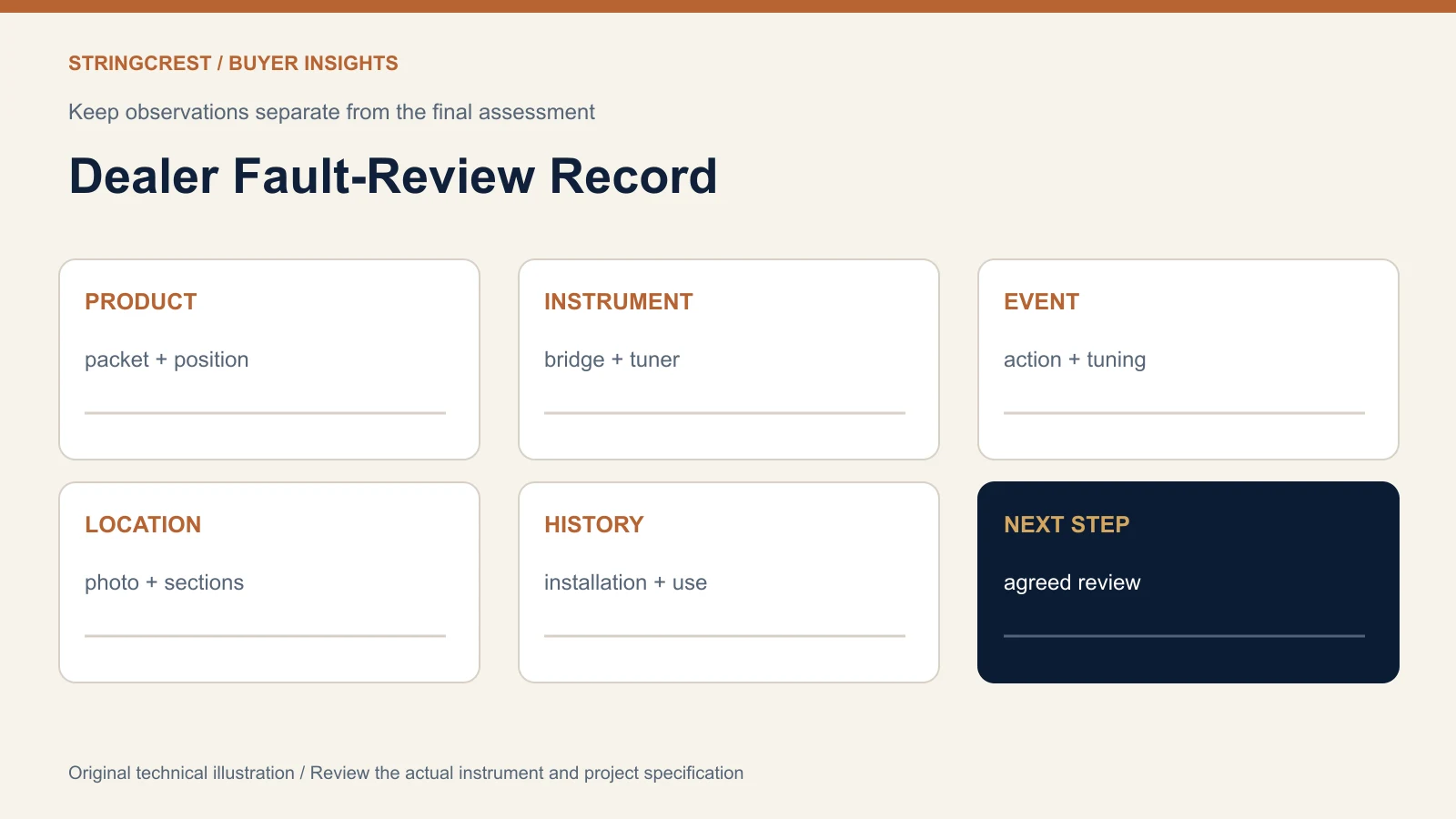
| Record field | Useful evidence | Question it can support |
|---|---|---|
| Product identity | Packet, position and set revision | Was the intended component installed? |
| Instrument context | Guitar, bridge and tuner reference | Which contact and attachment system was involved? |
| Event | Customer's account and known tuning | When and under what action did the break occur? |
| Location | Installed photograph and retained sections | Which area deserves examination? |
| History | Installation, use and known changes | Is this an incoming, installation or service report? |
| Scope | Reported units and inspected denominator | Is there a pattern worth investigating? |
A short record with genuine evidence is better than a long form filled with guesses. Include an “unknown” entry where needed. Separate the supplier's later assessment from the initial dealer observations so the original account remains available.
Investigate a repeated location as a system question
If several replacements break near the same contact point on one guitar, ask for an instrument inspection. A competent technician can assess relevant edges, alignment and setup. Do not tell retail staff to file hardware based on a distant photograph.
If the location changes between failures, compare the product identity and use history before treating the events as the same issue. One report at a tuner and another along the neck may require different questions even if they share a set name.
Consider the comparison scope carefully. An uneventful installation on another guitar does not erase the reported event. It adds an observation under different conditions. Likewise, reproducing a break on one instrument does not establish a shipment-wide material defect.
Use an agreed test plan when further comparison is needed. Identify the instrument, sample, tuning, preparation and stopping criteria. Avoid repeatedly provoking a failure without a qualified method; it can be unsafe and may answer a different question from the original complaint.
Distinguish a field report from laboratory testing
An installed-string report describes an event in service. A tensile test investigates behavior under a defined laboratory method. They can contribute to the same investigation, but they are not interchangeable evidence.
If a supplier proposes testing, ask which component is being examined, what condition it is in, and what fixtures and procedures are used. Determine whether the sample is unused, installed, bent or already broken. Comparisons should acknowledge those differences.
Request the actual report and its interpretation rather than a number without context. A load value does not establish compatibility with every instrument, and a test result from a different construction should not approve the current set. Do not advertise a breaking-strength claim from an informal demonstration.
Factory testing can support a project when its method corresponds to the agreed specification. The relevant question is what the test establishes for that component and revision, not whether the supplier can display equipment in a photograph.
Review patterns without inventing a defect rate
Count the actual reports and identify the exposure denominator where available. Distinguish packets sold, units installed and samples examined. A count of complaints without a reliable denominator is useful for tracking, but it is not a production defect percentage.
Keep product revisions, supplied lot references and instrument combinations separate. If traceability is absent, note that limitation. Do not group unrelated replacements under one assumed batch to produce a more dramatic trend.
A review may identify concentration around one hardware variant, installation practice or component position. Treat that pattern as a reason to investigate, not a final diagnosis. Records selected because they contain failures cannot estimate the prevalence among all users without an appropriate sampling basis.
For distributors, consistent intake improves the ability to distinguish a support issue from an order-control issue. It also prevents a repeated customer story, copied between dealers, from being counted as several independent events.
Turn the review into a specific corrective action
Possible actions include clearer installation scope, a revised gauge brief, better position identification, an instrument-service referral or a supplier investigation of a defined component. Select the action that matches the evidence instead of changing everything at once.
If a product revision is proposed, compare the new sample with the intended requirement and preserve its revision code. A different gauge that survives one attempt may alter feel and setup; it is not automatically a like-for-like replacement for the approved range.
Update dealer information when an instruction or compatibility statement changes. Avoid allowing an old packet, a new product and an outdated support sheet to circulate together without clear identification. A corrective action should be recognizable when receiving the next shipment.
Keep the customer conversation practical
Explain what is known, what remains uncertain and the next step. Avoid telling a player that a break proves poor technique or a defective factory product before the review supports either conclusion. A neutral explanation keeps the dealer's recommendation credible.
If a replacement is supplied, retain the original report and identify the replacement specification. Do not silently substitute a construction with different installation requirements. Where service is needed, explain why the instrument requires assessment before further installation attempts.
For a brand, support language is part of product quality. A clear form, a responsive evidence review and a controlled product change can be more useful than an unsupported claim that the range never breaks.
FAQ
Does a broken string automatically mean it was defective?
No. Material, wear, contact damage, installation, specification and use conditions can all be relevant. Preserve the evidence and identify the event before deciding which explanation is supported.
What does repeated breakage near the saddle indicate?
It directs attention to that contact zone and the installation around it. It does not prove a cause by itself. A competent instrument assessment and a product-reference check are appropriate next steps.
Should a dealer install a heavier string immediately?
Not as an automatic remedy. A gauge change can affect feel and setup and may leave the underlying contact issue unresolved. Confirm the intended specification and investigate the relevant condition first.
Can a photo identify the failure mechanism?
It can show location and visible condition, but interpretation may require retained components and further assessment. Keep unedited photographs and describe uncertainty rather than presenting an image as a laboratory diagnosis.
Which pieces should be returned to the supplier?
Retain both broken sections where available, the packet or position envelope and the product references. Agree safe packaging and the review procedure with the supplier before sending components.
What can an OEM buyer do before launch?
Define the instrument scope, full set, installation guidance, sample evaluation and dealer intake process. Product and packaging specifications can then be approved against clear requirements rather than a broad strength slogan.
Conclusion
A useful answer to “Why do guitar strings break?” begins with the event and a traceable component. Location, specification and use history guide the investigation, while instrument assessment and appropriate testing help resolve questions that photographs cannot settle.
For wholesale brands, the goal is a specific support or product-control action. Preserve the original evidence, avoid universal diagnosis and keep revised instructions attached to the correct set. That gives dealers a more reliable path from a complaint to a practical next step.
Explore custom string projects and Send Your Requirements to discuss your set specification and sample approval needs. Include the guitar and hardware references when installation or recurring contact questions matter.
Sources and interpretation limits
- Fender: why guitar strings break provides manufacturer context for contact points, wear and use-related factors.
- Fender setup instructions describe model-specific installation and maintenance considerations.
The intake record, investigation sequence and corrective-action suggestions are proposed buyer practices. This article does not report a StringCrest failure rate, laboratory outcome or customer case, and does not replace a qualified instrument inspection.
FROM GUIDE TO PRODUCT
Connect this guide to StringCrest product ranges.
Review the relevant range, then bring the instrument, complete specification and open questions into one project brief.
YOUR PRODUCT · YOUR BRAND
Discuss your next string project with Frank.
Share your instrument category, target market, gauge or material direction and private-label packaging requirements.

ABOUT THE AUTHOR
Frank Zou
Frank works directly with musical-instrument brands, importers and distributors on string specifications, product selection and private-label project requirements.
Meet Frank