
Buying Guides
Specifications & Fit
Nashville Tuning Guitar Strings: A Dealer’s Six-Position Set Guide
Turn a high-strung enquiry into a complete six-position candidate and a clearer dealer packet.
Introduction
Choose Nashville tuning guitar strings by the intended pitch of every position, the acoustic or electric application and the actual instrument requirements. A high-strung six-string set is a separate purchasing item from a complete twelve-string set. Confirm the specification before installation; raising an ordinary set into a higher register is not an appropriate shortcut.
For a retailer, the first question is what the customer means by “Nashville.” They may want a second guitar for a recording arrangement, replacement strings for an existing high-strung instrument, or the higher members of a twelve-string set. Those requests can sound similar at the counter while requiring different packets and instructions.
This guide helps a dealer or private-label buyer turn that request into a reviewable six-position brief. The suggested listening tasks, packet checks and example conversations are planning tools, not accounts of StringCrest studio tests or customer projects. Specialist construction and supply must be confirmed for the proposed order.
Identify the high-strung application before choosing a packet
Ask whether the guitar will be used alone or alongside another guitar part. If the purpose is layering, ask how the complementary part is tuned and which instrument will carry it. Keep the recording aim separate from the specification of the replacement set. A desired sound cannot establish the appropriate diameter or construction for an unidentified instrument.
A useful enquiry identifies the guitar, its current set, the proposed six pitches and the intended signal path. For an acoustic recording, that may include the microphone or installed pickup used for the comparison. For an electric application, include the pickup system and normal amplification. These details define the listening task without promising a particular recorded result.
Ask whether this is a like-for-like replacement or a proposed conversion. An existing high-strung configuration should have an identifiable approved reference. A conversion needs an instrument and setup review before a retailer presents a candidate as suitable. Do not infer that approval from six tuners or an ordinary steel-string label.
Staff should also check whether “high tension” has been used accidentally in place of “high-strung.” Those phrases describe different questions. High-strung concerns the intended pitch arrangement; a tension requirement needs an appropriate specification and conditions. Clarifying the language at this point is more useful than guessing from the package size.
Read Nashville tuning as six individual pitch positions
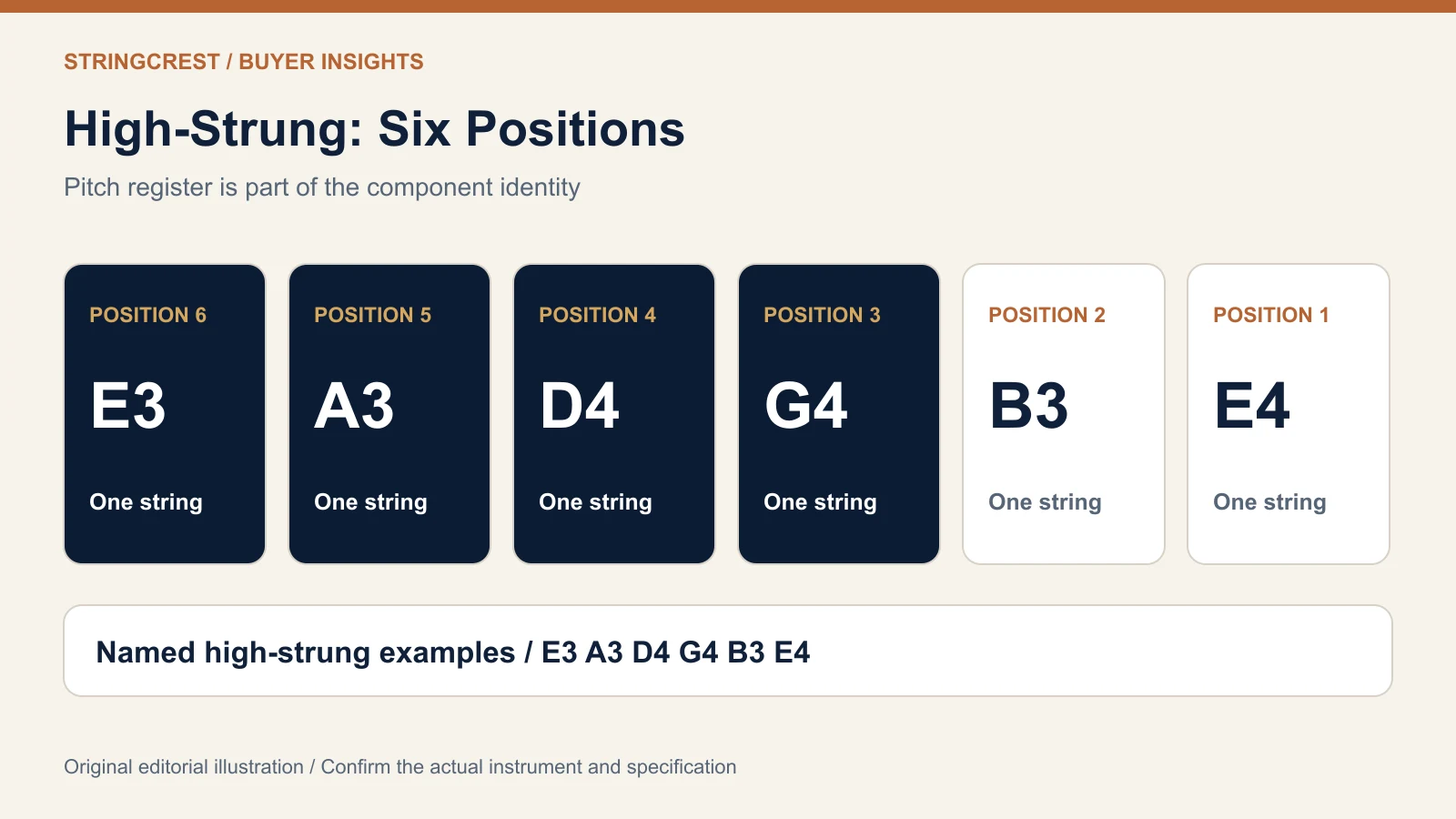
Two named examples help explain the request. D’Addario identifies EJ38H as a six-string high-strung acoustic set and EXL150H as its electric counterpart. Their published tables show the following position map, written here from sixth position to first. These are manufacturer examples, not StringCrest product specifications.
| Instrument position | Example target pitch | What the buyer must preserve |
|---|---|---|
| Sixth | E3 | Position identity and register |
| Fifth | A3 | Position identity and register |
| Fourth | D4 | Position identity and register |
| Third | G4 | Position identity and register |
| Second | B3 | Position identity and register |
| First | E4 | Position identity and register |
The octave number is part of the pitch. A row marked only “G” leaves the register unresolved. A buyer should request the same notation convention across the supplier’s component record, the installation card and the retail proof. If different systems are used, agree on their equivalent meaning before approving the artwork.
For comparison, the conventional six-string pitch map from sixth to first is E2, A2, D3, G3, B3 and E4, as illustrated in D’Addario’s standard acoustic set table. In the two named high-strung examples, the sixth through third positions are an octave above that map, while the second and first retain B3 and E4. This comparison explains the application; it is not an instruction to retune the strings already on a customer's guitar. The candidate must be appropriate to the intended pitches and instrument.
An illustrative packet question shows why the register matters. A customer requesting a third-position replacement marked only G could be discussing an ordinary six-string set or a high-strung set. Ask for the complete product reference and its published pitch map before choosing the component. The same letter on two records is not evidence that their intended registers or constructions agree. Keep the confirmed position in the order and the installation information.
Notice that the position list does not climb continuously in pitch. That matters when staff try to arrange loose strings by an assumed low-to-high progression. Use the approved position identifiers instead. A sorting habit that works for ordinary stock should not replace a specification check for this application.
The table deliberately omits gauge and numerical tension. Copying those values from another maker’s example would not establish the construction or suitability of a proposed custom product. Request a complete candidate specification for the identified instrument, then evaluate that candidate under the agreed application.
Keep six-string high-strung stock separate from twelve-string sets
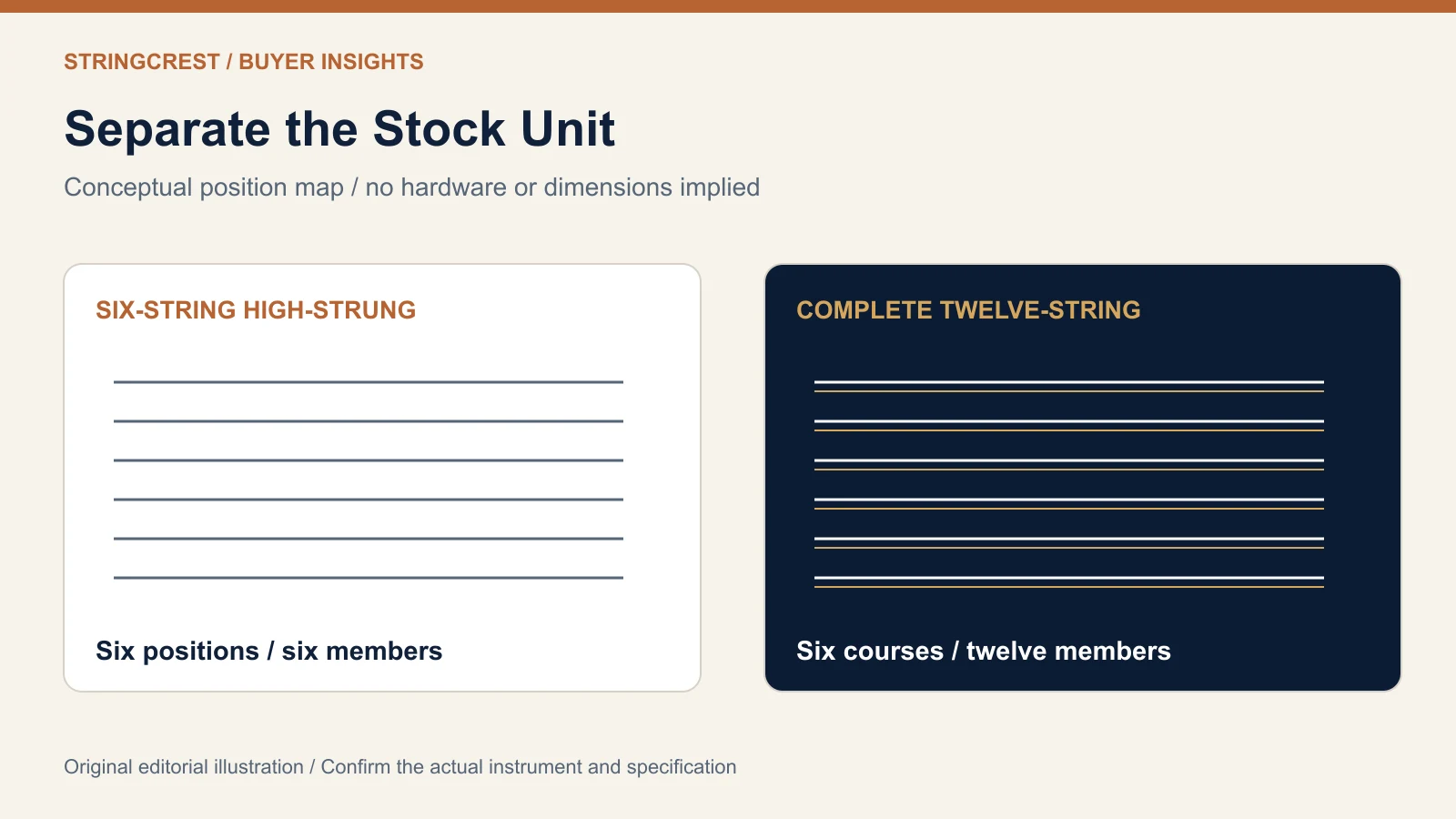
A complete twelve-string guitar set supplies paired courses. A six-string high-strung set supplies one string for each of six instrument positions. The stock unit, installation map and replenishment question are therefore different, even when the musical aim refers to a twelve-string effect.
Our twelve-string acoustic purchasing guide explains complete paired-set planning. Use it when the buyer needs all members of those courses. For a high-strung enquiry, use a separate six-position record rather than deleting half the rows from a packet proof without checking the remaining components.
If a customer proposes taking strings from another set, ask for its exact product reference and component identities. Do not tell staff that any twelve-string packet can supply an interchangeable high-strung set. A component choice still needs the required pitch, construction, usable length and instrument approval.
For distributor records, make the selling unit explicit: one complete six-string set, individual replacement positions, or a complete twelve-string set. “One set” should not be the only description on the purchase order. A receiving team needs to recognize which unit was ordered without hearing the original sales conversation.
The twelve-string electric guide remains relevant when the enquiry concerns paired electric courses. Link these explanations in staff training, but retain separate product identities so customers can recognize the intended instrument configuration.
Separate acoustic and electric proposals
The existence of acoustic and electric maker examples is a reason to ask about the application. It does not make the two constructions interchangeable. Identify the instrument recommendation, proposed material and pickup context before discussing a private-label equivalent.
A buyer should keep any material comparison attached to the complete candidate set. Naming a wrap alloy alone leaves plain positions, wound positions and other construction details unanswered. Likewise, a familiar pair of gauge endpoints cannot identify every intermediate component in a specialist arrangement.
For an electric proposal, ask the supplier to identify the intended pickup application. For an acoustic proposal, retain the instrument’s approved steel-string requirements and the proposed listening context. This guide does not authorize fitting steel high-strung strings to a nylon-string instrument.
Separate acoustic and electric sample labels, even if both projects use the same pitch map. A shared musical arrangement is not a shared sample identity. Feedback such as “the high-strung sample sounded right” needs the candidate reference so the buyer can tell which construction was heard.
Prepare the instrument review and listening task
Before a sample is fitted, send the full candidate information to the person responsible for the instrument. Ask them to check the relevant installation and setup requirements. The supplier can describe its proposed strings; that description alone should not be treated as an approval of an altered guitar configuration.
Preserve the uncut packet identity until the installation is checked. If usable length or an end attachment is uncertain, resolve it before cutting or tuning. A demonstration is harder to investigate when the only identifiable label has been discarded and the components have been mixed with other stock.
Define what the listening comparison will answer. A retailer might compare the high-strung part alone and then within the planned two-guitar arrangement. Record the same musical passage and identify which take uses which guitar. This is a suggested comparison method, not a claim that a particular construction has been measured to sound better.
Keep a reference take available for the evaluator. If the player changes the arrangement, effects or recording position during the session, record that change rather than treating the result as a direct string comparison. The goal is an intelligible observation the buyer can revisit.
Include the intended playing task in the assessment. A product proposed for light chord layering should be evaluated in that context before someone writes a broad recommendation for every style. Record the player’s preference as a preference, with the setup and signal path that produced it.
Turn the enquiry into a candidate brief
Give the supplier enough information to propose a defined product. Start with the instrument and purpose, then attach the six-position map and any approved replacement reference. Identify which details are fixed and which the buyer wants to explore. This avoids an apparent agreement in which each party assumes a different construction.
Ask for the position-by-position gauge, plain or wound status, material, end construction and usable length. Request installation information appropriate to the candidate. Any numerical tension information should include the maker’s conditions so it can be interpreted correctly; it is not a substitute for reviewing the actual instrument.
In the sample feedback, separate fit, playing observations and the arrangement preference. An attachment concern belongs in the fit record. A particular take sounding too prominent belongs in the listening notes. A packet with an unclear position identifier belongs in the artwork review. Combining those findings into “failed sample” gives the supplier little useful direction.
If a field is missing, identify it explicitly in the enquiry. State who must supply that field and which decision is waiting on it. Do not silently replace an unanswered instrument requirement with a general marketing description of the set.
Consider two illustrative dealer requests. In the first, an existing high-strung guitar has an identified packet and needs a like-for-like complete replacement. Preserve the product reference, confirm that the current configuration is still the intended one, and ask the supplier whether that exact candidate can be provided. A different packet is a substitution proposal and should be visible as such.
In the second, a studio wants to use another six-string guitar for a complementary recording part. There is no accepted replacement reference yet. Obtain the instrument review and define the six pitches before requesting the candidate. The listening preference can be evaluated afterward. These requests may share the word Nashville, but only the first begins with an accepted string identity; the second is an application-development enquiry.
Proof the packet for the way customers will install it
Put the configuration where a customer can find it before opening the packet. “High-strung six-string application” and a readable position map provide more practical information than a broad reference to a shimmering sound. Avoid a front design that can be mistaken for an ordinary replacement set.
Check the numbering direction on the artwork with the installation instructions. Some internal records may begin with the sixth position while retail instructions begin with the first. Either order can be used if it is explicit and all references agree. A reversed order in one document creates a preventable identification problem.
Ask a colleague who did not write the brief to choose the intended packet from the proof and explain its application. If they need the author beside them, revise the product description. This is a suggested usability check; it does not require making an unsupported performance claim.
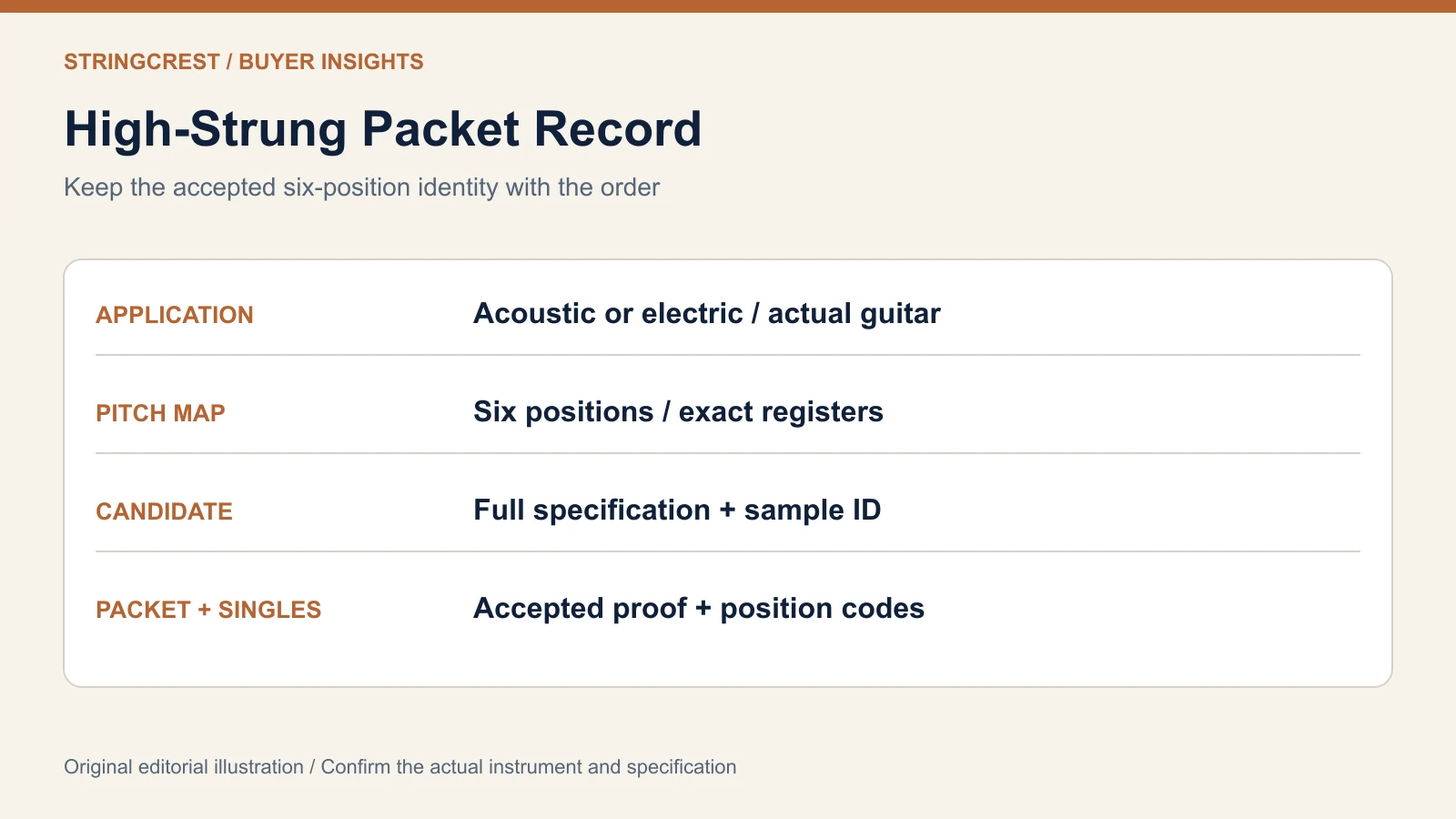
Keep the complete set reference next to any single-position replacement code. A loose replacement should lead back to the accepted specification. Similar appearance and a matching note letter do not establish that it belongs to the same product revision.
For receiving, check the actual unit count, product reference and accepted artwork against the purchase order. If a packet has six components but the identifiers disagree with the released proof, isolate the discrepancy for review. Count and specification identity answer different questions.
Support a replacement enquiry without guessing
When a customer needs one replacement, ask which instrument position it occupies and which complete set it came from. Retain the pitch register in the reply. A phrase such as “the high G” is helpful context, but it should not be the entire picking instruction.
If the original product is unknown, explain that the shop needs identification before supplying a matching component. The customer may be able to provide a packet photograph, invoice reference or the installation record. Do not identify construction from color or apparent thickness in a photograph alone.
A breakage complaint needs a different record from ordinary replenishment. Ask for the actual failed position, location, installation context and product identity, then preserve the available evidence. Do not diagnose the cause simply because the application uses a high register. Any proposed replacement or changed specification needs its own review.
Keep dealer support notes with the accepted product revision. When the project changes material or an individual position, review the packet, picking reference and installation wording together. An unchanged front design should not conceal a changed component specification.
FAQ
Is Nashville tuning a complete twelve-string set?
A six-string high-strung product and a complete twelve-string product have different component counts and installation maps. Confirm what the customer wants to replace. A recording reference to a twelve-string effect does not mean the purchase order should contain twelve components.
Can an ordinary set be tuned into the high-strung register?
Do not recommend raising an ordinary set without a suitable string specification and instrument review. Select a candidate for the intended pitches. The nickname of a tuning cannot establish that the currently fitted strings are appropriate for it.
Do the acoustic and electric versions need separate records?
Yes. Keep the application, complete construction and sample identity separate. If the pitch maps agree, that still does not demonstrate interchangeability or identical response through the customer’s instrument and signal path.
Can a supplier quote from the tuning name alone?
The name can start the conversation, but a reviewable quotation needs the instrument application and complete candidate specification. Include all six pitch registers, fit requirements, packaging direction and order scope. Discuss unresolved fields before approving a sample.
Should a dealer carry individual high-strung replacements?
Make that decision from actual customer requests and replenishment needs. If singles are offered, identify each against a specific complete set and revision. This guide provides no demand forecast or claim that specialist singles will sell in a given quantity.
Conclusion
A clear high-strung enquiry preserves six individual positions, exact pitch registers and the identified acoustic or electric application. Use those details to review a candidate, organize a meaningful listening task and proof the packet. Keep specialist replacements tied to the approved set reference.
Sources and interpretation limits
D’Addario’s linked EJ38H and EXL150H pages provide the named six-string examples and pitch registers, checked on 13 October 2026. Their dimensions, tension values, prices and manufacturing claims are not StringCrest specifications. The purchasing records and listening tasks are editorial recommendations; they do not demonstrate an existing specialist SKU or measured recording outcome.
FROM GUIDE TO PRODUCT
Connect this guide to StringCrest product ranges.
Review the relevant range, then bring the instrument, complete specification and open questions into one project brief.
YOUR PRODUCT · YOUR BRAND
Discuss your next string project with Frank.
Share your instrument category, target market, gauge or material direction and private-label packaging requirements.

ABOUT THE AUTHOR
Frank Zou
Frank works directly with musical-instrument brands, importers and distributors on string specifications, product selection and private-label project requirements.
Meet Frank