
Quality Control
String Care
Guitar String Intonation After a Change: A Dealer’s Assessment Guide
A service-desk framework for pitch discrepancies across fretted positions after a string change.
Introduction
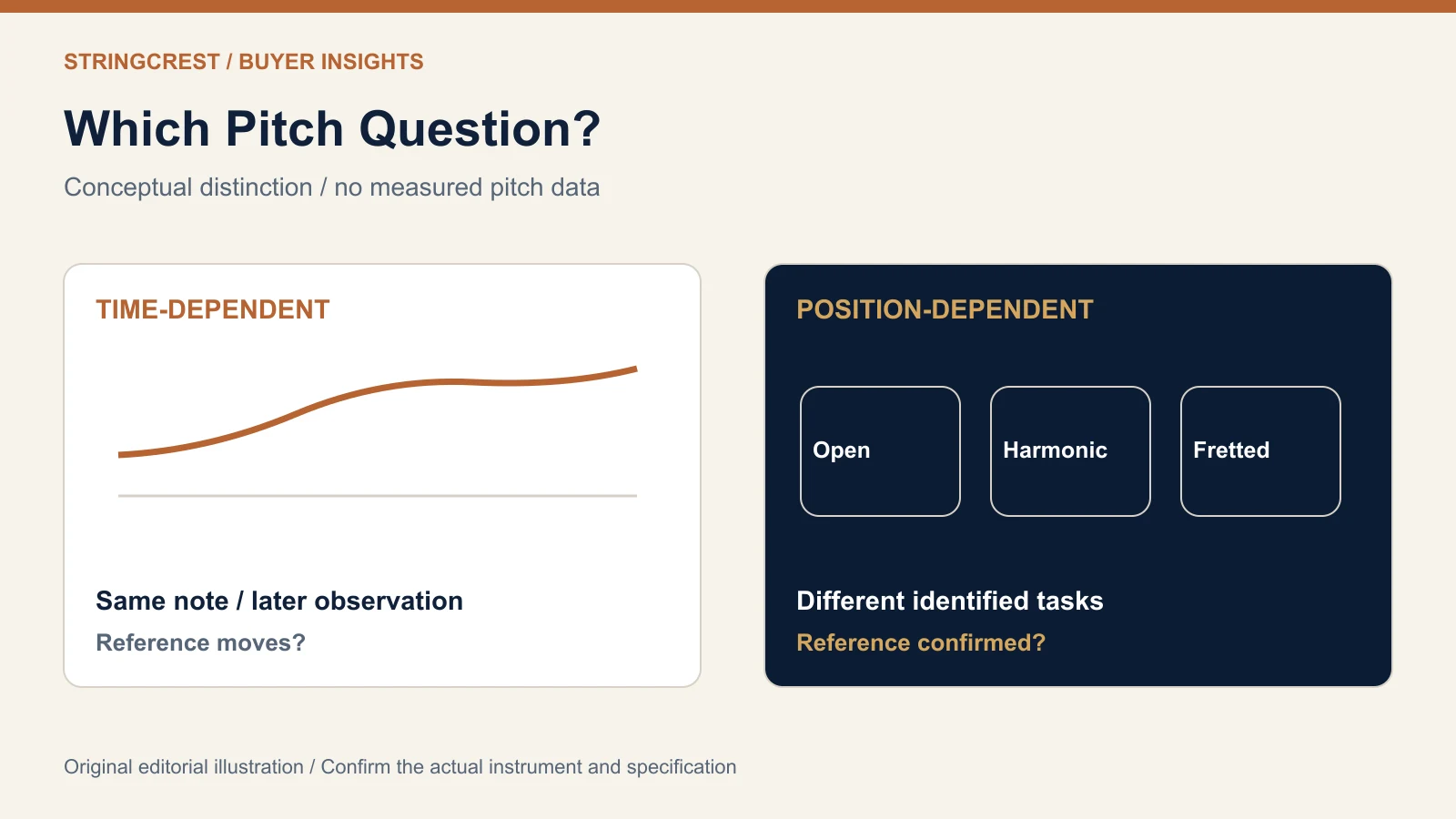
If a guitar’s open strings tune correctly but fretted playing sounds wrong after a string change, record the installed set and check pitch at identified fret positions before recommending another product. Separate a pitch discrepancy across positions from pitch that changes over time. A repeatable observation helps a qualified technician assess the instrument and helps a supplier understand a defined product concern.
A dealer service manager needs to decide which question to investigate: incorrect product identity, installation, changed setup, the player’s fretting task or a potentially affected component. The fact that a complaint followed a string change establishes a sequence. It does not establish the cause.
The procedure below is a suggested observation and referral framework for fretted guitars. It is not a universal adjustment tutorial, a numerical pass standard or a report of StringCrest testing. Follow the instructions for the identified instrument and leave structural adjustments to an appropriately qualified technician.
Distinguish intonation from tuning stability
Tuning stability asks whether a note remains at its intended pitch during a defined period or playing task. Intonation concerns the pitch relationship of notes produced at different positions. A guitar can raise both questions, but staff should record them separately so the reply addresses the actual complaint.
For example, “the open string moves after a bend” and “the open string is correct but the stopped note reads sharp” describe different observations. These are illustrative customer descriptions, not findings from a shop repair. Ask the customer which description fits, where the problem is heard and how it was checked.
The new-string retuning and handover guide addresses permitted settling, retuning and time-dependent pitch movement. Use that process when the reference itself is moving. An unstable reference makes it difficult to interpret a fretted-note comparison.
If the complaint is primarily a rattle, use the guitar string buzz guide to identify the sound and playing condition. A customer may report both noise and pitch concerns. Keep both observations rather than treating one symptom as proof of the other.
Compare the old and new complete sets
Start the record with the guitar model, relevant scale information, intended tuning and the complete replacement set reference. Ask whether the prior set can be identified and whether the setup changed at the same time. Preserve a packet photograph or invoice when available; do not reconstruct a full specification from memory alone.
List changes position by position. A set’s first and last gauge do not identify all its components. Note any changed gauge, construction or intended pitch, and separate those changes from adjustments made to the instrument. If the previous specification is unknown, state that limitation in the service record.
The third string deserves an explicit entry when its construction changes. A plain G versus wound G specification records that choice within the full set. It should not disappear behind a familiar “light” or “regular” label.
Fender’s intonation support guidance calls for checking intonation after string changes and discusses gauge and string variation in relation to the active vibrating length. This supports a post-change review. It does not justify describing every new set as defective when the previous setup no longer gives the desired result.
For a private-label sample, keep the specification revision with the actual sample ID. A production reference should identify what the evaluator installed, including the positions that did not change. That makes a later comparison possible without pretending the two sets were identical.
Establish a usable pitch reference
Use a suitable tuner and record its reference setting. Confirm the intended note and register for the position being observed. A tuning nickname or an unlabelled display photograph may not tell a technician which reference the customer used.
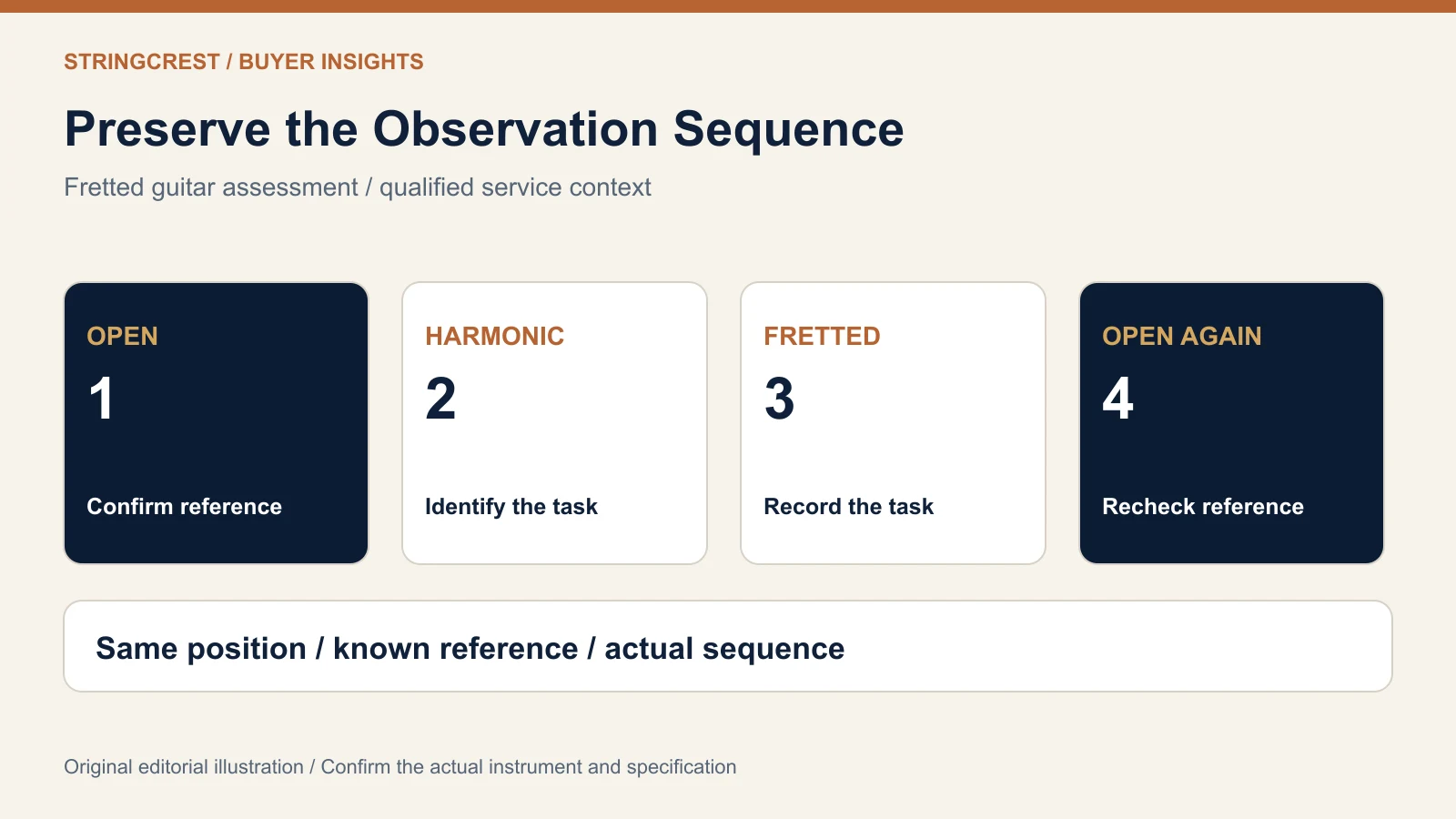
Observe the open note before the fretted comparison and recheck it afterward. If the open reference has moved, note that result and return to the appropriate tuning-stability investigation. Do not preserve only the stopped-note reading while omitting the changing reference.
Use a consistent way of sounding and reading the note. Record whether the reading is taken through a pickup or another relevant path, and avoid changing that path between observations without a note. A supplier should be able to tell whether two readings came from the same method.
Write the observed values only when someone actually takes them. A blank service template can request cents, note identity or a tuner photograph, but this article supplies no universal allowable deviation. The acceptance requirement should come from the agreed instrument context and assessment purpose.
The customer’s account and a shop observation should remain distinguishable. “Customer reports sharp notes” is not the same entry as a recorded check under defined conditions. Both can be useful; neither should be converted into a measured result it does not contain.
Label each saved reading with its string position and whether it is open, harmonic or fretted. Include the reference setting and the order in which the observations were made. A video that shows the task may be more useful than separate images if the images cannot establish their sequence. Retain the original files rather than cropping away the information that identifies the instrument and observation.
Use the twelfth-fret comparison in its proper scope
Fender’s Intonation 101 describes comparing a twelfth-fret harmonic with the note fretted at that position using an accurate tuner. It explains the direction of a string-length correction when the fretted note is sharp or flat relative to that reference. That is a useful technical context for a trained service assessment.
For the dealer record, identify the string, confirm the open reference, record the harmonic and then the fretted note under a consistent technique. Recheck the reference and retain the sequence. Do not ask untrained staff to convert a single reading into instructions to turn a bridge screw.
Readings from this check do not demonstrate that every chord and every fret position will sound perfect. State the positions actually assessed. If the concern occurs elsewhere, include that task in the technician’s review instead of treating one reference comparison as a complete clearance.
Do not apply the fretted-guitar procedure unchanged to a fretless instrument. This guide concerns identified fretted guitars; the player’s stopping position on a fretless instrument raises a different observation problem. Keep service instructions specific to the instrument being discussed.
Check the playing task without blaming the player
Taylor’s acoustic intonation explanation describes how fretting stretches a string and how action and fretting pressure influence the resulting pitch. Its discussion also places acoustic compensation within a setup assessment. This provides context for recording how a note was played, rather than diagnosing a cause from a tuner display alone.
Ask the customer to demonstrate the passage that sounds wrong. Record the actual fret positions, whether a capo is involved and whether the observation concerns a single note or a chord. A description such as “the guitar is out” is too broad to decide which service question should come next.
Keep any comparison between players respectful and clearly described. The point is to understand the playing task and instrument interaction, not to dismiss a customer’s report. If another person makes an observation, record that person’s method separately.
Avoid adding unsupported adjustments to this conversation. A technician may consider setup variables, but a dealer should not tell a customer to file a nut or alter relief because one fretted note reads sharp. Observation is useful precisely because it lets the appropriate specialist decide what must be investigated.
Interpret patterns as questions for assessment
An observation pattern can guide the next enquiry without proving the cause. Keep the product and instrument records available while deciding whether the concern can be reproduced and whether the reference is stable enough for interpretation.
| Recorded pattern | Question to resolve next | Conclusion to avoid |
|---|---|---|
| Open reference moves during the check | Was the installation and permitted settling process established? | Every fretted reading proves an intonation defect |
| One position differs under a repeatable task | Is that component correctly identified and installed, and what does the technician observe? | The entire shipment is defective |
| Several positions differ after a specification change | Which setup and specification changes need review together? | Another gauge will automatically solve it |
| A customer’s chord concern is not reproduced in the reference check | Which actual playing passage and conditions were omitted? | The customer’s concern is disproved |
If a concern follows a changed component, identify that component precisely before a supplier discussion. Preserve the original sample or available evidence, and ask what comparison the supplier needs. A complaint name is not enough to select a replacement revision.
Two illustrative cases help a service manager select the next enquiry. If the previous and replacement specifications agree and one position produces a repeatable discrepancy, preserve that component's identity and ask the technician to assess the installation and relevant instrument condition. A supplier can then discuss what component evidence is needed. Agreement between packet names alone is insufficient; check the actual specification revision.
If several positions differ after a documented change in construction or gauge, record those changes together and obtain the instrument assessment before proposing another set. That avoids repeatedly changing products while leaving the setup question unanswered. Neither case establishes a cause by itself.
If the technician cannot achieve an appropriate result within the actual hardware's permitted adjustment, record that limitation and refer the unresolved instrument question. Do not present maximum saddle travel as a universal allowance or advise an improvised structural change. Record the observation, the permitted work completed and what still needs review.
If the instrument presents uncertain attachment, visible damage or an unresolved setup requirement, stop the demonstration and arrange appropriate assessment. Continuing to collect pitch readings under that condition may obscure the problem rather than clarify it.
Keep acoustic and electric service instructions separate
An electric guitar with adjustable individual saddles and an acoustic guitar with a fixed compensated saddle do not offer the same adjustment process. Identify the actual bridge and applicable maker instructions before discussing service. This article intentionally supplies no universal screw direction, displacement or replacement-saddle recommendation.
For an acoustic enquiry, a qualified technician should assess the relevant setup and compensation questions. Taylor’s guidance describes that service context. Do not turn its account of a technician’s work into a consumer instruction to reshape a saddle.
For an electric enquiry, record the bridge type and any linked setup changes. Familiar-looking hardware should not be assumed to follow another model’s procedure. Obtain the correct instructions and refer the task when the necessary skill or equipment is unavailable.
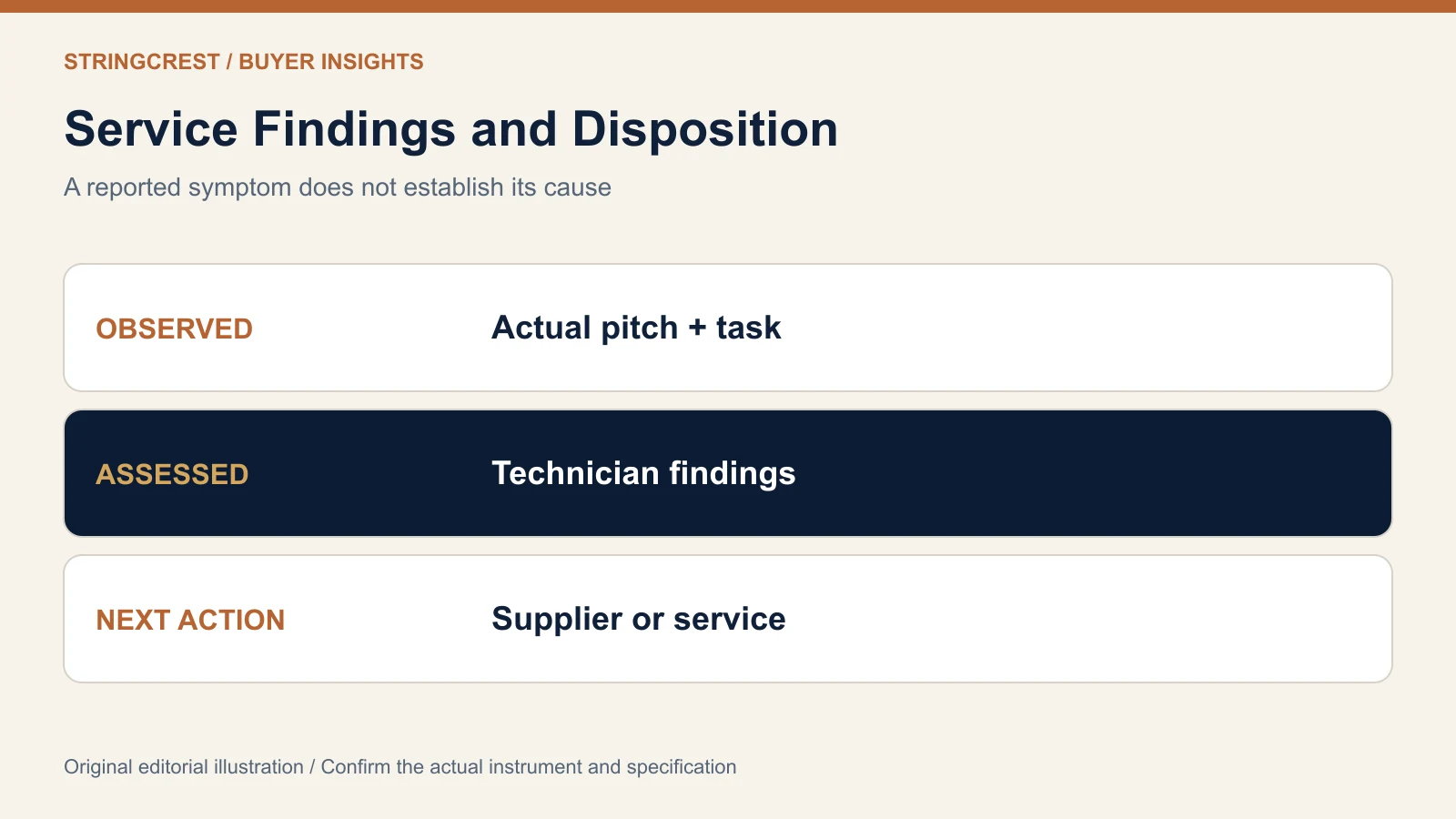
Record the action actually taken and who took responsibility for it. The service outcome might be a corrected installation, a documented setup change or a referral for further review. Preserve the earlier observation rather than rewriting it as if the original condition never existed.
Create a useful supplier complaint record
A supplier needs to know which product and position are involved, how the concern was observed and which conditions were established. Include the set reference, sample or order identifier, instrument model, intended pitch and available installation information. Identify the previous configuration if known.
Attach the observation sequence rather than a selected screenshot. If actual readings exist, retain their positions and reference setting. If a video is useful, identify the string and musical task so it can be understood without a separate conversation with the person who recorded it.
Distinguish a component complaint from a sample-preference decision. A buyer may prefer a different construction after a controlled review without demonstrating a defect. Conversely, a well-liked sound does not resolve an unidentified fit or installation problem.
For shipment inspection, product labels and unit checks can verify that the delivered references match the order. They do not measure installed intonation on every possible guitar. If an installed evaluation is part of the agreement, define the instrument, method, samples and reporting responsibility separately.
Keep the disposition clear: further information requested, instrument assessment pending, candidate revision proposed or an agreed concern resolved. Do not mark a claim closed because a replacement packet was dispatched if the original question remains unanswered.
Explain the outcome when handing the guitar back
Describe what was checked in terms the customer can use. Name the set and relevant playing task, then explain the actual result and any remaining limitation. Avoid saying that a guitar is “perfect everywhere” because a reference comparison was completed.
If a specification changed, record it in the handover information. A customer ordering the old packet later should not have to guess which product the shop fitted. Keep replacement details and any applicable installation guidance together.
When a concern remains, name the next action and responsible party. That might be a maker service consultation or a supplier request for component evidence. Giving a customer a defined next step is more useful than recommending repeated string changes without an assessment plan.
Use accumulated service records to identify what needs review in your product information. A pattern of unclear position labels calls for identification improvements. It does not establish an unmeasured manufacturing failure rate or justify a numerical quality claim in marketing.
FAQ
Can open strings be in tune while fretted playing sounds wrong?
Yes. Open tuning and pitch relationships across stopped positions are different checks. Confirm the reference, identify the fretted task and preserve repeatable observations for assessment. A correct open note alone does not settle the customer’s entire playing concern.
Does a gauge change always require a bridge adjustment?
It requires an appropriate review, not an automatic prescribed adjustment. Fender calls for intonation checks after string changes. The actual action depends on the instrument, installed set and qualified assessment; this article gives no universal displacement or tolerance.
Is the twelfth-fret check enough to clear every note?
No. It provides a defined reference comparison. A concern involving another position, capo or chord needs the relevant task assessed as well. Report the scope of the check instead of converting it into a whole-instrument guarantee.
Should a supplier receive the technician’s setup information?
Include relevant findings and distinguish them from the original observations. Explain what changed and whether the concern remained. That allows a supplier to interpret the component question without treating an unidentified adjustment as evidence about the string itself.
Can a retailer promise that a new construction fixes intonation?
Only make a claim supported by the agreed product, instrument and evidence. A proposed construction is a candidate for evaluation. Product description alone cannot establish the customer’s cause or a guaranteed correction.
Conclusion
After a string change, establish a usable open reference, identify the complete set and record the playing positions that produce the concern. Keep observation, technician assessment and supplier disposition separate. That lets a dealer explain what is known and choose the next action without guessing at a cause.
Sources and interpretation limits
Fender’s linked support and Intonation 101 pages supply the post-change review and reference-comparison context. Taylor’s linked acoustic explanation supplies the fretting-pressure and service context. Sources were read on 13 October 2026. The records and routing examples are editorial recommendations, not company test results, measured tolerances or universal adjustment instructions.
FROM GUIDE TO PRODUCT
Connect this guide to StringCrest product ranges.
Review the relevant range, then bring the instrument, complete specification and open questions into one project brief.
YOUR PRODUCT · YOUR BRAND
Discuss your next string project with Frank.
Share your instrument category, target market, gauge or material direction and private-label packaging requirements.

ABOUT THE AUTHOR
Frank Zou
Frank works directly with musical-instrument brands, importers and distributors on string specifications, product selection and private-label project requirements.
Meet Frank