
String Care
String Care
When to Replace Guitar Strings: A Retailer Guide to Better Customer Advice
A practical customer-education framework for retailers and string brands covering visible wear, feel, response, use patterns, environment and setup changes.
Introduction
There is no single calendar answer to how often to change guitar strings. A useful decision combines the string’s visible condition, feel, tuning and tonal response with how often the instrument is played, the environment in which it is stored and the player’s expectations. A touring player, a student with one weekly lesson and a guitar kept in a humid coastal room do not create the same replacement pattern.
That makes replacement advice a valuable content opportunity for music retailers, distributors and string brands. Good advice helps customers diagnose a real need and choose the correct replacement set. Poor advice gives an unsupported number of days, ignores corrosion or installation problems, and may encourage a gauge change without mentioning setup consequences.
This guide provides a customer-education framework rather than a promised lifespan. It explains the strongest replacement signals, how retailers can turn them into clear store or package content, and where a technician should enter the conversation. It does not claim that StringCrest has tested a fixed service interval for every material, player or climate.
Give customers a condition-based answer first
Replace strings when wear or performance no longer meets the player’s needs
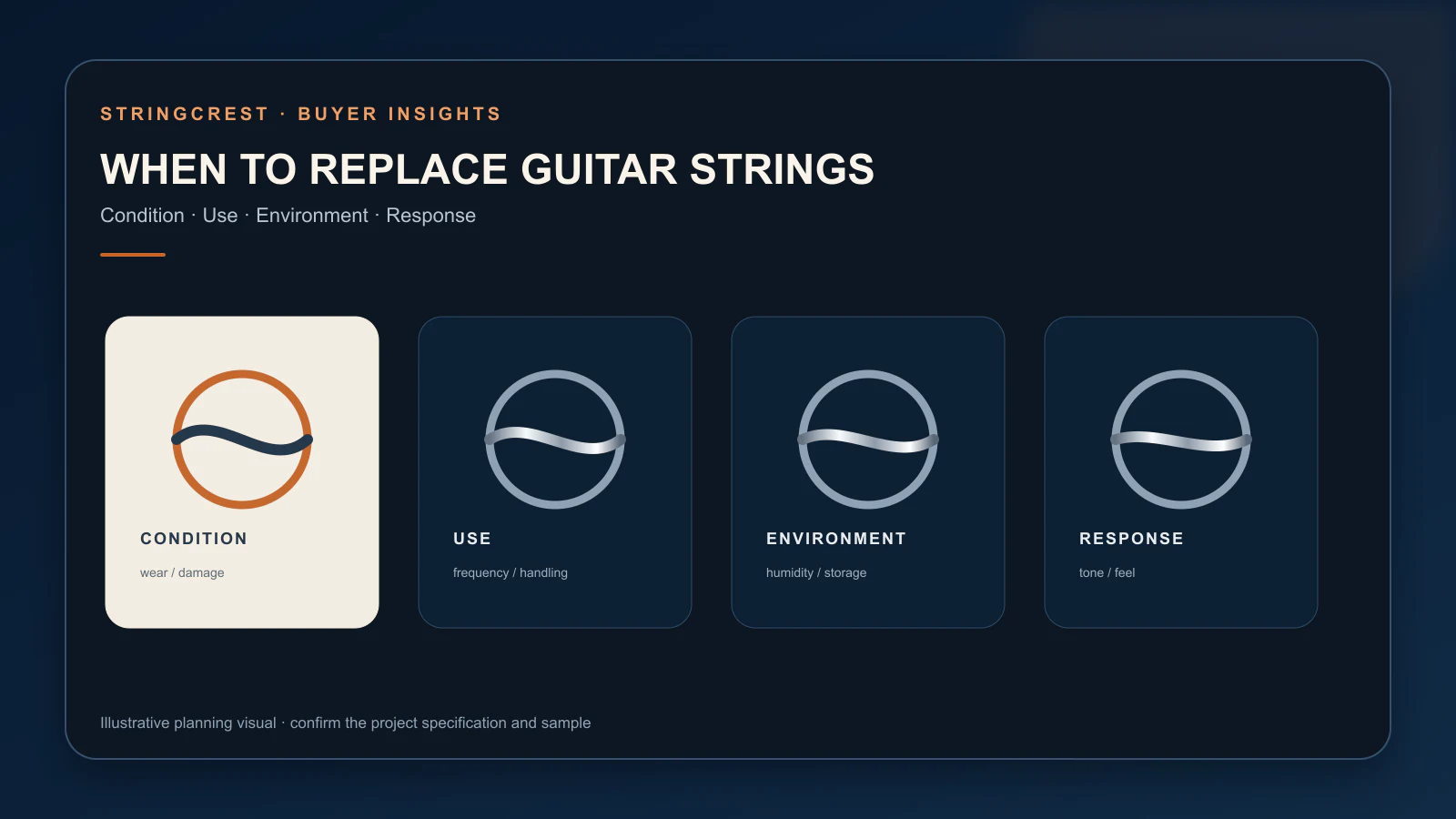
Fender’s support guidance says there is no set rule and points to worn, flattened, kinked, corroded, rusty or dirty strings, as well as a loss of the desired tone, brightness or response. That is a more defensible foundation than “change every X days.” It recognizes that physical condition and player preference are both relevant.
Retail staff can begin with four questions: Are there visible signs of corrosion or damage? Do the strings feel rough, contaminated or uneven? Has tuning or intonation behavior changed after other causes are checked? Has the player lost the response or tone they expect? An affirmative answer does not automatically diagnose every instrument problem, but it provides a reason to inspect and, when appropriate, replace the set.
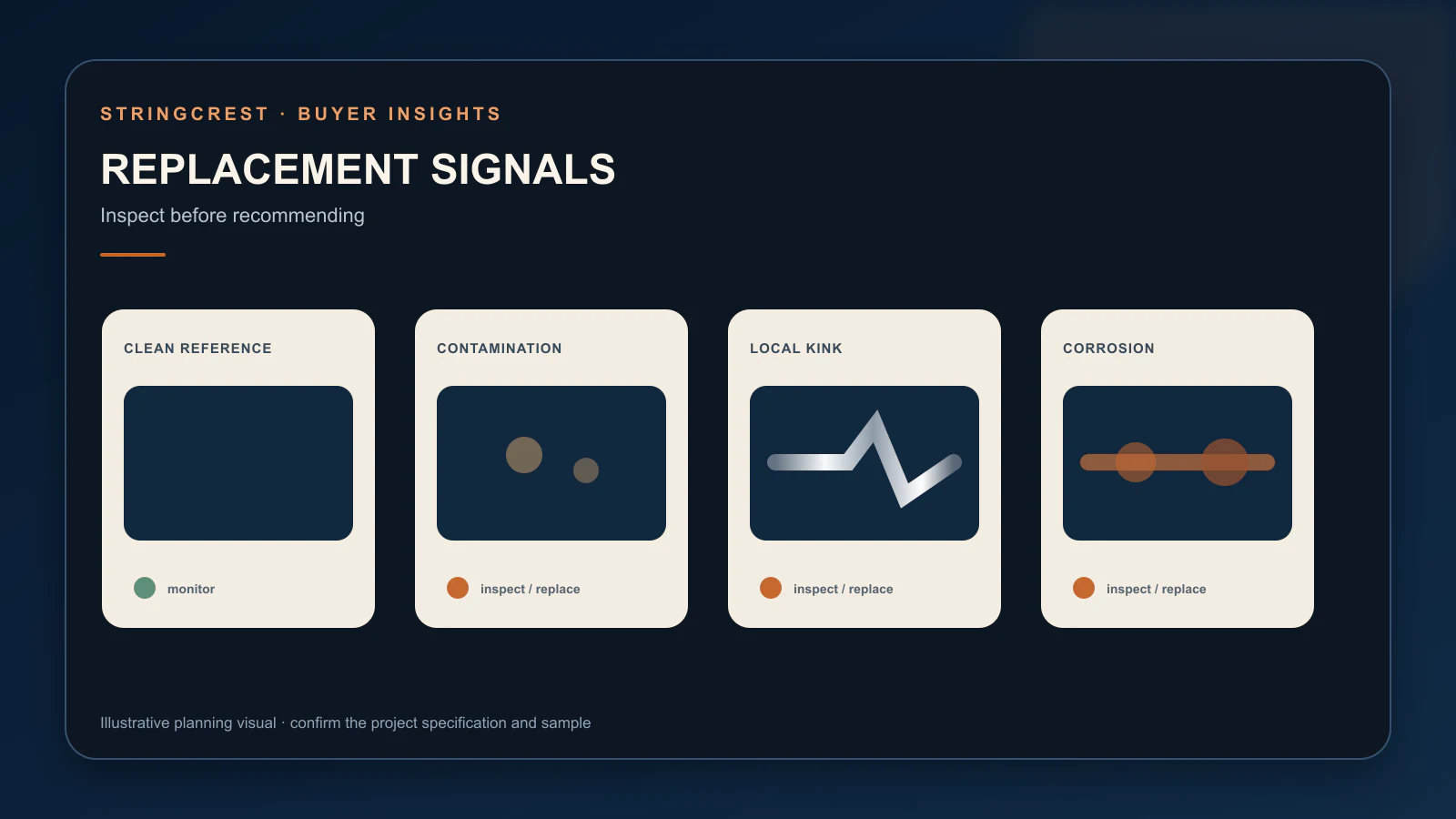
Visible damage deserves priority. A kink, severe flattening or localized corrosion can compromise use even if the pack was installed recently. Dirt buildup and surface change may develop gradually. A broken string also raises a second question: replace only one position or the complete set? The answer depends on the age and condition of the remaining strings, the need for a consistent set and whether a matching single is available.
| Signal | Customer-friendly explanation | Retailer action |
|---|---|---|
| Corrosion or rust | Moisture and residues have visibly changed the surface | Recommend replacement and discuss care/storage |
| Kink or flattened area | Local damage can affect feel and reliability | Replace the damaged string; assess the rest of the set |
| Persistent dirt or rough feel | Cleaning no longer restores the desired surface | Compare an appropriate fresh set |
| Dull or unwanted response | The set no longer produces the player’s preferred response | Confirm instrument and set type before recommending |
| Tuning/intonation concern | Old or damaged strings may contribute, but setup can also matter | Replace consistently, then check setup if the issue remains |
Explain why replacement intervals vary
Use, handling and environment change the result
Playing frequency is only one variable. Session length, hand chemistry, wiping habits, sweat, dust, humidity, storage and case conditions can all influence how quickly a player notices change. The instrument itself also matters: bridge contact, frets, nut slots and sharp hardware can create localized damage that a new set alone will not solve.
Two customers who both play “three times a week” may have different outcomes. One may wash and dry hands, wipe the strings and store the guitar in a stable room. Another may play long stage sets under hot lights and leave the instrument exposed. A brand should avoid converting those differences into a false precision formula.
Material and surface treatment can also change expectations, but any comparative lifespan claim requires a defined test and scope. Retail education can say that construction and treatment are factors to consider. It should not promise that one set lasts a fixed multiple longer unless the evidence supports that exact claim under stated conditions.
The customer’s tonal preference is legitimate too. Some players replace strings when the initial brightness changes; others prefer a settled-in sound and continue until feel or stability declines. Retailers can acknowledge both preferences while still identifying safety or condition problems that deserve action.
Create a practical replacement decision tree
Help staff move from symptom to recommendation
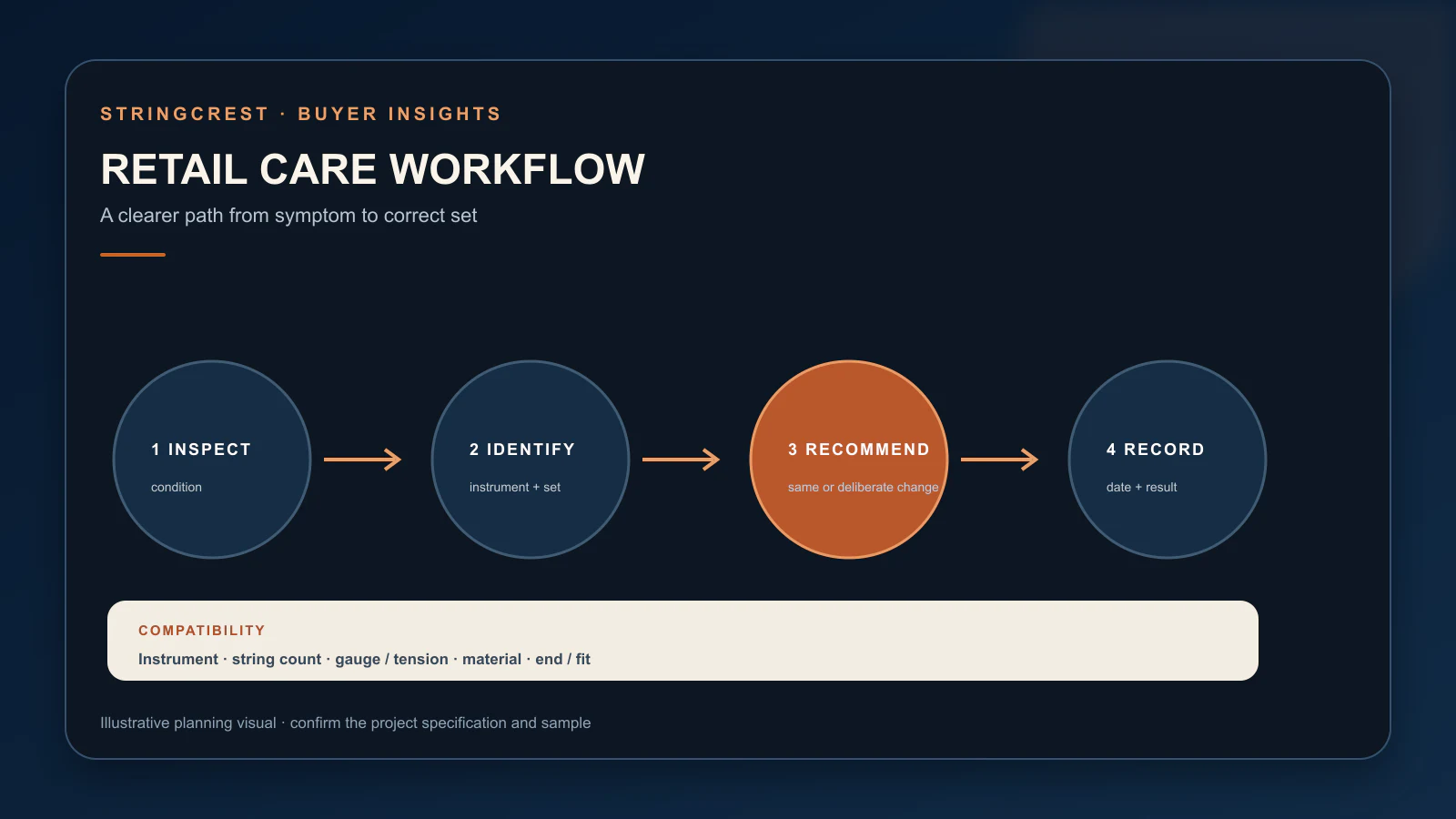
Start with inspection. If a string is broken, sharply kinked, visibly rusted or damaged at a contact point, replace it and inspect the guitar for a cause. If no severe damage is present, ask whether cleaning and tuning restore acceptable feel and response. If not, a fresh set is a reasonable next step.
Next confirm what is currently installed. Record instrument type, string count, gauge, material or product family, scale or fit requirement and special end construction. Do not let a generic replacement conversation create a compatibility error. Classical tie-end strings, electric ball-end strings, bass scale requirements and violin tailpiece ends are different product decisions.
Then ask whether the player wants the same result or a deliberate change. If the same, match the known specification as closely as possible. If the player wants a different feel or tuning, explain that a gauge or tension change can affect setup. Fender’s support guidance notes that changes in string gauge, material, brand and climate can affect neck tension and setup needs. This is a reason for careful advice, not a reason to frighten customers.
Finally, establish a personal check routine. Rather than promising a fixed interval, suggest that the player inspect strings before important rehearsals or performances and note when feel, appearance or response changes. A simple record of installation date and use can help that player discover their own pattern.
Separate string wear from instrument setup problems
New strings cannot correct every symptom
Buzzing, tuning instability, poor intonation or breakage may involve the strings, but may also involve the nut, bridge, tuner, frets, neck relief or installation method. Retail advice should leave room for inspection by a qualified technician.
If a string repeatedly breaks at the same point, inspect that contact point instead of selling another identical replacement without comment. If intonation remains poor after a correctly installed, appropriate set has stabilized, a setup check may be needed. Fender’s intonation guidance explicitly begins with fresh strings, demonstrating that string condition and setup diagnosis are connected.
A gauge change can alter tension and may require adjustment. When a customer moves from a light set to a much heavier set, changes tuning substantially or changes material family, recommend checking the instrument maker’s guidance or consulting a technician. A retailer does not need to diagnose the guitar at the counter to give responsible boundaries.
This distinction also protects product trust. If every buzz or tuning issue is blamed on “bad strings,” customers may cycle through products without solving the underlying problem. A transparent troubleshooting path is more credible and can support long-term relationships.
Turn the guidance into useful retail content
Build short answers for shelves, packages and product pages
Customers rarely read a long technical essay while standing in a store. Retailers can convert the framework into several content layers. A shelf card can list three visible replacement signs. A package insert can show correct product identification and care reminders. A product page can host the full decision tree and link to instrument-specific replacement guidance.
Use plain language. “Check for rust, kinks, roughness and a response you no longer like” is more useful than “replace regularly.” Add a reminder to confirm instrument, string count and gauge before purchase. If the brand offers several materials, explain their construction and intended choices without unsupported durability rankings.
QR codes can connect small packaging to a maintained guide, but the destination must stay live and mobile friendly. Avoid printing a code that leads to a temporary campaign page. The online guide should show a clear contact option for compatibility questions and should not hide essential product identification behind a form.
Staff training can use the same decision tree. Give employees a one-page prompt with condition, current set, desired change and setup flags. This helps a new salesperson ask better questions without pretending to be a repair technician.
Online filters should mirror those questions. Let customers narrow by instrument, string count, gauge or tension, material and special fit. A replacement article can then link into a filtered category rather than dropping the reader on an undifferentiated catalog. If the exact previous set is unknown, invite a compatibility question and ask for a clear photo of the current package or instrument details.
Plan replenishment without inventing a universal cycle
Use actual sales and customer segments
A retailer’s replenishment plan should use store data, not a public claim that everyone replaces strings on the same schedule. Track sales by instrument category, gauge and material. Watch stockouts, slow-moving SKUs and single-string demand. Separate school, service, professional and casual-player channels when those segments are observable.
Replacement education can improve demand quality even when it does not increase immediate volume. A customer who understands compatibility is less likely to buy the wrong set. A technician who can identify a repeated break point can solve the actual problem. A brand that states uncertainty honestly is more trustworthy than one that prints an arbitrary lifespan.
For B2B buyers, packaging quantities and assortment should reflect the channel. A repair counter may need common singles alongside sets. An online brand may prioritize clear filters and fit information. A school program may value simple product identification and reorder consistency. These are commercial design choices to validate with real customers.
Create a responsible care message
Offer habits without turning them into guarantees
General care guidance can recommend clean, dry hands, wiping strings after use and storing the instrument appropriately. The wording should be practical and modest. It should not claim that one habit guarantees a precise extension of service life.
If the product has a coating or treatment, state what is actually supplied and follow the approved care guidance for that product. Avoid strong chemical-cleaner recommendations unless they are compatible with the strings and instrument finish. When uncertain, direct the customer to the instrument and product instructions.
An installation-date field on an inner sleeve or a digital reminder can help players observe their own cycle. The purpose is to support awareness, not to force automatic replacement. A player can use the date together with condition, use and upcoming performance needs.
Retailers can also publish a short pre-performance checklist: inspect the set early enough to replace and stabilize it, carry an appropriate spare, and confirm tuning and intonation before the event. The advice should avoid claiming that brand-new strings are always required. Its value is preparation and correct product identification, especially for players who use alternate tunings or less common string counts.
Write claims that can survive scrutiny
Distinguish advice, observations and verified product evidence
“Replace when strings are corroded, damaged or no longer give the response you want” is general decision guidance. “Our strings last twice as long” is a comparative performance claim that needs evidence, a comparator and test conditions. Keep those categories separate during content approval.
Do not turn factory testing, shipment inspection or customer comments into fictional stories. If a company later completes documented testing, publish the scope, method and limits. Until then, describe the recommended evaluation process and invite buyers to define their own acceptance criteria.
The same discipline applies to photos. A clean diagram of wear signals can educate without pretending to be a laboratory record. If documentary factory or inspection photos are used, they should be authentic, current and accurately captioned.
FAQ
How often should guitar strings be changed?
There is no universal interval. Inspect condition, feel, tuning behavior and response, then consider playing frequency, environment and personal preference. Replace damaged, corroded or unsuitable strings promptly.
Should all strings be replaced when one breaks?
If the remaining set is relatively fresh and a matching single is available, one position may be replaced. If the rest is worn or a consistent response is important, a complete set may be more appropriate. Inspect repeated breakage at the same point.
Do old strings cause tuning or intonation problems?
Worn or damaged strings can contribute, but instrument setup and installation also matter. Install an appropriate fresh set consistently, allow it to stabilize and seek a setup check if the problem remains.
Does changing gauge require a guitar setup?
A meaningful gauge, material or tuning change can alter tension and may require adjustment. Follow the instrument maker’s guidance or consult a qualified technician.
Can coated strings be given a fixed lifespan?
Not responsibly without defined evidence. Treatment, use, environment and player preference all affect the result. Describe the actual construction and give condition-based replacement advice.
What replacement information belongs on packaging?
Prioritize instrument category, string count, gauge or tension, material, end or fit information and a short condition-based care message. Link to fuller instructions when space is limited.
Conclusion
The most useful answer to “when should I replace guitar strings?” is a decision process, not a countdown. Inspect for damage, corrosion, dirt and unwanted response; identify the current string specification; separate wear from setup issues; and help the player choose an appropriate replacement. For retailers and brands, this approach supports credible education, better compatibility decisions and claims that remain within the evidence.
Explore StringCrest string categories · Discuss customer guidance for your string line
Sources and interpretation limits
- Fender: How often should I change my strings?
- Fender: The easy way to change electric guitar strings
- Fender: Setup adjustment frequency and changing conditions
- Fender: Intonation guidance
These official resources support the condition-based guidance and setup cautions used here. They do not establish StringCrest lifespan, testing, service or performance claims. Product fit and care should be confirmed for the instrument and set in question.
FROM GUIDE TO PRODUCT
Connect this guide to StringCrest product ranges.
Review the relevant range, then bring the instrument, complete specification and open questions into one project brief.
YOUR PRODUCT · YOUR BRAND
Discuss your next string project with Frank.
Share your instrument category, target market, gauge or material direction and private-label packaging requirements.

ABOUT THE AUTHOR
Frank Zou
Frank works directly with musical-instrument brands, importers and distributors on string specifications, product selection and private-label project requirements.
Meet Frank