
Wholesale Planning
Wholesale Planning
Plain G vs Wound G Electric Guitar Strings: An OEM Set Specification Guide
Compare plain and wound G strings by construction, gauge, tension context, setup, sample evaluation, packaging identity and replacement-string planning.
Introduction
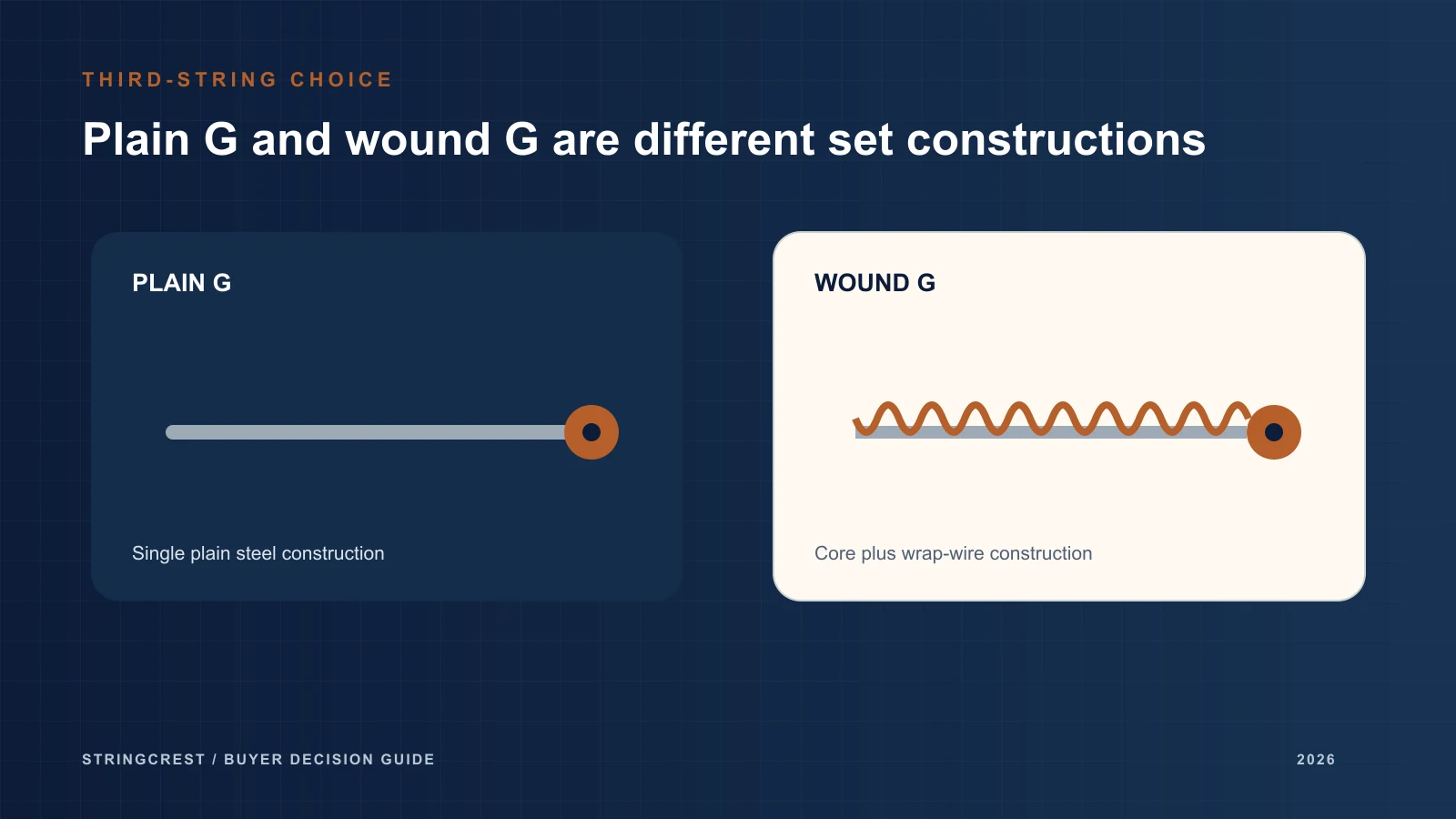
A plain G and a wound G are two constructions for the third string of a conventional six-string electric guitar. Both can be tuned to G3 in standard tuning. A plain-steel G is an unwound wire; a wound G has a core with wrap wire around it. The choice can change the candidate's playing response and setup requirements, but the construction label alone does not tell a buyer which will bend more easily or intonate better on a particular guitar.
For an OEM range, define the player's bending and chord tasks, identify the complete six-string set, and compare the actual candidates on a documented guitar. Keep the observations tied to each candidate and its setup. The practical outcome is a specified third string that the dealer can explain and replace accurately.
Locate G3 before specifying its construction
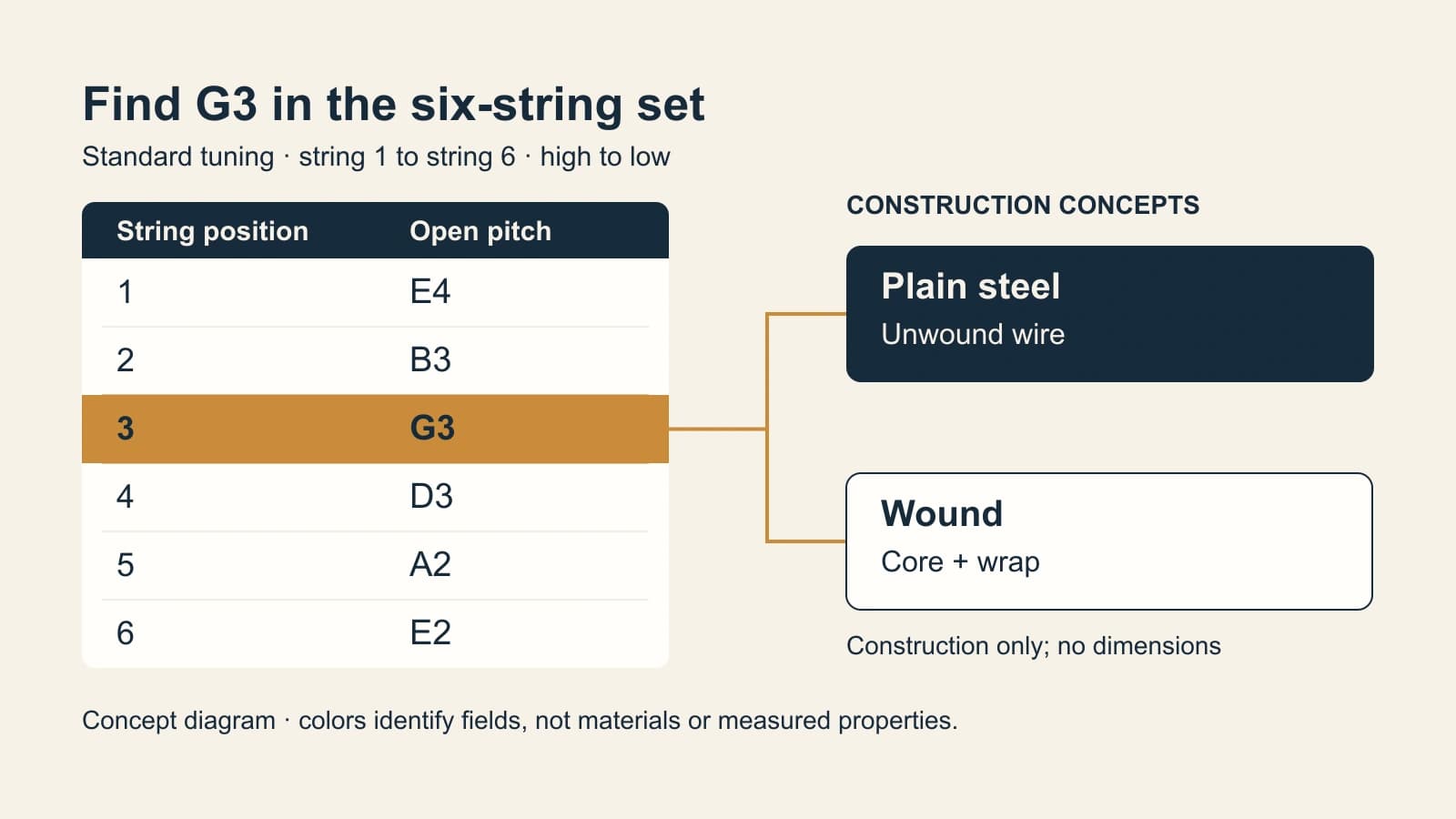
The following table runs from string 1, the high E, to string 6, the low E. The number is a physical string position; the letter and octave identify its open pitch in standard tuning.
| String position | Open pitch |
|---|---|
| 1 | E4 |
| 2 | B3 |
| 3 | G3 |
| 4 | D3 |
| 5 | A2 |
| 6 | E2 |
D’Addario's NYXL1254 product chart lists this six-note sequence and explicitly identifies a plain-steel third string. Its EJ21 product page identifies a wound third string with the same G3 open pitch. These are examples from that maker, with different complete-set specifications. They establish neither a controlled plain-versus-wound comparison nor a StringCrest product specification.
Put the finished gauge and construction beside each position in the proposed set record. The first and last gauges printed on a pack do not reveal the third-string construction or the four intermediate gauges. If the range uses an alternate tuning, replace the pitch column explicitly instead of continuing to label it standard tuning.
Separate playing wire, core, wrap and finished gauge
For the G string, ask for the fields that distinguish the actual proposals:
| Construction field | Plain-steel G | Wound G |
|---|---|---|
| Playing-wire or core specification | Plain-wire material and diameter | Core material, geometry and dimensions where disclosed |
| Wrap | No wrap wire | Wrap material and winding construction |
| Finished gauge | Outside diameter of the playing wire, with any treatment declared | Finished outside diameter of the wound string |
| Surface treatment | Record separately | Record separately from the wrap |
| Fit identity | End format and defined usable length | End format, defined usable length and relevant winding transitions |
A wound string's finished gauge includes its wrap. It is not its core diameter. A plain and wound string with the same nominal outside gauge therefore cannot be assumed to have the same core, mass per unit length or tension. Likewise, “wound” does not mean nickel, and it does not mean coated. State the wrap material and any treatment separately.
For hidden geometry and handling questions, use the round-core versus hex-core guide. A sketch or outside-diameter measurement cannot establish an undisclosed core specification.
D’Addario's tension explanation identifies unit weight, vibrating length and frequency as the inputs for calculating tension. An outside-gauge label is insufficient for a numerical comparison between unspecified constructions. Use the applicable product data and conditions; do not transfer that maker's tension figures to a proposed OEM string.
Compare a defined bend, not an adjective
“Flexible” is too vague to approve a third string. If the intended player bends the G string, choose a fret, starting pitch and target pitch or interval. Have the evaluator attempt the same bend with each correctly installed candidate, then describe whether the target was reached, the perceived effort, control near the target, and the return to pitch after release.
Keep effort and travel separate. A player may describe one candidate as requiring less effort while needing a different finger movement to reach the target. Neither description is a measured open-string tension result. Unless force and displacement were actually measured with a defined method, record them as playing observations.
Use the same evaluator and task where practical. Note the guitar, action and bridge state, including whether a tremolo is floating. If those conditions change between trials, the result includes that change. Do not publish “all plain G strings bend more easily,” “wound G is always softer,” or a universal bright/dark ranking from these labels.
Also include the passages that motivated the range: selected chord voicings, single-note lines and transitions between the B, G and D strings. A bend-focused preference does not answer whether the same candidate suits the buyer's chord work or set balance.
Recheck intonation when the G string changes
Tuning the open G to G3 does not confirm its fretted-note intonation. Review the candidate with the guitar's normal setup procedure, especially when its gauge or construction changes. Fender's factory setup guidance ties its specifications to the original string gauges and notes that gauge changes may require compensation. Its numerical settings are model guidance, not universal OEM acceptance limits.
For an adjustable saddle, Fender's intonation explanation compares the fretted twelfth-fret note with the twelfth-fret harmonic. A fretted note that reads sharp calls for a longer vibrating length; one that reads flat calls for a shorter length. Follow the actual bridge's adjustment instructions and retune before checking again.
Record the initial reading, adjustment and final reading. Do not prescribe a fixed saddle movement for switching between plain and wound G, or infer the required amount from gauge alone. Check the intended lower-position chords as well; a twelfth-fret check is not a record of every fretted note.
Before interpreting a problem as a construction preference, have the installer check seating and clearance at the nut, bridge and tuner, along with the action and relevant neck or tremolo setup. Stop a trial that cannot be installed correctly. A nut modification or bridge change needs its own authorization and record; it should not disappear inside “same guitar” test notes.
Discuss the current G construction, complete gauges, target tuning and bending task so the proposed comparison addresses the intended instrument and player.
Use a G-string observation card on the same guitar
First decide what the trial is comparing. Replacing only the G while retaining the other five strings is a component trial; identify that mixed set. Installing two complete sets is a complete-set comparison, which may include changes beyond G. Neither should be described as isolating construction unless the relevant other variables are actually controlled.
Keep the guitar, tuning, evaluator and tasks consistent. Use comparably fresh candidates and record installation order and settling routine. For amplified comparisons, retain the pickup selection, guitar controls, amplifier and recording settings. If listening copies are level-matched, preserve the original recordings and identify the adjusted versions separately.
Begin from a documented setup that is suitable for each candidate. If one needs adjustment, record the before-and-after states and evaluate its properly set-up result as a separate condition. Forcing both candidates into an unsuitable unchanged setup would not answer which configuration the buyer should offer.
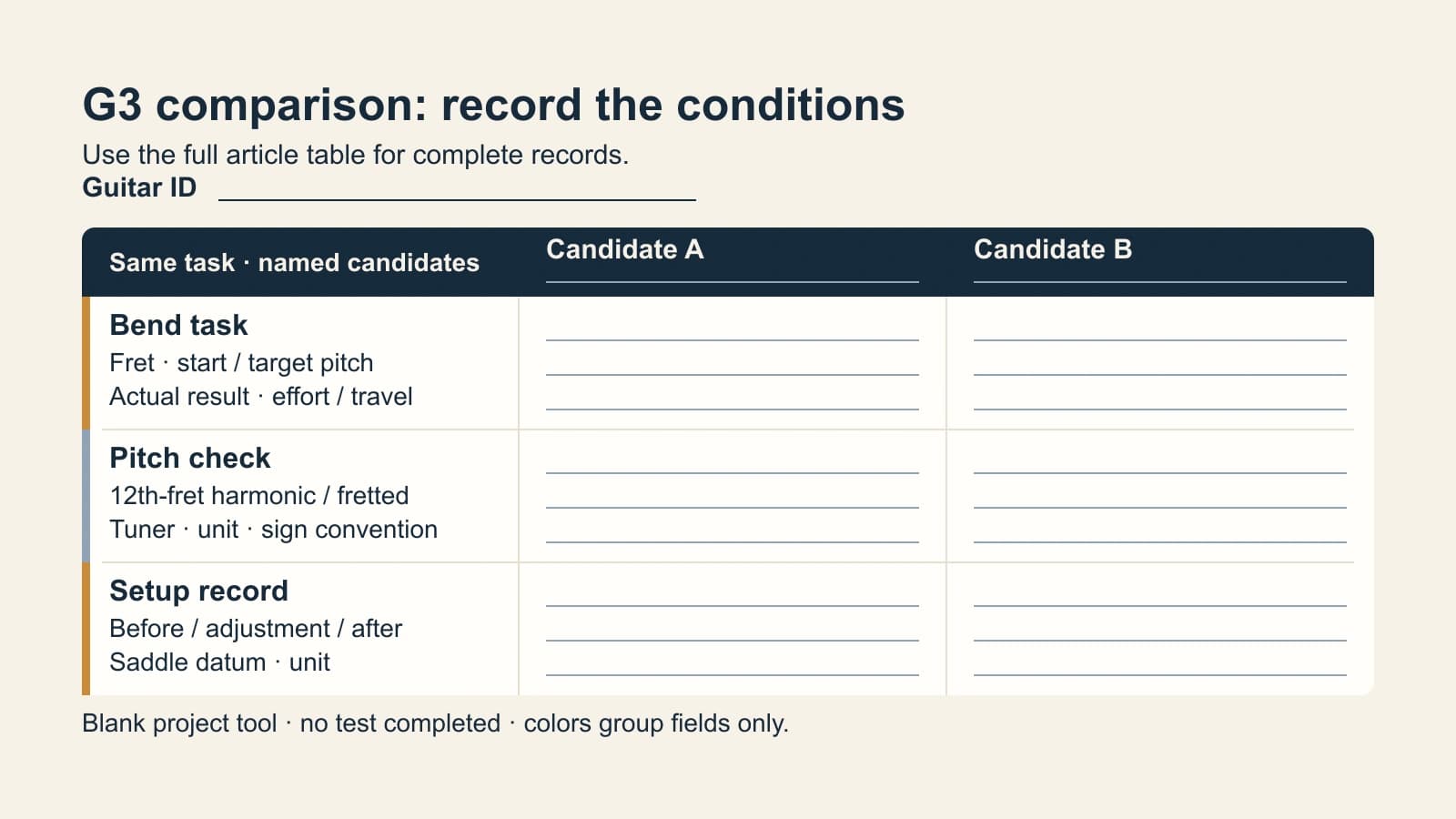
Use the following blank card alongside the six-position specification. Enter actual observations; empty cells are unconfirmed, not zero or a pass result.
Shared record: guitar ID, nominal scale and measured reference if used, tuning, evaluator, date, pickup/recording path, installation order and trial purpose.
| G3 comparison item | Candidate A | Candidate B |
|---|---|---|
| Set/component code and revision; other five strings retained or replaced | ||
| Plain or wound; finished gauge; declared wire/core, wrap and treatment | ||
| Installation and fit observations; action, nut and bridge/tremolo state | ||
| Bend fret, starting pitch, target pitch/interval and actual result | ||
| Perceived bend effort/travel; return-to-pitch observation | ||
| Twelfth-fret harmonic/fretted readings, tuner method and units | ||
| Setup changes, saddle reference/datum and final pitch readings | ||
| Selected chord/line observations; recording references | ||
| Unresolved issue and decision for the intended use |
If recording intonation error in cents, define the sign convention, such as positive for the fretted note being sharp relative to the harmonic. If recording saddle position, name a repeatable datum and unit. A photograph without a reference is useful context but is not a measured compensation amount.
Carry the selected candidate into the electric OEM sample-approval record. That parent guide covers the broader sample-to-production handoff; the card here preserves the third-string tasks and setup evidence behind the choice.
Keep replacement identity attached to the decision
A replacement G should resolve to the approved component, not just a nominal diameter. Keep its plain/wound construction, finished gauge, wire or core/wrap family, treatment, end and fit identity linked to the set revision. If a supplier offers an alternative, compare its declared differences before treating it as an interchangeable single.
Where a range contains both variants, make “plain G” or “wound G” visible in the set description and replacement list. Separate product codes help the dealer avoid supplying the wrong third string. The label communicates construction; a claim about better tuning, longer life or universal genre suitability would need separate evidence for the actual product.
FAQ
Does a wound G mean the whole set is flatwound?
No. Plain/wound identifies whether that string has wrap wire. Roundwound and flatwound describe a wound string's outside winding construction. Specify both fields for G and record the rest of the set separately.
Can a wound G be substituted without changing the guitar setup?
That must be checked on the actual guitar and candidate. Confirm physical fit, then review tuning, action and intonation through the appropriate setup procedure. A successful replacement on one guitar is not a compatibility guarantee for another bridge or nut.
Is a higher gauge number enough to predict bending effort?
No. It does not identify the complete construction or the playing conditions. Use appropriate tension data for numerical comparisons and perform the intended bend task for a playing observation. Keep those two kinds of evidence separate.
Conclusion
Choose the third string by the task the set needs to support. Identify G3 in the full six-position record, keep core and wrap distinct from finished gauge, and document the bend target and setup changes that shape the result. Preserve that construction identity when the buyer orders replacement singles.
The proposed observation card and construction illustrations are educational tools, not StringCrest test results or an approved product specification.
Explore the electric guitar string category, then send your six-position specification, current G construction and intended playing tasks to discuss the candidate requirements.
FROM GUIDE TO PRODUCT
Connect this guide to Electric Guitar Strings.
Review the relevant range, then bring the instrument, complete specification and open questions into one project brief.
YOUR PRODUCT · YOUR BRAND
Discuss your next string project with Frank.
Share your instrument category, target market, gauge or material direction and private-label packaging requirements.

ABOUT THE AUTHOR
Frank Zou
Frank works directly with musical-instrument brands, importers and distributors on string specifications, product selection and private-label project requirements.
Meet Frank