
Wholesale Planning
Wholesale Planning
Electric Guitar String OEM Sample Approval: From Coded Set to Production Reference
Turn a coded electric string trial into a traceable production reference.
Introduction
An electric guitar string sample is useful only when the buyer can identify exactly what was tested and carry the decision into the production order. “Sample B felt good” does not tell purchasing which six-position gauge matrix, material direction, ball-end construction, usable length or pack revision should be produced.
This guide gives private-label brands and distributors a controlled sample-approval workflow. It does not promise a particular StringCrest gauge, alloy, MOQ, lead time or performance result. Availability and commercial terms must be confirmed for the actual brief, and musical observations remain tied to the named sample and instrument.
Build a sample code before playing
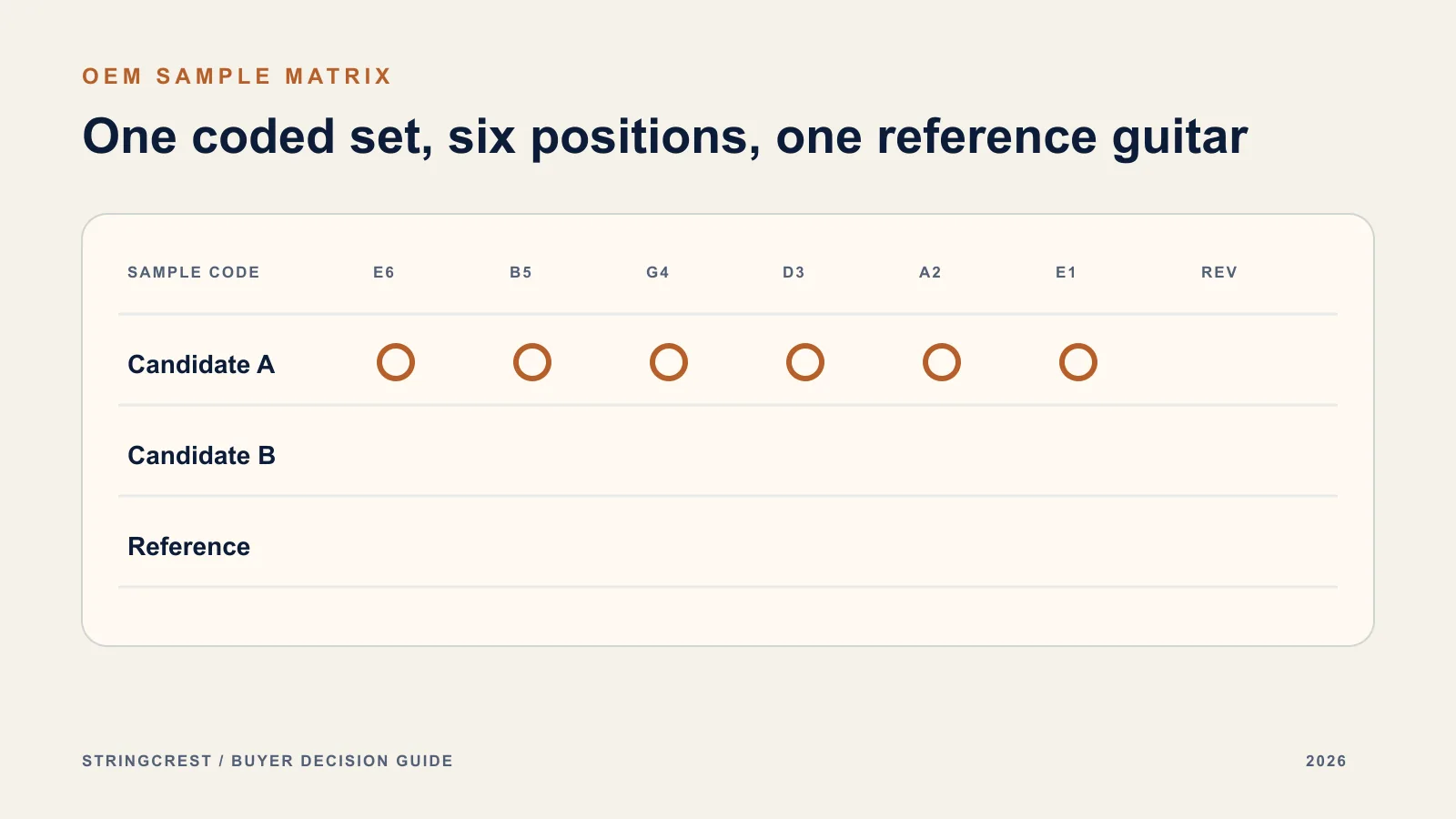
One code should resolve to one six-position set
Assign each candidate a code that connects to a dated specification. Record all six positions, plain and wound allocation, proposed wrap and core direction, end format, overall or usable length definition, winding transition and any coating or surface treatment if applicable. Mark every open field.
The package and individual sleeves should preserve that identity. If strings arrive as loose coils, label them by position without covering the end or winding transition that needs inspection. Never combine strings from different sample revisions into one test set unless the purpose and mixed construction are explicitly documented.
Define the decision the samples must support
A trial may compare two gauge schedules, two material directions, a standard and special end, or a proposed packaging system. Avoid changing all variables at once. Write one decision statement, such as: “Select the gauge direction for a standard six-string dealer range while keeping material and ball-end format fixed.”
Separate fit, feel and commercial readiness
Fit answers whether the set can be installed correctly on the target bridge, nut and tuners. Feel and response are observations made under controlled playing conditions. Commercial readiness covers the confirmed specification, pack identity, artwork, quotation and ability to reorder the same revision. A sample may perform acceptably but still be unready for production because its construction or code is unclear.
Use the StringCrest electric guitar string category as a product-direction reference, then ask which proposed options are actually available for sampling. Do not convert another maker’s gauge or marketing language into an unconfirmed StringCrest specification.
Record the reference instrument and setup
Identify the guitar, scale length, bridge type, tuning, setup condition, pickup and signal path relevant to the trial. Photograph the bridge and string path. If a technician changes nut slots, intonation, action or tremolo balance, record the change and do not compare the before and after states as though only the strings changed.
Install in a repeatable sequence
Check pack identity and visible condition, confirm each string position, seat the end correctly, bring the set to the intended tuning and allow the same practical settling routine for each candidate. Record installation difficulties, winding location, excess length and removal observations. Stop if a fit issue could damage the instrument.
Use repeatable playing tasks
Choose short tasks that represent the intended customer: open and fretted chords, single-note lines across all six positions, bends on selected plain strings, controlled picking, quiet-to-strong attack and tuning checks at defined points. Keep amplifier, effects, pickup selection and recording path stable when they matter to the decision.
Ask evaluators to describe observations rather than rank “tone” with one unexplained score. Useful notes identify the instrument, task and sample: “On Guitar A, Sample C required more left-hand effort during whole-step bends than the retained reference.” That statement does not become a universal performance claim.
Inspect construction and identity after the trial
Review ball ends, winding transitions, visible surface condition and any abnormal damage after removal. If a break occurs, preserve the string, position, break location, instrument and installation record. Do not diagnose wire quality from a photograph alone.
If diameter or length measurements are part of approval, agree on the measuring method and reference points. A nominal gauge label is not a complete construction specification, and a measured diameter by itself does not establish tension. Keep competitor data attributed to the competitor.
Turn observations into an approval decision
Approve, revise or reject with scope
An approval should name the sample code, six-position matrix, material and end direction, approved instrument scope, open deviations and packaging status. “Approved for production” is too broad if artwork or individual-string labels are still drafts. A revision request should identify which field changes and whether another installation trial is required.
If evaluators disagree, retain the observations instead of averaging them into a false consensus. Ask whether they used the same instrument and tasks, and whether the difference affects the intended channel. The buyer may need a second controlled round or may decide that two samples are not commercially distinct enough for separate SKUs.
Connect the approved set to packaging and purchasing
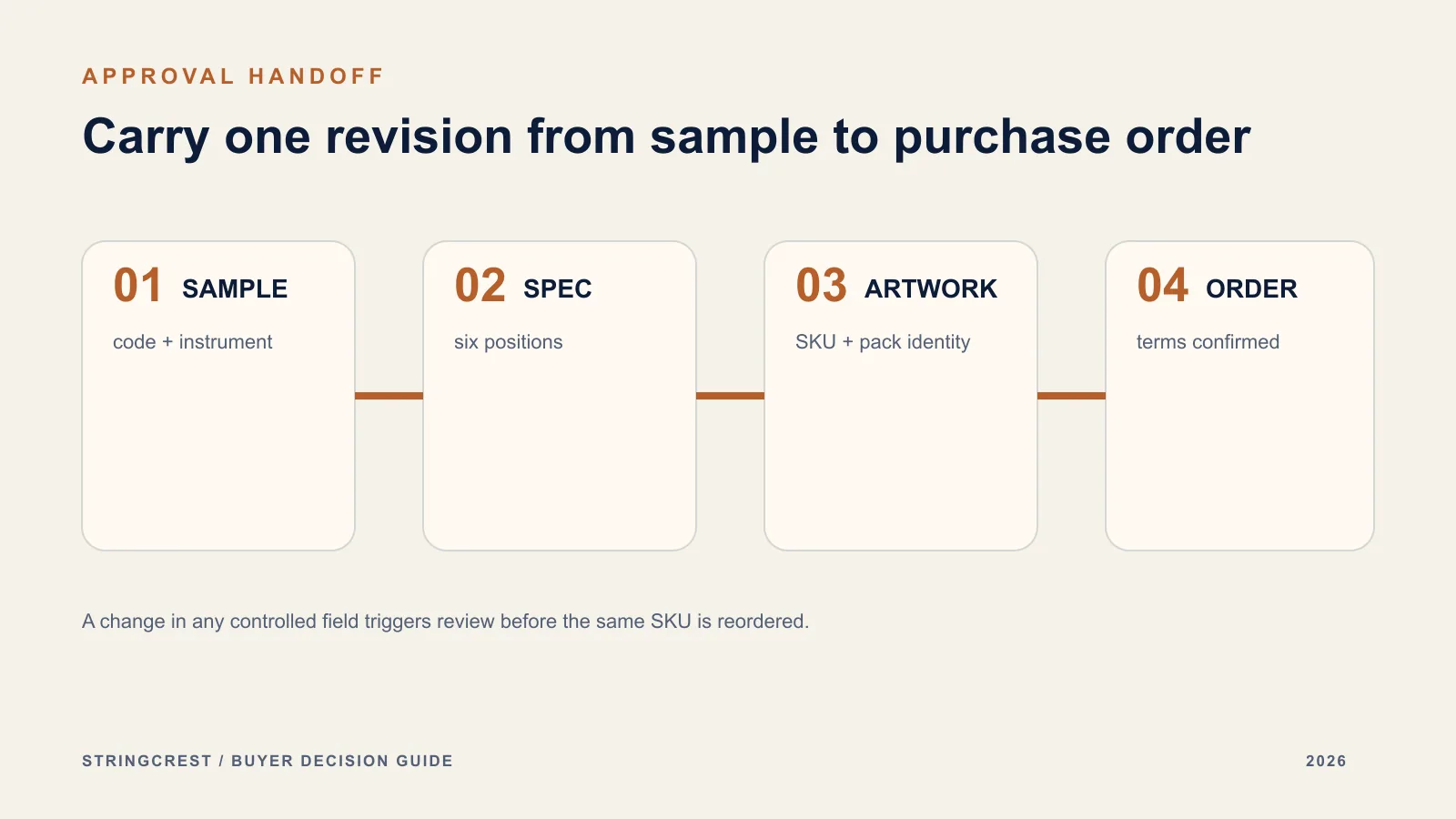
The technical panel, individual sleeves, barcode supplied by the buyer, retail listing and purchase-order line should all name the same SKU and revision. Confirm whether the pack communicates gauge, material and special fit accurately. A beautiful pack cannot correct an unresolved set identity.
Attach the approved sample record to the quotation. Request project-specific MOQ, price, sample charges, lead time, delivery terms and change-notification boundaries. None of these should be inferred from the sample itself. Retain an unused reference set when practical and document how it is stored.
Check the first shipment against the reference
Receiving inspection should confirm carton and pack identity before opening selected sets. Check six positions, labels, visible end and winding construction, pack seals and any dimensions included in the agreement. Record the lot, sample selection and exceptions. A first-shipment check confirms the agreed evidence; it does not prove universal tuning stability, tone or service life.
Require review when a supplier proposes a change in wire, wrap, core, gauge, end component, length, coating, protection or artwork. The buyer can accept documented equivalence, request a new sample or create a revised SKU, but the decision should not happen silently.
FAQ
How many electric guitar string samples should I compare?
There is no universal number. Use enough coded candidates to answer one defined decision without changing too many variables at once. More samples can create noise if their differences are not controlled.
Can one guitarist approve the set?
One evaluator can provide useful observations, but the buyer should match the review scope to the market risk. Record the evaluator, instrument and tasks so the decision is transparent.
Does successful installation prove bridge compatibility for every guitar?
No. It proves the documented sample fit the named instrument under the recorded setup. Other bridge systems or scale paths may require separate confirmation.
Can a sample prove better tuning stability or longer life?
Not from a short informal trial. Such claims need a defined method, controlled conditions and sufficient observations. Keep the approval language within the evidence collected.
What should be retained after approval?
Keep the specification revision, sample code, decision record, instrument sheet, artwork version, open deviations and, when practical, an unused physical reference set.
Conclusion
An electric guitar string sample becomes a production reference only when its six positions, construction, instrument trial, observations, packaging and purchase order remain connected. Control one decision at a time, document fit separately from playing response, and approve with explicit scope. That record allows the buyer and supplier to discuss production without relying on memory or marketing shorthand.
If you have a sample round to prepare, send the six-position specification, reference guitar, bridge path and packaging outline. StringCrest can respond to the confirmed project fields and identify what still needs sampling.
Sources
FROM GUIDE TO PRODUCT
Connect this guide to Electric Guitar Strings.
Review the relevant range, then bring the instrument, complete specification and open questions into one project brief.
YOUR PRODUCT · YOUR BRAND
Discuss your next string project with Frank.
Share your instrument category, target market, gauge or material direction and private-label packaging requirements.

ABOUT THE AUTHOR
Frank Zou
Frank works directly with musical-instrument brands, importers and distributors on string specifications, product selection and private-label project requirements.
Meet Frank