
Specifications & Fit
Specifications & Fit
Balanced Tension Electric Guitar Strings: An OEM Specification Guide
Build a position-by-position engineering and sample brief without confusing similar calculated tension with identical playing feel.
Introduction
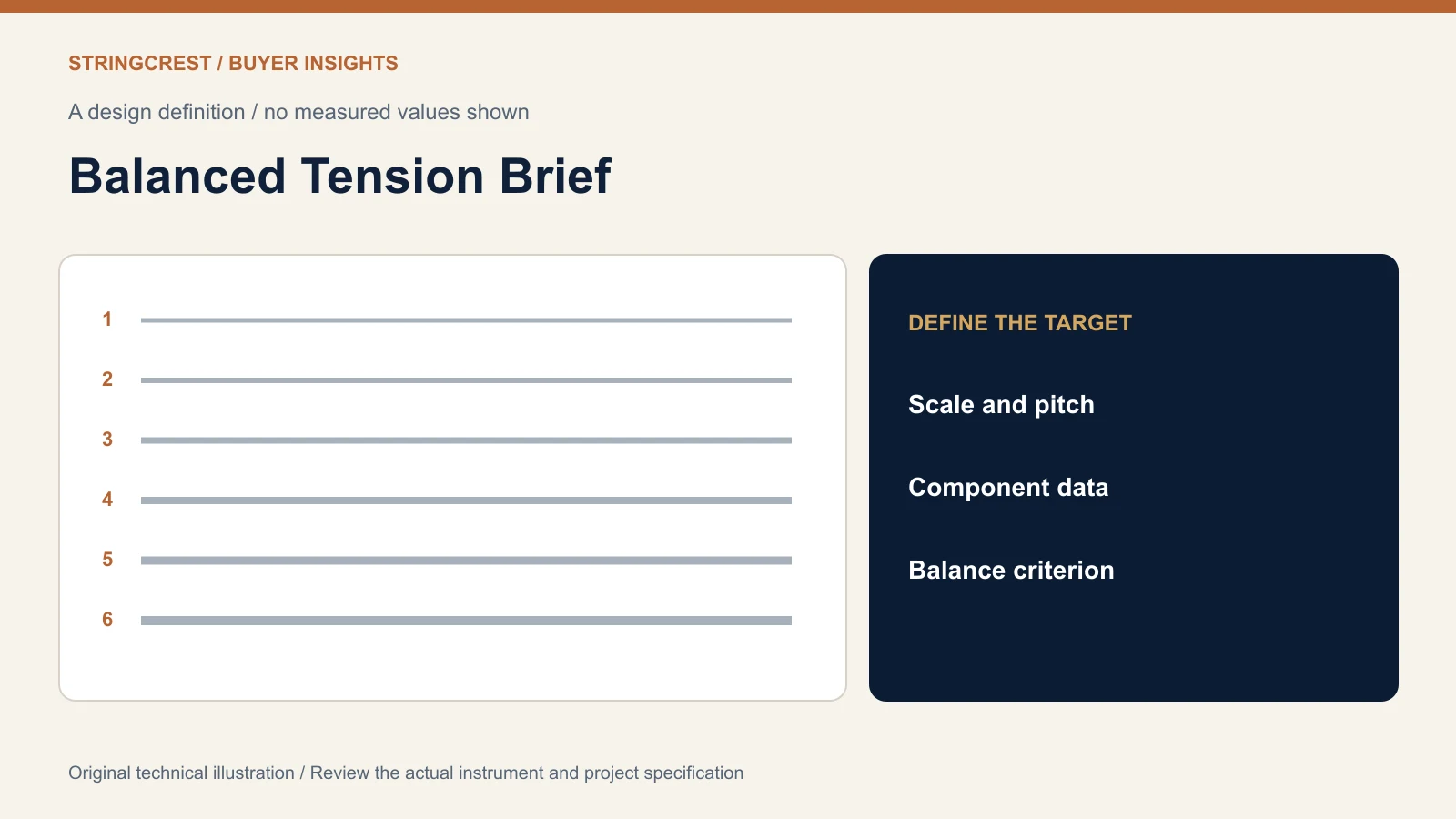
Balanced tension guitar strings usually refer to a set designed to bring the installed tensions of its individual strings closer together under defined scale and tuning conditions. That is a different claim from equal gauges, equal perceived stiffness or a universally easier-playing guitar. An OEM buyer should define the intended balance, confirm the inputs and evaluate the complete set before using the term on packaging.
The distinction matters because “balanced” can mean several things in a buying conversation. A supplier may mean similar calculated force across six positions. A player may mean a comfortable transition between plain and wound strings. A distributor may mean an assortment that serves different customers. Those are legitimate aims, but they do not describe the same specification.
This guide focuses on the first two meanings: position-by-position tension planning and the subsequent playing assessment. It explains what data a private-label buyer needs, how to review a calculation sheet and how to prevent a useful design idea from becoming an unsupported product promise.
StringCrest makes strings to the customer specifications agreed for an order. Start with the electric guitar string range, then discuss the complete set, instrument and sample requirements. This article does not confirm a stocked balanced-tension SKU or provide measured tension values for StringCrest products.
Decide what the balance statement will mean
A defined engineering target
If the target is similar installed tension, describe the six positions, intended pitches and speaking scale. Ask the supplier to explain how the proposed set approaches that target. Any allowed spread or production tolerance must be agreed using relevant product and measurement information.
A playing preference
A player can prefer how one set feels without demonstrating equal physical tension. Record that preference as a sample observation. Do not reverse the reasoning and assign an engineering property because the reviewer described the strings as comfortable or even.
A range-positioning description
The word can also appear in commercial language about an all-round set. If that is the intended meaning, avoid presenting it as a numerical tension claim. A clear application description is better than a term that purchasing, marketing and customers interpret differently.
D’Addario's balanced-tension explanation describes its own approach to bringing the six tensions close together. It is a useful example of an explicit definition, not a specification or proprietary performance claim that another brand can inherit.
Identify the inputs before discussing a gauge sequence
For each string, record intended pitch, vibrating length and the relevant construction or linear mass information. Gauge is useful for identifying a component, but a wound string's external diameter does not uniquely determine its mass per unit length.
Ask whether the data describe the proposed component or a different reference product. A spreadsheet can be internally consistent while using inputs from another core, wrap or construction. Its calculated output would then fail to establish the property being discussed.
Use actual pitch information, including octave where needed. A letter name without register can create a large calculation error. Likewise, a scale value should describe the speaking section used by the model, not the total uncut string length or the route to the tuning post.
Document the input source and revision. If the supplier changes a construction during development, review whether the previous data remain applicable. Keep the calculation linked to the specific sample rather than allowing an old number to follow a new string automatically.
Understand the calculation and its limits
For an ideal string, the fundamental-frequency relation leads to T = μ × (2 × L × f)², where μ is linear mass density, L is vibrating length and f is frequency. With consistent SI units, the resulting tension is in newtons. OpenStax's standing-wave treatment explains the underlying ideal-string model.
This relationship helps show why the same component can have different tension at another pitch or scale. It does not supply an unknown component's mass information or establish a complete playing-feel model. Label calculated values as calculated, with their assumptions visible.
Manufacturer tools such as String Tension Pro are useful for their supported product inputs. Do not treat a selected competitor component as a verified substitute for an unmeasured custom string merely because its gauge looks similar.
Keep force units consistent. If a sheet presents more than one unit, state which governs and calculate conversions deliberately. Avoid a mixture of rounded values and differing units that creates the appearance of balance through formatting rather than the underlying data.
Review all positions as one set
A headline gauge range is not a complete balanced-tension definition. Ask for the exact position sequence, plain or wound status and intended tuning. The design may alter intermediate gauges even when the first and last gauges resemble a familiar range label.
Compare the tension pattern across the entire set. A set total can stay similar while the distribution changes substantially. A buyer concerned about the transition from plain to wound positions needs the individual values, not only their sum.
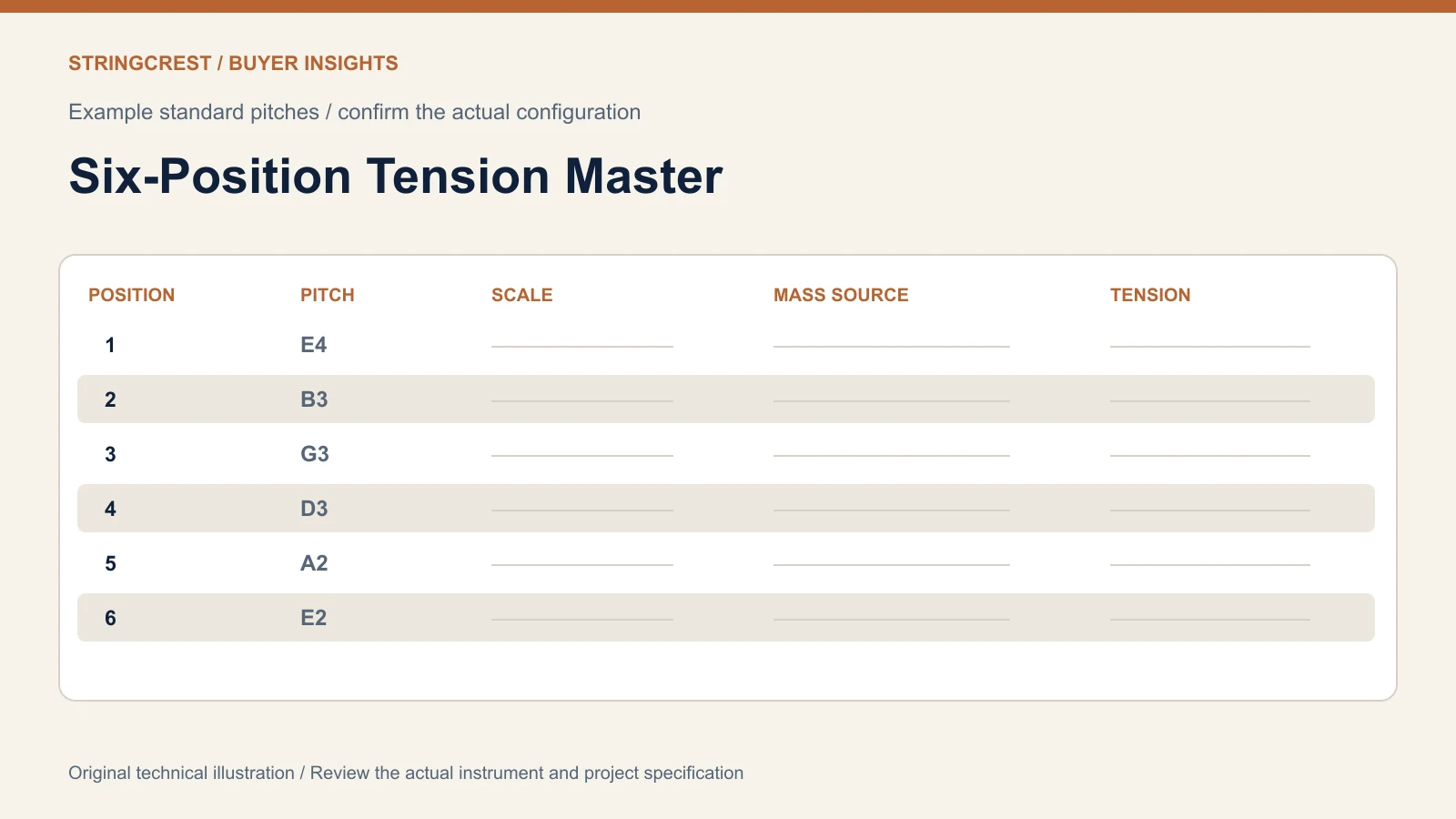
| Specification field | Required clarification | Approval purpose |
|---|---|---|
| Position identity | String number and intended pitch | Connects each component to the calculation |
| Speaking scale | Defined reference and unit | States the instrument condition |
| Construction | Plain/wound, core and wrap description | Identifies the proposed physical component |
| Linear-mass input | Value source and revision where available | Supports the calculation basis |
| Tension output | Calculated or measured, with method | Prevents unsupported precision |
| Balance criterion | Agreed pattern or allowable spread | Defines what the term will mean |
An incomplete row should remain unresolved. Do not fill missing inputs with values from a convenient online chart and then approve a custom set as balanced. The supplier's data and the buyer's intended conditions must meet in the same record.
Keep equal force separate from equal feel
Tension is a force in the installed string. The player's experience also involves construction, stiffness, setup, contact geometry and the action being performed. Picking, fretting and bending are different tasks, so a preference under one does not guarantee the same preference under the others.
Avoid a claim that every string will require identical bending effort simply because calculated tensions are close. Ask the reviewer to assess the actual transitions and playing tasks that matter to the target customers. Keep that application result beside, rather than inside, the calculation column.
The same distinction prevents an inappropriate instrument adjustment from being mistaken for a string-design result. If action, relief or contact conditions differ between samples, note the change. A controlled comparison should make those differences visible.
Prepare a sample comparison with a clear question
Choose whether the review is intended to assess the proposed tension distribution or the complete set's overall preference. If several construction factors change together, describe the test as a whole-set comparison. Do not isolate a causal conclusion that the comparison cannot support.
Identify the reference guitar and reference set. Record the reference's condition and installation history. A fresh development sample should not quietly be compared with a heavily used set while the difference is attributed entirely to balanced tension.
Use the same intended tuning and document setup interventions. If the new set needs an appropriate setup adjustment, the reviewer should not be asked to judge its intended feel before that issue is assessed. Equally, adjustment does not prove the string's numerical claim.
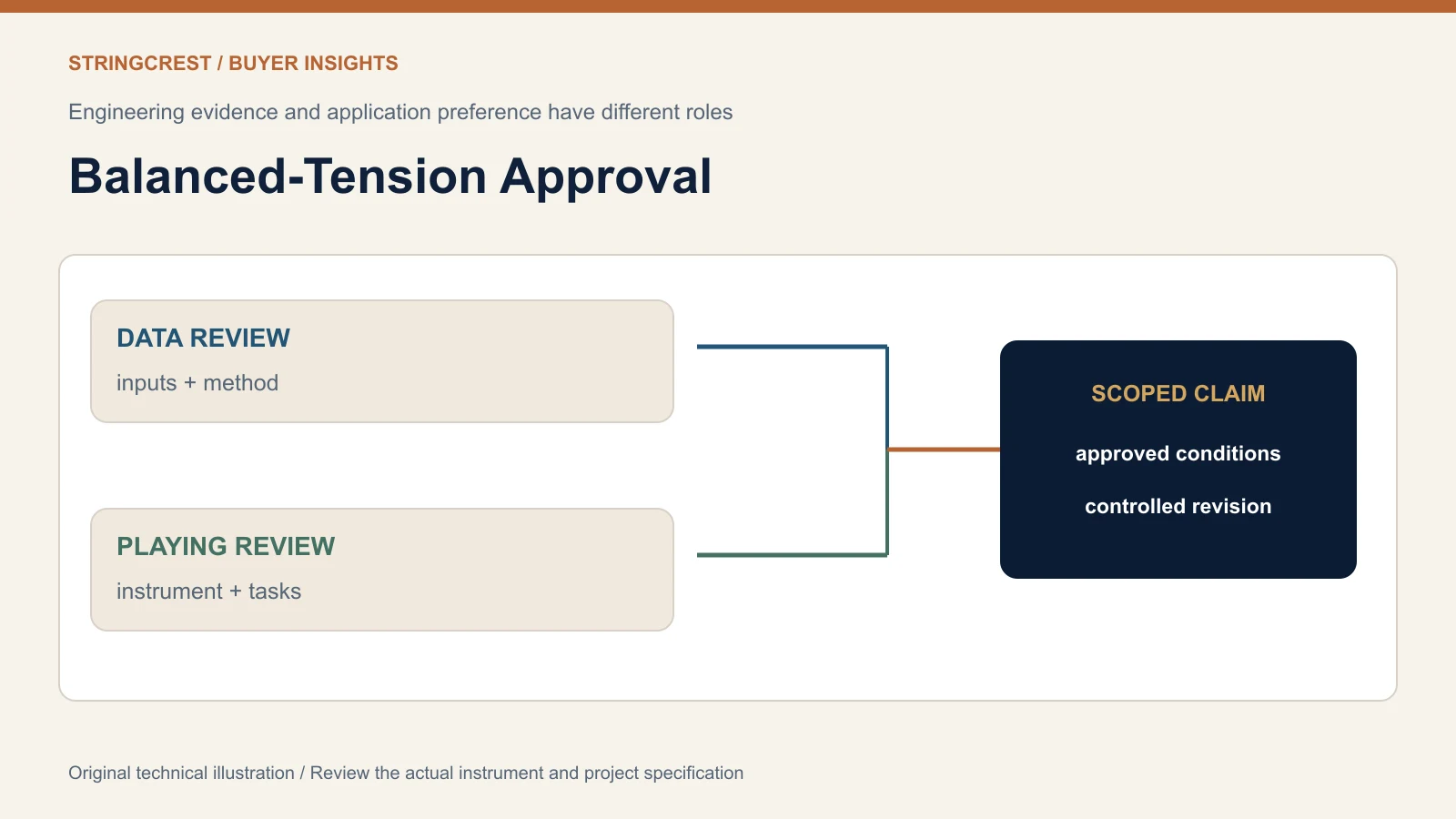
Use separate engineering and application records
Engineering review
Record the input sources, equations or measurement method, force units and target distribution. Check calculations independently and investigate inconsistent values. Do not let a positive playing comment resolve a missing construction input.
Application review
Ask reviewers to describe picking response, transitions between positions, fretting comfort and the relevant bend or passage. Identify the reviewer and instrument conditions. A rating can summarize a preference if its scale is explained, but it is not a force measurement.
Release decision
State which requirements passed and which need further work. A project can have a coherent numerical target while the customer prefers another feel. That is useful development information, not a contradiction to hide by changing the meaning of “balanced.”
The two records help departments use the right evidence. Engineering can check the physical definition, while marketing receives a description that the application review actually supports. Purchasing retains the approved component revision connecting both.
Evaluate the plain-to-wound transition deliberately
The transition between a plain string and a wound string is a useful place to focus sample questions. Review it during comparable passages rather than relying on a single isolated note. Ask whether the change in response is acceptable for the intended set role.
Record the construction of the third position explicitly when relevant. A plain or wound alternative changes the component being evaluated, even if both options carry the same pitch label. It also deserves a fresh calculation basis and an installation review.
The plain versus wound G guide addresses that specification choice in more detail. In a balanced-tension project, the important step is to keep the chosen construction tied to its own data and sample, rather than mixing assumptions across alternatives.
Do not promise that matching numerical values eliminates every transition a player can notice. The approval question is whether the confirmed set meets the agreed engineering definition and application aims, with the limits stated honestly.
Recheck alternative tunings and different scales
A balance established for one tuning need not remain the same when particular positions are retuned. Review the new conditions before describing the set as balanced for that configuration. Retuning only one position can change the distribution even when the other components remain unchanged.
For a different speaking scale, evaluate the relevant inputs again. If the project includes different lengths by position, as on some instruments, the worksheet should reflect each position's length. A single copied scale value would misdescribe the intended geometry.
Do not confuse this with supplied-length compatibility. A string can reach the tuner while still having a different installed tension under the new conditions. Our electric string length guide separates those measurement questions.
Create a defined compatibility scope rather than a catch-all list of genres or guitar types. Dealers should be able to identify which tuning and instrument conditions the information describes.
Approve a claim before designing the packet
Decide whether the packet will state a numerical property, a qualified design intention or a customer application direction. Each requires different support. “Designed to bring position tensions closer together at the stated tuning and scale” is more specific than an undefined balance slogan.
If numeric values are published, include the applicable units and conditions in an accessible specification record. Keep the label consistent with that record. A packaging shorthand should not suggest laboratory verification when the values are calculated from a model.
Avoid borrowing claims about control, endurance or playing speed from another brand's product page. Those outcomes require their own evidence for the relevant product and audience. Numerical tension proximity alone does not establish them.
The artwork proof should identify the correct revision and intended configuration. Check that an attractive “balanced” badge has not survived after a construction change invalidated the original data. Commercial language needs the same change control as the product drawing.
Preserve the design basis through reorders
Archive the approved set identity, component records, calculation sheet and application observations. Keep packaging artwork linked to the same revision. A future reorder should specify more than the familiar first and last gauges.
Ask which changes require a new review. Altered core or wrap construction, substituted components or a different intended tuning can affect the previous basis. Agree notification and sample requirements with the supplier rather than assuming unchanged outside diameter means unchanged behavior.
At receiving, verify the delivered set and any agreed inspection records. If a numerical test forms part of the order plan, specify its method and scope. A quick playing impression may be helpful for application sampling but cannot replace a defined engineering check.
Dealer feedback should distinguish a feel preference from a discrepancy against the approved specification. That separation supports useful range decisions without treating every subjective comment as a manufacturing nonconformity.
FAQ
Does balanced tension mean all strings have the same gauge?
No. Different pitches and constructions can require different components to approach a defined tension distribution. The full position sequence is essential; equal diameters do not establish equal tension.
Can a gauge chart prove a custom set is balanced?
Only when its inputs and conditions apply to the actual components. A chart for another construction is a reference, not verification. Confirm the data source, speaking scale, pitch and method.
Will equal tension make every string feel identical?
Do not assume that result. Playing feel involves the string and instrument system and the task performed. Evaluate relevant passages separately from the numerical tension record.
Can the same set be called balanced in any tuning?
The claim should identify its conditions. Retuning individual positions can change the distribution, so alternative configurations need their own review before the scope is expanded.
Should a supplier provide measured or calculated values?
Either can be useful when correctly identified and relevant to the approval requirement. Ask for the method and limitations. A calculated result should not be described as a measured factory test.
What should an OEM RFQ contain?
Provide all positions, intended pitch, scale, construction aims, available reference data and the balance definition. Include a sample-evaluation plan for the playing experience and the intended packaging statement.
Conclusion
Balanced tension is useful when it describes an agreed physical aim under explicit conditions. Its value for a private-label project comes from complete inputs, a position-by-position review and an application assessment that remains distinct from the calculation.
Avoid allowing one adjective to stand in for the specification. Preserve the sample revision and publish only the scope supported by the engineering and playing records. That gives dealers a clearer explanation and purchasing a dependable reorder reference.
Review electric guitar string options and Send Your Requirements with your tuning, scale and six-position brief. Custom specifications and packaging can be discussed against the customer requirements agreed for the order.
Sources and interpretation limits
- OpenStax: standing waves and resonance supplies the ideal-string physics background, not a full model of guitar playing feel.
- D’Addario balanced-tension explanation is a manufacturer-specific example of the term.
- String Tension Pro supports calculations for its stated inputs and products.
The worksheets and approval recommendations are original buyer guidance. No numerical tension result, production tolerance or StringCrest balanced-tension SKU is asserted here.
FROM GUIDE TO PRODUCT
Connect this guide to Electric Guitar Strings.
Review the relevant range, then bring the instrument, complete specification and open questions into one project brief.
YOUR PRODUCT · YOUR BRAND
Discuss your next string project with Frank.
Share your instrument category, target market, gauge or material direction and private-label packaging requirements.

ABOUT THE AUTHOR
Frank Zou
Frank works directly with musical-instrument brands, importers and distributors on string specifications, product selection and private-label project requirements.
Meet Frank