
Product Selection
Product Selection
12-String Electric Guitar Strings: A Wholesale Course-Pairing and Gauge Guide
A wholesale framework for mapping six courses and twelve positions, approving installed samples and keeping course order clear in packaging.

Introduction
A set of 12-string electric guitar strings is not simply a six-string pack doubled. It contains twelve positions arranged as six courses, and each course needs a defined musical relationship. Lower courses commonly combine a fundamental string with a lighter octave string, while upper courses may use unison pairs. The exact pitches, gauges and order must be written into the product specification rather than inferred from a photo or a first-to-last gauge label.
For wholesale buyers, the challenge extends beyond gauge selection. The pack must preserve course order, identify the two positions in each course, fit the intended scale and bridge path, and help the player install the octave and fundamental strings correctly. A sample plan must also test intonation, nut and bridge space, tuner routing and the combined load direction on a reference instrument.
This guide shows brands, distributors and product managers how to specify a twelve-string electric set without turning a market convention into an unsupported universal rule. It covers pitch mapping, plain and wound decisions, gauge comparison, packaging, installed samples, inspection and RFQ structure. It does not publish a StringCrest twelve-string formula, compatibility list, MOQ, capacity or delivery time. Confirm those details in the current technical review and quotation.
Start with six courses and twelve named positions
Map each string before comparing sets
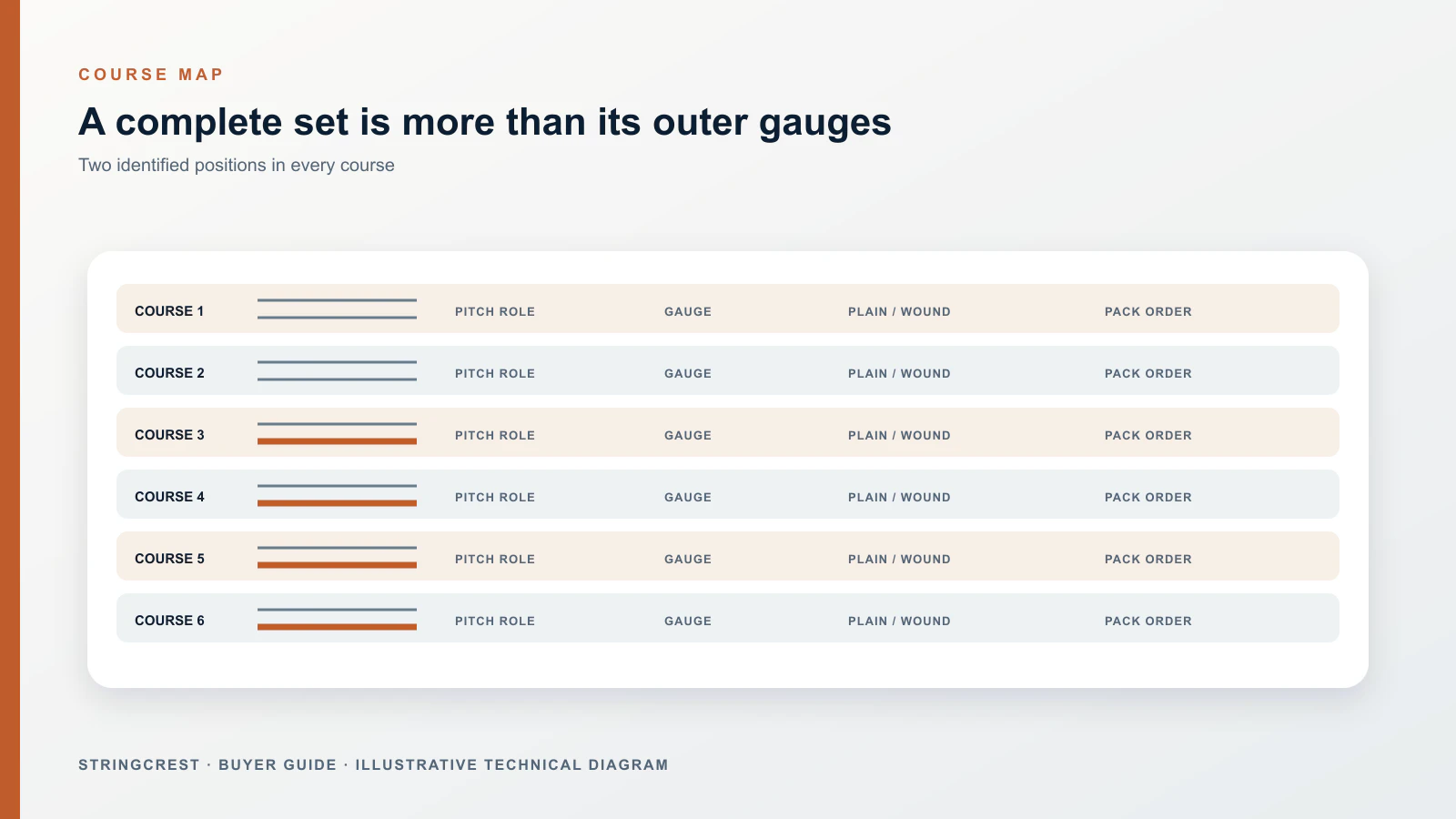
Create a table with Course 1 through Course 6, then give each course two rows. Record the target pitch, octave or unison relationship, gauge, plain or wound status, material, end, length and installation order for every row. This avoids a common ambiguity: two packs can carry similar outside gauge ranges while using different octave gauges or wound-position choices.
Many conventional twelve-string tunings use unison pairs for the highest courses and octave pairs for lower courses. That is a useful starting point, not a substitute for the product master. State the pitch in scientific notation or another consistent system so the supplier and artwork team do not interpret “high E” differently.
Define what the player sees during installation
Installation order can vary with the guitar’s bridge, headstock and tuner layout. The pack should not assume that every instrument places octave strings on the same physical side. Provide a course map, a position code and a gauge list that remain clear even when the player’s guitar routes strings differently.
Use separators or envelopes labeled by course and role, such as “Course 4 octave” and “Course 4 fundamental.” Color coding can help, but text and gauge identification must remain sufficient for users who cannot distinguish the colors or who open the pack in low light.
| Specification field | Required entry | Problem prevented |
|---|---|---|
| Course | 1–6 | Mixing strings from adjacent pairs |
| Role | Unison, fundamental or octave | Incorrect pitch assignment |
| Target pitch | Exact note and octave | Tuning the light string to the wrong register |
| Gauge | Every one of 12 positions | Hidden middle-string substitutions |
| Build | Plain or wound | Intonation and feel surprises |
| Order code | Pack and diagram reference | Installation confusion |
| Length/fit | Bridge path and tuner reach | Incomplete or excessive winding length |
Compare gauge tables position by position
Use published market sets as examples, not templates
D’Addario’s official EXL150 page provides one real-world twelve-position gauge sequence, while Ernie Ball publishes other twelve-string electric examples. These sources demonstrate how major manufacturers disclose complete sets. They do not establish one correct formula and do not confirm a StringCrest specification.
When benchmarking, transcribe each published set into the same twelve-row format. Compare the fundamental and partner string in every course. Do not compare only the lightest and heaviest gauges because the octave positions determine much of the set’s internal logic.
Keep units and construction visible
State gauges in inches, millimeters or both, using a consistent precision. Mark every wound position. Two strings with the same nominal outside diameter can behave differently if their core and wrap relationships differ, so retain material and construction fields even when the gauge table looks complete.
The transition between plain and wound positions deserves attention. A heavier fundamental may be wound while its octave partner is plain, and neighboring courses can use different combinations. The final pack needs to match the approved sample exactly.
Separate regular twelve-string and high-strung concepts
A high-strung set is not a complete twelve-string set
A Nashville or high-strung concept typically supplies the higher member of selected courses for a six-string guitar. It can create a bright layered part in recording or performance, but it does not replace the twelve positions required for a twelve-string instrument.
This distinction matters in product naming, quotation and packaging. A buyer searching for a complete twelve-string set should not receive a six-string high-strung pack, and a retailer should not have to infer the difference from gauge numbers alone. Use “12-string electric set” only when the pack contains the complete approved twelve-position architecture.
Keep related products in separate masters
If a range will include both a full twelve-string set and a high-strung set, assign separate item codes, gauge tables, artwork and sample approvals. Shared strings can be linked in the component records, but the packs have different installation contexts and customer expectations.
This separation also improves inventory accuracy. A missing octave single in a full set is a quality problem; a six-position high-strung pack is intentionally different. Clear masters prevent those identities from being confused during pack-out.
Review tension direction across paired courses
Gauge alone does not calculate the result
String tension depends on pitch, vibrating length and unit weight. Gauge contributes to unit weight, but construction matters too. An octave string may be much lighter than the fundamental because it is tuned higher, yet the desired relationship cannot be read from gauge alone.
Use verified unit-weight data for the intended construction when available. Apply the same scale and pitch assumptions to every position, then inspect each course and adjacent course transition. If exact unit-weight data is unavailable, label the calculation as directional and rely on installed samples for approval.
Consider the load on the complete instrument
A twelve-string guitar carries twelve strings, so the complete set’s load direction differs from a six-string set. Do not recommend a heavier custom sequence without considering the reference instrument, setup and maker guidance. Changes may affect neck relief, nut slots, saddle compensation and intonation.
The objective is not to advertise one total-tension number. It is to build a documented configuration for the intended instrument and tuning, then verify fit and playability under controlled sample conditions.
Check scale, bridge and tuner routing
Measure the complete installed path
Record the nut-to-saddle scale, ball-seat-to-saddle distance, bridge route and ball-seat-to-tuner distance for representative positions. Some electric twelve-string guitars use through-body routes; others use top-loading bridges or specialized tailpieces. The string needs sufficient usable length without placing an unsuitable taper or twist inside the speaking path.
At the headstock, twelve tuners may be arranged in six-per-side, inline or compact configurations. Record tuner-post hole size and the intended number of wraps, especially for heavier wound fundamentals. Do not generate product imagery with missing tuner holes or an incorrect number of posts; installation visuals must represent all twelve positions or use a neutral diagram without hardware.
Treat nut and bridge spacing as sample checks
Paired courses need suitable spacing at the nut and bridge. Gauge changes can alter how the two strings sit in their slots, and octave/fundamental combinations can expose intonation limits. Note any setup intervention required during the sample installation.
A string supplier can help define the string specification, but broad guitar compatibility also depends on instrument hardware and setup. Packaging should advise users to confirm fit and seek appropriate setup support when changing materially from the reference gauges.
Design an installed sample protocol
Use one identified baseline and controlled revisions
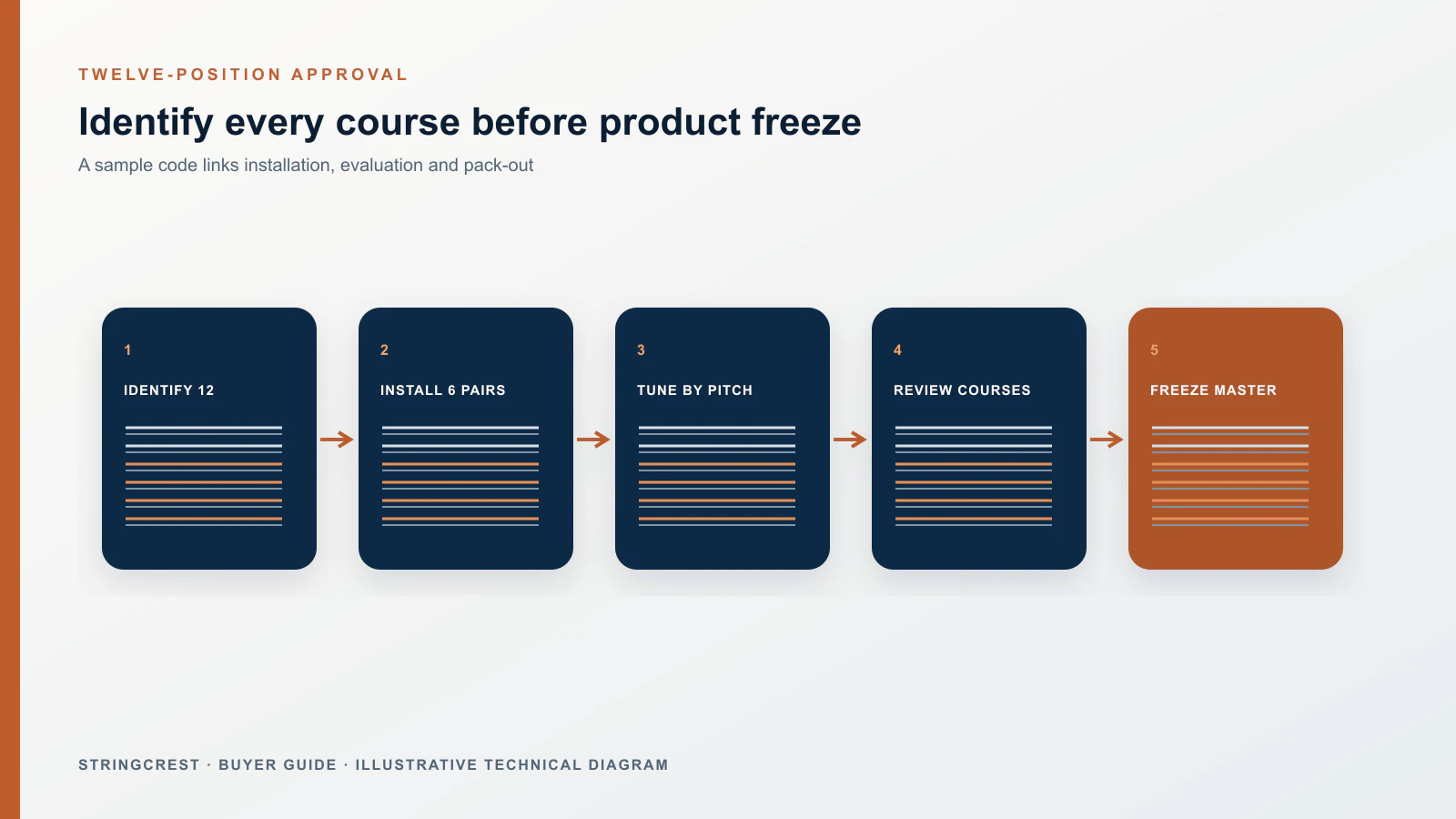
Begin with a complete documented set that already fits the reference guitar. Sample B may change one course family or one construction direction. Sample C can refine the result after the first review. Avoid changing every octave gauge, material and winding detail simultaneously, because the team will not know which change caused the observed difference.
Each sample needs a revision code on the strings’ separators, outer pack, evaluation sheet and photographs. Record the scale, bridge, tuner layout, setup state and installation date. Preserve the exact gauge table used during evaluation.
Evaluate course behavior, not just individual strings
Tune carefully to the intended pitch and allow the installed set to stabilize using normal procedures. Check whether each course can be identified and tuned without confusion. Review intonation, nut and saddle contact, tuner wraps, unison/octave relationship, chord definition, single-note picking and the transition across courses.
Feedback should name the course and task. “Course 5 octave feels too resistant in the reference tuning” is actionable. “The set is unbalanced” is not, unless the evaluator defines the comparison and conditions.
Build packaging around course clarity
Print the complete twelve-position gauge sequence
The customer should not have to guess which string belongs to which course. Show all twelve gauges in course order, with plain/wound status or clear visual grouping where useful. State the material and construction accurately, and identify whether pairs are intended as unison or octave relationships for the approved tuning.
A first-to-last label such as “10–46” can help shoppers compare ranges, but it cannot replace the full sequence. Multiple strings can share or approach the same gauge, making course labels even more important.
Make inner packing resistant to mix-ups
Consider separate envelopes, paired sleeves or a numbered sequence that keeps each course together. The pack-out instruction should specify which component goes into each position. Barcode and item-code checks should connect to the exact twelve-position master, not a generic family name.
Dealer material can include a simple installation map and an explanation of full set versus high-strung set. Avoid unsupported statements such as “fits every twelve-string electric,” “requires no setup” or “perfectly balanced tension.”
Plan replacements and wholesale inventory
Decide whether octave singles will be supported
Twelve-string players may need replacement singles, particularly for lighter octave positions. A B2B range plan should decide whether singles, course pairs or only complete sets will be offered. The choice affects product codes, dealer guidance and stock depth.
Map shared components carefully. A plain string may appear in more than one pack, but it should be treated as shared only when gauge, material, end, length and other controlled details match. Similar appearance is not enough.
Limit launch breadth until the base set is stable
One well-documented regular set can be more useful than several poorly differentiated gauge variants. Begin with the target customer and reference instruments, approve the base architecture, then use evidence from dealer requests and sample evaluation to decide whether lighter, heavier or alternate-tuning versions are justified.
This phased approach reduces artwork, component and pack-out complexity while the team learns which positions create the most customer questions.
Inspect shipment identity and pack-out
Use a twelve-position count and identity check
Receiving inspection should verify item and lot codes, outer pack condition, twelve-string count, course labels, complete gauge sequence, ball-end appearance and selected dimensional checks defined in the agreement. A count of twelve alone is insufficient if one octave string is duplicated and another is missing.
Use a position checklist and keep sampled sets separated after opening. When installed fit is a receiving control, use the defined reference guitar and record the revision and inspection result.
Do not treat visual inspection as material proof
Photographs can show pack condition, labels, ball ends and obvious winding differences. They do not prove alloy composition, core ratio, exact tension or service life. Use supplier documents or suitable testing when a claim requires that level of evidence.
Shipment inspection confirms conformance to the approved master. It should not silently redefine the product after production has begun.
Prepare a twelve-string electric RFQ
A complete request should include:
- full twelve-string electric set or separate high-strung concept;
- six courses and the two exact pitches in every course;
- twelve gauges with units and plain/wound status;
- scale, bridge route, tuner layout and reference guitar;
- core, wrap, material, treatment, ball end and usable length needs;
- installation order and course-labeling method;
- baseline set, controlled sample changes and evaluation tasks;
- packaging, artwork, barcode, separators, case pack and traceability;
- replacement-single or course-pair support requirements;
- request for current sample terms, MOQ, lead time and quotation validity.
Where the buyer needs a supplier recommendation, mark it as a proposal field. Review and approve the proposed position before it becomes the pack specification.
FAQ
Are twelve-string electric sets just two six-string sets?
No. They use six paired courses with defined unison or octave roles. The octave gauges, pitch map and installation labels make the product a distinct twelve-position set.
Is a Nashville high-strung set the same as a twelve-string set?
No. A high-strung set is generally a six-position concept used on a six-string guitar. A complete twelve-string pack must contain and identify all twelve approved positions.
Can the package show only the lightest and heaviest gauges?
That is inadequate. Publish the full twelve-position sequence so buyers can understand every fundamental and partner string.
Does one gauge sequence fit every twelve-string electric guitar?
Do not assume so. Scale, bridge route, tuner layout, nut slots and setup differ. Approve the set on representative instruments and communicate the verified fit basis.
Should the octave string always be installed on the same side?
Instrument layouts and player conventions can differ. The pack should identify course and pitch clearly without relying only on a universal left/right instruction.
How should a shipment be checked for missing positions?
Use a twelve-row course checklist tied to the approved product master. Verify count, labels and selected gauges or dimensions according to the agreed inspection plan.
Conclusion
A wholesale twelve-string electric set succeeds when every course is explicit. The product master must connect twelve pitches, gauges and constructions with the intended scale, bridge, tuner path and packaging order. A first-to-last gauge label cannot carry that information.
Controlled samples reveal whether the course relationships, fit and setup support the target use. Clear separators and pack diagrams then preserve the approved identity from production to installation.
Explore StringCrest electric guitar strings · Send your twelve-string electric set brief
Sources and interpretation limits
- D’Addario EXL150 twelve-string electric set example
- D’Addario EXL150H high-strung/Nashville set example
- Ernie Ball 8- and 12-string electric set collection
These official pages document examples from their respective manufacturers. They do not define a universal twelve-string formula or confirm StringCrest gauges, construction, fit, availability, performance, MOQ, capacity or lead time. Use the current project specification, quotation and approved sample as the controlling sources.
FROM GUIDE TO PRODUCT
Connect this guide to Electric Guitar Strings.
Review the relevant range, then bring the instrument, complete specification and open questions into one project brief.
YOUR PRODUCT · YOUR BRAND
Discuss your next string project with Frank.
Share your instrument category, target market, gauge or material direction and private-label packaging requirements.

ABOUT THE AUTHOR
Frank Zou
Frank works directly with musical-instrument brands, importers and distributors on string specifications, product selection and private-label project requirements.
Meet Frank