
Materials & Construction
Product Selection
Electric Guitar String Ends and Bridge Fit: An OEM Buyer’s Checklist
Document bridge paths, standard ball ends and fit testing before approving an OEM electric-string pack.
Introduction
An electric-guitar string can be correct in alloy and gauge yet fail at the bridge. End construction, the path through the instrument and usable string length are part of the specification, not finishing details. Most conventional sets use a ball end, but special bridge systems may require a different geometry. A buyer who requests only “10–46 nickel-plated strings” leaves the supplier to guess which end, string path and instrument the set must fit.
This guide gives OEM and private-label buyers a practical way to document that fit before they approve artwork or place a repeat order. Fender describes how string-through-body and stop-tailpiece installations differ, and its Bullet end is a proprietary design rather than another name for the ordinary ball end. D’Addario lists double-ball strings for a particular application. These examples establish that end types exist; they do not mean StringCrest offers every variant or that one design performs better on every bridge. Confirm the proposed end construction and the actual target instrument for each project.
Identify the bridge before requesting an end
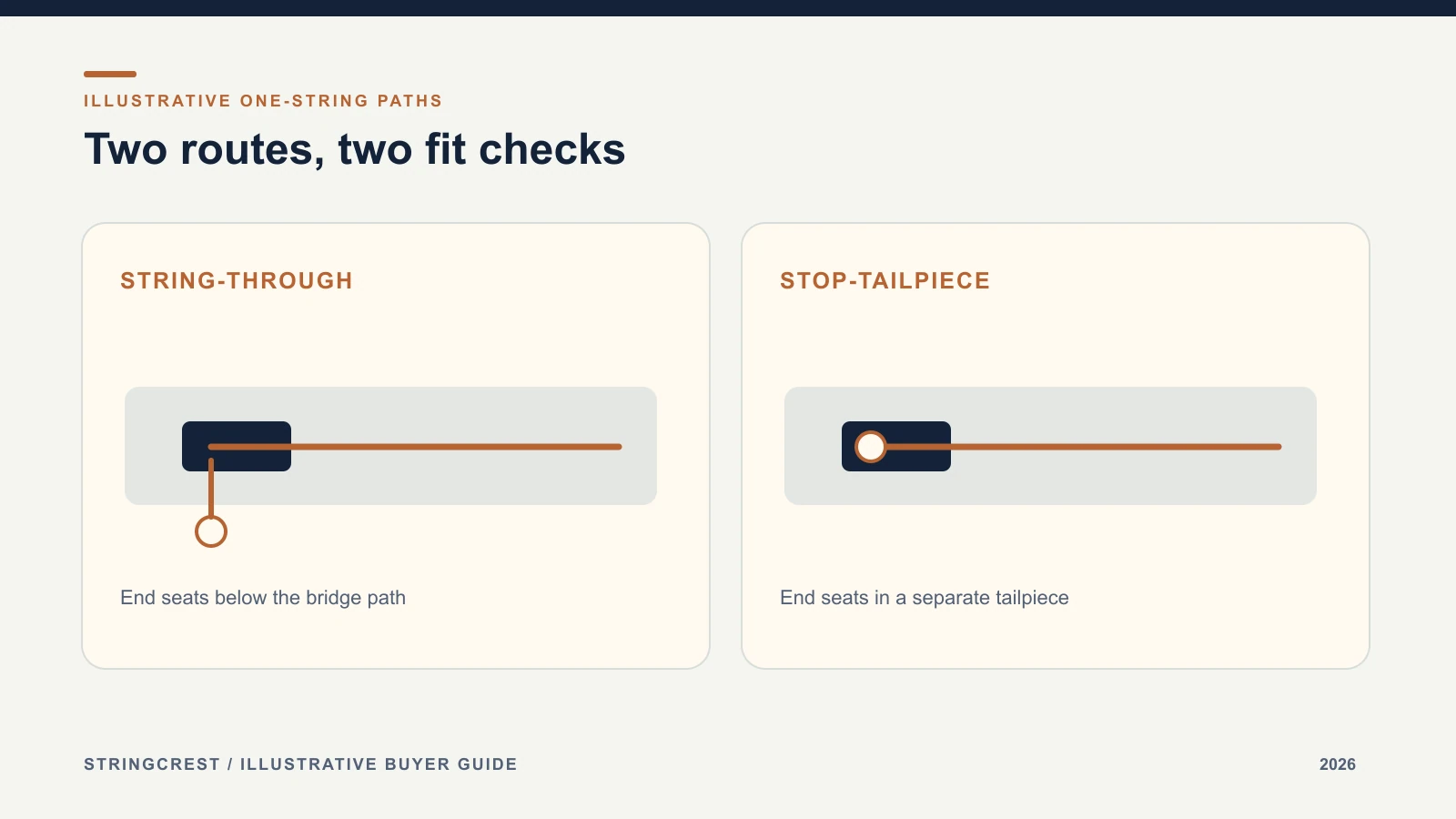
A set specification should begin with the instrument. “Six-string solid-body electric guitar” narrows the field but does not describe how strings are retained. A string-through bridge feeds the string through the body or block and captures the end at a specific point. A stop-tailpiece holds the end in a separate tailpiece behind the bridge. Some tremolo systems bring the string through a block; other systems clamp or lock it. The buyer does not need to become a repair technician, but the RFQ must show the string path the end will actually follow.
The most useful input is a clear photograph of both sides of the bridge, accompanied by a model reference and a marked path for one representative string. Include the point where the end seats, the distance to the nut and the tuner layout. If the instrument maker has a stringing diagram, attach it rather than describing the bridge from memory. A pack designed for a generic fixed bridge may be inappropriate for an unusual locking or headless arrangement, even if its gauge is familiar.
| Instrument detail to capture | Buyer question | What can go wrong if omitted |
|---|---|---|
| Bridge retention | Where does the string end physically seat? | Wrong end geometry or poor fit. |
| String path | Through body, tailpiece, block or clamp? | Insufficient usable length or an incorrect pack claim. |
| Tuner route | Conventional post, locking tuner or other system? | Cut length and installation assumptions differ. |
| Scale and count | How many positions, and what is the instrument scale? | Gauge/tension and pack identity may be wrong. |
| Service reference | Can a technician confirm installation? | Sample approval becomes a visual guess. |
Do not assume the end seen on a competing pack is interchangeable. Compatibility depends on the actual cavity, channel, retaining feature and setup. Ask the instrument maker or a qualified technician when a fit is uncertain. A buyer should not promise universal fit for a non-standard bridge in a marketplace listing.
Understand the common and special formats
Standard ball ends are a specific construction
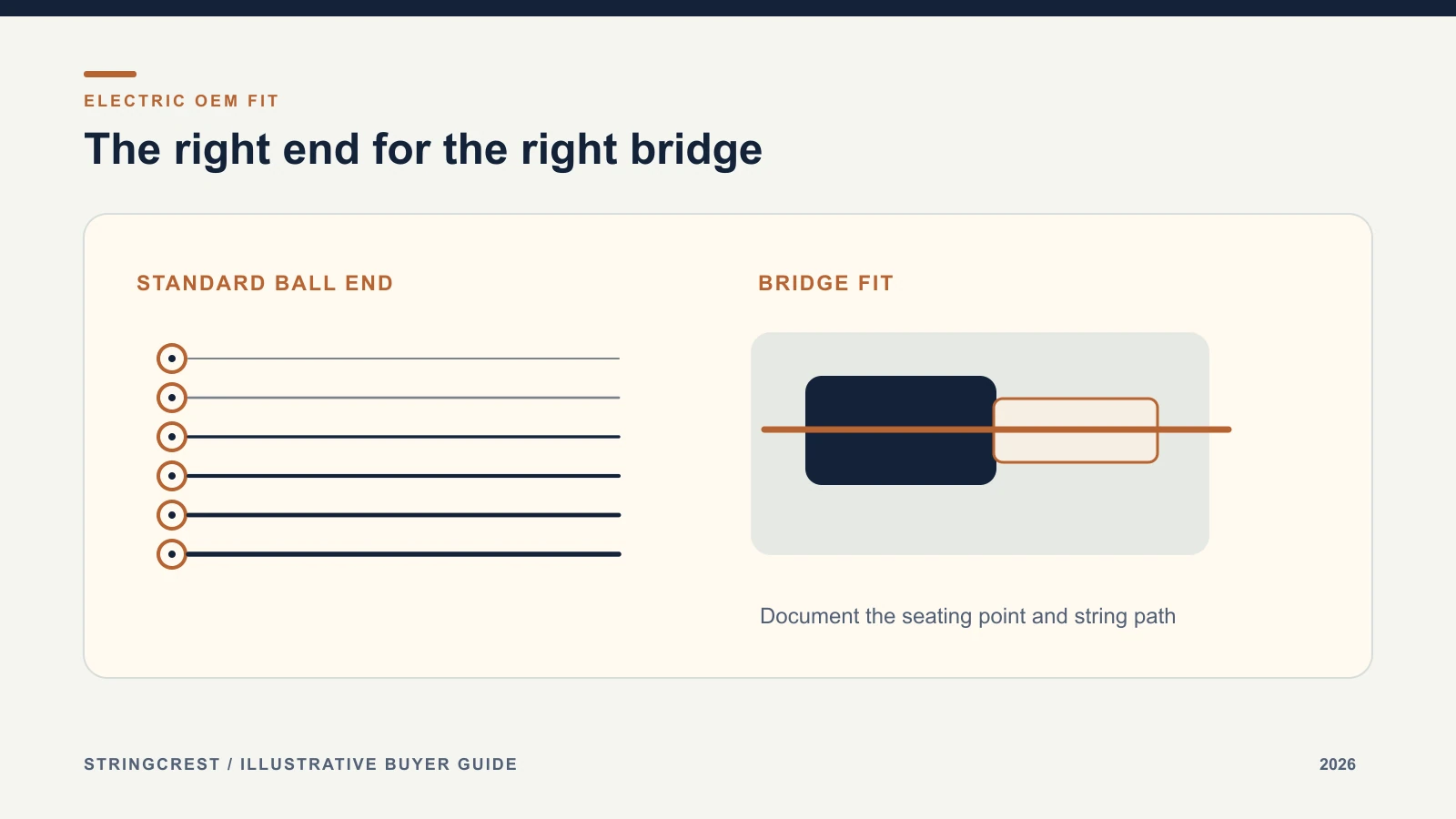
A conventional electric-guitar ball end uses a small metal anchor captured by the string’s loop or wrap. It is familiar on many electric guitars, but “ball end” is still too vague for a rigorous order. A supplier may need to confirm the anchor shape and dimensions, loop or twist workmanship, the beginning of the wound section and the length from the seated end to the tuner. Ask how each position is identified and whether the proposed end passes the target bridge without forcing or sticking.
For a comparison sample, inspect an unused end under magnification and then install it on the intended instrument. The anchor should seat where the bridge design expects it to seat. It should not snag during removal or leave a twist resting at a stressed bend point. These are sensible evaluation checks, not claims about an undisclosed StringCrest process or a substitute for an instrument maker’s requirements.
Bullet and double-ball are not generic synonyms
Fender’s Bullet design has a bullet-shaped termination. Fender describes it in relation to certain tremolo hardware and distinguishes it from an ordinary ball end. Its marketing claims and proprietary geometry should stay attributed to Fender. A buyer cannot write “Bullet” on a StringCrest RFQ and assume that an identical design is available, licensed or needed. The correct question is whether the target bridge requires a specified geometry and whether a supplier can lawfully and reliably provide the requested format.
Double-ball strings place an end at both sides of a string for compatible instruments. D’Addario’s ESXL110 is an example of a product described as a double-ball-end electric set. That does not make a double-ball end a universal upgrade. It changes the set’s installation logic, length and instrument compatibility. If a customer requests this format, obtain the precise instrument model and maker’s requirements before a quote. Do not advertise a conventional ball-end SKU as compatible merely because the gauge matches.
Use the double-ball end and headless fit guide to prepare the fit questions for that format.
Other systems may use clamps or require cutting off an end during installation. In those cases the buyer should confirm the maker’s procedure and whether the string will still be long enough after the cut. A special instrument can also impose limits on where the wound section starts. Fit documentation should be specific enough that a technician can reproduce the installation without improvising.
Make a bridge-fit reference sheet
A single page of measurements and pictures can prevent a costly ambiguous quote. Start with the target guitar's model, bridge type and scale length. Photograph the end seat with one string removed and a second view showing the path to the tuner. Mark the measurement origin: from the seated anchor, not from the outside of a decorative bridge cover. Record the ball-to-nut distance and the extra length needed for safe tuner winding or the specific locking procedure. If the end must pass through a narrow channel, record the channel size or the instrument maker's stated limit.
Do not measure the whole string coil on a table and conclude it will fit. A packaged length is only one value. The winding termination must also land in an appropriate place, especially when a buyer changes scale, bridge style or tuner geometry. What counts as appropriate depends on the instrument and how the string is designed. Ask for a sample and confirm on the actual guitar before defining a production tolerance.
The sheet should contain a revision code. If the instrument model changes, the old fit approval should not silently migrate to the new guitar. A bridge variant introduced in the next model year could make an earlier length assumption wrong. Product management, sourcing and artwork need the same revision so the package claim matches the instrument used to approve the sample.
Separate fit from tone and gauge decisions
The end is only one part of an electric string, but it is easiest to assess when other variables are controlled. If the buyer compares a standard ball end and a special end, keep the same finished gauges, intended tuning, core/wrap design and instrument setup where possible. Otherwise a change in feel or response cannot be attributed to the end. More importantly, the first acceptance criterion should be physical compatibility, not a subjective sound preference.
For a six-string set, list every position from high E through low E. If a seven-string instrument is involved, add the seventh position and revise all length and packaging records. Do not repurpose a six-string product photo to imply a seven-string configuration. A 10–46 shorthand specifies outside diameters for one common six-string idea; it does not define the inner gauges, end geometry or length. Those fields belong in a six-row technical schedule.
If the customer wants a performance comparison, ask what result matters: smooth installation, stable seating, quick service removal, resistance to premature breakage at the end or another observable property. Then agree a method with the buyer and supplier. A statement such as “better sustain” or “perfect tuning stability” is not supported by a single installation photo. If numerical results are wanted, define the instrument, test cycle, acceptance threshold and sample size first. Leave unsupported claims off the package.
Run an installation trial that a buyer can repeat
Pre-installation checks
Give each sample set an identifier and keep its sealed packaging until the test. Compare the six position labels with the specification, check the end style, and inspect visible damage. Use an instrument that represents the intended sales claim. Record its bridge, scale, tuning, current setup and any existing wear that could affect the result. A scratched saddle or a burr in a bridge channel can damage a good string and should be noted before it becomes a supplier complaint.
The installer should follow the instrument maker’s procedure, not a generic online shortcut. Fender’s string-change guide distinguishes string-through and stop-tailpiece routes; that difference alone shows why the path cannot be inferred from gauge. Keep hands, tools and photographs clear enough to verify where the end seats. If a string must be bent sharply or forced through a channel, stop the trial and investigate rather than declaring a pass.
Installation and removal observations
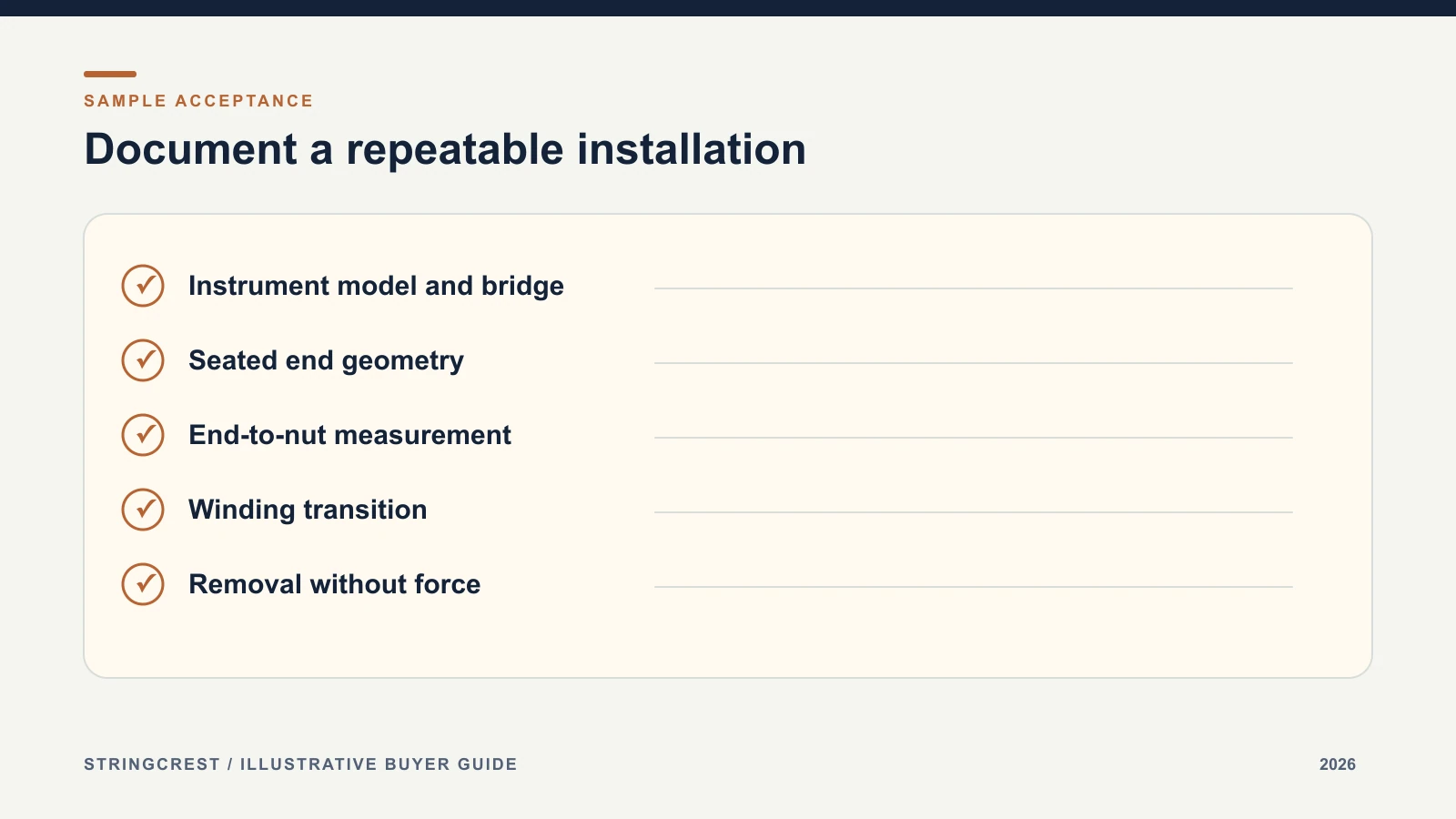
For every position, record whether the end passes through the bridge, seats correctly, can be tensioned without sliding into the wrong location and can later be removed without unusual force. Observe where the loop, twist and first winding land relative to contact points. Note any string end that hangs up during removal; serviceability is part of customer experience for a retailer or repair shop.
After installation, tune and play enough to identify immediate problems. Retune as the string settles. If a problem appears, isolate likely causes: bridge wear, nut slot, tuner post, wrapping procedure, gauge, or end fit. It is tempting to blame the last part changed, but a documented trial makes the decision more useful. The objective is to approve a reproducible specification, not to win an argument about one instrument.
An acceptance record with clear boundaries
The trial sheet can use pass, fail or unresolved for each position and each fit question. Attach close-up photographs of the seated end and of the full string path. State the pack revision and sample code. A passing sample on one guitar supports that defined application; it does not establish universal fit on all bridges marketed as the same type. If the proposed pack covers several instrument models, test each representative geometry or narrow the claim.
If a customer asks for a formal testing document, agree whether the deliverable is an internal installation record, a dimensional inspection or a third-party report. The title and method should match what was actually done. Avoid a decorative certificate that suggests a test or certification that has not been performed.
Write the RFQ and artwork around the approved fit
A concise RFQ should include instrument family, string count, tuning, full gauge sequence, core and wrap, coating decision, end construction, usable length, pack identity and the approved bridge reference. Put unknown choices in a “supplier proposal” column. Do not leave the product manager to infer them from an image.
For private-label packaging, the front can state the instrument type, six-string count, gauge family and construction. The back or online specification can provide full gauges and a compatibility note. If a set was approved only for a particular headless or double-ball system, that limitation belongs prominently on the listing. If it is a conventional ball-end set, say so plainly instead of implying compatibility with every proprietary tremolo. Accurate limitation text reduces wrong purchases and protects the dealer’s reputation.
The artwork proof should be checked against the sample and purchase order. Compare the end icon, terminology, barcode/product code, gauge schedule and customer support copy. If the end design changes after proof approval, the artwork must be reviewed again. A bridge-fit error can spread through cartons, digital listings and distributor databases quickly; a revision-controlled master record contains it.
Inspect the first shipment for identity and construction
A shipment inspection plan can start with carton and pack identity, then sample actual strings. Confirm the approved SKU, six positions, end style, visible end workmanship and length according to the agreed method. Examine pack seals and individual-string labelling so a service technician can select the correct position. Log sample size, batch identifier and exceptions. These are suggested controls to negotiate; they are not a claim that any specific historic StringCrest shipment passed them.
For dimensional acceptance, agree where length is measured from and how much variation is allowed. A measured value without a defined origin or tolerance is hard to use. A visual problem, such as a loose end anchor or a winding transition in the wrong place, may justify holding the lot even if the gauge sticker is correct. Keep a retained approved sample for comparison and document how nonconforming packs will be separated before distribution.
On repeat orders, ask to be told about changes in end component, attachment method, wire, winding or cutting length. A supplier substitution may be harmless, but it should not bypass the fit sample that justified the original label. Record whether the buyer accepted the change, requested another installation trial or created a revised SKU. This is particularly important when the range includes both standard and special bridge formats.
FAQ
Are ordinary ball-end strings suitable for every electric guitar?
No. Many conventional bridges accept them, but some instruments use another retention or length system. Confirm the target model and bridge path; test a sample rather than making a universal compatibility claim.
Is a Bullet end the same as a standard ball end?
No. Fender describes its Bullet as a distinct, proprietary termination. Its suitability and performance statements belong to that design and its intended hardware. A buyer should specify geometry and confirmed availability rather than use “Bullet” as a generic purchasing term.
When should an OEM buyer request double-ball strings?
Only when the target instrument or system requires that format. Obtain the instrument maker’s specification, including total length and the seating features at both ends. A standard ball-end sample cannot validate a double-ball package.
What photos should accompany a bridge-fit RFQ?
Include the whole bridge, the end-seat detail, the string path toward the tuner and any maker diagram. Mark the intended instrument model and measurement origin. A photo without scale or context can still leave a supplier guessing.
Can an installation trial prove better tuning stability?
A trial can document fit and immediate behaviour on named instruments. A comparative performance claim needs an agreed test method, controlled variables and enough observations to support it. Do not turn a single successful installation into a numerical or universal claim.
Conclusion
End construction belongs in the same controlled record as gauge, material and pack artwork. Name the target instrument, trace the bridge path, define how the end seats and where length is measured, then approve a physical sample on that bridge. Standard ball ends, Fender’s Bullet design and double-ball systems should remain separate concepts. Precise fit language helps an OEM buyer avoid an attractive set that a customer cannot install.
To discuss an electric-string range, send the instrument model, bridge photographs, gauge schedule and packaging brief. The response can focus on confirmed options for the actual application rather than assume that every special end type is available.
Sources
- Fender: The Easy Way to Change Your Electric Guitar Strings — string-through and stop-tailpiece installation examples.
- Fender: The Facts You Need About Fender Bullets Strings — manufacturer description of its proprietary termination; performance claims remain Fender’s.
- D’Addario: ESXL110 Double Ball End Electric Guitar Strings — maker-specific example of double-ball format.
FROM GUIDE TO PRODUCT
Connect this guide to Electric Guitar Strings.
Review the relevant range, then bring the instrument, complete specification and open questions into one project brief.
YOUR PRODUCT · YOUR BRAND
Discuss your next string project with Frank.
Share your instrument category, target market, gauge or material direction and private-label packaging requirements.

ABOUT THE AUTHOR
Frank Zou
Frank works directly with musical-instrument brands, importers and distributors on string specifications, product selection and private-label project requirements.
Meet Frank