
Range Planning
Product Selection
Drop C Electric Guitar Strings: A Private-Label Gauge, Scale and Setup Guide
A B2B framework for developing a six-position Drop C set through scale-aware gauge planning, controlled samples, setup review and accurate packaging.
Introduction
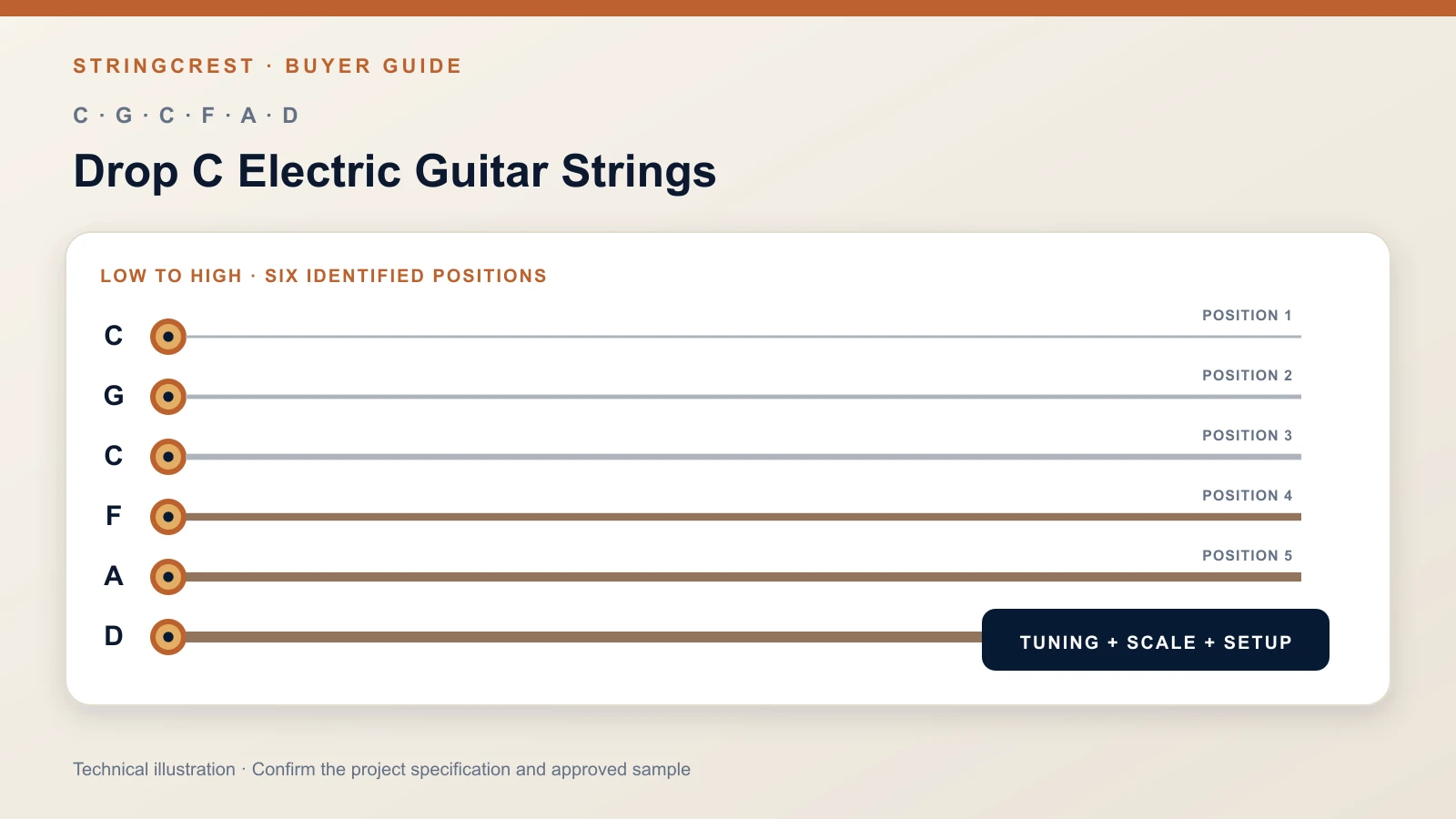
Choosing Drop C electric guitar strings for a wholesale or private-label range is a system-design task, not a request for “heavier strings.” The target tuning, six position gauges, scale length, string construction, nut and bridge fit, player reference and setup state all influence whether a sample feels coherent. A useful buying brief therefore begins with the actual low-to-high tuning—C, G, C, F, A, D—and records every string rather than concentrating only on the lowest C.
Drop C lowers every string one whole step from standard tuning and then lowers the sixth string an additional whole step. The lower pitch reduces tension when the same string and scale are retained. A buyer can compensate by changing gauges or construction, but gauge alone does not predict the final result: unit weight, core-to-wrap relationship, scale, action, relief and playing approach also matter. Published sets from established brands provide market reference points, yet their gauge sequences and construction data belong to those products and should not be copied as a universal StringCrest formula.
This guide gives brands, distributors and product managers a controlled way to define the range, request samples and evaluate installed results. It does not state a fixed StringCrest gauge recipe, instrument compatibility, MOQ, lead time, production capacity or verified performance claim. Those details require a current project specification, quotation and sample approval.
Start with the exact Drop C application
Write the tuning in position order
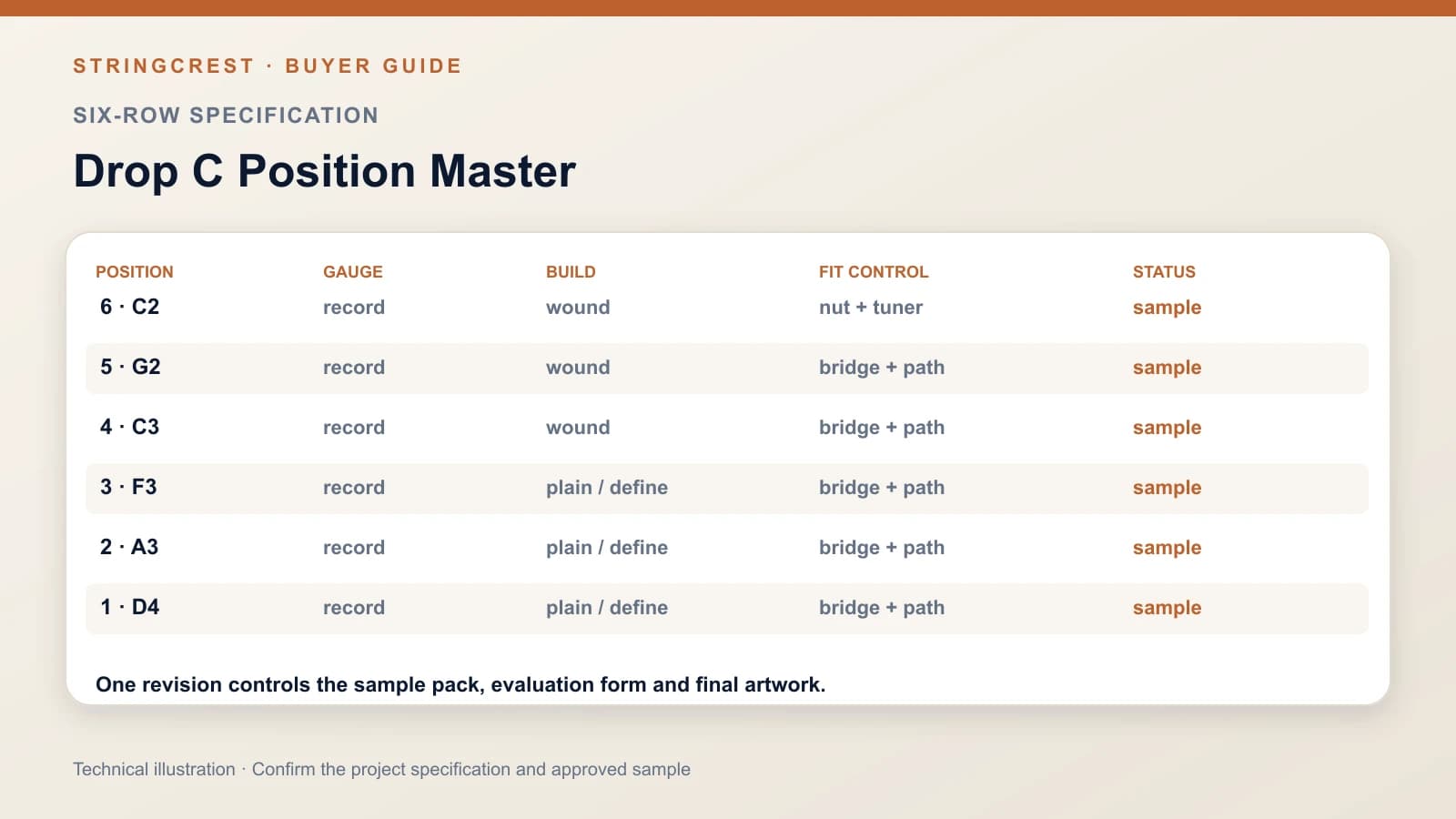
Use a six-row table and state pitches low to high: C2, G2, C3, F3, A3 and D4. Including octave numbers prevents confusion when a document passes between product, engineering, packaging and sales teams. It also distinguishes full Drop C from tunings that use the same words loosely or alter only one part of the set.
Record the reference scale, bridge type and intended guitar category. A conventional six-string solid-body guitar, a shorter-scale instrument and a longer-scale instrument do not place the same string under identical tension at the same pitch. Through-body and top-load routes can also change the required overall and winding lengths even when the speaking scale is similar.
| Position | Target pitch | Buyer should define | Installed check |
|---|---|---|---|
| 6 | C2 | gauge, wound construction, ball-to-tuner path | low-string feel, nut and tuner fit |
| 5 | G2 | gauge and transition from position 6 | bass-note separation |
| 4 | C3 | gauge and wound construction | chord and single-note balance |
| 3 | F3 | plain or wound direction if relevant | transition into treble positions |
| 2 | A3 | plain gauge and finish | bend and fretting reference |
| 1 | D4 | plain gauge and finish | top-string feel and intonation check |
The table is a starting format, not a recommendation that the same material or construction must be used for every project. The final six rows must match the proposed set and sample code.
Define the commercial job of the set
A Drop C product can serve several roles. It may be a dedicated alternate-tuning SKU, a heavier extension of a core electric range, a retailer-friendly set for players moving down from standard tuning, or part of a private-label collection built around specific scales. State which role is intended before debating individual gauges.
Dealers need a short, accurate reason to stock it. Product teams need to know whether the set should feel familiar to players coming from a current SKU or deliberately firmer. The sample brief should name the comparison set and intended difference without claiming one response is best for every player.
Understand what changes when pitch is lowered
Treat tension as a direction, not a slogan
For a given string and scale, lowering pitch reduces tension. Increasing unit weight or scale can raise it. That relationship explains why many lower-tuning sets use heavier gauges, but it does not justify selecting gauges by diameter alone. Two strings with the same finished diameter can have different unit weights because core, wrap and construction differ.
If verified unit-weight data are available for the proposed construction, calculate each position under the same scale and pitch assumptions. Keep those calculations labeled as design inputs until the actual sample is installed. If unit weight is unavailable, compare a supplier proposal with a known reference set and avoid publishing precise tension numbers.
Review adjacent transitions as well as the total. A set may have an acceptable overall feel while one middle position feels unexpectedly loose or firm. Drop C creates an especially important question between the lowest C and the fifth-string G because the sixth string is lowered farther relative to standard tuning than the other five positions.
Keep scale length visible in every comparison
Never discuss “the correct Drop C gauge” without a scale context. The same string tuned to the same pitch will behave differently when the vibrating length changes. Record the actual nut-to-saddle measurement on the test guitar and note whether the saddles are already close to the end of their adjustment range.
Confirm that the full-diameter section covers the speaking length, the ball seats correctly and the intended portion reaches the tuner. A gauge sequence does not resolve these fit questions.
Build a complete six-position gauge brief
Do not specify only first and sixth strings
“11–56” or a similar first-to-last label hides four decisions. Write all six gauges, units and plain-or-wound status. Then add target pitch, core direction, wrap material, winding style, coating or treatment if any, ball end, overall length and usable winding length.
This position master is the reference for samples, package copy and reorder inspection. Give it a revision number. When one gauge changes, issue a new revision instead of editing an old file without a record. A set described by only its endpoints can be packed incorrectly or evaluated against the wrong middle-string progression.
Use market examples as comparisons, not formulas
Official Drop C guidance and published string sets can help buyers see the range of commercial approaches. They show that brands may choose different gauge progressions for similar tuning language. Differences can reflect scale assumptions, construction, player preference and product positioning.
Use those examples to frame questions: Should the proposed set prioritize a familiar top-string feel? How firm should the low C be relative to the middle positions? Is the range aimed at rhythm work, mixed lead and rhythm, or a broader dealer audience? Then ask the supplier for a coherent proposal and document why each sample exists.
Competitor gauge tables are not evidence that an identical-looking StringCrest set will deliver the same result. Test the actual construction under the intended conditions.
Separate gauge, material and construction decisions
Change one major variable at a time
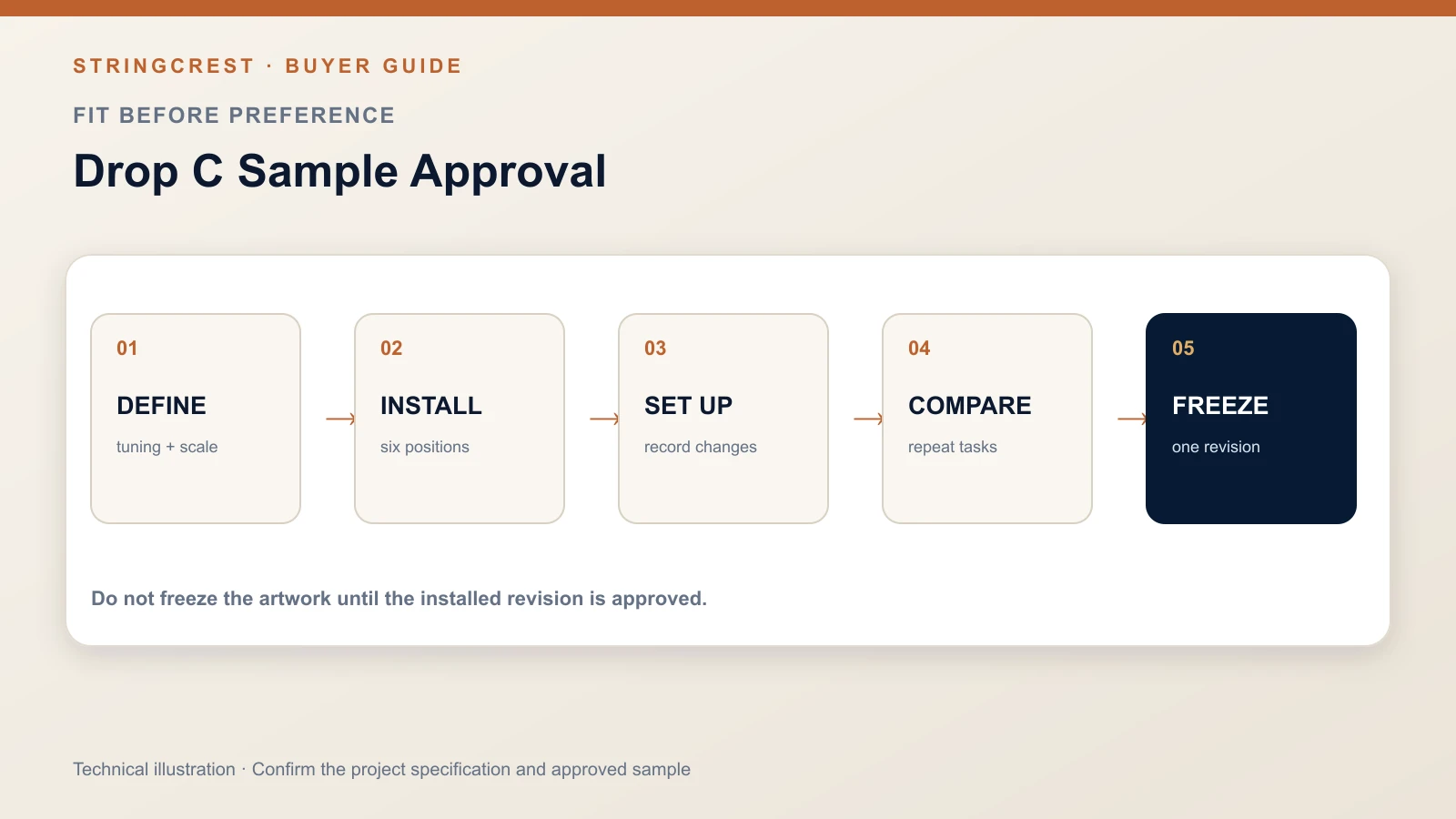
An efficient sample ladder begins with a documented baseline. A second sample changes the main variable under review, such as the lowest-string gauge or one middle-position transition. A third can refine the most useful direction. If gauge, core, wrap alloy and treatment all change at once, the feedback cannot explain which decision caused the difference.
Nickel-plated steel, pure nickel and stainless directions should be evaluated as distinct constructions. Roundwound, flatwound and other surface families also require their own product logic. The Drop C tuning does not automatically determine a material; material should support the intended range position and be declared accurately on the pack.
Be cautious with performance language
Words such as “perfect tension,” “maximum output,” “no fret buzz” or “universal Drop C fit” are not responsible specifications. Fret buzz and intonation depend on the guitar, setup, playing force and string. Output and response can differ with pickups, construction and technique.
Use claims that describe what is controlled: tuning target, complete gauges, stated wrap material, declared construction and verified fit basis. If a treatment is proposed, identify it accurately without assigning a life multiplier unless the final product and test method support that statement.
Plan the guitar setup as part of sample approval
Record the starting condition
Before installing a sample, document the reference guitar, scale, existing set, tuning, action, neck relief, nut condition, bridge and saddle position. Photograph the bridge and tuner path. A setup change made during the test should be recorded because it can alter feel, pitch stability and fret clearance.
Heavier strings may require attention to nut-slot fit, relief, action and intonation. A floating tremolo adds another variable because string tension interacts with spring balance and bridge position. These are setup considerations, not defects that can be judged from a loose string on a desk.
Use a repeatable playing sequence
After installation and tuning, allow the test team to stabilize the set using the same procedure for each sample. Then use a short list of tasks: open low-C notes, fretted low-position riffs, power chords across positions 6–4, chords using all six strings, single-note lines on positions 3–1, controlled bends and a tuning return check.
Capture comparative observations rather than absolute promises. For example: “Sample B felt firmer than the approved baseline on position 6 on the 25.5-inch reference guitar” is useful. “Sample B has perfect tension” is not. Include the evaluator, date, guitar and sample revision so another team can understand the comment.
Approve fit before musical preference
Inspect the full installed path
Confirm ball-end seating, bridge clearance, saddle contact, nut fit, tuner-hole entry and the number and placement of wraps. Look for winding damage, kinks or a heavy section reaching an unsuitable part of the tuner. Verify that every string has sufficient length without excess that complicates installation.
Check that the proposed gauges fit the reference nut slots without forcing. If nut work is required, note it as a setup requirement rather than assuming the set is a direct replacement for every guitar. For a dealer-facing product, the package or product page may need a cautious setup note.
Review intonation and operating range
Tune the guitar, check notes at agreed fret positions and record whether saddle adjustment remains practical. The purpose is not to certify every guitar. It is to confirm the reference instrument and reveal whether the sample creates a clear setup problem.
Evaluate tuning after controlled bends and repeated low-string attacks. Record the observation and conditions. Do not turn one instrument check into a universal stability claim.
Design a wholesale assortment around clear use cases
Avoid a wall of nearly identical gauge sets
A focused launch may use one primary Drop C set and one clearly differentiated alternative. The second SKU should solve a stated need—different scale, firmer low-string direction or different construction—rather than changing one number without a merchandising story.
Create a range matrix with tuning, complete gauges, scale basis, material, construction, reference feel and sample status. Show how the Drop C set relates to standard, Drop D and lower-tuning products already in the line. This helps dealers recommend the right pack and prevents internal SKU confusion.
Do not describe projected demand as proven sales. Start with a controlled range, monitor reorder and support questions, then decide whether another gauge direction deserves development.
Plan singles and replacements
The low C may be the position most likely to prompt replacement or experimentation. Decide whether corresponding singles are part of the commercial plan. If they are, the single-string code must connect to the same approved construction and length as the set component.
Singles can isolate one position during development. Final approval must still include a complete installed set because adjacent-string interactions matter.
Make packaging reduce selection errors
Put the decision facts where buyers can see them
The package should identify electric guitar, Drop C tuning, all six gauges, construction and verified fit guidance. Show one labeled gauge order consistently.
Inside the pack, position and gauge labeling should remain unambiguous. The actual contents, outer artwork, barcode record and product master must use the same revision. If the tuning is shown, verify every printed pitch against C–G–C–F–A–D before release.
Control artwork claims separately
Technical approval does not automatically approve marketing language. Review statements about tuning, feel, material, treatment and compatibility against the final sample and documented construction. Remove claims that are merely preferences or that depend on an untested instrument.
Use an artwork checklist covering title, six gauges, gauge units, tuning order, declared material, item code, barcode, origin and compliance text where applicable, and the approved setup note. Commercial and legal requirements vary by market, so confirm them for the actual destination rather than copying a competitor pack.
Define receiving and shipment inspection
Check identity before performance
Receiving inspection should first confirm item code, purchase-order revision, quantity, lot or batch reference, package condition, print version and six-position sequence. A controlled sample may be used for selected dimensional or installation checks agreed with the supplier.
Visual appearance cannot prove alloy composition, core ratio or coating performance. Those attributes require supplier records or an appropriate verification method. Keep shipment inspection language precise: a pack and gauge check is not a laboratory material certificate.
Protect the approved revision
Require review before changes to gauges, core, wrap, treatment, ball end, length, winding area or package components. The requalification level can depend on the change: document review for a minor print correction, dimensional check for a length change, or a new installed sample for construction changes.
Link the approved position table, sample code, artwork and order revision. This gives future reorders a traceable reference without claiming a capability that has not been confirmed for the current project.
Prepare a useful Drop C RFQ
Include these items in the inquiry:
- exact low-to-high tuning C2–G2–C3–F3–A3–D4;
- intended six-string guitar type and reference scale;
- complete proposed gauges and units, not only first and sixth;
- plain or wound status, wrap material and construction direction;
- bridge route, tuner constraints and usable length requirements;
- baseline set and intended change in feel or range position;
- reference guitars and setup state for sample evaluation;
- sample ladder, labels and feedback form;
- packaging, barcode, inner identification and case-pack requirements;
- request for current price, sample terms, MOQ, lead time and quotation validity.
Mark unresolved fields as questions. A supplier proposal should remain visibly separate from approved requirements until the buyer accepts the documented sample.
FAQ
What tuning is Drop C on a six-string guitar?
Low to high, it is commonly written C–G–C–F–A–D. Include octave numbers and the direction of the list in technical documents to prevent mistakes.
Is there one best string gauge for Drop C?
No. Scale, construction, player preference, setup and intended feel change the decision. Use published sets as market references and approve the actual proposed construction on the intended guitar.
Can a standard-tuning set be tuned down to Drop C?
It can be lowered in pitch, but whether the resulting feel and setup are acceptable is an instrument-specific question. A dedicated set may use a different progression, followed by setup and sample review.
Does a heavier sixth string solve every Drop C problem?
No. The middle and treble positions still need a coherent progression. The nut, bridge, tuner, intonation and full set response must also be checked.
Should a Drop C pack promise “no setup required”?
That broad promise is risky. Gauge changes can require nut, relief, action, tremolo or intonation adjustments. State the verified fit basis and advise appropriate setup review.
How should a private-label buyer compare samples?
Use one reference guitar and repeatable tasks, keep the baseline stable, change one major variable per revision and record both fit and playing observations.
Conclusion
A strong Drop C product starts with the complete six-position system. The tuning, scale, gauges, construction and installed path must be defined together, while sample changes remain controlled enough to explain the result. The lowest string matters, but it cannot replace decisions about the other five.
For brands and distributors, the most useful deliverable is a revision-controlled position master linked to installed sample evidence and accurate packaging. That gives buyers and suppliers a shared reference for quoting, approval, receiving and reorder discussions.
Explore StringCrest electric guitar strings · Send your Drop C string requirements
Sources and interpretation limits
- D’Addario: The Complete Guitarist’s Guide to Drop C Tuning
- D’Addario: Electric Guitar Drop Tuning Guide
- D’Addario: Drop Tuning Tension Guide
- D’Addario: String Tension Specifications
These sources support the tuning relationship, the importance of tension, scale and gauge, and examples from one manufacturer. Their gauge tables, unit weights and product descriptions are supplier-specific. They do not establish StringCrest formulas, inventory, compatibility, sample results, MOQ, capacity or delivery time.
FROM GUIDE TO PRODUCT
Connect this guide to Electric Guitar Strings.
Review the relevant range, then bring the instrument, complete specification and open questions into one project brief.
YOUR PRODUCT · YOUR BRAND
Discuss your next string project with Frank.
Share your instrument category, target market, gauge or material direction and private-label packaging requirements.

ABOUT THE AUTHOR
Frank Zou
Frank works directly with musical-instrument brands, importers and distributors on string specifications, product selection and private-label project requirements.
Meet Frank