
Product Selection
Range Planning
How to Build an Electric Guitar String Gauge Assortment for Your Dealer Network
A buyer-focused framework for turning dealer applications, gauge sequences and sample feedback into a manageable electric-string range.
Introduction
A useful electric guitar string assortment starts with the applications your dealers serve, not with the largest possible list of gauges. Define a small number of product roles, record every string diameter and confirm the intended instrument configuration. Then evaluate samples and commercial requirements before deciding which variants belong in the opening order.
For private-label brands, importers and distributors, gauge selection is both a product and inventory decision. Each variant needs a clear identity, an explanation for sales staff, approved packaging and a replenishment plan. Adding another gauge without a distinct role can make the range harder to sell and manage.
This guide explains a practical selection process. The gauge sequences are illustrative starting points, not confirmed StringCrest stock, guaranteed best sellers or recommendations for every instrument. Confirm the offered construction and project conditions through the electric guitar string range. Any instrument adjustment should follow the maker's guidance or be assessed by a qualified technician.
Identify the customers behind your dealer orders
Ask dealers about recurring customer requirements before choosing the opening assortment. Which instruments are common? Which tunings are requested? Are buyers replacing a familiar set, looking for a different feel or trying to solve a specific application problem? Record what dealers actually report and separate it from your own assumptions.
Distinguish the user from the purchasing customer. A music shop may need a clearly explained core assortment for walk-in sales, while a specialist dealer may want variants for particular configurations. An online retailer may need detailed product data that helps customers compare without a staff conversation.
Group these needs into a few roles that your team can explain. Examples include a general replacement option, a lighter-feeling candidate and an alternative with a different treble-to-bass balance. These are hypotheses for evaluation. They are not evidence of market share, sales velocity or a universal preference.
Ask for observations rather than invented demand figures
Dealer interviews can identify repeated questions and confusing product choices even when no sales dataset is available. Mark those findings as qualitative. If a dealer supplies actual sales information, record its period, channel and coverage before using it in a purchasing forecast.
Do not convert search interest or an AI-generated keyword list into a precise order ratio. Search behavior can inform the questions your content should answer, but it does not by itself establish how many sets your dealer network will buy.
Define every gauge in the set
A range label such as light or regular is not a complete specification. Record each diameter, the unit, string count and which strings are plain or wound. The familiar first-and-last shorthand helps navigation, but the middle strings still matter to the finished product.
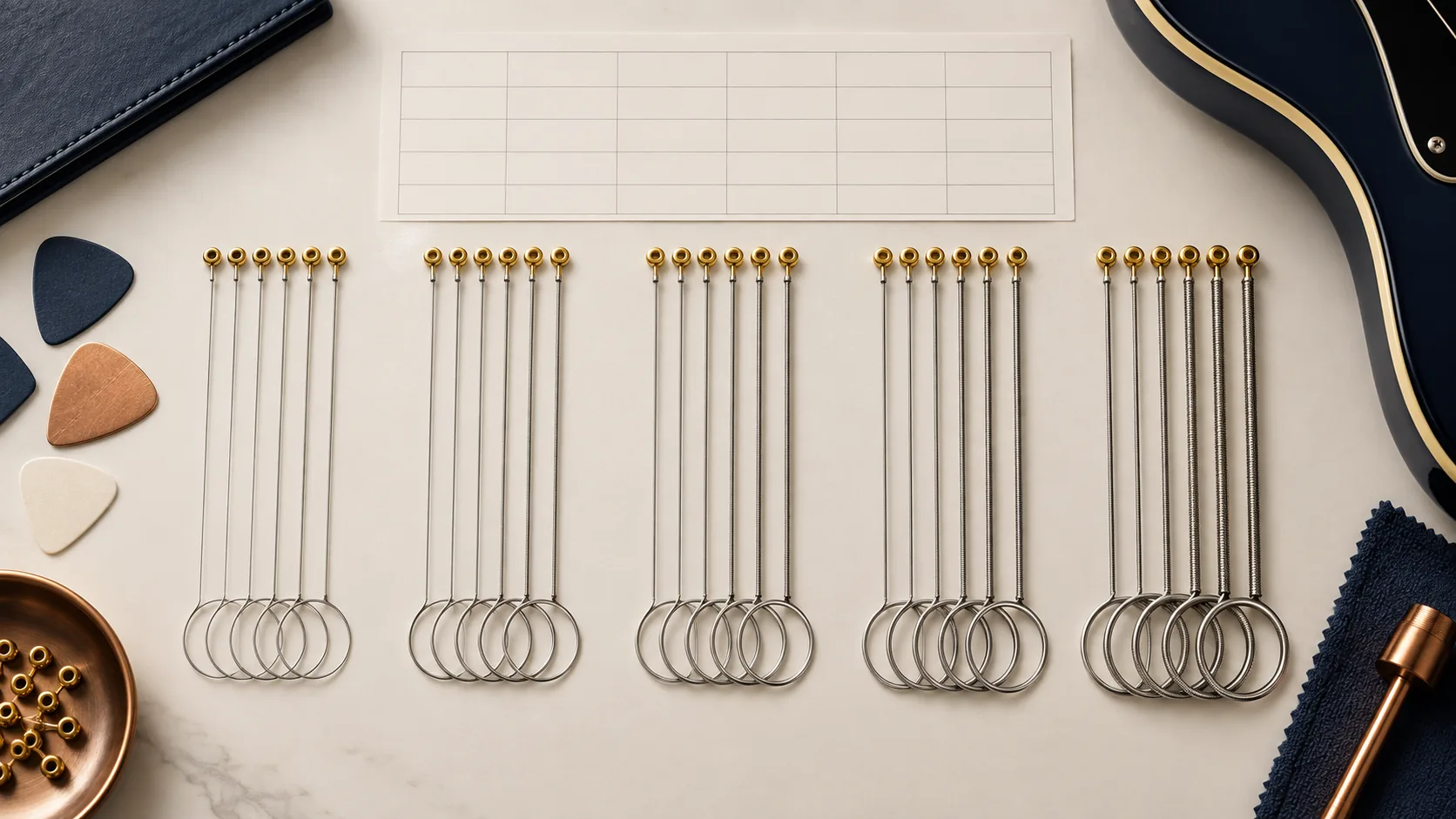
For example, a purchasing discussion might compare the following six-string sequences. These figures are examples expressed in thousandths of an inch; they should be confirmed rather than treated as a promise of availability.
| Illustrative role | Example sequence | Question to evaluate |
|---|---|---|
| Lighter candidate | 9, 11, 16, 24, 32, 42 | Does the feel suit the intended customer? |
| General-purpose candidate | 10, 13, 17, 26, 36, 46 | Does it provide a useful core option? |
| Different bass balance | 10, 13, 17, 30, 42, 52 | Is the changed bass response useful? |
| Firmer candidate | 11, 14, 18, 28, 38, 49 | Is there a distinct application and demand? |
Keep the sequence attached to the sample and quotation. If the third string changes from plain to wound, or a middle diameter changes, treat that as a specification difference even if the printed first-and-last gauge remains unchanged. Range names should never conceal such a revision.

Separate gauge, construction and playing conditions
Gauge influences the product discussion, but diameter alone does not describe the entire system. Material, core and wrap construction, treatment and instrument conditions can also matter. When comparing gauge candidates, keep other variables equivalent where practical and record the differences that remain.
D'Addario's explanation of string tension connects tension with gauge, scale length and pitch. For a purchasing decision, any numerical tension information must also apply to the particular string construction. Do not copy another product's force values onto a private-label specification.
A set that feels suitable on one guitar at one tuning may not answer the same application on another instrument. Ask for the intended scale, tuning and configuration before making a recommendation. If those details are unknown, keep them visible as open questions rather than filling them with assumptions.
Treat setup changes as part of application planning
Changing gauges can create a need to review the instrument's setup. Do not promise that every customer can install any candidate without adjustment. Refer customers to the instrument maker's instructions or a qualified technician when fit or setup needs assessment.
In a dealer training note, explain what information to collect before advising a buyer: current set, desired change, instrument and tuning. This is more useful than a blanket claim that thicker strings are always better or that one gauge suits every playing style.
Create a controlled sample comparison
Identify the samples with codes and a revision record. Document the full sequence, construction, packaging and any differences from the requested brief. Ask the supplier to clarify deviations before your evaluators start, so feedback refers to a known product.
Use a simple instrument record for installation preparation: guitar identification, scale length, tuning, setup condition and the procedure used. If different guitars are involved, record that fact. Do not describe an informal comparison as an experiment that has eliminated all variables.
Give evaluators consistent tasks that match the intended customer. These might include single-note passages, bends, rhythm playing and observations of treble-to-bass balance. Record comfort, response and application fit separately. A preference with a reason is more actionable than an unexplained numeric score.
Evaluate the role of each candidate
After sample review, return to the commercial role statement. Does the candidate solve a different customer need, or is it difficult for staff to distinguish from an existing option? Ask dealers how they would describe it in a short, accurate conversation without relying on exaggerated tone claims.
Keep individual playing preference separate from assortment usefulness. A dealer may personally favor one candidate while recognizing demand for another application. Conversely, a technically interesting option may not have an identified customer in the opening distribution plan.
When feedback is mixed, identify whether the disagreement follows instrument, tuning, playing task or customer segment. You may need another comparison or a narrower product description. Do not average unlike conditions into a simple claim that one gauge won the test.
Keep extended-range instruments in a separate brief
A seven-string or another extended-range configuration needs more than an extra number added to a six-string package. Confirm the entire sequence, intended tuning, instrument fit, string construction and the way the product will be identified in the range.
Ask whether the distribution network has a specific customer group for that configuration. If the answer is only that more options look impressive, the opening assortment may need a clearer rationale. A specialist variant should have an identifiable application and a supportable ordering explanation.
Avoid presenting one heavy bass string as a universal solution for every lower tuning. Suitability depends on the complete instrument and string specification. Keep technical questions with the project team and confirm the proposed set before printing application claims on the package.
Build quotations that can be compared
Request each candidate on an equivalent basis: complete sequence, material, construction, treatment, packaging, quantity and delivery basis. Ask for alternatives as separate lines. A lower unit price is not directly comparable when the quoted pack or product differs.
Confirm minimum quantities, sample charges, production timing and packaging requirements for the actual assortment. Do not infer them from an example gauge table. Ask whether splitting an opening quantity across more variants changes the commercial proposal or development work.
Use a comparison sheet that separates confirmed terms from open items. Include the offered revision and the questions that must be answered before approval. This helps purchasing understand whether a price difference reflects an agreed specification, a different option or an unresolved assumption.
Plan the opening order without pretending to know demand
An opening order is a controlled commercial decision, not a proof that the assortment will sell in a fixed proportion. Use available dealer commitments, relevant historical data and the agreed commercial conditions. If these inputs are weak, state the uncertainty instead of inventing a recommended percentage split.
Consider the consequences of each additional SKU: artwork, stock positions, reorder administration and dealer education. A broader range may be justified, but its usefulness should be evaluated against those responsibilities. The objective is a range your organization can maintain, not merely launch.
Decide what information will be reviewed after launch. Separate sales by channel and period where possible, and distinguish unavailable stock from low demand. A product that was not available to dealers cannot be interpreted in the same way as one that was available but seldom ordered.
Make product identification easy at every touchpoint
Keep the product name, full gauge sequence, instrument configuration and material consistent across the website, package, price list and order form. Use a controlled product code so two similarly named variants do not become interchangeable in a warehouse or purchase order.
The first-and-last shorthand can remain prominent, with the complete sequence available nearby. If terminology is localized, preserve the same technical meaning. A translated range name should not imply a different construction or an unverified application promise.
Give dealers a concise selection note explaining the intended role and the information needed for an application discussion. Connect it to the appropriate product page and inquiry route. This helps staff direct unresolved questions to the supplier instead of improvising specifications.
Link sample approval to quality records
Create an approval package with the final sequence, construction, sample reference, packaging and agreed changes. Identify the person who can authorize a later revision. Preserve the relationship between the sample evaluated and the item ordered for production.
Factory testing and shipment inspection should be defined around agreed questions. These may include identity, gauge verification, visible condition, string count, labeling and packaging. For measurements or performance requirements, agree on the method, sampling approach and acceptance criteria before the order is released.
Do not use photographs of winding or measuring equipment as substitutes for product-specific records. When a record is needed, it should identify the applicable product or shipment and the conditions of the check. An unsupported statement that every set is tested does not resolve a specific purchasing question.

Use replenishment to improve the assortment deliberately
At the first review, bring together dealer comments, sales information, returns information where available and supply conditions. Distinguish a product issue from a selection misunderstanding or an identification problem. Each calls for a different response.
If a gauge variant is changed, review the affected product code, package, website data and dealer explanation. Do not substitute a different sequence under the same description without a controlled change process. Maintaining clear product identity matters as much on a repeat order as at launch.
Keep a decision log explaining why a variant is retained, adjusted or discontinued. This allows a future colleague to understand the assortment without relying on memory. It also makes the next sampling discussion more focused because the previous questions and evidence remain available.
FAQ
Which electric guitar string gauge should a new brand launch first?
Choose from the applications and customers your dealers actually serve. Define a clear core role, confirm the complete sequence and evaluate samples. There is no universal opening gauge that can be justified for every network without knowing instruments, customer preferences and commercial conditions.
Is a 10–46 label enough for a purchase order?
No. It identifies only the first and last diameters in a common shorthand. Record all diameters, units, string count, plain or wound construction and other agreed details. Two products can share an outer range label while differing in meaningful middle-string specifications.
Do heavier strings always sound better?
No universal quality ranking follows from gauge alone. Feel and response should be evaluated for the intended instrument, tuning and application. Avoid promising an improvement for every player, and account for any setup assessment needed when changing the installed specification.
Should an opening range include seven-string sets?
Include them when a defined customer group and practical purchasing plan support the addition. Use a separate complete specification for the configuration. Do not assume that adding one low string to an existing six-string concept resolves instrument fit, tuning and range positioning.
How many of each gauge should I order?
Use verified demand inputs and the confirmed commercial proposal. Dealer commitments and relevant sales history are more useful than invented universal ratios. When evidence is limited, record the uncertainty and define a review plan rather than presenting a speculative split as industry fact.
What information should I send to request samples?
Provide instrument configuration, intended tuning and scale where known, full gauge candidates, material preferences, packaging direction and target applications. Mark unresolved questions clearly. Include a sample evaluation plan so the supplier understands what your team needs to compare and approve.
Conclusion
A coherent electric string assortment connects customer needs, full specifications, sample evaluation and controlled replenishment. Start with explainable product roles, compare like-for-like candidates and keep uncertain demand assumptions visible. Your dealers gain a clearer selection story, while purchasing gains a range that can be ordered and maintained accurately.
FROM GUIDE TO PRODUCT
Connect this guide to Electric Guitar Strings.
Review the relevant range, then bring the instrument, complete specification and open questions into one project brief.
YOUR PRODUCT · YOUR BRAND
Discuss your next string project with Frank.
Share your instrument category, target market, gauge or material direction and private-label packaging requirements.

ABOUT THE AUTHOR
Frank Zou
Frank works directly with musical-instrument brands, importers and distributors on string specifications, product selection and private-label project requirements.
Meet Frank