
Range Planning
Range Planning
Extended-Range Electric Guitar Strings: A Wholesale Guide for 7- and 8-String Sets
A technical buying guide for tuning, single or multiscale length, complete gauges, lowest-string fit, packaging and shipment control.
Introduction
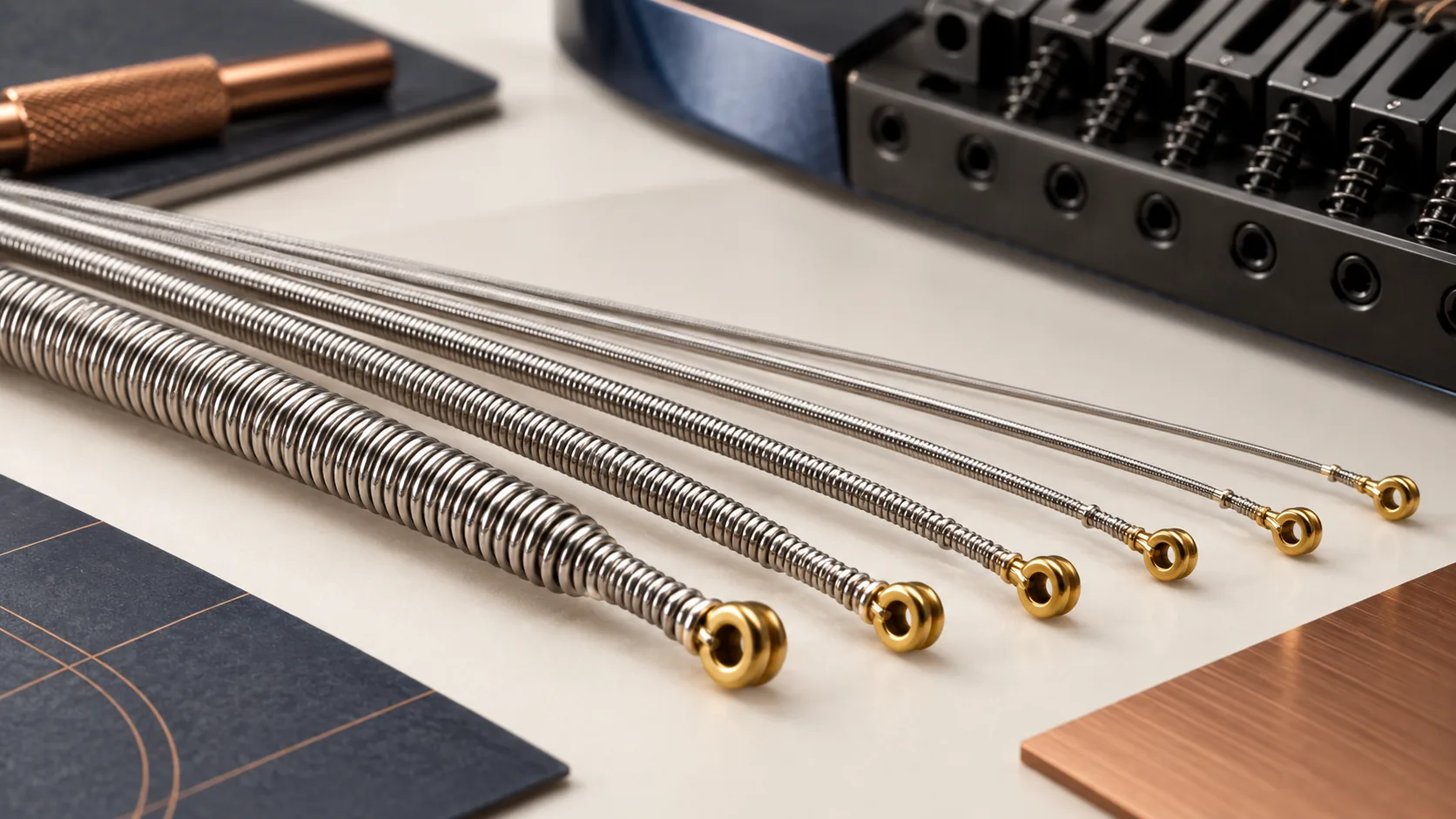
Buying 7- and 8-string electric guitar strings requires more than adding one or two heavy strings to a familiar six-string set. The buyer needs the target tuning, scale or multiscale geometry, full gauge sequence, construction of the lowest strings, usable and wound lengths, hardware clearances, package identity and sample method. Without those details, a wholesale quotation may describe a set that reaches the tuner but does not fit the bridge, tapers in the wrong place or feels unbalanced in the intended tuning.
Established manufacturers publish dedicated extended-range sets and singles. D’Addario’s electric gauge guide lists 7- and 8-string examples and its extended-range material discusses low-string challenges involving feel, intonation and tonal balance. Those product examples confirm that extended range is a distinct application. They do not supply the specification for a private-label set, and another brand’s gauge sequence should not be copied without checking the intended instrument and product rights.
This guide helps importers, distributors, dealer groups and private-label brands turn extended-range demand into a controlled assortment. It focuses on RFQ fields, fit verification, sample testing, packaging and shipment inspection. It does not claim that one gauge or scale works for every 7- or 8-string guitar.
Define the instrument application before selecting gauges
Start with the instrument, tuning and customer. A seven-string used in standard or near-standard tuning is a different application from a long-scale instrument tuned much lower. An eight-string with a single scale differs from a multiscale design, where the bass and treble strings terminate across angled contact points. Bridge type, headstock layout and string-through-body routing can also change the length required.
Write one use-case statement for each proposed SKU. Include string count, target tuning, scale range, bridge style and player direction. For example, a dealer network may want an accessible 7-string reference set for common production guitars, plus a separate lower-tuning option. That is a planning hypothesis. Validate it with dealer and customer evidence rather than presenting it as a universal bestseller.
Ask dealers which models and tunings generate requests, which gauge sequences customers currently recognize, and what fit complaints occur. Record exact examples without claiming that the sample represents the whole market. Sales history, search queries, returns and support tickets can support the decision when available.
Record multiscale and hardware details
For multiscale instruments, request the shortest and longest scale and identify which string uses each end of the range. Record bridge-to-tuner distance, string-through path where applicable, and the location at which the outer winding or taper must pass hardware. A nominal “28-inch scale” label does not fully describe the string path.
Photographs with measurements can help a supplier understand the setup, but the final specification should contain written dimensions and tolerances where needed. Do not rely on a product photo alone. Confirm whether the lowest string must pass through a tuner post, bridge hole or ferrule with a restricted diameter.
Build the full 7- or 8-string set specification
List every string from highest to lowest. State pitch, nominal gauge, plain or wound status, core material and shape, wrap material, winding construction, total length, wound length or taper location, and end. If the supplier uses product codes rather than publishing certain construction details, keep the code tied to the approved revision.
| Field | What to include | Risk if omitted |
|---|---|---|
| String count | Seven or eight, with positions listed | Missing or misordered low strings |
| Tuning | Pitch for every position | Inappropriate tension or balance |
| Scale | Single-scale length or multiscale range | Incorrect fit and taper placement |
| Gauges | Complete high-to-low sequence | Ambiguous “light” or “heavy” label |
| Construction | Plain/wound, core, wrap and lowest-string design | Uncontrolled feel and response |
| Lengths | Total, usable and wound/taper information as required | Winding may stop at the wrong point |
| Hardware | Bridge, body-through path and tuner clearance | Lowest string may not install safely |
| Packaging | Set identity, tuning, gauges and compatibility limits | Customer chooses the wrong SKU |
Avoid relying on only the first and last gauges, such as “10–74.” Buyers and players need the complete sequence. Two sets with the same endpoints can distribute the intermediate gauges differently and feel unlike one another.
Use tension as a comparison tool, not a copied number
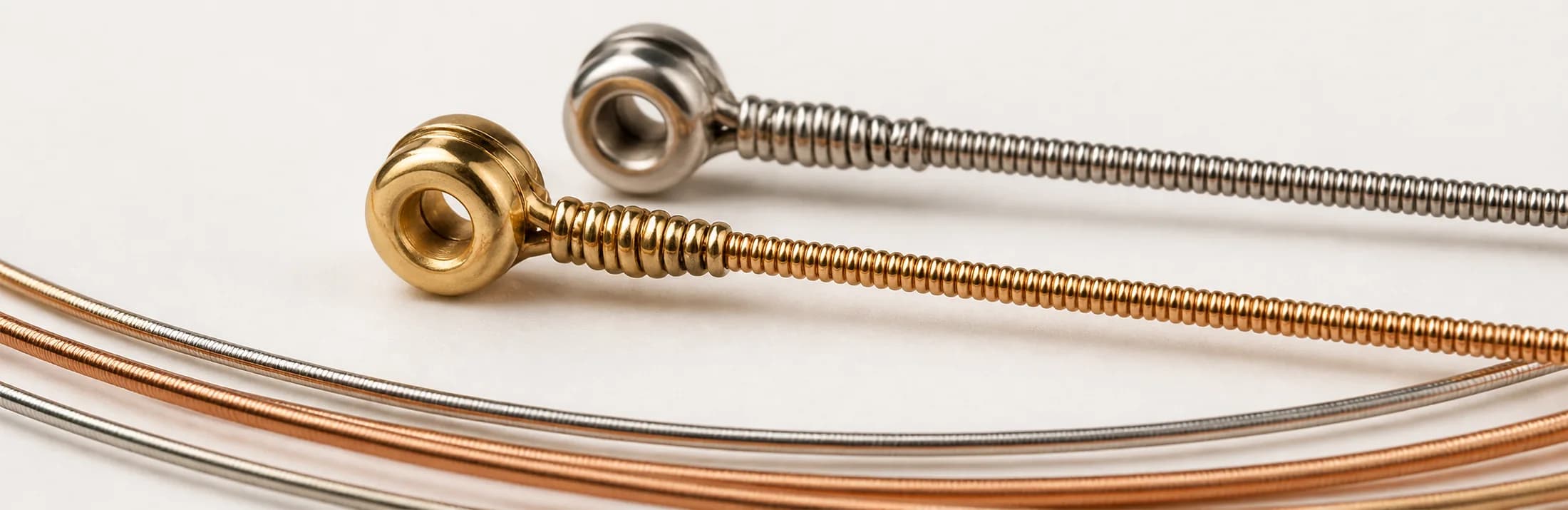
Tension depends on scale length, pitch, unit weight and construction. A gauge that works on one scale or tuning may feel different on another. When numerical tension data is needed, use information applicable to the exact string construction and intended scale. Do not copy force values from another brand’s chart and label them as the offered product.
A useful internal matrix records pitch and scale for each position, the proposed string code, applicable manufacturer data and sample observations. If the supplier provides calculated figures, ask what inputs and revision they cover. If the data is unavailable, keep it as an open field and rely on controlled samples rather than invented precision.
Look for balance, not identical numbers
A balanced set does not necessarily mean every string has the same numerical tension. Players may prefer different resistance across plain and wound strings, bends and low-register picking. Define the target experience and use numbers to understand the proposal, not to replace testing.
Record observations for fretting, bending, pick attack, low-string movement, tuning and transitions between adjacent strings. Compare several candidate sequences on the same instrument and tuning when practical. Do not change scale, setup and amplifier settings at the same time.
Specify the lowest string carefully
The seventh or eighth string creates many of the fit and response questions. A larger diameter can challenge tuner posts, bridge openings and saddle geometry. A wound section or taper in the wrong location can sit across the nut, tuner or bridge contact point. A substituted bass string may have unsuitable length, taper or construction even when its nominal gauge looks useful.
Request total length, wound length and taper details for the lowest string. Confirm the maximum diameter through relevant hardware. If a supplier proposes a construction designed for extended-range guitar, record how it differs from a standard guitar or bass string. Do not claim improved intonation or clarity without product-specific evidence and an applicable test.
During installation, do not force a string through hardware. Record any modification that would be required and decide whether that is acceptable for the target customer. A retail set described as compatible with common instruments should not silently require tuner drilling or nut work.
Separate 7-string and 8-string product roles
Treat seven- and eight-string sets as separate families. Their lowest pitch, scale patterns and customer expectations differ. A distributor may need more than one tuning or gauge direction in each family, but every added SKU increases inventory and support complexity.
Build a range map with columns for instrument type, tuning, scale, player use, complete gauges, material, pack color and planned channel. Identify where two SKUs overlap. If the only difference is a small gauge change that dealers cannot explain, a sample or pilot may be more appropriate than a permanent launch.
Use neutral names tied to facts. “7-String Regular” or “8-String Lower Tuning” can be supported by a complete technical panel, whereas dramatic terms such as “ultimate low-end” create expectations that are hard to verify. The final names should match the approved gauge and tuning matrix.
Run fit checks before playing tests
Begin with an installation checklist. Confirm the sample code and gauge order. Inspect the nut, bridge, tuner and body-through path. Measure the instrument dimensions recorded in the brief. Install without irreversible instrument changes unless the evaluation specifically includes a qualified setup procedure.
Check that the ball end seats correctly, the wound section crosses the required contact points, the taper does not fall in an unintended location and enough suitable string length reaches the tuner. Record the number of wraps only as an installation observation, not a universal requirement. Photograph any fit concern with the sample code visible.
If a string is too short, excessively long in a way that affects installation, or too large for hardware, stop and classify the mismatch. Do not continue to tone evaluation and ignore a commercial fit failure.
Evaluate samples in the intended tuning
After fit is confirmed, bring the instrument to the stated tuning using an appropriate setup. Record the instrument, scale, setup, tuning, sample revision and date. Allow normal stabilization without promising a fixed time. If setup changes are made, document them so the next sample is compared fairly.
Use tasks that reflect the customer: low-register single notes, chords, palm-muted passages, fast alternate picking, sustained notes, bends on upper strings and transitions across the range. Record tuning behavior, perceived resistance, low-string movement, attack, note separation, noise and string-to-string balance separately.
Use clean and relevant driven settings while keeping the signal path consistent. Audio recordings can support review, but note the instrument, pickups, interface or amplifier and settings. A clip is evidence of that setup, not proof that all users will hear the same result.
Review intonation and setup responsibly
Different gauges and constructions may require professional setup changes. Record saddle travel, nut fit and relief observations where qualified personnel are involved. Do not advertise “perfect intonation” based on one guitar. State the intended application and advise that setup requirements depend on the instrument and tuning.
If a sample cannot reach a workable setup on representative instruments, investigate whether the gauge, construction, scale assumption or hardware compatibility is responsible. Keep the failed revision in the project record.
Decide how many variants to launch
Start with evidence, not the largest possible matrix. Review dealer requests, product searches, current sales, backorders and support questions. Separate 7-string from 8-string and group tunings or scale ranges only when the product can support the claim clearly.
A pilot may include one reference set for each instrument count and a second option only where demand or application differs meaningfully. This is a method, not a recommendation for a fixed SKU count. Track sell-through, repeat orders, fit questions and returns by SKU before expanding.
Do not call a gauge sequence a bestseller without verified sales data. If the business uses common market sequences as a starting point, label them as candidate benchmarks and complete its own sample and channel review.
Build packaging that prevents fit mistakes
Put string count, full gauge sequence and intended tuning on the front or an easily visible panel. State single-scale or multiscale scope only when confirmed. If the set has a minimum or maximum applicable scale, define the measurement and avoid a broad “fits all” claim.
The technical panel should identify material, winding, lowest-string details, end construction and product code. A diagram can show how scale and wound length are defined. Keep web, catalog, price list, carton and pack data synchronized.
Use distinct visual identity for 7- and 8-string families, but do not let color replace text. Warehouse staff and customers should be able to verify the code and gauges. For international markets, localize explanatory copy while preserving pitches, gauges, units and SKU identity.
Define production and shipment controls
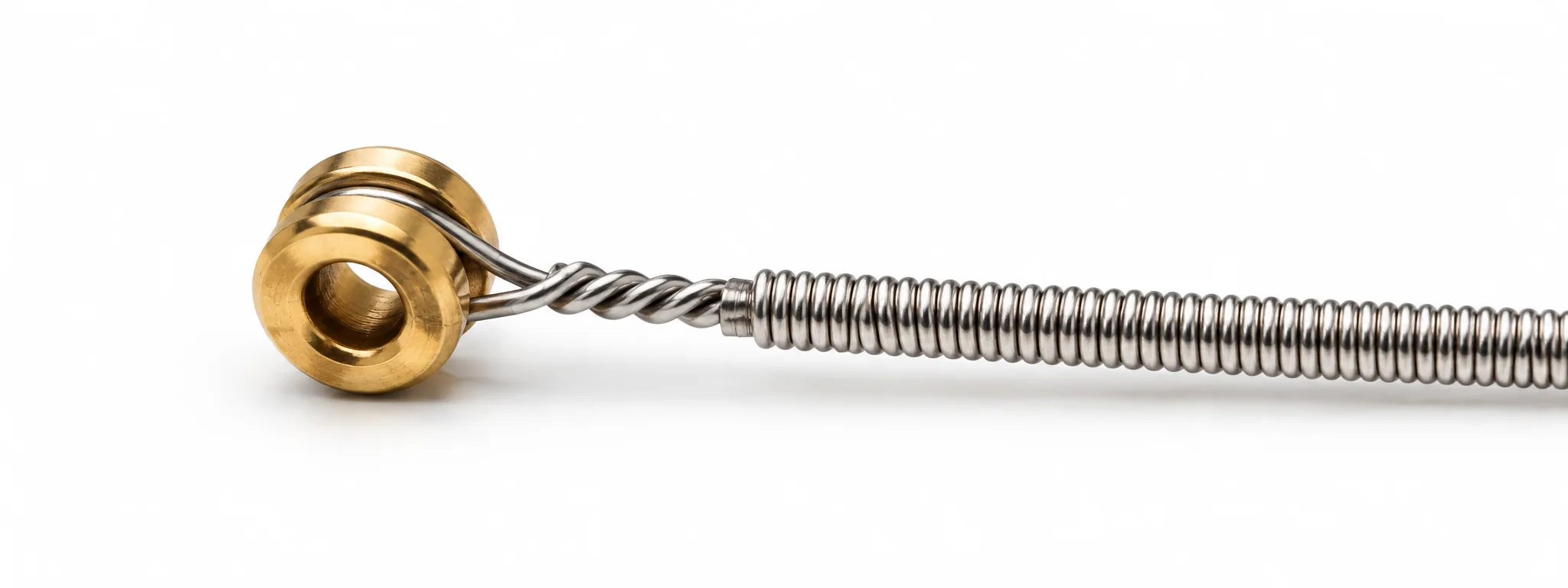
Tie production to the approved sample and specification revision. Basic checks include item identity, string count, gauge sequence, visible winding and ends, total or wound length where specified, pack data and quantity. For measurable controls, define sampling, tools, measurement locations, tolerances and acceptance decisions.
The lowest string deserves an explicit fit-related check if length or taper is critical. A generic diameter photo does not confirm the path through a target bridge or tuner. Use the agreed dimensional definition and link results to the batch or shipment.
Inspect packaging for mixed 7- and 8-string labels, missing low strings, incorrect gauge tables, damaged inner protection and carton separation. Confirm artwork revision and quantities. Decide how nonconforming items will be contained and reviewed before shipment.
Compare quotations and commercial terms
Issue one RFQ matrix to all qualified suppliers. Include quantities by SKU, destination, currency, trade term, packaging scope and sample needs. Ask for separate pricing where lowest-string construction, special lengths or packaging create options.
MOQ and lead time can depend on gauge combinations, special strings, pack variants and order mix. Ask the supplier to state assumptions. Early figures can help planning but should not be published as a fixed capability before the final matrix and artwork are confirmed.
Compare total landed scenarios when reliable packing dimensions, weights and freight inputs are available. Keep estimates labeled. A lower unit price may not be a better commercial result if fit uncertainty, excessive variant count or unclear packaging increases returns and slow inventory.
Prepare a complete extended-range RFQ
Include company, market, channel, string count, target tuning by position, single or multiscale dimensions, hardware path, complete gauges, construction, lowest-string length and taper, ends, packaging, languages, quantity scenarios, sample protocol, required documents and inspection questions. Attach measurement diagrams where useful.
Ask the supplier to mark every line confirmed, proposed or open and to identify the sample revision. When a set is approved, create one record containing the technical specification, instrument context, evaluation results, artwork files and commercial conditions. A later change to the lowest string, gauge sequence or length should trigger review.
FAQ
What should I include in a 7-string or 8-string guitar string RFQ?
Include string count, tuning by position, scale or multiscale range, bridge and tuner path, complete gauge sequence, material and construction, total and wound lengths where relevant, ends, packaging, quantity scenarios and sample goals. Identify any uncertain field as a question.
Can I add a heavy single string to a six-string set?
It may create a playable experiment, but it is not automatically a suitable commercial set. Confirm tension context, length, taper, hardware fit, winding, balance and product identity. A bass string can be unsuitable even when the gauge appears close.
Do all 7-string guitars use the same scale and tuning?
No. Instruments vary in scale, bridge, headstock and tuning. Multiscale designs add another dimension. Define representative applications and avoid universal compatibility claims.
What is the most important specification for the lowest string?
No single field is enough. Gauge, construction, pitch, scale, total length, wound or taper location and hardware clearance work together. The lowest string should be checked for both fit and playing behavior.
Should an extended-range set have equal tension on every string?
Not necessarily. Numerical data can help compare proposals, but players may prefer different resistance across the set. Define the target feel, use product-specific data and validate the complete sequence on the intended instrument.
How should samples be tested?
Verify fit first, then evaluate in the intended tuning using recorded instruments and consistent tasks. Separate observations for installation, resistance, response, tuning, noise, balance and setup. Preserve the sample code and any audio or measurement records.
What should shipment inspection verify?
Check revision, 7- or 8-string identity, complete gauge sequence, low-string construction and length fields, ends, pack text, quantities and carton separation. Use defined methods for measurements and connect the report to the shipment or batch.
Conclusion
Extended-range wholesale buying succeeds when the set is specified as an instrument system. Define tuning, scale, hardware and every string; give the lowest string extra fit attention; use product-specific tension information; and test coded samples on representative guitars. Then keep the approved revision consistent through packaging, production and shipment checks.
This process reduces avoidable installation failures and gives dealers a clearer way to explain 7- and 8-string options. It also produces more useful product pages because compatibility and limitations are stated directly rather than hidden behind a generic gauge name.
FROM GUIDE TO PRODUCT
Connect this guide to Electric Guitar Strings.
Review the relevant range, then bring the instrument, complete specification and open questions into one project brief.
YOUR PRODUCT · YOUR BRAND
Discuss your next string project with Frank.
Share your instrument category, target market, gauge or material direction and private-label packaging requirements.

ABOUT THE AUTHOR
Frank Zou
Frank works directly with musical-instrument brands, importers and distributors on string specifications, product selection and private-label project requirements.
Meet Frank