
Product Selection
Product Selection
Flatwound vs Roundwound Electric Guitar Strings: A Wholesale Assortment Guide
A wholesale framework for assigning clear range roles to roundwound and flatwound electric sets, then controlling gauges, setup, samples and dealer support.
Introduction
The choice between flatwound and roundwound electric guitar strings affects more than surface feel. It changes how a buyer should describe construction, select gauges, evaluate samples, plan replacement singles and position the product for dealers. Roundwound sets usually occupy the familiar core of an electric-guitar range, while flatwound sets can serve a narrower use case where a smoother surface and a different response are wanted. Those are market directions, not guaranteed outcomes for every guitar or player.
For wholesale purchasing, the construction name must be connected to a complete specification. The supplier still needs the core system, outer wrap material, gauges, wound-string positions, ball ends, scale and usable length, coating status, tuning and reference guitars. A label such as “flatwound 12–52” does not reveal the intermediate gauges or whether the third string is plain or wound. Those details can determine whether the set meets the intended channel role.
This guide helps distributors, private-label brands and specialist retailers plan a controlled flatwound-versus-roundwound comparison. It covers assortment strategy, construction language, gauge architecture, installed samples, packaging and receiving inspection. It does not claim that every construction is currently available from StringCrest, and it does not publish a fixed recipe, MOQ, lead time or performance promise. Availability and final data must be confirmed for each project.
Understand what the construction terms describe
Roundwound refers to the outer surface geometry
In a conventional roundwound string, round wrap wire is wound around the core. The ridged outer profile contributes to the familiar tactile and response characteristics associated with the category. The exact result depends on the wrap material, core, gauge, winding process and instrument, so “roundwound” is not a complete tonal specification.
Official D’Addario electric-string categories list roundwound, half-round and flatwound constructions as distinct options. Its single-string catalog also separates flatwound and roundwound wound strings. This confirms the category distinction and the commercial importance of construction identity. It does not provide a private-label bill of materials.
Flatwound uses a flatter outer wrap direction
A flatwound electric-guitar string has a smoother outer profile created with flattened ribbon-like wrap material or a comparable declared construction. D’Addario describes one of its flatwound families as using flattened stainless-steel ribbon that is wound and polished. That statement applies to that manufacturer’s product. A buyer should not assume that every flatwound quotation uses the same metal, core or finishing process.
Ask the supplier to state the outer wrap material, core, winding method and finishing steps for the proposed set. If the buyer wants a wound third string, identify it explicitly. If a sample contains any plain position that differs from the planned retail set, mark the sample as a development variant rather than an approved production reference.
| Field | Roundwound sample | Flatwound sample | Approval question |
|---|---|---|---|
| Outer surface | Round wrap profile | Flat or polished wrap profile | Is the construction accurately named? |
| Wrap material | Declare exact material | Declare exact material | Does artwork match the declaration? |
| Wound positions | Confirm by string | Confirm by string | Is the third string plain or wound? |
| Gauge sequence | Record all six | Record all six | Are comparisons like for like? |
| Fit | Length and ball end | Length and ball end | Does each set fit the same reference guitars? |
| Range role | Core or broad-use direction | Specialist or defined-use direction | Does the SKU solve a real dealer need? |
Define a channel role before adding another construction
Roundwound usually anchors the comparison
If a retailer already sells electric-guitar strings, a common roundwound set can provide the practical baseline for price tier, gauge architecture and dealer education. The baseline should be described factually: string count, full gauges, material, construction, coating status and intended tuning. Avoid calling it “standard” unless the word is clearly limited to your own range rather than a universal industry rule.
The baseline also makes sample feedback more meaningful. Reviewers can compare a flatwound proposal against a documented reference rather than against memory. The reference should be a product the team has actually identified and installed, not a competitor pack whose internal construction is unknown.
Flatwound needs a specific reason to exist in the range
A flatwound SKU may serve players seeking a smoother tactile direction, a more restrained surface response, a wound-third configuration or a specialist setup. These needs should be confirmed through dealer conversations, inquiry records or controlled samples. Do not assume that the presence of a keyword proves sufficient demand for multiple gauges.
For a first private-label assortment, one flatwound set may be enough to test the role. Expansion into lighter, heavier or alternative-tuning formats can follow evidence. A focused range reduces packaging work, prevents slow replacement inventory and gives the sales team a clearer comparison story.

Compare construction without hiding gauge differences
The outside numbers are not the full set
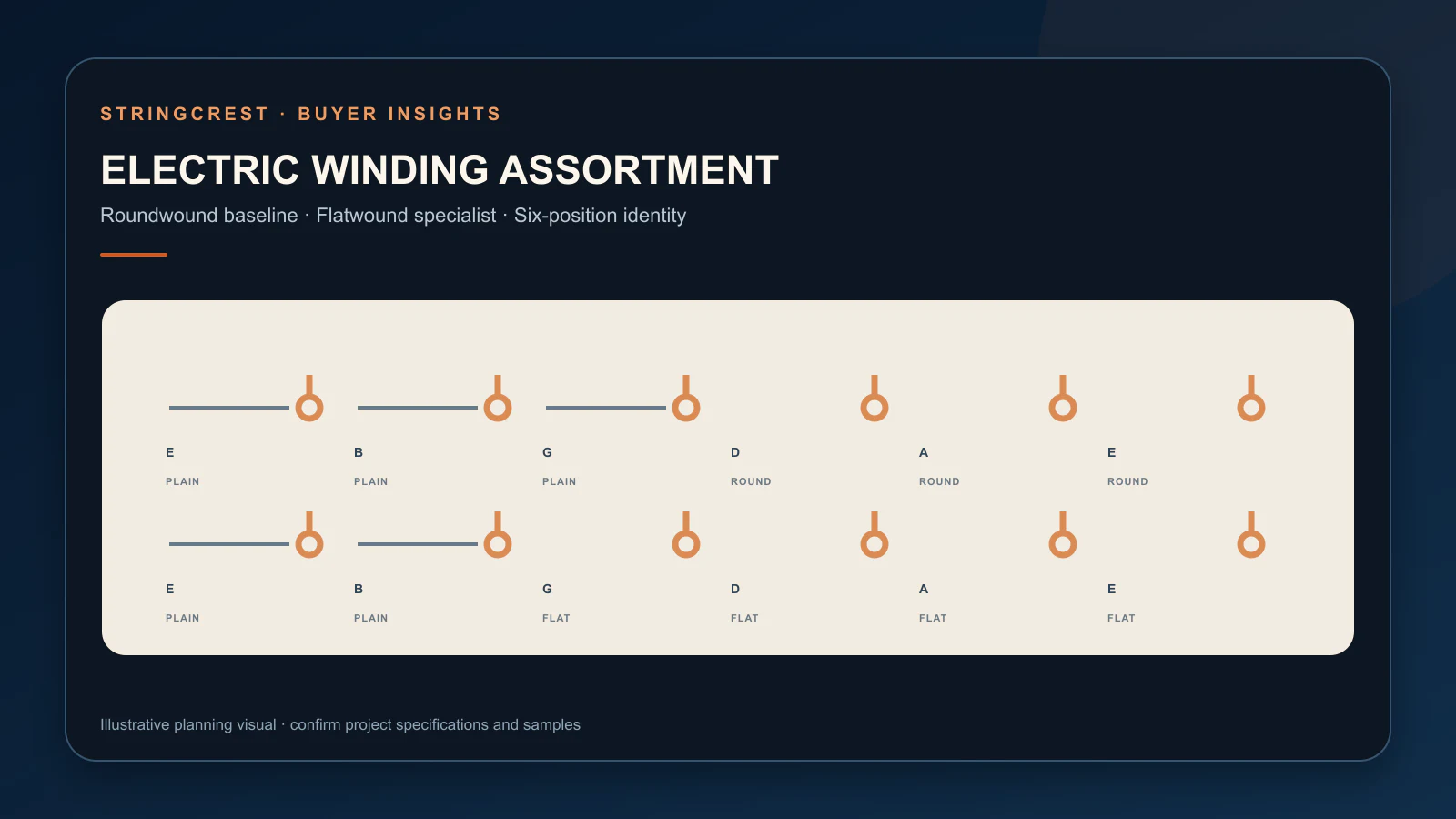
Electric-guitar packs are often summarized by the first and sixth gauges, but that shorthand does not show the middle positions. A 10–46 set can use different B, G, D and A gauges. It may also use a plain or wound G. A flatwound set with a wound third cannot be evaluated as a direct material-only comparison against a roundwound set with a plain third.
Write all six positions in the sample request. Include note, gauge, plain or wound construction, wrap material where applicable, end type and any color code. If the supplier proposes a different sequence to achieve the intended feel, preserve both versions in the record and approve only the identified revision.
Keep setup effects visible
A change in gauge or wound-third construction may require setup review. Nut slots, bridge saddles, intonation and playing feel can change. The article should not tell dealers that every customer must make a specific adjustment; it should tell the buyer to assess setup on named reference guitars and to state when professional setup may be appropriate.
Use at least two reference instruments if the range is intended for broad retail coverage. Record scale length, bridge type, pickup configuration and initial setup. The purpose is not to prove universal compatibility. It is to identify the tested scope and expose obvious fit or balance problems before bulk production.
Specify the wound third string explicitly
A wound G changes the product identity
The third string is a frequent source of ambiguity in electric-guitar sets. A buyer may expect a plain G because it is common in many roundwound sets, while a flatwound or jazz-oriented set may use a wound G. The two constructions differ in diameter, feel, bending behavior, balance and setup interaction. The package and master specification must make the choice visible.
Record the G string as its own line item, including gauge, core, wrap and finished construction. During sample review, test chord intonation, single-note transitions, bending tasks appropriate to the intended player and balance between B, G and D. Do not approve the set using only the first and sixth gauges.
Replacement singles must match the approved construction
If dealers will stock singles, a wound G must be replenished with the same approved construction and gauge. A plain string carrying the same note name is not an equivalent replacement. The inventory code should identify the position and construction clearly enough that warehouse and retail staff do not substitute by note alone.
This consideration can affect the launch decision. A specialist set is easier to support when replacement policy, pack quantity and item coding are designed at the same time as the full set.
Use an installed sample protocol, not adjectives alone
Prepare a repeatable task list
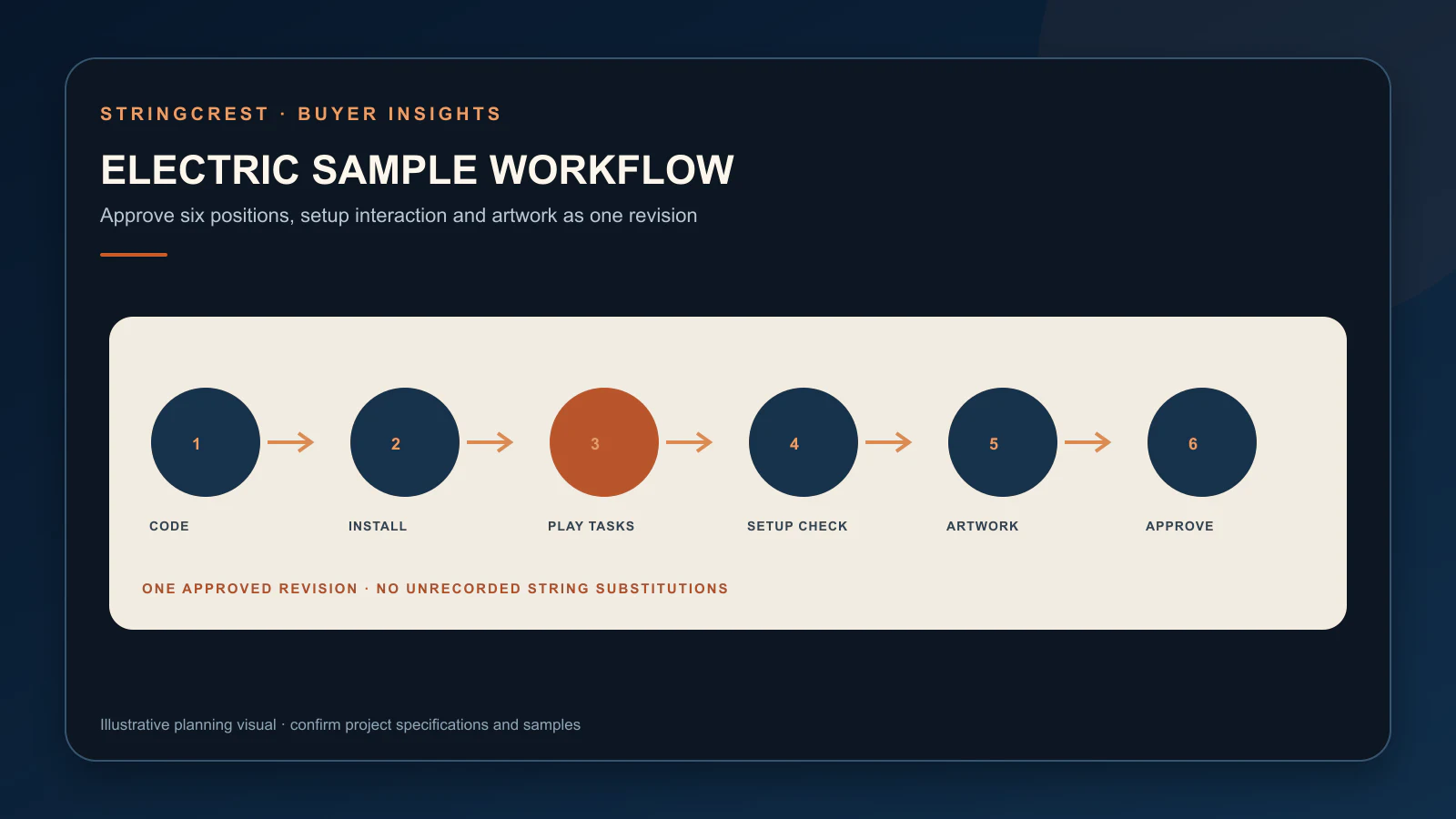
Install identified samples on the same reference guitars under recorded conditions. Note the sample code, tuning, string age, guitar, setup state and evaluation date. Use a consistent task sequence: open chords, fretted chords across the neck, single-note lines, sustained notes, position shifts, picking dynamics and any bending expected for the target use case.
Reviewers should compare the samples using observable language. They can record surface noise during shifts, perceived stiffness under the chosen task, balance between plain and wound positions, attack direction and whether intonation adjustment was needed. They should avoid claiming that one construction always produces a particular genre, tone or playing result.
Separate initial response from service-life evidence
An installation session can approve fit, basic balance and immediate response. It cannot establish long-term corrosion resistance or lifespan. If the marketing plan requires durability language, define a separate test with controlled use or exposure, enough samples, inspection intervals and pass criteria. Keep that record connected to the exact production construction.
Do not infer life from surface smoothness. A flat outer profile and a protective coating are different specification fields. Likewise, stainless wrap material does not automatically prove a fixed corrosion outcome for the complete string in every environment.
Create a six-position product master
Make every position auditable
The approved master should answer what is in the pack without relying on a family name. A practical table includes:
| Position | Note | Gauge | Plain/wound | Wrap material | End and length |
|---|---|---|---|---|---|
| 1 | Confirm | Confirm | Plain or confirmed alternative | Not applicable or confirm | Ball end; length confirm |
| 2 | Confirm | Confirm | Plain or confirmed alternative | Not applicable or confirm | Ball end; length confirm |
| 3 | Confirm | Confirm | Plain or wound | Confirm if wound | Ball end; length confirm |
| 4 | Confirm | Confirm | Wound | Confirm | Ball end; length confirm |
| 5 | Confirm | Confirm | Wound | Confirm | Ball end; length confirm |
| 6 | Confirm | Confirm | Wound | Confirm | Ball end; length confirm |
Add tolerances, core data and treatment details only when they are confirmed and suitable for sharing. Keep confidential manufacturing controls in the technical agreement rather than exposing them as vague public claims. The public page can explain selection logic while the quotation carries the project-specific detail.
Freeze the revision after approval
Assign a sample revision and approval date. The production purchase order should reference that revision, the artwork version and the item code. Any proposed change to material, core, gauge, length, end or treatment should trigger written review. A family name alone cannot control a product over repeated orders.
Write packaging that helps the dealer sell the difference
Lead with identity and intended comparison
The front panel should make construction and gauge sequence easy to find. The back can explain the intended range role in careful language. For example, it can say that a set uses an approved flatwound construction designed for a smoother surface direction, provided that this description matches the sample and documentation. It should not promise “zero noise,” “perfect jazz tone” or universal comfort.
Include instrument, string count, full gauges, construction, material, wound-third identity, tuning if nonstandard, item code and traceability field. If the set is compatible only with a tested instrument group or setup, use appropriate qualification rather than a blanket fit statement.
Keep competitor terminology out of private-label artwork
Industry construction words may be generic, but branded family names, slogans and proprietary performance claims are not. Build artwork from your own approved specification and evidence. Source pages can help buyers understand the category; they should not become packaging copy.
Plan inventory and sales support together
Forecast the specialist SKU conservatively
Because flatwound electric sets may serve a narrower segment, consider smaller initial SKU breadth and a clear reorder rule. Separate full-set demand from replacement-single demand. Track inquiries by gauge, wound-third preference and instrument type instead of treating every mention of “flatwound” as the same request.
Dealer training can use a compact comparison card: construction, material, full gauge sequence, feel direction, wound G status and setup note. This gives staff a factual conversation tool without asserting that one construction is better.
Avoid three near-identical packs
A roundwound baseline, a flatwound specialist set and a half-round option may look like a complete ladder, but each additional SKU requires separate samples, artwork, inventory and replacement support. Add a third construction only when it solves a defined buyer problem and can be explained without confusing the range.
Inspect production shipments against the approved identity
Receiving inspection should confirm item code, carton and pack labels, set count, gauge identification, wound-third status, ball ends, visible surface consistency and packaging condition. Use a documented sample plan. Install selected sets when the purchase agreement requires a fit or functional check.
Visual inspection cannot verify alloy chemistry or every hidden construction detail. Material declarations, supplier production records or appropriate testing may be needed for those controls. If a pack says flatwound but the contents or surface differ from the approved reference, quarantine the affected lot and record the evidence before deciding disposition.
Prepare a quotation request that suppliers can answer consistently
Ask for the following in one version-controlled brief:
- construction direction: flatwound, roundwound or two controlled samples;
- six individual gauges and plain/wound status for every position;
- core, outer wrap material, finishing and coating declarations;
- scale, overall usable length, ball-end and any color-code requirements;
- tuning, reference guitars and sample-evaluation tasks;
- packaging, barcode, item-code, case-pack and artwork language;
- replacement-single requirements and inventory pack sizes;
- current sample terms, MOQ, production lead time and quotation validity.
Do not fill missing fields with a competitor’s product data. Mark a field “supplier proposal required” and approve the answer through an identified sample. This keeps the RFQ honest and gives each quotation the same comparison structure.
FAQ
Are flatwound electric-guitar strings the same as coated strings?
No. Flatwound describes the winding surface construction. Coating or another protective treatment is a separate field. A product can be flatwound without using the same treatment as a coated roundwound set.
Do flatwound sets always use a wound G string?
Not every set should be assumed to use one. Confirm the third-string construction in the complete position table and show it on packaging when it is important to fit and player expectations.
Can a 10–46 flatwound set replace any 10–46 roundwound set directly?
The first and sixth gauges do not prove an identical middle sequence, feel or setup requirement. Compare all six strings and install the sample on the intended reference guitar before making compatibility statements.
Should a general music retailer carry several flatwound gauges?
Only when customer demand and support capability justify them. A single well-defined specialist SKU may be more useful than several poorly differentiated packs.
What is the safest way to describe tone?
Use qualified, comparative language tied to the approved sample and intended use. Avoid universal genre claims or guaranteed tonal results, because guitars, pickups, setup and players change the outcome.
What should the buyer retain after sample approval?
Keep the approved physical sample, six-position specification, evaluation record, artwork proof, item and lot coding rules, quotation and purchase-order revision together.
Conclusion
Flatwound and roundwound electric strings can support different channel needs, but construction names alone do not create a dependable assortment. The buyer must connect each name to a six-position gauge sequence, material declaration, wound-third decision, installed-fit record, identified sample and accurate package.
A focused range makes the difference understandable to dealers and manageable for inventory teams. It also gives the supplier a precise target for repeat production and gives receiving inspection a real reference instead of a marketing adjective.
Explore electric guitar string options · Discuss your flatwound or roundwound range brief
Sources and interpretation limits
- D’Addario electric guitar string category
- D’Addario electric single-string category
- D’Addario 12–52 flatwound electric set example
The sources document one manufacturer’s category structure and product examples. They do not establish StringCrest construction, availability, sample results, compatibility, production capacity, MOQ or lead time. Confirm the final specification and commercial terms for the intended project.
FROM GUIDE TO PRODUCT
Connect this guide to Electric Guitar Strings.
Review the relevant range, then bring the instrument, complete specification and open questions into one project brief.
YOUR PRODUCT · YOUR BRAND
Discuss your next string project with Frank.
Share your instrument category, target market, gauge or material direction and private-label packaging requirements.

ABOUT THE AUTHOR
Frank Zou
Frank works directly with musical-instrument brands, importers and distributors on string specifications, product selection and private-label project requirements.
Meet Frank