
Product Selection
Wholesale Planning
Stainless Steel vs Nickel-Plated Electric Guitar Strings: An OEM Range Guide
Compare stainless and nickel-plated electric-string ranges by wrap, core, gauges, controlled sample review, setup, packaging and revision.
Introduction
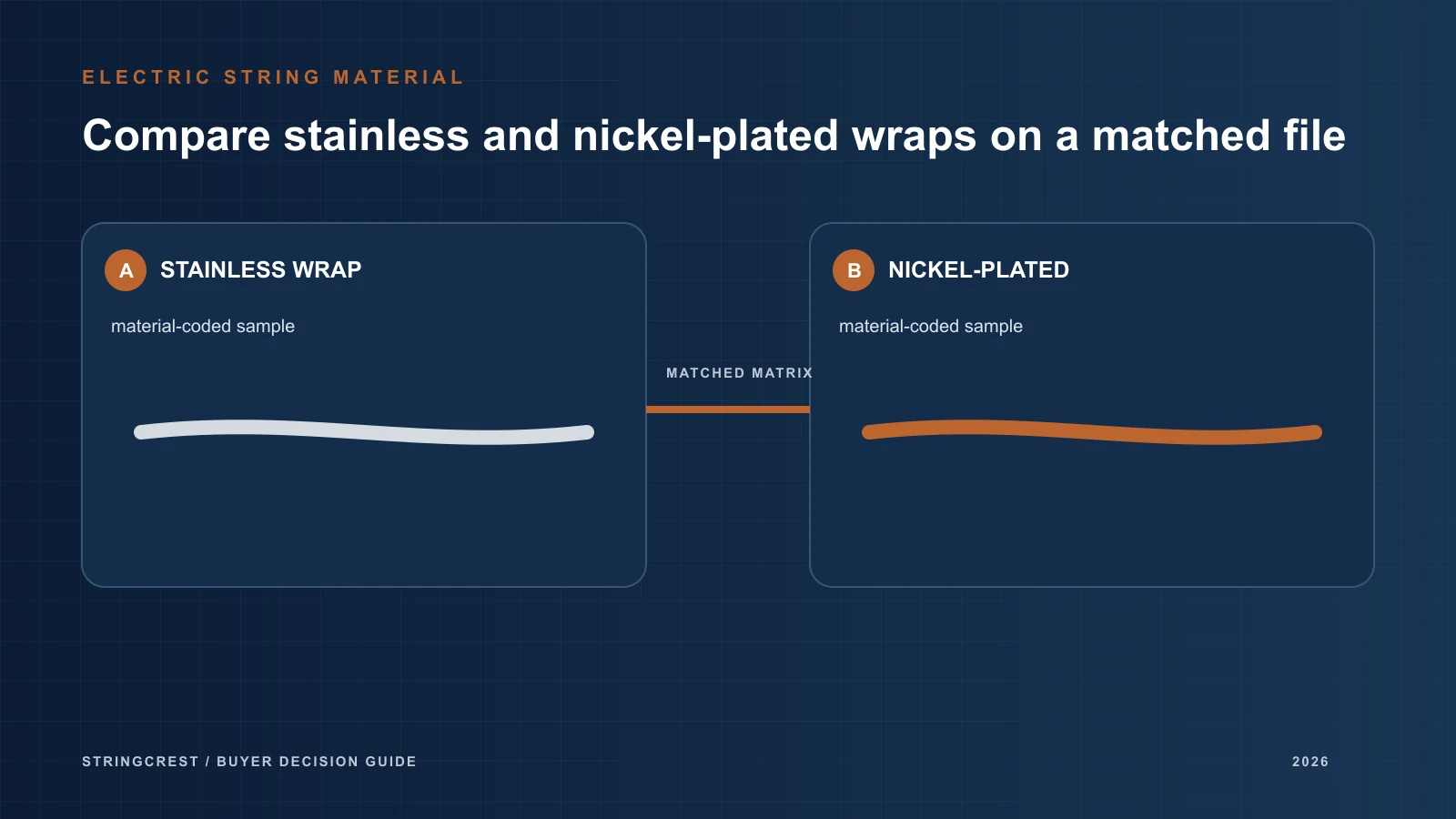
Stainless steel and nickel-plated steel identify different wrap materials for wound electric guitar strings. Choosing between them for an OEM range requires a complete construction record and a comparison on the intended guitar. Core wire, plain strings, gauges, surface treatment and setup remain separate variables. A set's material name does not establish how every position is built or how the set will perform.
For brands, importers, distributors and guitar stores, the useful question is whether each proposed construction offers a choice the channel can explain. Compare coded candidates on the same instrument with recorded pickup, recording and playing conditions. If other construction details differ or remain unknown, the observations describe those complete products; they cannot establish that wrap alloy caused every difference.
Identify the material at component level
For a wound string, distinguish the core wire, wrap wire and finished outside diameter. Nickel-plated steel, abbreviated NPS here, uses a steel wrap wire with nickel plating. Pure nickel wrap is a different material option. Stainless steel wrap is another family; the word stainless does not specify the core or the plain strings supplied in a set.
Current Ernie Ball product pages provide useful, specific examples. Its .026 Nickel Wound single (P01126) is described as nickel-plated steel wrap over a tin-plated hex-shaped steel core. Its .026 Stainless Steel Wound single (P01926) is described as stainless wrap over a tin-plated hex-shaped steel core. These are Ernie Ball constructions, not approved StringCrest builds. The public descriptions do not establish identical core dimensions or winding geometry between the two examples.
Ernie Ball separately identifies Classic Pure Nickel Wound singles as pure nickel wrap over a tin-plated hex steel core. That example explains why a supplier's shorthand “nickel” needs clarification before it enters an NPS comparison. The NPS versus pure nickel guide addresses that separate range decision.
Plain strings also need their own declaration. Ernie Ball's .010 Plain Steel single (P01010) uses tin-plated high-carbon steel. Its August 2025 plain-string packaging announcement lists Slinky Nickel Wound and Slinky Stainless Steel among families sharing matching-gauge plain strings. This maker-specific example shows why “stainless set” should not be rewritten as “all strings are stainless.” Confirm the proposed set position by position, including any wound third or special plain-string construction.
| Component field | What the supplier should declare |
|---|---|
| Wound wrap | Stainless steel or nickel-plated steel; actual material designation where available |
| Core | Material, shape and dimensions where disclosed |
| Plain positions | Wire material, plating or other treatment, and end construction |
| Finished gauge | Every string's outside diameter and unit, with plain/wound status |
| Surface and winding | Winding form, coating or treatment, and relevant construction differences |
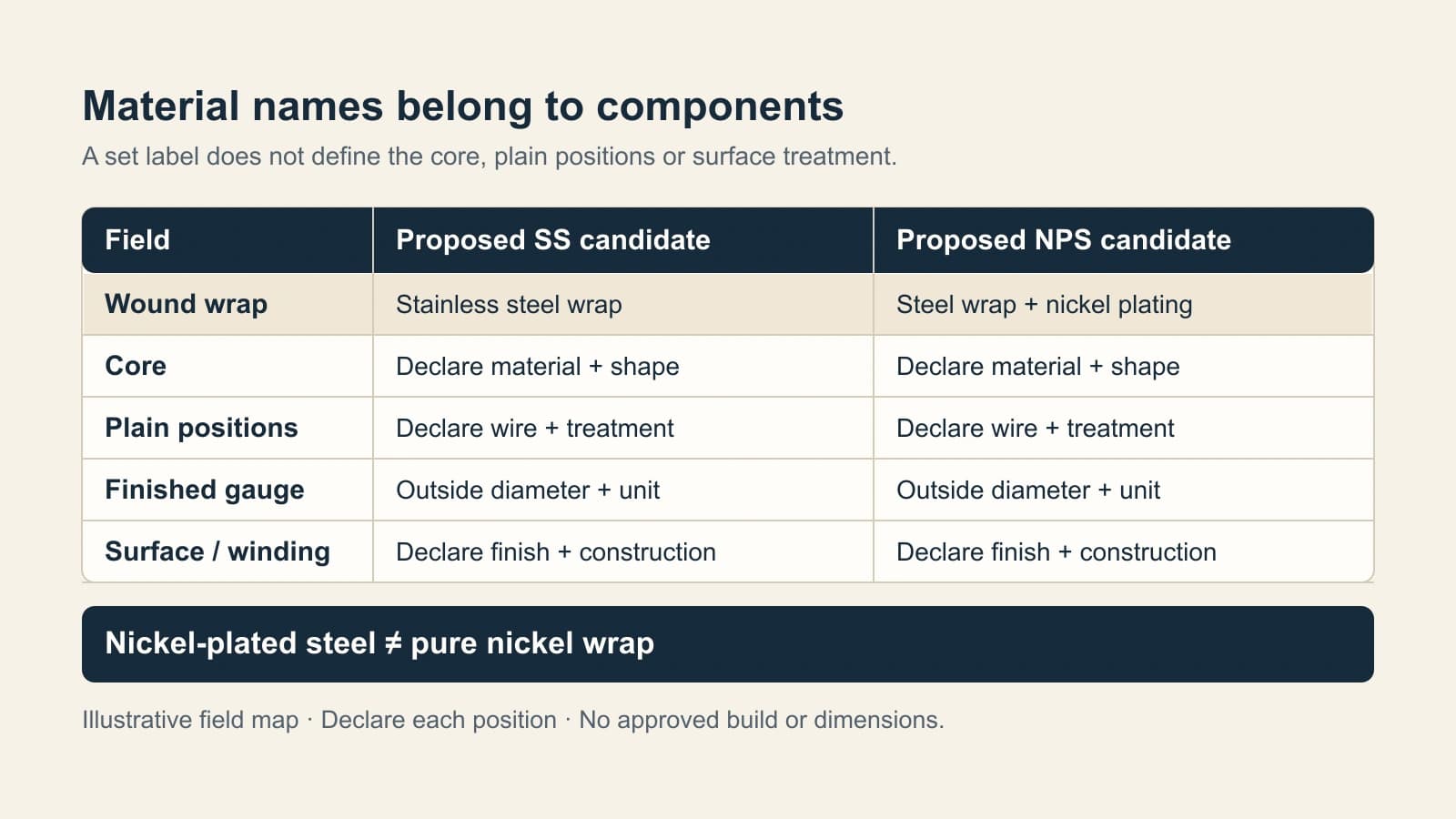
The round-core versus hex-core guide explains the core field. A common core-shape label or endpoint gauge range does not complete the material comparison.
Decide what the comparison can answer
A wrap-material comparison attempts to keep the other relevant construction and application conditions stable. A complete-product comparison evaluates offered sets with their documented differences. Both can support buying decisions, provided the conclusion uses the right scope.
Before sampling, compare all six position records. Ask whether finished gauges, plain/wound allocation, core specification, winding geometry, surface treatment, ends and installed lengths are matched, different or unknown. Keep any supplier dimension that has not been disclosed marked unknown. Two sets labeled 10–46 can have different middle gauges and internal construction; two nominally identical gauges can still have different cores or wraps.
If the proposed stainless candidate also changes core shape, coating or the wound third, record those differences before playing. The resulting notes can help choose that candidate for a range. They cannot isolate the effect of stainless wrap. Request another candidate with documented controls if that narrower question matters.
Use one reference guitar and record its tuning, scale, bridge, nut condition, action, intonation and tremolo state where applicable. Follow each candidate's actual installation instructions. If a technician must change the setup, record the intervention and distinguish observations before and after it. An unresolved fit problem should be corrected or referred for guidance before sound and feel are compared.
For a sequential trial on one guitar, record the installation order and time since installation. Use a comparable settling and playing routine for each fresh candidate. Changing from a well-used reference to a fresh set introduces string condition as another variable. Where practical, a further fresh-set comparison in the opposite order can help check whether the preference follows the candidate or the sequence; it does not turn the exercise into a universal material test.
Preparing a material comparison? Send the proposed six-position records, target use and reference-guitar conditions. Identify the fields already matched and those that are different or unknown so the sample question is clear.
Keep pickup, recording and surface observations separate
For amplified response, record pickup selection, any coil or active/passive mode, pickup height if relevant, guitar controls, cable, amplifier or modeler, effects and recording input settings. Keep those settings fixed for the first comparison. Record the pick and playing task as well: a different attack or pickup selection changes the conditions under which a preference was formed.
If output differences are part of the question, preserve the original recording levels and note the method used to compare them. If you also make a level-matched listening comparison, retain it as a separate version and record how the levels were matched. Turning the louder clip down can help answer a listening-preference question, but it removes that clip's original output level from the comparison. Do not infer a material's magnetic properties from one subjective loudness impression.
Then, if useful for the channel, try an individually optimized amplifier setting for each candidate. Mark this as a second task. It asks how each complete set works with an adjusted sound, whereas the first pass holds the signal chain stable.
Surface feel and sliding noise need their own tasks. Ask the same evaluator to use the same wound-string positions, slides and approximate playing pressure. Record whether notes concern finger drag, pick contact, sliding noise, bends or fretting effort. Note the string's condition and any coating or surface construction difference. An observation that one candidate felt smoother does not establish a friction measurement, longer life or reduced fret wear.
Listen across the declared plain and wound positions. A changed wound-to-plain balance can matter to a set decision, even if the plain strings are unchanged. Keep the complete set identity attached to that observation; avoid labeling every position with one blanket tone adjective.
Blank A/B observation card
This is an original planning tool. Its empty fields are for the actual review; no samples, measurements or winning material are represented below. Use A and B as codes and keep the material identity key separate when practical to reduce the influence of pack design or prior preference.
| Session record | Entry |
|---|---|
| A / B sample codes and specification revisions | ______ / ______ |
| Guitar ID, tuning and setup record | ______ |
| Construction comparison: matched / different / unknown fields | ______ |
| Pickup, controls and signal-chain record | ______ |
| Fixed-setting recording references and original-level notes | ______ |
| Level-matched version references and matching method, if used | ______ |
| Separately optimized settings and pass references, if used | ______ |
| Installation order, dates and observation time | ______ |
| Evaluator, pick and task definitions | ______ |
| Observation task | Candidate A | Candidate B | Position, conditions or deviation |
|---|---|---|---|
| Attack and response on declared wound positions | ______ | ______ | ______ |
| Balance between declared wound and plain positions | ______ | ______ | ______ |
| Finger drag and sliding noise in the same passage | ______ | ______ | ______ |
| Bending or fretting feel on the specified positions | ______ | ______ | ______ |
| Tuning/intonation observations after the stated routine | ______ | ______ | ______ |
| Visible surface condition at the recorded time | ______ | ______ | ______ |
| Preference for the target use, with reason | ______ | ______ | ______ |
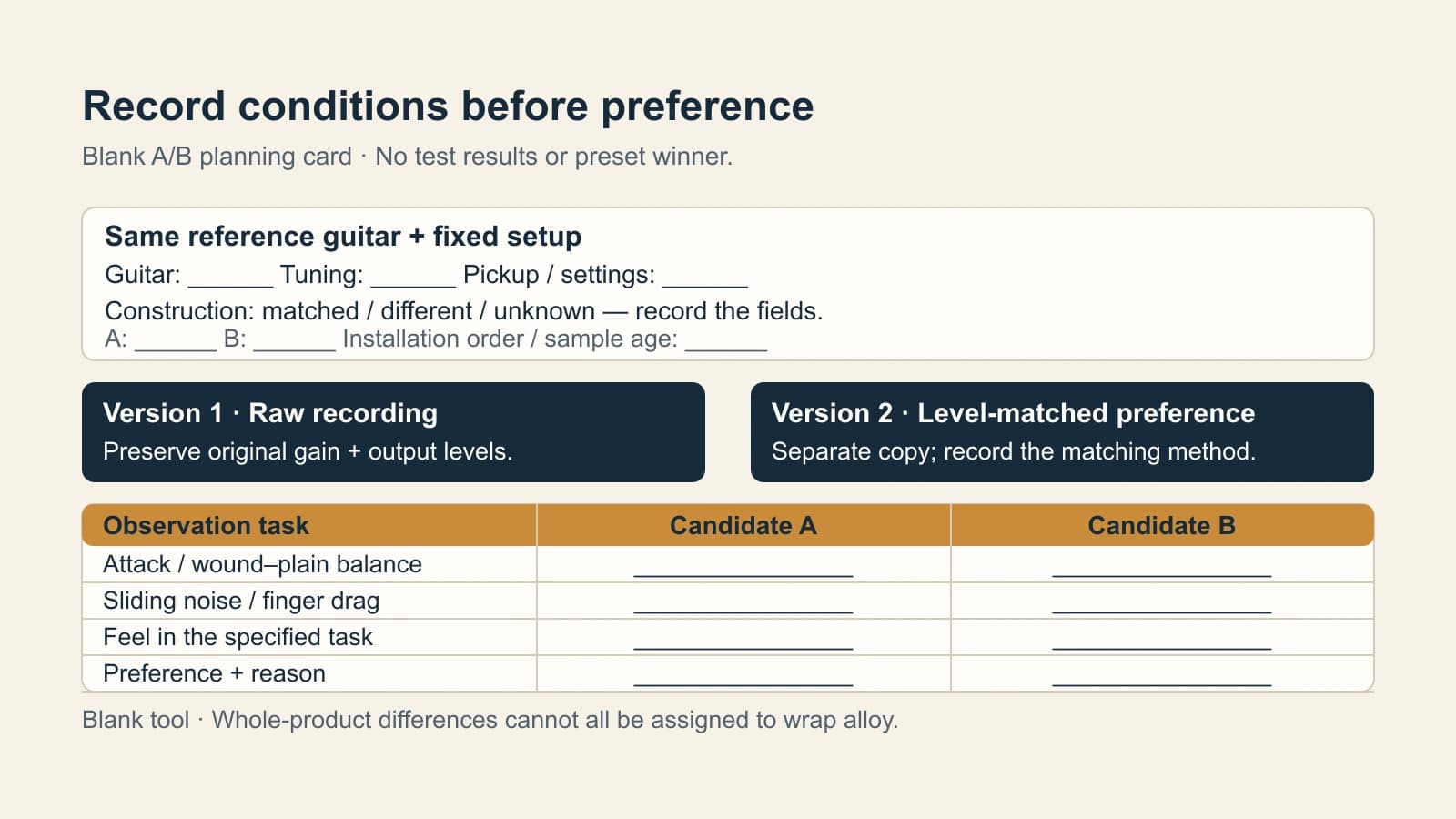
Keep observations in words unless an actual measurement method was agreed. If readings are collected, attach the method, units, instrument and raw records. Leave genuine disagreements visible instead of averaging them into an unsupported claim of consensus. The electric OEM sample-approval guide supplies the broader sample-identity and approval record; this card adds the material-comparison conditions.
Turn the notes into a supported range decision
Use the card to decide whether to retain the current candidate, request a revised comparison or propose distinct range roles. A channel-specific preference can support a buying decision without proving that one material is better for every guitarist. If evaluators cannot explain a useful difference under the intended conditions, duplicating the range may add stock complexity without resolving a buyer need.
Separate three evidence levels. A material declaration identifies the proposed build. A documented playing session supports observations on the named sample and guitar. A performance claim needs a method and evidence covering the actual product, comparison and conditions. A handheld diameter reading or visual inspection cannot by itself certify the alloy.
Lifespan, corrosion resistance and fret wear require their own evidence. A short A/B session cannot establish how long a string will last, a corrosion-resistance advantage or what a different fret material will experience. Define the exposure or use conditions, comparison, observation period and acceptance method before pursuing such claims. Preserve relevant sample and instrument records rather than substituting another maker's advertising description.
For range and packaging discussions, identify the wrap family accurately while declaring plain strings and cores separately. Link the accepted candidate code and construction revision to the intended SKU and copy. An attractive stainless label does not approve the construction behind it.
The electric guitar category is the appropriate product direction. The NPS regular-set page is a specification-brief example; its illustrative gauges do not confirm an approved stainless counterpart or a matched StringCrest A/B build. Actual sample options, constructions and commercial terms need confirmation for the project.
FAQ
Does a stainless-wrap set contain only stainless steel strings?
The set name does not establish that. Check the wound-string core and each plain-string specification. The attributed Ernie Ball examples above have stainless wrap around a separately declared steel core. Its August 2025 announcement identifies matching-gauge plain strings shared by the listed Slinky Nickel Wound and Slinky Stainless Steel families. That is a maker-specific example; declare every position in the proposed set.
Does the same printed gauge make two sets a fair alloy-only test?
Gauge is one control. Core dimensions, winding geometry, plain/wound allocation, treatment, installed fit and application conditions also need checking. If those differ or remain unknown, describe the trial as a comparison of the complete candidates.
Can a cleaner or brighter clip establish longer life or lower fret wear?
No. Those claims answer different questions and require their own method and product-specific evidence. A recorded clip can document a sound under stated conditions; it does not supply the missing exposure, use or wear observations.
Conclusion
A useful stainless-versus-NPS decision connects the actual components with a comparison the buyer can interpret. Declare wrap, core and plain strings separately, identify the controlled and open variables, and retain pickup, recording and surface observations with the sample codes. Use those notes to choose or revise a range direction within the evidence collected.
Send Your Material Comparison Requirements with the six-position constructions, reference guitar, intended playing tasks and completed or proposed A/B card. Mark any missing construction fields and the performance questions that still need separate evidence before packaging copy is approved.
FROM GUIDE TO PRODUCT
Connect this guide to Electric Guitar Strings.
Review the relevant range, then bring the instrument, complete specification and open questions into one project brief.
YOUR PRODUCT · YOUR BRAND
Discuss your next string project with Frank.
Share your instrument category, target market, gauge or material direction and private-label packaging requirements.

ABOUT THE AUTHOR
Frank Zou
Frank works directly with musical-instrument brands, importers and distributors on string specifications, product selection and private-label project requirements.
Meet Frank