
Product Selection
Product Selection
Round Core vs Hex Core Guitar Strings: An OEM Specification and Sample Guide
Compare core geometry with controlled gauges, alloy, winding, installation, sample records, packaging and inspection.
# Round Core vs Hex Core Guitar Strings: An OEM Specification and Sample Guide
Core shape is a construction field
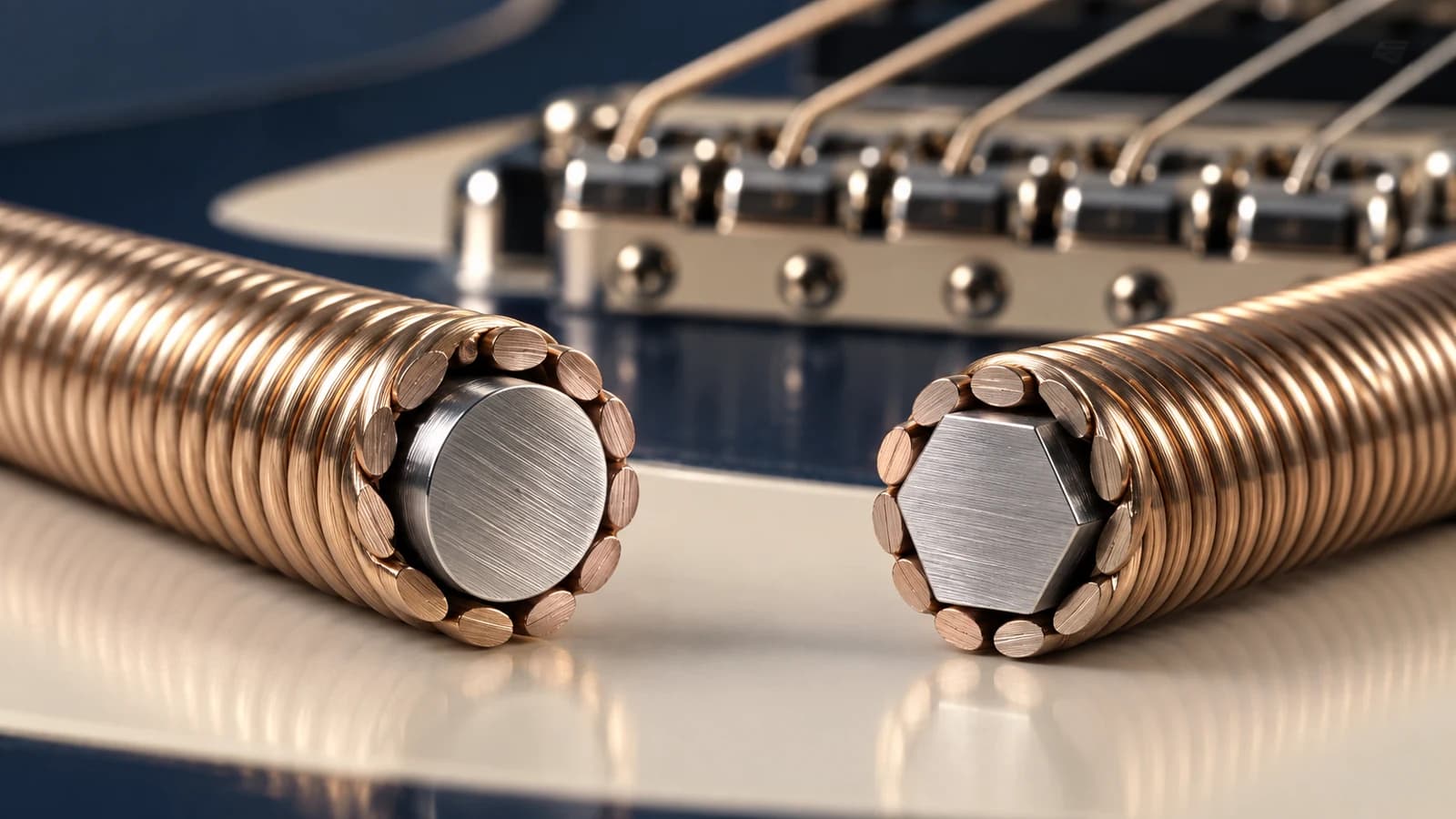
Round core and hex core describe the cross-section of the wire beneath a wound string. A round core has a circular section; a hex core has six sides. The terms do not describe whether the outside winding is roundwound or flatwound, and they do not apply in the same way to a plain, unwound string.
For an OEM buyer, the useful decision is whether a proposed construction suits the target instrument and player task. Ask for the complete set matrix, the supplier's installation instructions and candidates that can be compared under documented conditions. Core shape alone cannot establish a sound, tension, lifespan or quality ranking.
Separate core, wrap and finished diameter
A wound string combines a core and wrap wire. The finished outside diameter does not reveal the core dimensions or the core-to-wrap proportion. Two candidates with the same printed gauge may differ in material, wrap dimensions, construction and handling requirements.
DR's construction guidance gives a specific example of a round core and its wrap-retention arrangement. D’Addario's pure-nickel product description gives a separate hex-core example with a steel core and nickel wrap. These are named suppliers' constructions. They do not establish StringCrest availability or prove that either core geometry is better for every application.
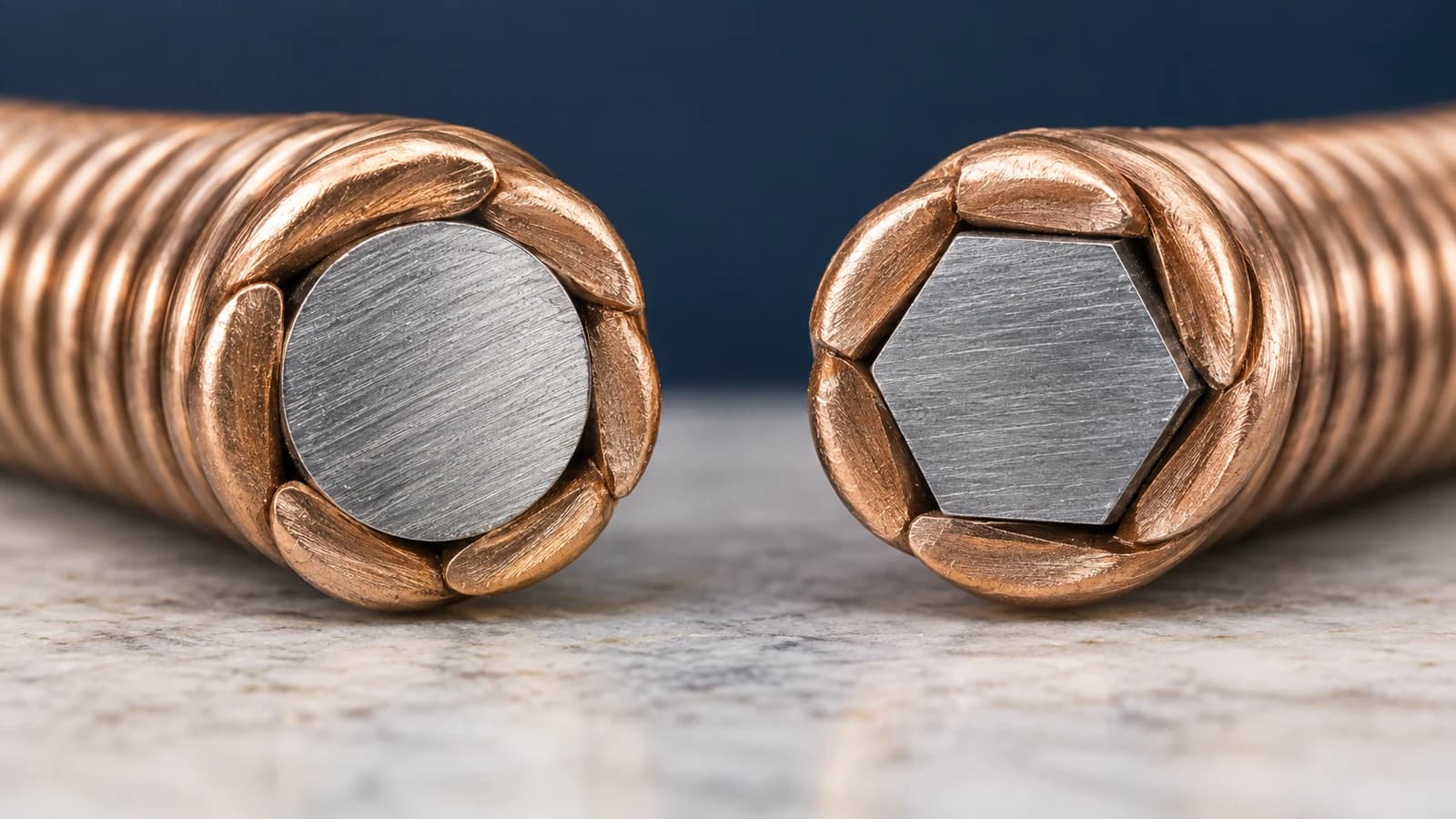
Use the specification request to separate fields that often get compressed into “round core” or “hex core”:
| Field | Why it changes the comparison |
|---|---|
| Instrument and intended tuning | Establishes the application |
| Position and finished gauge | Identifies the candidate within the complete set |
| Core material, geometry and dimensions | Defines more than the outside diameter |
| Wrap material and construction | May change surface and playing response independently |
| Coating or treatment | Keeps surface treatment separate from core geometry |
| End and usable length | Establishes physical fit |
| Trimming and installation instructions | Defines how the proposed sample should be handled |
If the supplier does not disclose a dimension, record what is actually known and the resulting limitation. The buyer can compare complete offered products, but should not describe that comparison as a controlled experiment isolating core geometry.
Follow the candidate's instructions before cutting
Installation can invalidate an otherwise useful comparison. A string that loses wrap retention after unsuitable trimming is not evidence that its normal playing response is inferior.
DR describes a flattened anchor in its round-core construction and a crimping procedure when trimming in the specified region. That published method explains why retention matters for those products. Obtain and follow the instructions for the actual candidate; do not apply a generic bend location or cutting sequence to every round-core string.
Ask how the supplied length reaches the nut and tuner, where any retention feature is located, and whether the end should be trimmed before or after securing it. Include the tuner type and reference instrument in the question. A locking tuner, slotted post and other attachment arrangements should be checked against their own instructions as well as the string guidance.
Record deviations during installation before starting tonal evaluation. If handling differs between candidates, describe the approved procedure used for each. For broader preparation, use the sample evaluation guide.
Choose what the A/B comparison can actually answer
There are two useful types of comparison. A controlled construction comparison attempts to change core geometry while keeping the other relevant specifications stable. A complete-product comparison evaluates the offered sets as they are, with all their differences disclosed. Both can support a purchasing decision; they answer different questions.
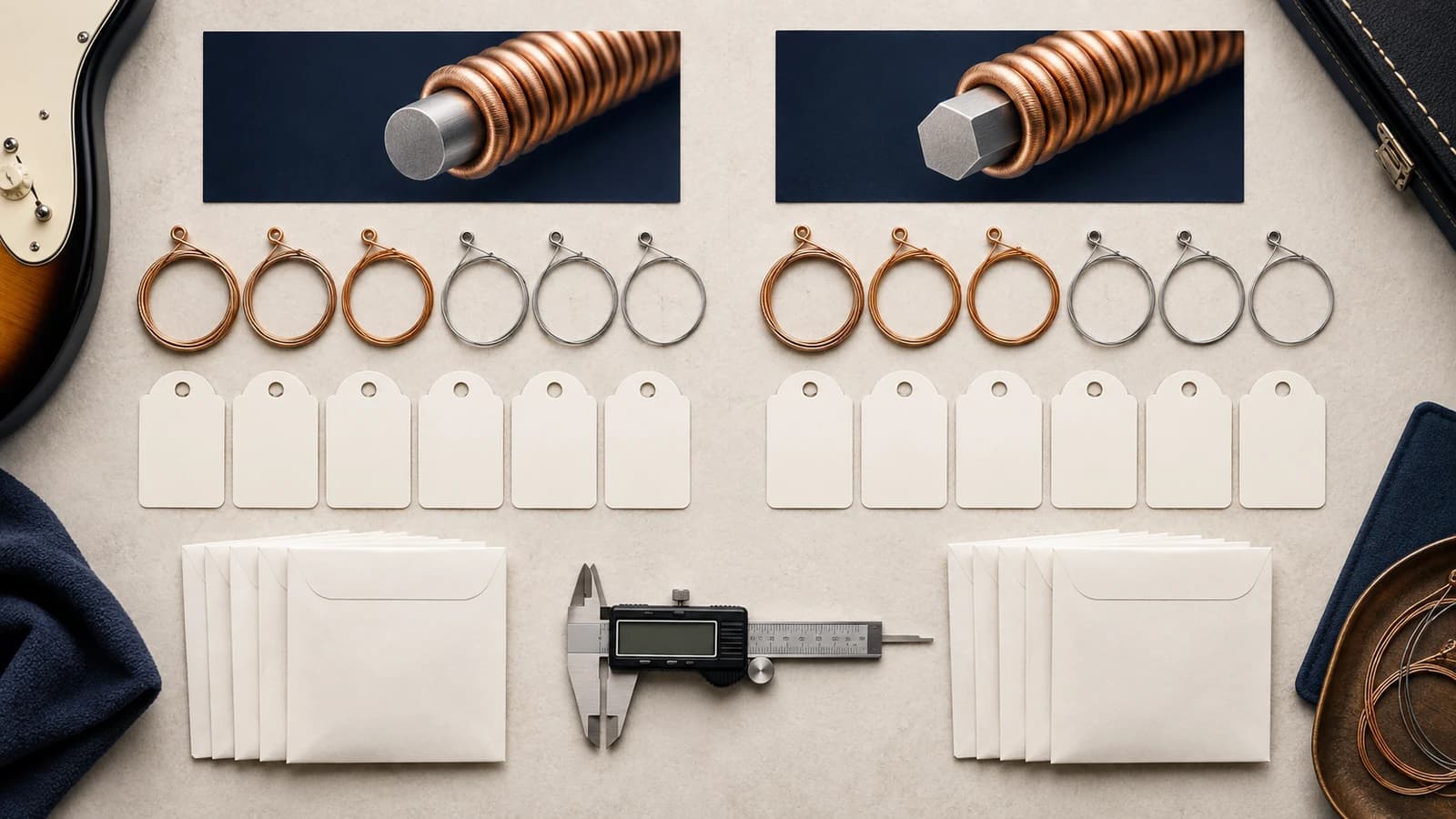
Before installing, compare the six position records rather than only the first and last gauges. Note every known difference in wrap alloy, finished gauge, coating, end, length and construction. Match tuning, instrument, setup, playing tasks and observation method as closely as practical. If those conditions cannot be matched, retain the result as a comparison of complete candidates rather than a claim about core shape alone.
For feel, ask evaluators to perform the same intended task: chord work, bending or another task relevant to the range. Describe what they experienced under those conditions. Avoid turning “this candidate felt easier to bend” into a measured tension result. Tension comparison requires the applicable pitch, vibrating length and construction-specific mass data; outside gauge alone is insufficient.
For electric strings, document pickup and recording settings if output or tone is being compared. For acoustic strings, document the instrument and recording conditions. Neither setup converts subjective notes into a universal tonal guarantee.
Use a comparison card that does not preselect a winner
| Question | Candidate A record | Candidate B record | Interpretation |
|---|---|---|---|
| Is the exact set identified? | Supplier record and revision | Supplier record and revision | Unidentified sets cannot support repeat orders |
| Which construction fields differ? | Declared fields | Declared fields | Determines whether geometry is isolated |
| Was installation completed as instructed? | Procedure and deviations | Procedure and deviations | Handling problems need separate investigation |
| Does each fit the target instrument? | Nut, bridge and tuner observations | Nut, bridge and tuner observations | Fit precedes a response preference |
| What did evaluators observe? | Same defined playing tasks | Same defined playing tasks | Findings apply to the recorded conditions |
| What remains unresolved? | Questions for supplier | Questions for supplier | A preference can be conditional |
Approve the chosen candidate by its product record and revision. Keep the handling instruction with the dealer information supplied for that product. If geometry, materials, coating, gauges or retention method change later, decide whether the earlier comparison still applies before reusing its claims.
FAQ
Does round core mean roundwound?
No. Core geometry describes the wire underneath; roundwound describes the outside wrap construction. Record them as separate fields.
Will a round-core string always have lower tension?
No conclusion follows from the geometry label alone. Numerical tension depends on the specified pitch, vibrating length and string's mass per unit length. Perceived flexibility during playing is a separate observation.
Can we identify the core from a photograph of a finished coil?
A general coil photograph does not establish hidden core geometry or dimensions. Use the supplier's specific record, appropriate drawing or controlled inspection for the candidate. An illustrative cutaway is an explanation, not product verification.
Can one installation instruction cover every candidate?
Only if the relevant suppliers and hardware guidance support it. Otherwise retain the candidate-specific instructions and document how the comparison was performed.
Conclusion
The stronger OEM decision identifies what was compared, how it was installed and what the observations can support. Specify core shape within the complete construction, then select an approved product for the intended application instead of using geometry as a universal quality label.
Turn the comparison into a sample brief. Send the candidate specifications, reference instrument and decision your samples need to support.
FROM GUIDE TO PRODUCT
Connect this guide to StringCrest product ranges.
Review the relevant range, then bring the instrument, complete specification and open questions into one project brief.
YOUR PRODUCT · YOUR BRAND
Discuss your next string project with Frank.
Share your instrument category, target market, gauge or material direction and private-label packaging requirements.

ABOUT THE AUTHOR
Frank Zou
Frank works directly with musical-instrument brands, importers and distributors on string specifications, product selection and private-label project requirements.
Meet Frank