
Product Selection
Product Selection
Acoustic vs Electric Guitar Strings: A Dealer’s Compatibility and Range Guide
A dealer decision path for cross-family replacements, acoustic-electric instruments and distinct wholesale range identities.
Introduction
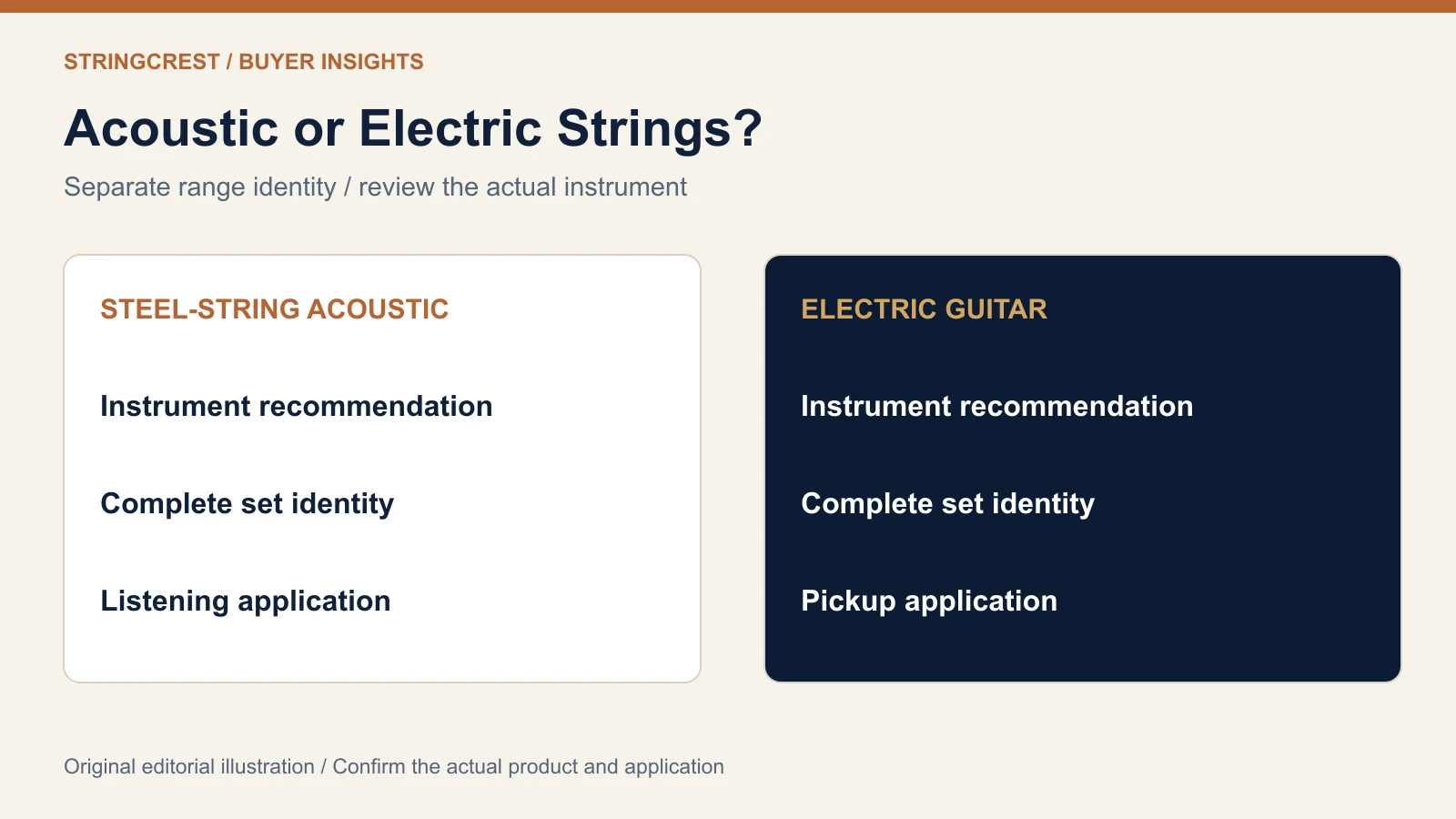
Acoustic and electric guitar strings should be selected for the actual instrument, its intended setup and the way its sound is captured. Similar-looking packets, matching first and last gauges or a shared ball-end attachment do not establish an interchangeable set. Begin with the guitar maker’s recommendation, then identify the complete construction and the customer’s application.
For a dealer, the most useful distinction is between a suitable replacement and a proposed experiment that requires review. A customer asking for strings for an “acoustic-electric” guitar is describing an instrument with amplification, not necessarily requesting an electric-guitar set. Ask about the guitar and pickup system before choosing a shelf section.
This guide helps retailers and private-label buyers create separate, explainable acoustic and electric ranges. It concentrates on cross-family selection and product identity, rather than ranking alloys or prescribing a universal gauge.
Establish the instrument family at the counter
Ask for the instrument model or a clear description. Separate steel-string acoustics, electric guitars and classical instruments before discussing tone preferences. A customer's use of “acoustic” may refer to a classical guitar, which makes a broad metal-string recommendation unsuitable.
Confirm what is currently installed when that information is available. The packet, purchase record or maker’s specification gives a stronger starting point than a guess based on the guitar’s shape. If a customer is unsure, keep the recommendation conditional until the instrument can be identified.
An existing replacement history can also be useful, but it deserves checking. “The last shop fitted these” records a previous decision; it does not establish that the product matched the guitar maker’s requirements or that the customer wants the same result again.
For the classical-versus-steel distinction, use the nylon and steel compatibility guide. The comparison below concerns steel-string acoustic and electric applications after the instrument family has been established.
Understand what the material names describe
Steel-string acoustic ranges commonly include bronze-family outer windings, such as phosphor bronze and 80/20 bronze. Electric ranges commonly include nickel-plated steel, pure nickel and stainless-steel directions. A material name may describe the wrap on a wound string rather than every component of the set.
D’Addario’s acoustic-string overview describes acoustic materials and construction. Fender’s electric-string guide separates material, core and winding choices in its electric range. These are industry references, not a list of confirmed StringCrest stock items.
When buying a set, distinguish its plain positions from its wound positions. Two products can share plain steel trebles while using different wound-string constructions. That shared element does not turn the complete sets into the same product.
For a detailed acoustic alloy decision, see the acoustic range-planning guide. Here, the purchasing task is to keep the intended instrument and complete set attached to the material description.
Ask how the instrument captures sound
The pickup system matters because “plugged in” does not describe one mechanism. Fender explains that its steel electric strings work with magnetic pickups. An acoustic-electric instrument may use a different pickup arrangement, or a combination, so a retailer needs the relevant model information.
Avoid a blanket promise that any bronze-wound set will behave like an electric set through every magnetic pickup. Equally, do not claim that any string sold for electric guitar is automatically unsuitable for every acoustic application. The useful response is to review the instrument’s requirements and the proposed complete set.
Ask where the customer's concern occurs: in the room, through an amplifier or in a recording. A preference heard acoustically may differ from an amplified observation. That distinction helps staff decide which demonstration would answer the customer’s question.
Handle hybrid instruments individually
An instrument with several sound sources deserves an application-specific recommendation. Use the maker’s string specification and document which outputs the customer actually uses. A broad shelf label such as “hybrid” cannot replace that information.
Keep pickup review separate from attachment fit
A set can attach successfully while leaving a pickup-response question unresolved. The reverse can also occur. Approve the physical installation and the intended listening result as separate observations.
Compare complete sets rather than gauge labels
The first and last printed gauges are a shorthand, not the whole order specification. Check each string position, its plain or wound construction and the intended tuning. Products marketed with similar gauge names can have different intermediate strings or construction details.
An illustrative comparison begins with two identified candidate sets and one stated application. The buyer records the complete sequences and asks the instrument technician whether either candidate requires setup work. A changed setup is then recorded as part of the comparison rather than omitted from the result.
| Ordering question | Why a dealer needs the answer | Evidence to request |
|---|---|---|
| Which instrument and model? | Establishes the intended application | Maker’s recommendation or confirmed service record |
| What is each string position? | Separates plain and wound construction | Complete position specification |
| Which pitch and setup? | Makes the installed comparison interpretable | Tuning and setup notes |
| How will the sound be heard? | Defines the customer’s relevant task | Acoustic and amplified listening context |
The acoustic gauge guide and electric gauge assortment guide provide more detailed range-specific planning. Do not copy one range’s gauge assumptions into the other simply to simplify purchasing.
Review attachment and installed fit
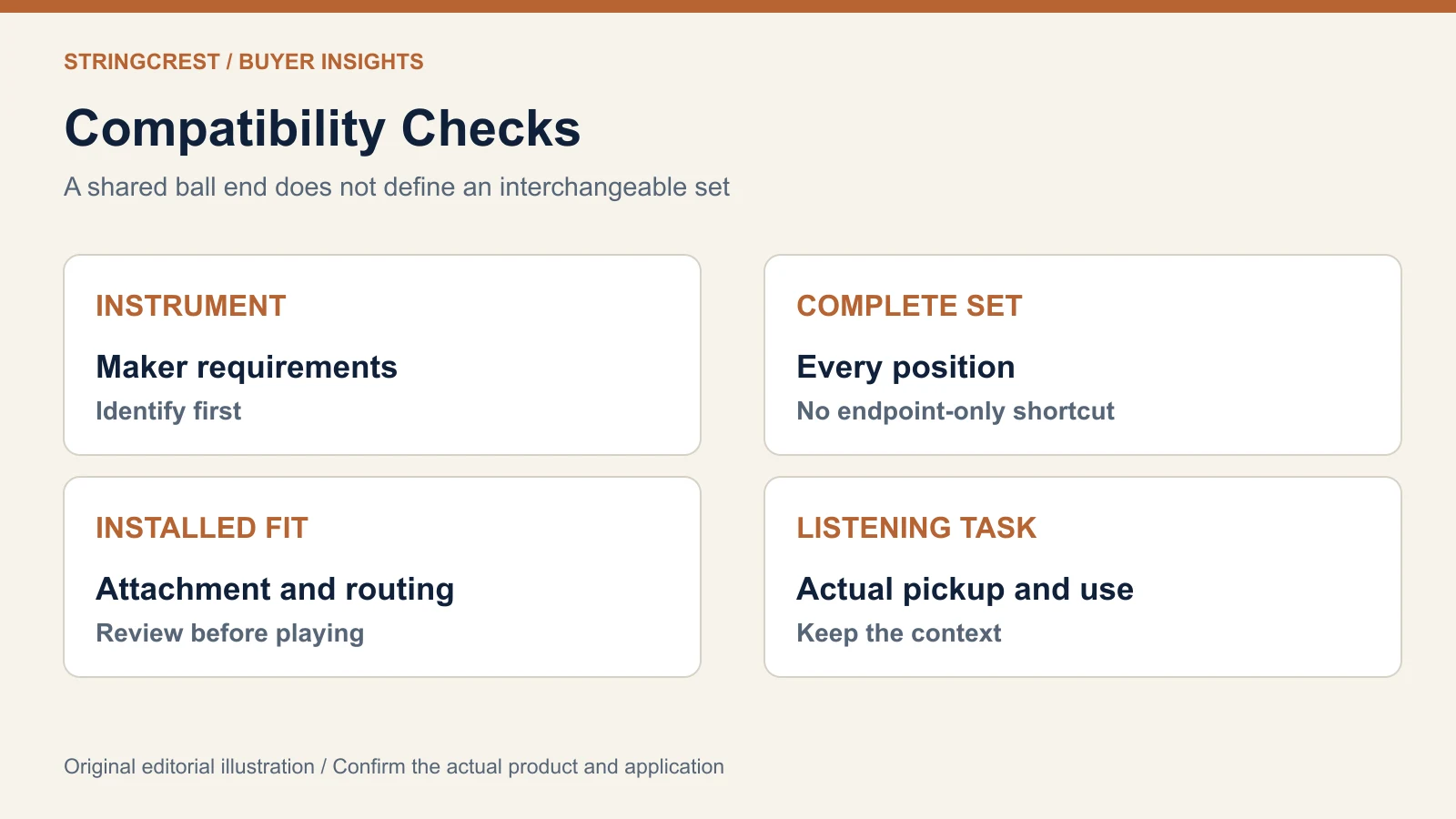
Both families may include ball-end products, but a common end description does not guarantee identical fit. Confirm the intended bridge attachment, overall length, relevant wound length and tuner requirements for the actual instrument. Any uncertainty about seating or routing belongs with competent installation review.
A dealer should not use a successful physical installation as the whole compatibility argument. The intended construction, setup and response remain part of the recommendation. A set that can be brought to pitch has not necessarily passed the proposed application review.
For wholesale purchasing, define which instrument configurations a packet is intended to serve. Keep exceptions out of the main shelf claim until they have a supported application basis. A short, accurate description is more useful than an expansive “fits all guitars” statement.
Installation preparation should establish the guitar’s condition and the permitted procedure before comparing products. Staff should preserve any original observations when a customer has already fitted an unexpected set.
Answer substitution requests without guessing
A customer may ask whether an electric set can be used on an acoustic because that is the packet available at home. Start with the instrument maker’s requirements and the exact proposed set. If the substitution changes the approved configuration, explain what needs assessment before recommending it.
An illustrative counter response is: “Please show us the guitar model and the full set information. We will check the intended construction, installation requirements and how you use the instrument before recommending that substitution.” It acknowledges the request while avoiding a promise based only on the packet category.
If the customer’s main goal is lower playing resistance, address that goal within a suitable family first. A different instrument category is an incomplete proxy for feel. Setup, complete construction and the actual playing task can all matter to the result being evaluated.
The same approach applies to a supplier offering an alternative during replenishment. The buyer should receive a clear list of proposed differences and decide whether a new sample review is needed. A temporarily available product does not automatically inherit the previous SKU’s application claims.
Keep tone comparisons tied to an actual task
Tone descriptions can help someone choose a candidate, but they should lead to a defined demonstration. Ask whether the customer is listening for chord definition, response under their picking style or a particular amplified balance. Record the instrument and signal path used for that review.
Avoid changing several conditions while presenting the outcome as an isolated material result. If the guitar was adjusted, the pickup setting changed or a different player performed the demonstration, say so. The observation may still be useful, but its scope is different.
An importer evaluating both ranges can use separate acoustic and electric sample sessions. The acoustic session answers the needs of the intended steel-string instruments; the electric session uses the intended pickup and playing applications. The sessions can share a record format without pretending that one instrument represents both markets.
Build shelf labels that answer the customer’s first question
Put the intended instrument family where a customer can see it. Follow with the material direction and complete set identity appropriate to that product. Gauge information, any relevant coating description and the exact product code should remain readable at the point of selection.
Do not make packet color the only distinction between acoustic and electric products. A picking team, an online buyer or a customer with a saved photograph may not interpret the color system correctly. Written identity also helps when artwork changes.
For acoustic-electric customers, include an explanation in the online buying guide rather than inventing a universal compatibility badge. The staff question should still be about the instrument’s specified strings and pickup arrangement.
Keep the online filter names consistent with those front-panel descriptions. An acoustic set should not enter an electric filter merely because both products contain steel components. A product serving an explicitly reviewed exception needs its own explanation in the relevant listing. The category label is a navigation aid, while the specification describes the accepted application.
For a customer searching by gauge, show the family alongside the result. That helps them recognize that a matching printed size is only one part of selection. If the complete position lists differ, make the difference available before purchase rather than asking the customer to discover it during installation.
Where a dealer supplies schools or rental instruments, connect the range identity to the instrument group in the replenishment record. An administrator ordering replacement stock may know the packet code more readily than the guitar's construction. A clear reference lets staff check the right family before approving another carton.
An illustrative private-label shelf decision
A buyer plans one acoustic range and one electric range under the same brand. The design uses a common visual system, while the front panels name different instrument families and product constructions. The buyer declines a shared “universal guitar strings” statement because the proposed products have separate applications. This example describes an artwork decision, not a completed StringCrest range launch.
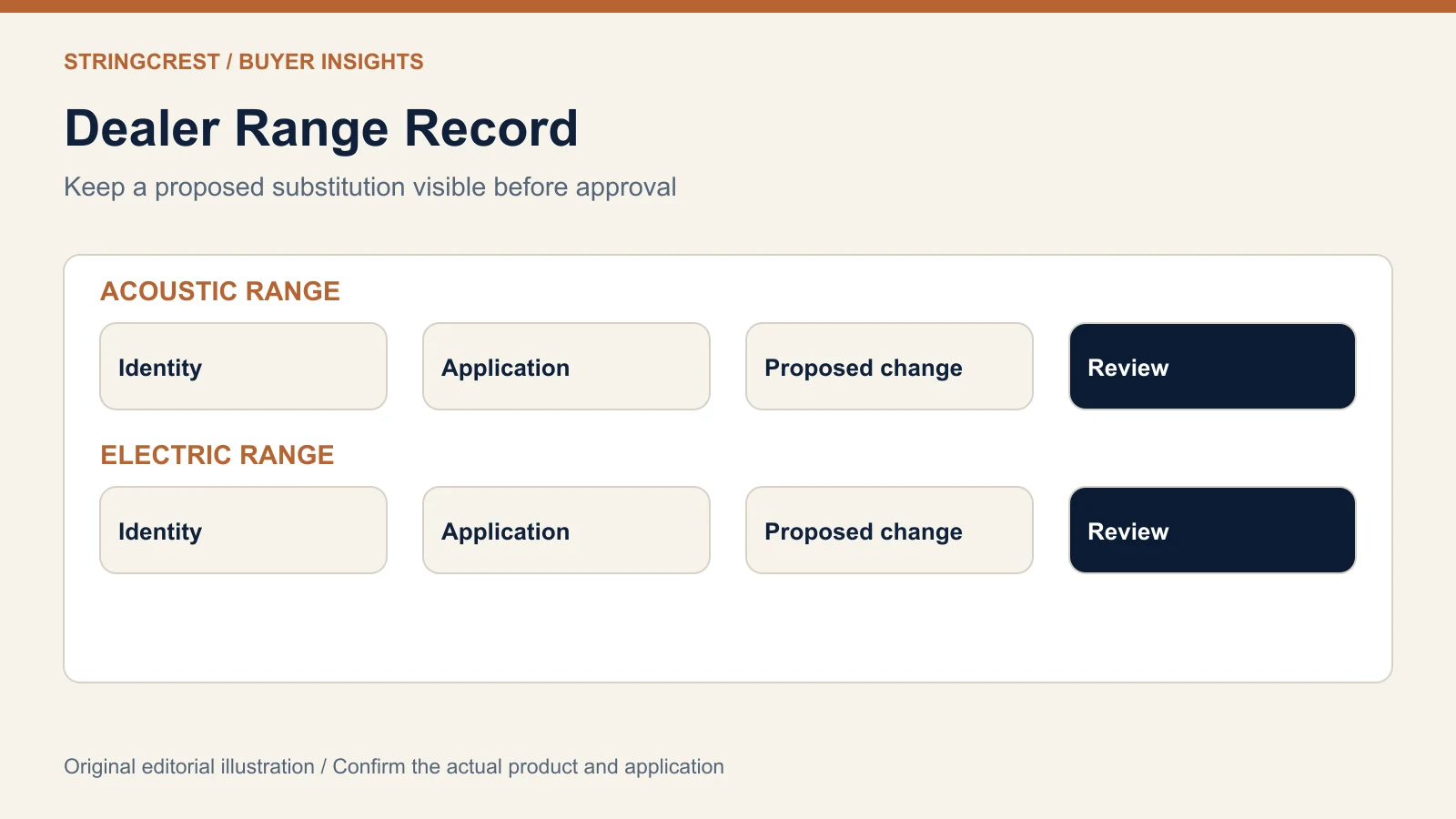
Keep substitutions visible in the product master
A wholesale product master should link each SKU to its intended instrument family, construction and approved sample. Add any application restrictions that sales staff need to explain. Keep the product master aligned with carton labels, web descriptions and customer care guidance.
When purchasing proposes a substitute, show its differences explicitly. An acoustic wrap change, an electric winding change or an altered intermediate string can require a different review even when the packet still carries a familiar gauge name. Decide which current recommendation remains supported.
An approved substitute should receive a traceable identity and effective revision. If it is only a temporary proposal, do not quietly replace the product description on the dealer’s order record. Staff need to know which strings the customer actually received.
For an acoustic range or an electric range, StringCrest can discuss the customer specifications to be agreed for the order. Product availability and minimum order requirements need confirmation against the product and packaging brief; the comparison in this guide does not establish availability of every construction mentioned.
Turn a compatibility question into a useful enquiry
Send the actual instrument category, maker’s recommendation where available, string count and intended tuning. Include the complete candidate specification and the question the sample should answer. A buyer asking for acoustic strings with a specific feel needs a different comparison from one investigating magnetic pickup response.
If the proposal crosses product families, explain why. Cost, emergency replacement, customer preference and a planned new range are different reasons, which can lead to different review requirements. State which existing product is the reference and which differences are being considered.
Request supplier information relevant to those differences rather than a general “premium quality” assurance. A construction declaration, complete position list and identified sample are useful starting points. Factory testing should be requested only with a defined question and agreed interpretation; it cannot replace the instrument application review.
Consider an illustrative order enquiry from a dealer whose customers use both unamplified steel-string guitars and acoustics with fitted electronics. The buyer initially asks for one replacement set. The next step is to identify the actual instruments and their recommended constructions, then decide whether a common approved set is appropriate or separate references are needed. The answer depends on the resulting application review, not the convenience of one carton code.
Give the supplier the unresolved question explicitly. If the guitar or pickup identity is missing, request the information before interpreting a sample response. A supplier can explain a proposed string construction, but an incomplete instrument description limits what can be concluded about the installation. Keep that limit in the enquiry so sales staff do not turn a preliminary proposal into a confirmed recommendation.
During shipment inspection, check that the supplied product, packet and carton identity match the accepted specification. That inspection is a conformance check. It does not create a new compatibility claim for an instrument outside the approved scope.
FAQ
Are acoustic and electric guitar strings interchangeable?
Do not assume that complete sets are interchangeable. Check the guitar maker’s requirements, every string position, installation fit and intended response. A shared attachment or similar gauge label is insufficient evidence for a universal recommendation.
Does an acoustic-electric guitar need electric guitar strings?
The instrument’s amplification does not by itself determine the string family. Follow the maker’s specification and identify the pickup arrangement. A steel-string acoustic with electronics may still require its specified acoustic set.
Why can two sets have the same gauges but feel different?
The gauge sequence does not describe every internal or surface feature. Compare the actual construction, installed conditions and playing task. Avoid treating the printed endpoint gauges as a complete explanation of the experience.
Can a retailer choose a substitute using packet color?
Use written product identity and the complete specification. Color can support a visual system, but it should not be the only evidence. Artwork changes and similar colors across ranges can otherwise make the recommendation ambiguous.
Should a classical guitar enter this comparison?
Identify classical instruments separately and use their maker’s string requirements. This guide compares steel-string acoustic and electric applications; it is not authorization to fit a steel set to a classical instrument.
What should an importer request before approving a range?
Request a complete product definition, identified samples and the proposed packet wording. Establish the intended instrument applications and evaluate relevant fit and playing tasks. Confirm commercial requirements for the actual accepted brief.
Conclusion
The acoustic-versus-electric decision becomes useful when it identifies a suitable product for a particular instrument and use. Material, pickup system, complete construction, attachment and setup each answer part of that decision. A broad packet category answers only the first question.
For dealers and private-label buyers, maintain separate range identities and make proposed substitutions visible. That gives staff a recommendation they can explain and a supplier brief that describes the actual compatibility question.
Sources and interpretation limits
D’Addario’s acoustic-string overview and Fender’s electric-string guide were checked on 11 October 2026. They explain their own products and general selection concepts. Their construction examples, specifications and performance descriptions do not verify equivalent StringCrest products. Dealer scenarios here are illustrative; actual compatibility follows the instrument and accepted product requirements.
FROM GUIDE TO PRODUCT
Connect this guide to Acoustic Guitar Strings.
Review the relevant range, then bring the instrument, complete specification and open questions into one project brief.
YOUR PRODUCT · YOUR BRAND
Discuss your next string project with Frank.
Share your instrument category, target market, gauge or material direction and private-label packaging requirements.

ABOUT THE AUTHOR
Frank Zou
Frank works directly with musical-instrument brands, importers and distributors on string specifications, product selection and private-label project requirements.
Meet Frank