
Product Selection
Product Selection
Acoustic Guitar String Gauges for Wholesale: Planning 11–52, 12–53 and 13–56 Sets
A buyer-first way to compare three acoustic gauge ranges without guessing the four inner string gauges.
Introduction
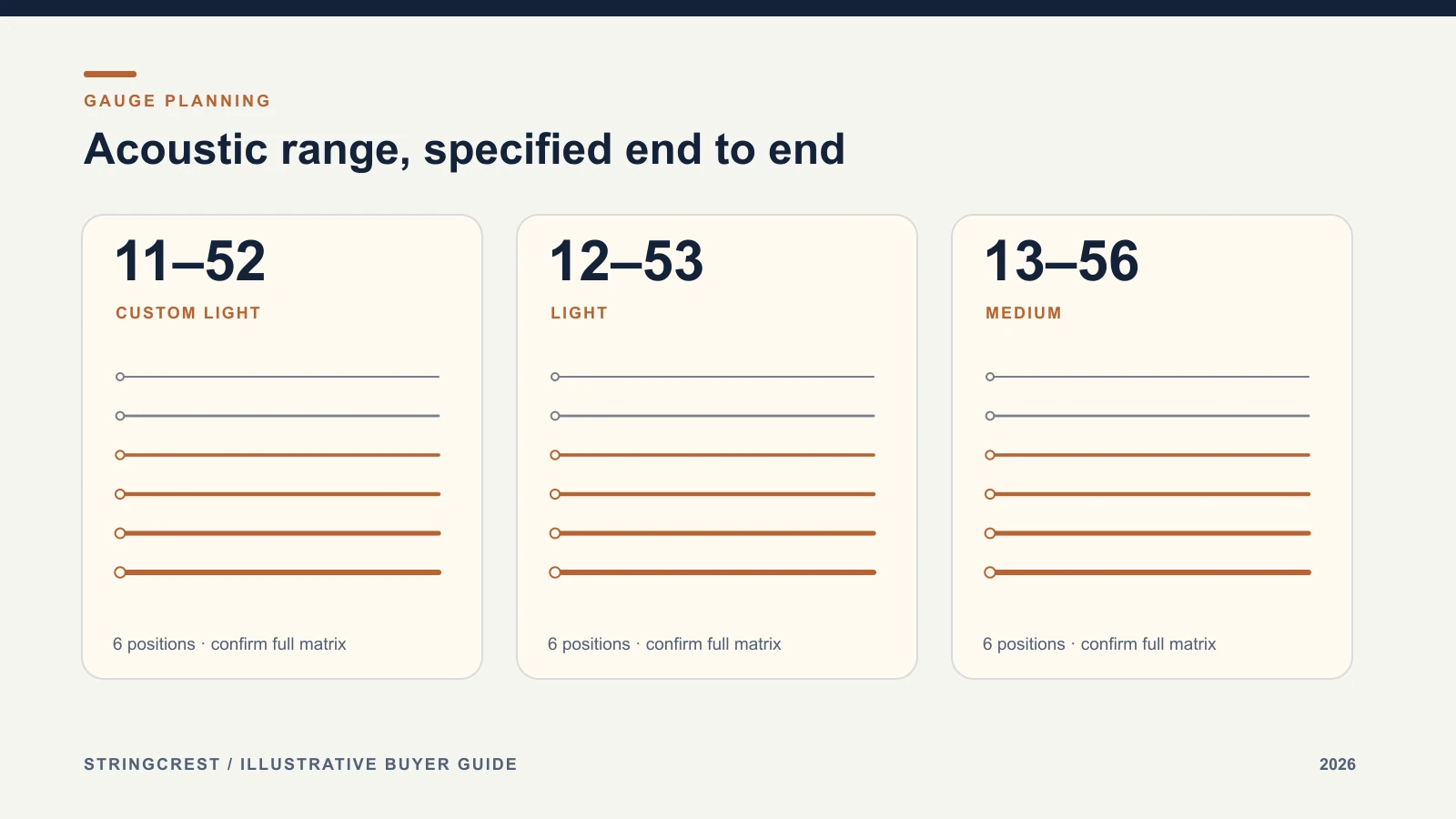
An importer choosing acoustic guitar string gauges needs more than three numbers on a carton. 11–52, 12–53 and 13–56 describe the first and sixth string diameters, not the complete six-string specification. Two sets with the same outside numbers can have different middle gauges, wrap materials, core designs and playing feel. The useful purchasing question is therefore not “Which gauge sells best?” but “Which instruments and players will each set serve, and can we approve a repeatable six-position specification?”
This guide is for distributors, private-label teams and product managers building a small acoustic range. The three ranges are familiar market examples, not confirmed StringCrest stock-keeping units, sales rankings or tension promises. D’Addario lists these gauge families in its own acoustic range, while Martin advises players to consider the guitar maker’s recommendations and setup when changing gauge. Neither company’s construction or performance claim transfers automatically to a different string. The practical method below turns those examples into a controlled request for quotation and a sample decision.
Start with the job each set must do
A three-set assortment can look comprehensive on a spreadsheet and still confuse a dealer. Give each candidate a reason to exist. For example, an 11–52 set might be evaluated for customers who ask for a lighter fretting feel; a 12–53 set can serve as the reference against which other candidates are judged; and a 13–56 set can be explored for players who want a firmer response if their instruments are suitable. These are positions in an evaluation plan, not claims that a gauge guarantees a sound or fits every guitar.
The sequence matters. First identify the instruments, playing styles and price tier your dealer network actually serves. Next select a baseline set already familiar to those customers. Only then test whether a lighter or heavier choice creates a useful distinction. Without that baseline, feedback such as “the medium set feels better” cannot tell the buyer whether the difference came from gauge, alloy, action height, a fresh installation or the individual guitar.
| Candidate label | Illustrative outside gauges | Purchasing question | Approval risk |
|---|---|---|---|
| Custom Light | 11–52 | Does a lighter top change the intended playing experience? | The four unlisted diameters and winding may vary. |
| Light | 12–53 | Can this act as the controlled reference set? | A familiar label does not define construction. |
| Medium | 13–56 | Is a firmer option appropriate for the target instruments? | Higher tension may call for a setup review or may be unsuitable. |
Do not infer demand from those labels. A dealer's point-of-sale reports, returns, customer questions and instrument mix are stronger evidence for assortment size than a generic “best-selling gauge” statement. If those records are unavailable, treat the first purchase as a measured pilot and keep the assortment deliberately small.
What the gauge name leaves out
Record every position, not only the outer pair
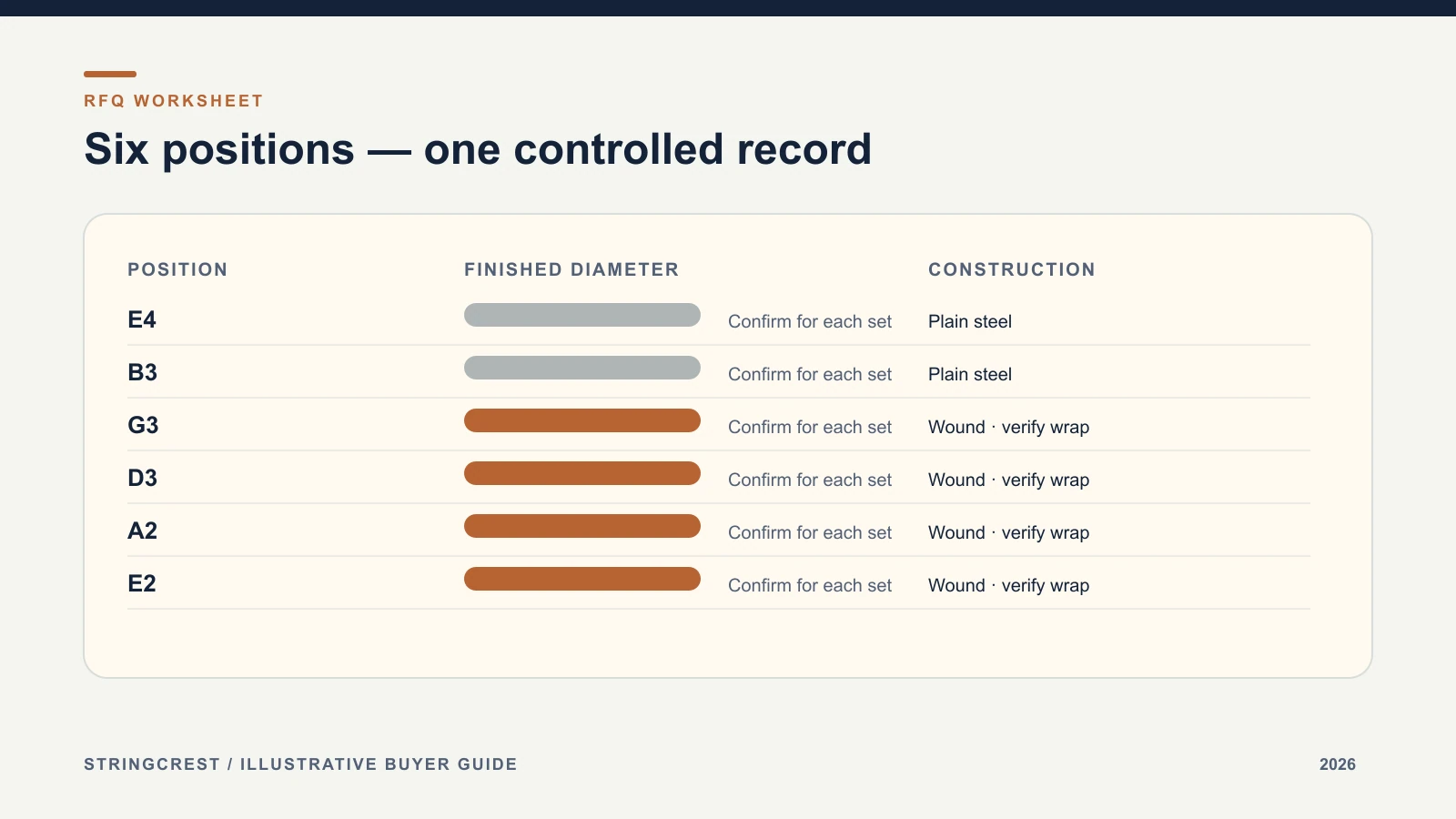
Acoustic six-string sets are normally described from the high E through B, G, D, A and low E positions. The pack-facing shorthand gives only the smallest and largest diameters. Request a six-row schedule showing note or position, finished diameter in thousandths of an inch or millimetres, plain or wound construction, core material, wrap material, end construction and proposed tolerance. A 12–53 label cannot tell you whether the G is plain or wound, what the D and A measure, or how the wrap is made.
Use one unit convention in the approved master record and show the other only as a conversion if needed. Decimal points and leading zeros are easy to lose between artwork, an RFQ and a production worksheet. Write “.012 in” or “0.012 inch” rather than “12” in technical files. The retail pack can use a concise format after the specification is locked. Keep the product code on every sheet so a revised matrix cannot be mistaken for the previous one.
Use the string gauge measurement and inch/mm guide when defining how each position will be measured and recorded.
Keep alloy and construction fixed during a gauge comparison
Phosphor bronze and 80/20 bronze are distinct wrap families in the market. Coated and uncoated surfaces introduce another comparison. If one 11–52 sample uses 80/20 bronze and a 13–56 sample uses phosphor bronze, the evaluation cannot isolate the effect of gauge. For an initial comparison, ask for the same wrap alloy, coating decision, core approach, winding specification and end type across all three candidates where technically feasible. Record any unavoidable difference explicitly.
Even with those controls, a numerical gauge does not by itself specify tension. Pitch, scale length, material and string construction matter. A maker’s published tension table belongs to that maker's particular set and test assumptions; it is not a transferable specification for a proposed StringCrest set. If your assortment needs a tension target, request a position-by-position calculation or measurement with the assumed scale and tuning stated, then approve the target separately from the pack label.
Define ends and usable length
Most conventional steel-string acoustics use a ball-ended string seated at the bridge, but the buyer should still specify the end and the length needed for the instrument. The full distance from the seated ball to the tuner, plus a practical winding allowance, matters more than a photograph of a coiled string. On bridge-pin instruments, the ball must seat against the bridge plate as intended; Fender’s bridge-pin explanation describes that seating step. An image of a loop end, or a ball too large for a particular bridge, should not become an accidental approved standard.
For a private-label pack, document whether the set is intended for standard six-string acoustic guitars only. A 12-string instrument requires a different string count and position map. A nylon classical guitar does not become compatible because it shares a nominal high-E diameter; its construction and bridge attachment are different. The straightforward label “Steel-string acoustic guitar · six strings” avoids two preventable customer-service errors.
Decide whether the instrument can take the change
Treat the guitar, not the carton, as the limit
Martin’s gauge guidance cautions that moving to heavier strings increases load and can require a setup review; it also tells owners to check the instrument maker's recommendations. That caution is especially relevant when a retailer suggests a 13–56 set to a buyer who previously used a lighter gauge. Bracing, top condition, neck relief, saddle, nut slots and playing style all affect the decision. No wholesale article can certify a gauge for an unknown guitar.
Ask sample testers to note the guitar model, scale length if known, prior gauge, tuning and setup condition. Install the candidate on a sound instrument and let it settle before judging tuning and feel. If the action changes or fret buzz appears, separate an installation or setup issue from the set itself. Do not describe a stiffer feel as a defect when it follows an intentional gauge change; equally, do not dismiss a fit issue by saying the player must “get used to it.” A useful review asks what the product promised and whether the particular guitar can support it.
Compare candidates on matched instruments
Ideal comparisons use the same model of guitar and similar setup, or the same instrument in a documented sequence with fresh strings each time. That is rarely a perfect laboratory experiment: wood instruments vary, the player adapts and humidity changes. A practical dealer trial can still be disciplined. Note installation date, climate, play duration, pick or fingerstyle use, tuning, perceived fretting force, balance across positions, noise and any early winding or end issue. Keep comments descriptive and avoid false precision such as an invented “20% brighter” result.
If the customer mix includes light fingerstyle and firm flatpicking, invite both use cases into the sample review. The goal is not to prove one gauge “wins.” It is to learn whether each proposed set has a credible audience and whether its packaging tells that audience enough to choose appropriately.
Build a quote that can be compared
A price attached to “12–53 bronze” is difficult to compare. It may represent a different alloy, wrap ratio, protective packaging, string count or inspection scope from another supplier's quote. Give each prospective supplier the same controlled specification sheet. Leave genuinely undecided items marked “proposal requested,” not blank; otherwise each quote silently fills the gap in a different way.
| RFQ field | What to state or request | Why the buyer needs it |
|---|---|---|
| Instrument and tuning | Six-string steel-string acoustic; intended E–A–D–G–B–E or stated alternative | Prevents a wrong family or tuning assumption. |
| Gauge schedule | All six finished diameters and tolerance | Makes equivalent offers comparable. |
| String construction | Plain/wound by position, core, wrap and coating decision | Defines the actual set behind the shorthand label. |
| End and length | Ball geometry, usable length and installation reference | Reduces bridge and tuner fit uncertainty. |
| Packaging | Individual-string identity, set barrier and outer label | Protects identity through picking and retail handling. |
| Approval record | Sample revision, test instrument, acceptance notes | Connects the purchase order to the accepted sample. |
Ask for quote components that matter to your channel: sample terms, packaging options, target quantity and shipping terms. Do not assume a universal MOQ or delivery window. A buyer should confirm those commercially with the supplier for the actual construction and packaging artwork. If a quote changes after the sample, compare the revised bill of materials and label against the approved version before accepting it.
Plan a sample review by decision, not by applause
Use one reference and two controlled alternatives
Start with a light reference set chosen for your market. Then test the 11–52 and 13–56 candidates against it under the same alloy and package identity. If the light set itself is not confirmed, approve its six-position schedule first. A three-way comparison of unfinished concepts can consume time without producing a decision.
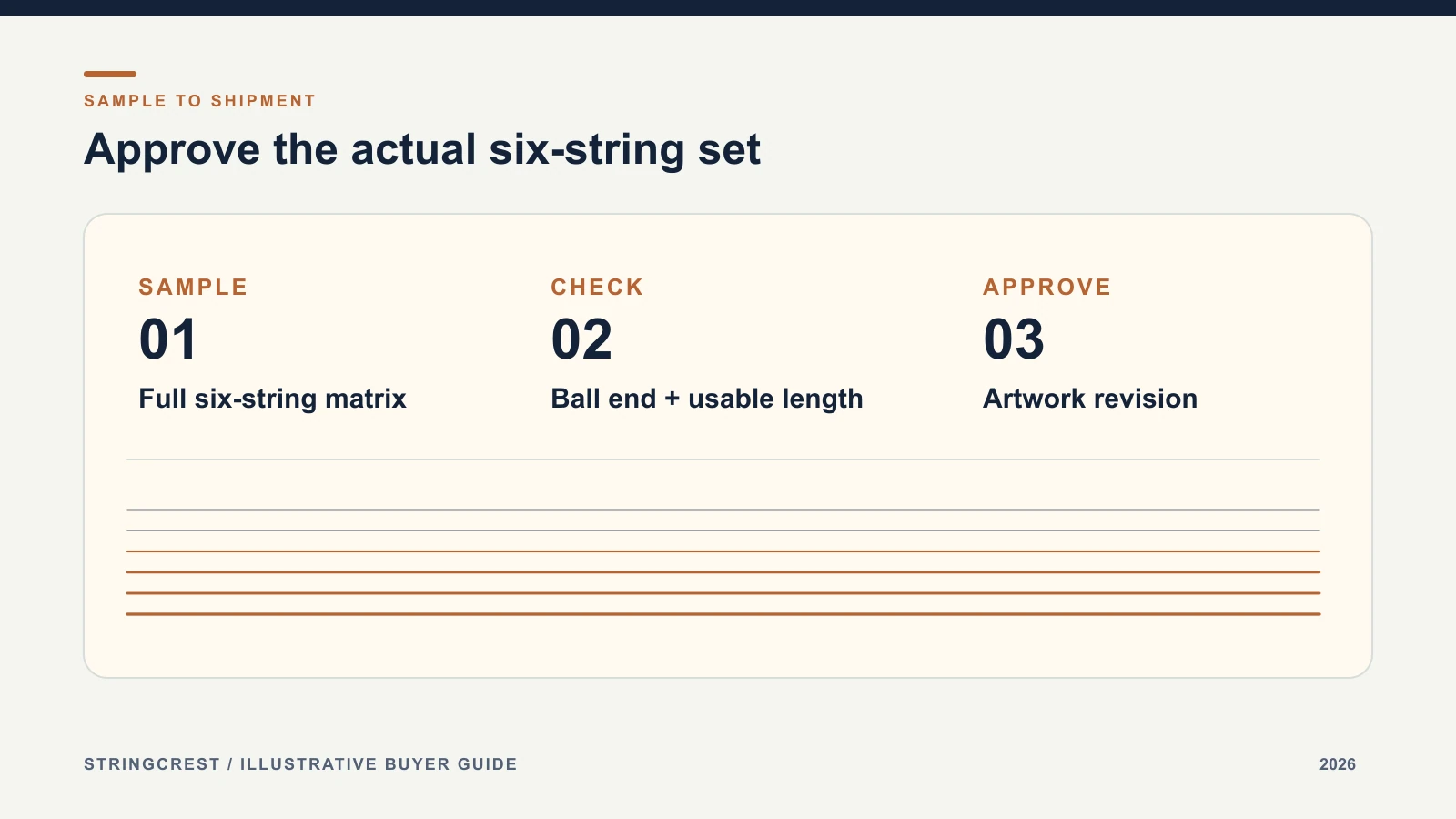
For each candidate, request at least one clearly labelled sample set per test instrument and a spare set for checking consistency. “At least one” is an evaluation suggestion, not a promise about StringCrest sampling policy. A sample card should state the exact six gauges, string materials, revision code and packing date if available. The tester should record whether the first and sixth strings correspond to the carton, and whether the middle four positions are correctly identified. These simple checks catch a surprising share of avoidable approval confusion.
Separate sensory notes from measurable checks
Playing feel, dynamic response and sound are useful but subjective. Capture them in a short standard form. Measurable checks include position count, nominal diameter, end appearance, visible winding consistency, actual usable length and whether each string installs without an obvious fit conflict. If a buyer wants tensile strength, corrosion resistance, coating thickness or any other laboratory claim, agree the method and threshold before testing. A generic “factory tested” badge without an agreed test plan does not establish a meaningful specification.
Reviewers should note an uncertain result as uncertain. One unusually dry guitar or a fresh setup can change the impression. A second instrument or a repeat sample may be justified before deciding which gauge gets a separate SKU. Keep the sample record attached to the artwork and purchase-order revision; an attractive package cannot compensate for a different set inside.
Make the range understandable at shelf and in search
The front of a pack can show the instrument family, six-string count, full or shorthand gauge and wrap material. The back or digital product data should give the complete six-gauge sequence and any specific construction statements that have been confirmed. Clear product names help a dealer’s inventory system as much as they help a player. “Acoustic Guitar Strings · Phosphor Bronze · 12–53 Light” says far more than “Premium Acoustic Set.”
Avoid claiming that one gauge is “best for beginners,” “safe for all vintage guitars” or “maximum projection.” Such claims depend on the instrument and player. A more reliable approach describes the selection direction and adds an instrument-fit reminder. A 13–56 pack can say that it offers a firmer gauge option, with a note to follow the guitar maker’s guidance when moving up from lighter strings. A retailer can then advise a customer without interpreting a broad performance promise.
Private-label artwork needs version control. Record the approved copy, barcode, six-position matrix, string code and language version. During a proposed change, check the physical set and digital listing together. If the supplier changes a middle gauge while the pack still says the old matrix, the error can appear in a shipment, a marketplace listing and customer support at once. One master record, one revision identifier and one named approver are simple safeguards.
Inspect the first shipment against the approved set
Shipment inspection begins with identity, not an elaborate laboratory. Select a documented sample of cartons or retail packs and verify that the label, code, gauge family and quantity match the purchase order. Open selected sets to check six distinct positions, individual sleeves or identifiers, ball ends and visible condition. Measure diameters using an agreed tool and tolerance if this is part of the contract. Record the sample size and any exceptions rather than writing “all good” on an untraceable sheet.
Inspection should also look for damaged barriers, wrong language panels, mixed gauge stickers or a 12-string image on a six-string product. If a question arises, quarantine the affected lot and compare it with the retained sample and master specification. No buyer should present this suggested checklist as evidence that a particular factory performed these checks on a past shipment. It is a practical inspection plan to agree before ordering.
For repeat orders, keep a concise change log. Ask the supplier to flag changes to core or wrap supply, gauge sequence, packaging materials, end geometry and approved artwork. The buyer can then decide whether to accept a documented equivalence, request another sample or treat the proposal as a new SKU. Consistency is a process of identifying and approving changes, not merely ordering the same outside numbers twice.
FAQ
Is a 12–53 set always the correct starting point?
No. It is a useful comparison reference because that label appears in major makers’ ranges, but your instruments, customers and current assortment determine the starting point. Confirm the full six-position construction before treating any 12–53 set as your baseline.
Can I use the same tension figures for another supplier’s 11–52 set?
No. Published tension figures describe a particular maker’s materials, construction, pitch and assumed scale. Ask for a calculation or test tied to the proposed set and state the tuning and scale used. A shared outside gauge is not proof of equal tension.
Should every acoustic range contain a 13–56 option?
Only if the target instruments and buyers justify it. Check guitar-maker guidance, test fit and setup, and review actual channel demand. A smaller range with clearly differentiated choices may serve dealers better than an unvalidated three-tier lineup.
What should be on the sample approval sheet?
Include the six-position gauge and material schedule, revision, installation instrument, tuning, observations, measurable checks, package version and named approval decision. Record unresolved points explicitly so they cannot become silent assumptions in the production order.
Does the gauge label tell me the alloy or coating?
No. “11–52” expresses outside diameters only. Wrap alloy, coating, plain/wound allocation, core and end construction are separate choices. Put those fields in the RFQ and confirm them on the physical sample.
Conclusion
The strongest wholesale acoustic range is one a buyer can explain, compare and reorder without guessing. Begin with the target instruments and customers. Specify every string position. Hold construction constant when comparing gauges. Check setup and instrument suitability before calling a heavier set “better.” Approve samples and artwork against the same master record, then inspect early shipments for identity and fit. The numbers 11–52, 12–53 and 13–56 are useful signposts; the controlled six-string specification is the product.
If you are planning a branded acoustic range, send your gauge matrix, instrument types and packaging requirements. StringCrest can discuss which constructions and sampling options are available for your brief; no unconfirmed gauge, lead time or production claim is assumed here.
Sources
- D’Addario acoustic guitar string collection — maker-specific examples of 11–52, 12–53 and 13–56 families.
- Martin: How to Choose a String Gauge for Your Acoustic Guitar — instrument suitability and setup considerations; Martin’s advice is specific to its own guitars.
- Fender: Why Bridge Pins Can Affect Your Acoustic Performance — how a ball end seats in a bridge-pin instrument.
FROM GUIDE TO PRODUCT
Connect this guide to Acoustic Guitar Strings.
Review the relevant range, then bring the instrument, complete specification and open questions into one project brief.
YOUR PRODUCT · YOUR BRAND
Discuss your next string project with Frank.
Share your instrument category, target market, gauge or material direction and private-label packaging requirements.

ABOUT THE AUTHOR
Frank Zou
Frank works directly with musical-instrument brands, importers and distributors on string specifications, product selection and private-label project requirements.
Meet Frank