
Product Selection
Product Selection
Acoustic Guitar Strings for Fingerstyle: A Wholesale Gauge, Material and Sample Guide
A wholesale method for translating fingerstyle technique into six-position gauges, material comparisons, repeatable samples and a clear acoustic range role.
Introduction
Selecting acoustic guitar strings for fingerstyle is not a search for one universally “best” set. Fingerstyle describes a broad family of techniques in which the picking hand assigns fingers to individual strings, alternating bass and treble parts, arpeggios, melody and accompaniment. Instruments, touch, repertoire, setup and tonal preference vary widely. A wholesale range should therefore turn the word “fingerstyle” into a clear application brief and a controlled sample plan.
The string decision still rests on familiar technical inputs: steel-string acoustic instrument, six-position tuning, scale, complete gauges, core and wrap direction, material, coating or treatment, ball end, usable length and packaging. Gauge and construction influence feel, but they do not work independently of action, relief, nut and saddle condition or the player’s attack. Material names such as phosphor bronze and 80/20 bronze identify important product families, yet they do not guarantee a single response across every design.
This guide helps brands, distributors and product managers define a fingerstyle-oriented acoustic set without inventing performance claims. It focuses on six-string steel-string acoustic guitars; it does not apply the same specification to nylon classical strings. It does not state StringCrest MOQ, lead time, production capacity, proprietary formulas, universal compatibility or customer-tested results. Confirm commercial and technical details through the current project quotation and approved installed sample.
Translate “fingerstyle” into observable requirements
Describe the playing pattern
Begin with the tasks the range should support. A player may alternate bass notes with the thumb while the fingers play melody, use sustained arpeggios, combine fretted notes with open strings, add percussive attacks or move between fingerstyle and light strumming. These techniques place different priorities on bass-to-treble balance, individual-note clarity, left-hand resistance and dynamic range.
Write three to five sample passages or task descriptions rather than a single adjective. For example: alternating bass with treble melody, quiet arpeggio, open-position chord with separated notes, melody above held bass, and a brief strummed transition. The evaluation does not need a public song recording; it needs repeatable actions that each sample can undergo.
Fender’s description of fingerpicking and Travis picking supports the idea that fingers can serve distinct string roles, including an alternating bass part. It does not identify a specific string formula. Use the technique explanation to define tasks, then let the proposed strings and reference guitars answer the product question.
State who the set is for
A dealer core set, a lighter-feel option, a fingerstyle-specific specialist SKU and a balanced general acoustic product have different merchandising roles. Define whether the range targets experienced players with a specific preference, mixed-technique customers or retailers who need a simple step from an existing set.
Avoid making “fingerstyle” a decorative label on an otherwise undefined pack. The product team should be able to explain what was evaluated, which gauge and material family was approved, and how the SKU differs from adjacent acoustic sets.
Confirm the instrument category and fit
Separate steel-string acoustic from classical guitar
This article addresses steel-string acoustic guitars with ball-end steel strings. Classical guitars use a nylon-string system and different bridge attachment. Do not install steel strings on an instrument designed only for classical nylon strings.
The buying brief should say “six-string steel-string acoustic guitar” and identify the reference body and scale. If a range also needs classical or folk nylon products, create a separate specification and sample program. Mixing those categories in one request creates a serious fit and communication risk.
Measure the installed path
Record nut-to-saddle scale, bridge type, ball seating, saddle path and tuner locations. Photograph the current installation. Confirm overall and winding length for all six positions, and note any unusual bridge pin or tuner constraint.
Most steel-string acoustic sets use ball ends, but the buyer should still specify the required end and inspect it. Gauge changes can interact with nut slots, action and relief. A sample may need a setup review, and that condition should be documented instead of hidden behind a “universal fit” claim.
| Input | What to record | Why it matters for a fingerstyle sample |
|---|---|---|
| Guitar | model or controlled reference, body style | keeps comparisons on the same platform |
| Scale | measured nut to saddle | affects tension direction |
| Tuning | pitch for all six positions | defines the operating condition |
| Setup | action, relief, nut and saddle state | affects playability and noise |
| Technique tasks | bass, melody, arpeggio, mixed passage | makes subjective feedback more repeatable |
| Baseline set | exact construction and gauges | gives every observation a comparison |
Build a complete six-position specification
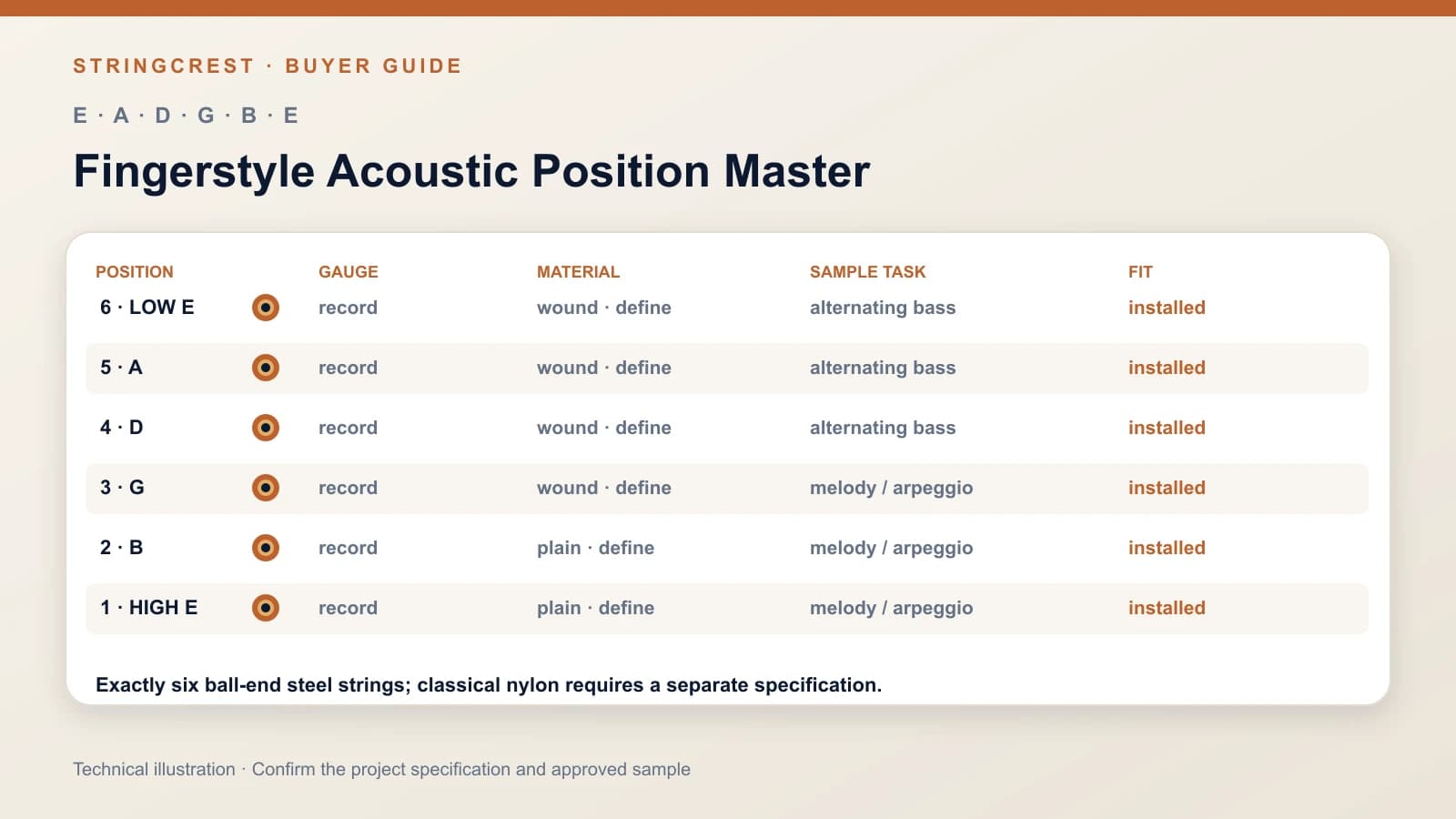
Record E A D G B E and every gauge
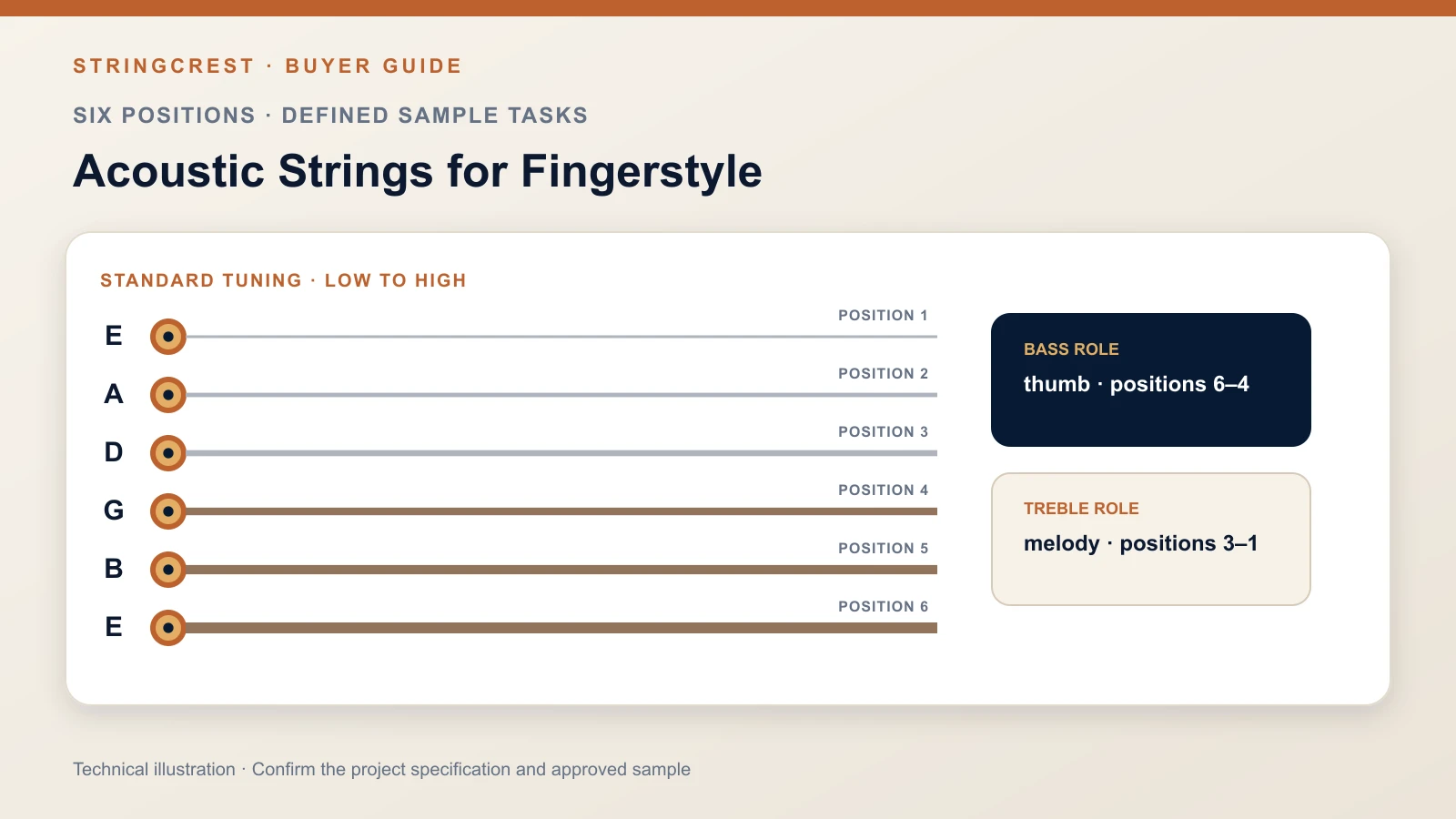
Use one row for each position, clearly stating whether the list runs low to high. A standard-tuning brief can show low E2, A2, D3, G3, B3 and high E4. Add finished gauge, unit, plain or wound status, core direction, wrap material, coating or treatment, ball end, overall length and winding length.
Do not specify the set only as “light” or by its first and sixth gauge. Those labels vary across product lines, and the four middle strings determine much of the bass-to-treble progression. A fingerstyle review needs to know exactly which position changed between samples.
Give each version a development code. Put the code on the sample pack and feedback record. Once approved, connect the final table with artwork, barcode and purchase-order revision.
Keep gauge progression tied to the application
A buyer may explore a lighter overall feel, a firmer bass side, or another deliberate progression. None is automatically correct for all fingerstyle players. The proposed sequence should relate to the intended technique tasks and the reference set.
When comparing gauges, change one clear variable at a time. A sample that changes every gauge, material and treatment may sound different, but it does not reveal which decision should be retained. A controlled ladder produces more useful feedback and supports later change control.
Evaluate phosphor bronze and 80/20 bronze carefully
Treat material as a construction input
Phosphor bronze and 80/20 bronze are established acoustic wrap-material categories. Manufacturers often describe them with different tonal language. Those descriptions help buyers understand market positioning, but the actual result also depends on the core, wrap, gauge, treatment, guitar and player.
If the project compares material, hold complete gauges, scale, setup and evaluation tasks as stable as practical. Label each sample only with the information evaluators need or use a blind code when appropriate. Record observations against the baseline rather than converting them into broad claims.
Avoid declaring one material “best for fingerstyle”
One player may prefer a more prominent top end; another may prioritize a different bass character or a familiar aged-in response. The retailer may need both a core material and an alternative. A fingerstyle application does not erase these preferences.
Describe the approved product by its verified construction and the sample context. If packaging uses tone language, keep it moderate and consistent with the final set. Do not state frequency response, lifespan or corrosion performance without an applicable method and evidence.
Review gauge and tension without oversimplifying
Gauge is not the whole calculation
Tension depends on pitch, vibrating length and unit weight. Finished diameter influences unit weight, but internal construction matters. Two wound strings with the same nominal gauge can differ when their core and wrap relationships differ.
Use verified unit-weight data for the proposed construction when available and keep pitch and scale assumptions explicit. If the data are unavailable, avoid precise calculated claims. Compare installed samples with an identified baseline and record the limitations.
Review each transition, not only the set total. Fingerstyle playing can expose uneven bass-to-treble feel because the picking hand addresses strings independently. The goal is not necessarily equal numerical tension. The goal is an intentional progression that supports the product brief.
Include setup and player touch in the record
Lower action, strong thumb attack, altered tuning and a light right-hand touch can produce different impressions from the same set. Note who evaluated the sample, the guitar, setup, tuning and task. If the sample required nut, relief or intonation adjustment, record it.
This does not make evaluation useless; it makes it honest. The buyer is selecting a product for a defined range role, not proving that every musician will report the same feel.
Design an effective fingerstyle sample protocol
Establish a stable baseline
Install and document the existing reference set before changing anything. Record its age or use condition because a fresh sample compared with a heavily used baseline may produce misleading conclusions. Ideally compare fresh sets under a consistent preparation and stabilization process.
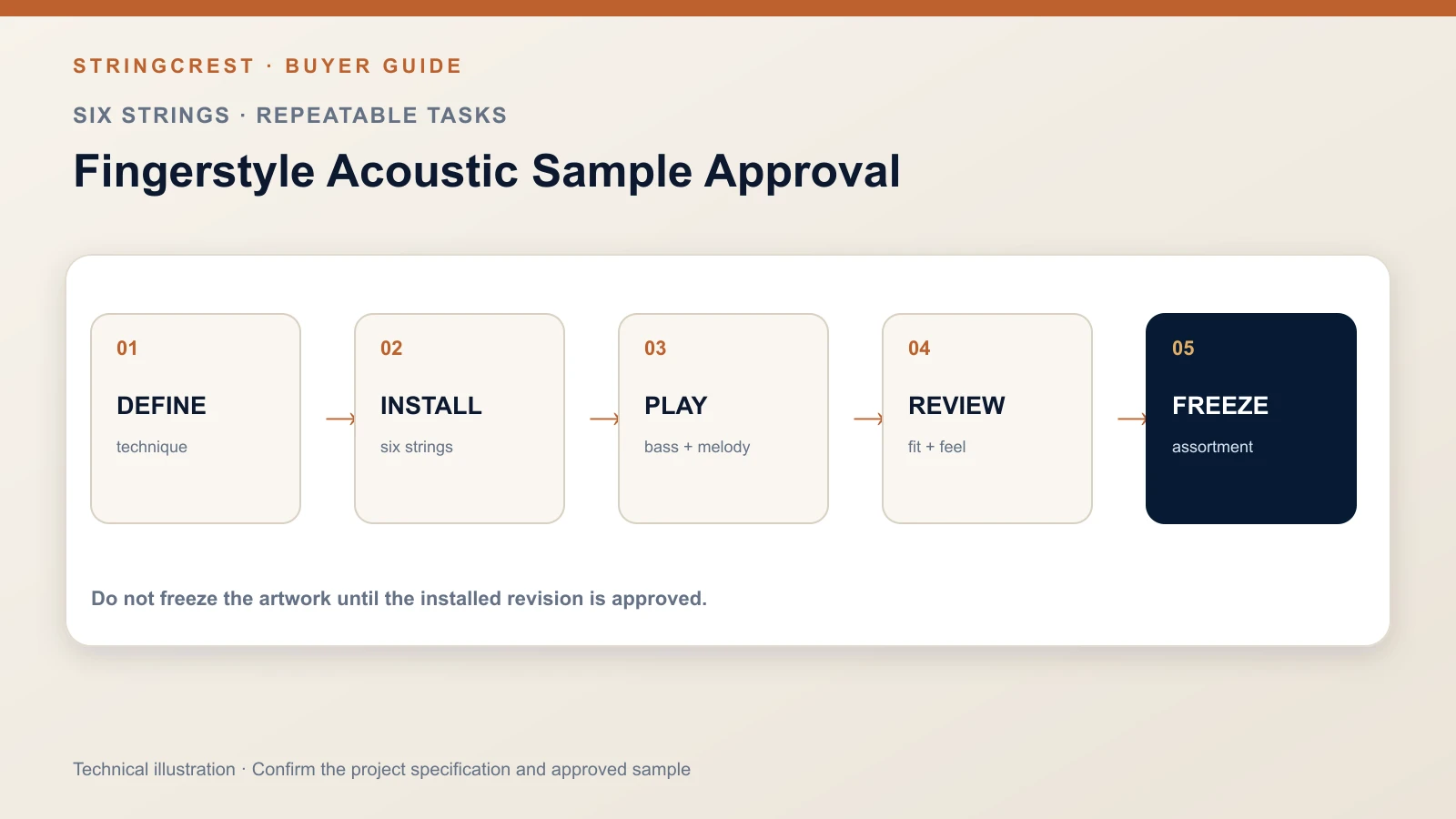
Sample A can represent the proposed core direction. Sample B should change the main question, such as gauge progression or material. Sample C can refine the preferred result. Keep the packaging generic during development so early artwork does not influence the decision or circulate as a finished SKU.
Use repeatable playing tasks
Ask evaluators to perform the same sequence:
- alternating bass notes on positions 6, 5 and 4 with treble melody;
- quiet sixteenth- or eighth-note arpeggios;
- open-position chords played one note at a time;
- fretted melody on positions 1 and 2 above sustained bass;
- slides and position changes to observe surface noise in context;
- a brief light-strumming passage if the SKU is intended for mixed technique;
- tuning and intonation checks after the controlled passage.
Record comparative observations for bass-to-treble separation, left-hand resistance, right-hand response, string-to-string transition and the declared material direction. Do not score “tone” without stating the task and baseline.
Inspect installed fit before sound preference
Check all six strings from bridge to tuner
Confirm six correct ball ends, secure seating, appropriate bridge-pin contact, clean saddle path, full winding across the speaking length, nut entry and usable tuner wraps. Look for damaged winding, kinks or mismatched position labels. Photograph the complete installation and any issue.
If a gauge change binds in the nut or alters the setup, pause the tonal comparison until the condition is understood. Do not force a string into an unsuitable slot. The sample record should distinguish product identity, instrument fit and setup work.
Verify the package-to-string match
Measure selected gauges using an agreed tool and method where appropriate. Check the inner labels and compare them with the six-row master. The high E and B plain strings can be visually similar, making clear position and gauge identification important.
Installed approval should use the exact packaging revision. Loose-string inspection alone cannot test ball seating, length and the playing system.
Plan a range that dealers can explain
Give each acoustic SKU a distinct job
A compact range might include a general acoustic core, a different material family and one fingerstyle-oriented option. The specialist option needs a factual distinction, such as an approved gauge progression and material, rather than a vague claim that it is inherently more musical.
Build a range matrix with six gauges, material, treatment, tension direction if verified, scale basis, sample task and target user. This makes overlaps visible before the company creates multiple near-identical packs.
One standard-tuning sample should not be marketed as verified for every alternate tuning. Treat a materially different tuning as another application review.
Use inquiries and reorders to guide extensions
Track which questions dealers and buyers ask: lighter top strings, firmer bass, coated direction, material alternative or replacement singles. These signals can support a future development brief. They are more useful than launching many variants based on assumed demand.
Do not turn keyword volume or competitor assortment size into a sales forecast. Search demand can inform content and discovery, while inventory decisions still need commercial evidence.
Write clear packaging and product-page copy
Show complete gauges and material
The pack should identify steel-string acoustic guitar, all six gauges, declared wrap material and any treatment. If “fingerstyle” appears prominently, the supporting copy should explain the range role without promising one ideal tone or effortless playing for everyone.
Use consistent low-to-high or high-to-low gauge order and label it. Confirm the barcode, item code, construction statement and actual contents against the final product master. Inner envelopes should identify position and gauge.
Use setup notes responsibly
If the approved set differs materially from a common reference gauge, consider a simple note that setup requirements vary by instrument. Avoid “no setup needed,” “works on all acoustics” or “no finger noise” unless the claim can be supported across the intended scope.
Packaging can also direct professional buyers to a specification page or inquiry form. It should not carry unverified test data or imitate a competitor’s tone vocabulary.
Establish receiving and reorder controls
Inspect what the receiving process can prove
A receiving check can confirm item and lot code, quantity, package condition, print revision, gauge sequence, position labels, ball-end appearance and selected dimensions. Periodic installation on a retained reference guitar may confirm fit against the approved sample plan.
Visual checks do not prove alloy content, treatment thickness, internal core ratio or service life. Use supplier documents or appropriate testing when those attributes are critical. Label photographs as pack, dimensional or condition records according to what they show.
Require controlled notification of changes
The agreement should require review before changing gauges, core, wrap material, treatment, ball end, length or package components. Decide the requalification level based on the change. A new wrap material or gauge progression deserves a fresh installed sample; a corrected punctuation mark may need only artwork approval.
Store the approved sample code, specification and artwork together so later orders reference the same product identity.
Prepare a useful fingerstyle acoustic RFQ
Include:
- six-string steel-string acoustic application;
- exact tuning and scale;
- complete gauge sequence and units;
- core, wrap material and treatment direction;
- reference guitar, setup and baseline set;
- fingerstyle and mixed-technique sample tasks;
- ball end, overall length and winding-length requirements;
- sample codes, comparison ladder and approval record;
- package size, artwork, barcode, inner labels and case pack;
- request for current sample terms, price, MOQ, lead time and quotation validity.
Ask the supplier to flag unknowns and propose alternatives in a separate column. Do not treat a proposal as approved until the exact installed revision is accepted.
FAQ
What makes a string set suitable for fingerstyle acoustic guitar?
Suitability depends on the player, guitar, tuning, gauge progression, construction and setup. Define repeatable bass, melody and arpeggio tasks, then compare identified samples on the intended instrument.
Are lighter acoustic strings always better for fingerstyle?
No. Some players prefer lower resistance, while others want a firmer bass or different response. Scale, construction and setup also affect feel. Approve the full set in context.
Is phosphor bronze or 80/20 bronze better for fingerstyle?
Neither material is universally best. They are established acoustic categories with different product positions. Compare the actual constructions under consistent conditions and use cautious language.
Can the same specification be used for a classical guitar?
No. Classical guitars use a different nylon-string system and bridge attachment. Do not apply a steel-string acoustic specification to a classical instrument.
How many strings should appear in the sample and product images?
A standard set should show exactly six positions, low E through high E, with six correct ball ends when the end details are visible. Images should not introduce extra strings or missing components.
What should a buyer ask before requesting a price?
Provide the instrument category, tuning, scale, all six gauges, material direction, reference set, sample tasks, fit measurements and packaging needs. Then request current commercial terms.
Conclusion
A credible fingerstyle acoustic set begins by turning a playing label into a documented application. The buyer must define the steel-string instrument, six positions, material, gauge progression, reference setup and repeatable playing tasks. Sample evidence can then support a focused product decision without pretending to describe every player.
For wholesale and private-label projects, the position master and sample record are more valuable than a list of adjectives. When the selected revision is linked to packaging, receiving checks and change control, dealers receive a product they can identify and explain accurately.
Explore StringCrest acoustic guitar strings · Send your fingerstyle acoustic-string brief
Sources and interpretation limits
- D’Addario: Everything You Need to Know About Acoustic Guitar Strings
- Fender: Acoustic Guitar 101
- Fender: Learn the Travis Picking Guitar Technique
- Fender: What Is PIMA?
These sources support standard six-string order, general acoustic-string variables and the way fingerstyle techniques assign fingers to bass and treble roles. They do not establish a StringCrest gauge formula, material response, product availability, compatibility, sample result, MOQ, capacity or delivery time.
FROM GUIDE TO PRODUCT
Connect this guide to Acoustic Guitar Strings.
Review the relevant range, then bring the instrument, complete specification and open questions into one project brief.
YOUR PRODUCT · YOUR BRAND
Discuss your next string project with Frank.
Share your instrument category, target market, gauge or material direction and private-label packaging requirements.

ABOUT THE AUTHOR
Frank Zou
Frank works directly with musical-instrument brands, importers and distributors on string specifications, product selection and private-label project requirements.
Meet Frank