
Product Selection
Product Selection
Nylon vs Steel Guitar Strings: A B2B Compatibility and Category Guide
A B2B guide to separating classical nylon and steel-string acoustic systems across construction, attachment, samples, catalog copy and receiving checks.
Introduction
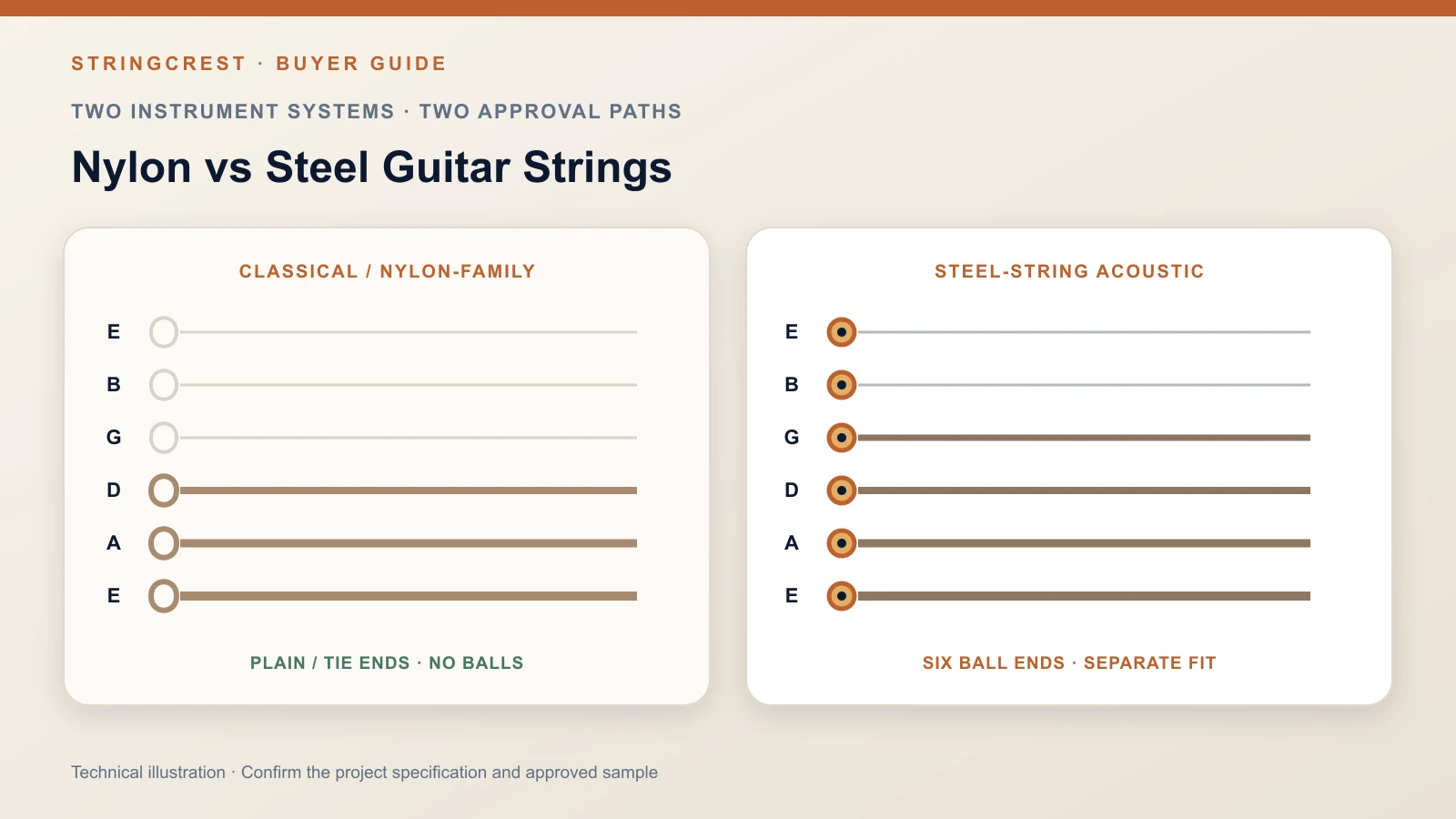
“Nylon or steel?” looks like a material question, but for a buyer it is first an instrument-system question. Classical nylon-string guitars and steel-string acoustic guitars differ in bridge attachment, neck and body design, string spacing, tension direction and normal product presentation. A set cannot be moved safely from one category to the other merely because both instruments have six strings and standard E–A–D–G–B–E tuning.
This guide helps wholesalers, dealers and private-label teams keep the two categories distinct. It covers construction, six-position mapping, end type, fit, sample preparation, packaging, catalog language and receiving inspection. It is not an instruction to retrofit an instrument. The guitar maker’s specification and a qualified technician should govern compatibility when the instrument is uncertain.
Fender’s nylon-versus-steel overview states that the instrument types differ beyond string material and that the strings are not interchangeable. D’Addario’s classical category separates treble material, tension, size and classical construction. These public references describe their own guidance and ranges; they do not confirm a StringCrest formula or universal fit.
Begin with the instrument identity
Separate classical nylon-string from steel-string acoustic
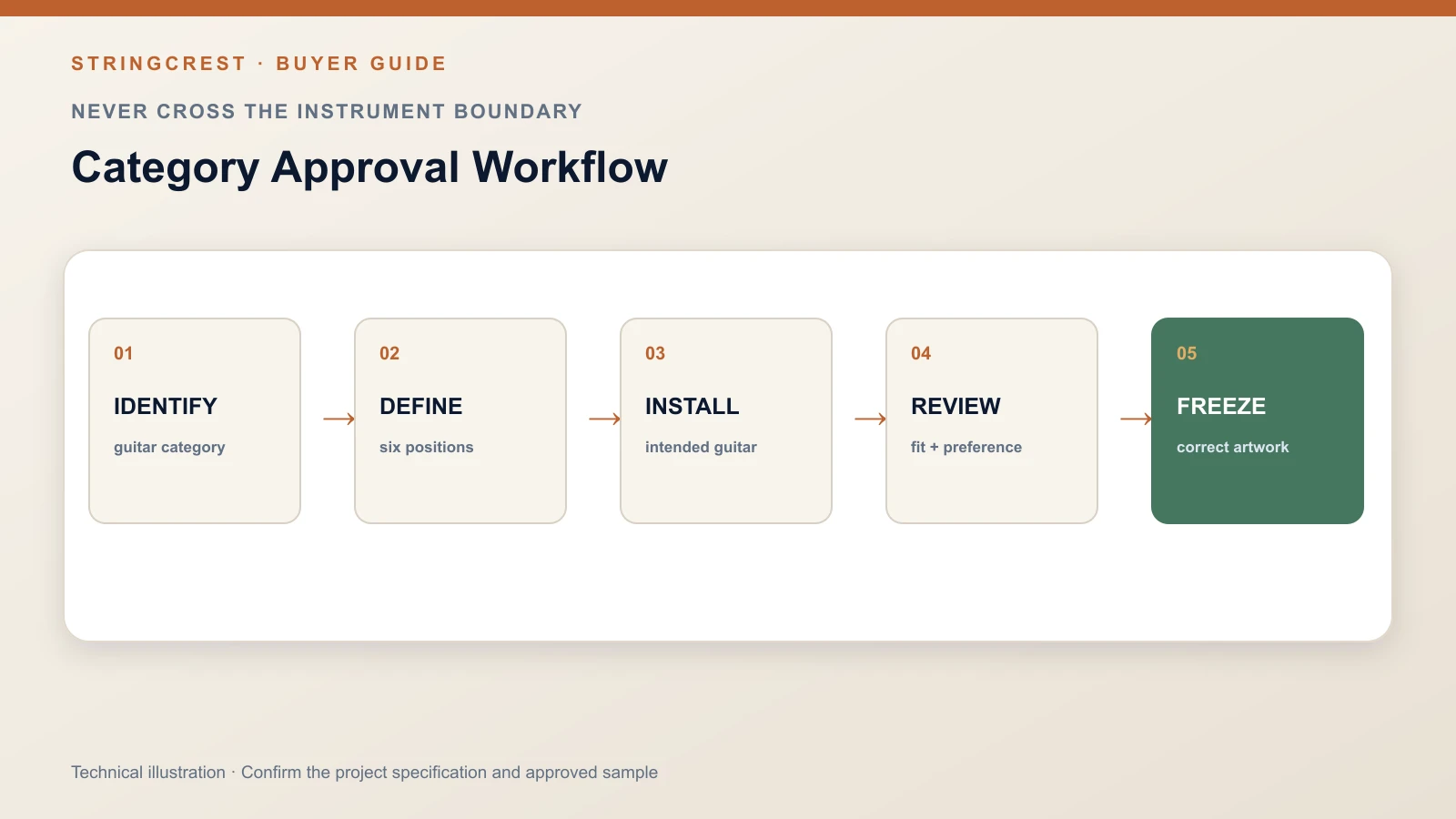
The purchasing brief should identify the guitar category before discussing gauge or tone. For a conventional classical set, record a classical or nylon-string guitar, classical scale basis, tie-block bridge attachment, wider string spacing and the expected nylon-family string system. For a steel-string acoustic set, record a steel-string guitar, ball-end bridge attachment, steel core or plain steel positions and a bronze-family wrap direction where applicable.
These descriptions are category patterns, not a substitute for inspecting the exact guitar. Crossover models, travel instruments, folk-nylon products and other specialty designs can differ. If a product is intended for a nonstandard bridge or an instrument maker’s special system, treat it as a separate compatibility project.
Do not use six-string tuning as proof of compatibility
Both common systems can be tuned low-to-high E2–A2–D3–G3–B3–E4, but identical pitch names do not mean identical tension, diameter, construction or attachment. The string obtains pitch through the combined effects of vibrating length, mass per unit length and tension. Changing material changes the relationship.
Never copy steel-string gauges into a nylon specification or convert nylon diameters into a steel set by appearance. Use the proposed manufacturer’s position data and tension information where available, then verify installed samples on the intended category.
Understand the two six-position constructions
A classical set combines treble and bass systems
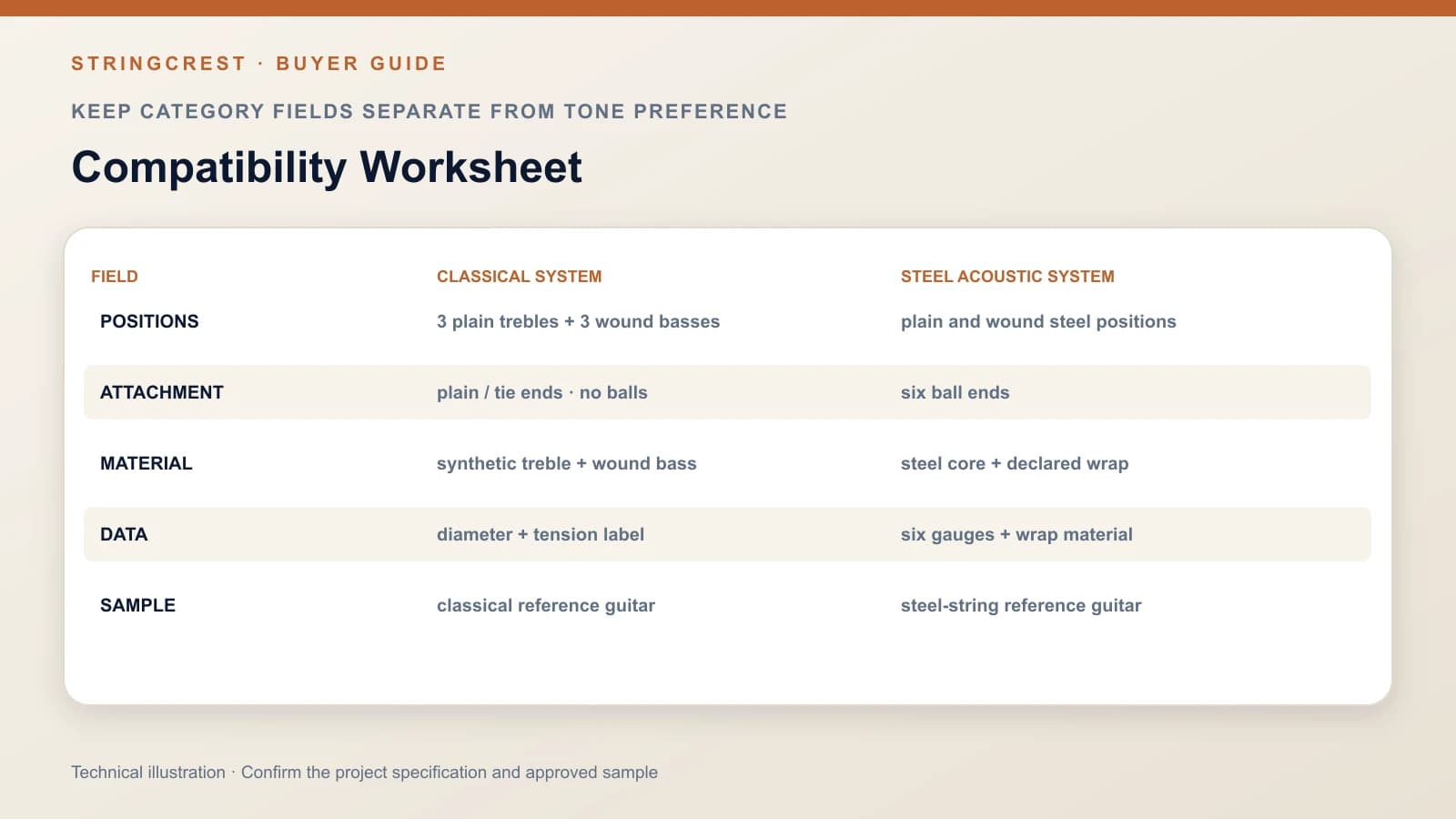
A typical classical set uses three monofilament treble strings for positions 1–3 and three wound bass strings for positions 4–6. Nylon is common for trebles, while fluorocarbon, composite and other synthetic directions also exist. Wound basses commonly combine a multifilament synthetic core with metal wrap. Therefore, calling the entire set “six plain nylon strings” is usually inaccurate.
Record each position rather than reducing the product to a material label. A useful classical position master includes pitch, nominal diameter or gauge, treble or bass role, core, wrap where present, tension label, color if controlled, end condition, overall length and approved revision.
A steel-string acoustic set combines plain and wound steel positions
A conventional six-string steel acoustic set usually has plain steel strings at positions 1 and 2 and steel-core wound strings at positions 3 through 6. A wound third is therefore common in this category. Special constructions must be identified in the exact set matrix rather than inferred from the material name. Wrap materials such as phosphor bronze and 80/20 bronze identify established acoustic categories, but the exact alloy and construction must come from the product record.
Record all six gauges, core, wrap, winding profile, ball end, length and treatment. Do not label a set only “bronze” because that omits gauge order, core, finish and fit.
Treat tension labels carefully
Classical tension words are range-specific
Classical packs may use light, normal, hard or extra-hard tension labels. These are useful within a maker’s range, but they are not universal numerical standards across every manufacturer. A “hard” label does not tell the buyer all six diameters or total set behavior. Preserve the individual position data and the manufacturer’s own tension table when supplied.
The D’Addario classical collection lists several tension directions and materials. That structure demonstrates that material and tension are separate choices. Its exact values belong to its products and should not be copied into a private-label specification.
Steel-string gauge names are also not universal
Light, custom light and medium can describe different sequences across brands. A steel-string buyer should name all six gauges in one declared order. Scale, tuning and setup affect the installed result, so gauge alone is not a promise of feel.
When comparing categories, avoid statements such as “nylon is always low tension” or “steel is always louder.” Fender describes general differences in common instruments, but a B2B page should state that construction, instrument and setup influence the result. Category direction is useful; universal claims are not.
Specify the correct end and bridge relationship
Classical tie-end strings require a tie-block workflow
For the StringCrest classical direction, the visual and specification should show plain or tie ends without metal ball ends. The strings are secured at the classical bridge tie block. Packaging and installation graphics must not add decorative string balls to nylon trebles or wound classical basses.
At the headstock, the string passes through a roller or post hole and is secured with an appropriate wrap. The procurement drawing should focus on usable length, clean ends and the approved material; it should not invent guitar hardware. If the project involves a specialty attachment system, document it separately and do not reuse the standard classical visual.
Steel-string acoustic sets normally use ball ends
The ball sits beneath or against the bridge system depending on the guitar design. Confirm ball size, twist quality, winding start, overall length and bridge path on the reference instrument. The outer winding should cover the speaking length as required and reach the tuner appropriately.
Ball-end appearance does not prove alloy or gauge. Use it as an attachment and identity check, while measurements and material records support the rest of the specification.
Prevent category errors in product photography
Count and inspect every visible string
A standard six-string image should show exactly six positions when the complete set is presented. Classical imagery should show three plain treble directions and three wound bass directions without metal balls for the StringCrest classical set. Steel-string acoustic imagery should show six ball ends only when all six ends are visible.
Artificial images often create extra strings, missing holes, impossible windings or mixed attachments. Use technical layouts or controlled product photography where the reviewer can count every position. If a hand, bridge or headstock appears, verify the hardware and string path against a real reference before publication.
Keep category props and captions accurate
A nylon set placed beside a steel-string bridge can imply compatibility that the copy denies. A close-up of transparent monofilament with ball ends can also contradict the approved classical construction. Captions should state whether the image is a technical illustration, sample photo or final production product.
Do not use another brand’s package, bridge detail or proprietary product appearance as the primary evidence for a StringCrest product. Public references can support the education section while original controlled visuals explain the decision model.
Prepare category-specific samples
Use separate instruments and baseline sets
Install classical candidates only on a suitable classical reference guitar and steel acoustic candidates only on a suitable steel-string reference guitar. Record instrument, scale, setup, date, sample code and baseline set. The objective is to compare alternatives within each system, not to decide which system is universally better.
Allow new strings to stabilize according to the test plan and retune consistently. Nylon-family materials may require a different stabilization schedule from steel. Record the schedule instead of promising a fixed settling time.
Define useful tasks for each application
For classical candidates, the review may include single-note balance across all six positions, rest-stroke and free-stroke passages, chord clarity, left-hand shifts, tuning behavior and bridge security. For steel acoustic candidates, tasks can include open chords, alternating bass, single-note work, light and firm strumming, tuning checks and ball-end seating.
Keep evaluation language relative: firmer or more flexible than the named reference, brighter or warmer on the test guitar, more or less surface noise in the defined passage. One room and one evaluator do not justify an absolute marketing promise.
Separate product fit from player preference
Fit covers secure attachment, usable length, correct position, clean nut and saddle path, full speaking-length construction and absence of visible damage. Preference covers feel and sound under the chosen tasks. A candidate that fits can still lose the tonal comparison; a favorite sound cannot excuse unsafe or incorrect fit.
Document setup changes. If the gauge or tension direction requires nut, saddle, neck or action work, the comparison must say so. Do not present a technician’s correction as proof that the original set was universally compatible.
Build two clear catalog paths
Give classical buyers the fields they need
The classical product page should state six-string classical application, complete material structure, tension label with exact position data where approved, full scale or intended size, tie-end attachment and sample availability. It should distinguish treble and bass materials rather than writing only “nylon.”
If the range offers several tension or treble materials, use a comparison table. Do not imply that every combination is available until confirmed. Link education about material and tension to the actual product fields.
Give steel acoustic buyers a different specification
The acoustic page should identify steel-string acoustic application, all six gauges, core and wrap material, winding construction, ball end, treatment if present and scale basis. Material comparisons can sit under this category without drifting into classical compatibility.
Navigation, filters and internal links should keep the two routes separate. “Acoustic guitar strings” can be ambiguous in conversation, so page headings and breadcrumbs should say “Steel-String Acoustic” or “Classical / Nylon” where needed.
Write packaging that prevents misuse
Put the instrument category on the front panel
Use “Classical Guitar Strings” for the nylon-family set and “Steel-String Acoustic Guitar Strings” for the steel set. Show all six positions or gauges on the back. Include end type, material statement, item code, barcode and traceability reference according to the approved master.
Avoid a universal “for acoustic guitars” claim. A classical guitar is acoustic, but that does not make steel acoustic strings appropriate. The category name must help a buyer make the correct choice in seconds.
Use warnings and installation notes proportionately
A concise note can say to use the set only on the intended instrument type and to follow the guitar maker’s guidance. Do not turn the package into a repair manual or make fear-based claims. When compatibility is uncertain, direct the user to a qualified technician.
Translate category names and instructions consistently for each market if localization is later authorized. Do not let a translation collapse “classical nylon-string” and “steel-string acoustic” into the same term.
Control receiving inspection and reorders
Verify different evidence for the two systems
For classical sets, inspect item and lot identity, six positions, treble and bass grouping, clean tie ends, color and surface where controlled, package revision and selected dimensions. Do not flag the absence of metal balls as a defect; for the approved StringCrest classical construction, no ball ends should be present.
For steel acoustic sets, inspect six gauges or position labels, ball ends, twists, winding condition, wrap appearance, length and package revision. Selected gauge checks should follow an agreed tool and method.
Neither visual inspection proves polymer identity, metal alloy, tension or long-term performance. Use supplier records and suitable testing where those attributes are critical.
Keep separate change-control lists
A classical change list includes treble polymer, bass core, wrap, diameter, tension direction, color, end preparation, length and packaging. A steel acoustic list includes core, wrap alloy, gauge sequence, winding, treatment, ball end, length and packaging. Any approved change should update the product master and determine whether new installed samples are needed.
Store samples and records under separate category codes. A shared six-string carton must never cause the warehouse to substitute one system for the other.
Create RFQs that suppliers can answer
Classical guitar string RFQ fields
Provide classical application, full or fractional scale, standard or alternate tuning, positions 1–6, treble material, bass core and wrap direction, proposed tension label, plain/tie ends, color, usable length, sample plan, package format and artwork requirements. Request current MOQ, sample terms, price, lead time and quotation validity rather than assuming them.
Steel-string acoustic RFQ fields
Provide steel-string acoustic application, scale and bridge route, tuning, all six gauges, plain and wound positions, core and wrap material, treatment, ball end, length, sample plan, packaging and case pack. Identify the reference guitar and comparison set.
For either RFQ, ask the supplier to mark unknowns and alternatives. Do not approve artwork while the position table or attachment remains unresolved.
FAQ
Can steel strings be installed on a classical guitar?
Do not assume they can. The systems are designed differently, and Fender’s overview says nylon and steel strings are not interchangeable. Follow the guitar maker’s specification or consult a qualified technician.
Are all classical guitar strings entirely nylon?
No. Typical sets combine synthetic monofilament trebles with wound basses, and alternative treble materials such as fluorocarbon exist. Describe every position accurately.
Do StringCrest classical nylon strings have metal ball ends?
The approved StringCrest classical direction should be presented as plain/tie-end strings without metal ball ends. Product imagery and receiving checks must preserve that construction.
Can nylon and steel sets use the same gauge numbers?
Gauge values cannot be transferred directly between different materials and constructions. Specify each system with its own position data and tension evidence.
Why do both systems use E–A–D–G–B–E?
They can share standard pitch names while using different materials, diameters, tension relationships and attachments. Tuning alone does not establish compatibility.
What should a dealer display first?
Show the instrument category, then material/construction, tension or gauge details and attachment. That order reduces category mistakes before buyers compare tone descriptions.
Conclusion
Nylon versus steel is not a contest between two interchangeable materials. It is a boundary between two instrument and string systems. B2B buyers should preserve that boundary in specifications, samples, images, navigation, packaging and receiving inspection.
Once the category is correct, each range can be developed on its own terms. Classical projects need six-position treble-and-bass data and tie-end fit; steel acoustic projects need exact gauges, wrap construction and ball-end fit. Clear evidence protects the instrument, the buyer and the credibility of the brand.
Explore StringCrest classical guitar strings · Send a category and compatibility brief
Sources and interpretation limits
- Fender: Nylon Strings vs. Steel Strings
- Fender Play: Nylon vs Steel Strings lesson
- D’Addario: Classical Guitar Strings collection and FAQ
- D’Addario: Single Guitar Strings categories
These sources support the category distinction and show common material and construction families. They do not establish StringCrest gauges, tension values, material formulas, compatibility beyond the intended category, product availability, sample results, commercial terms or production capability.
FROM GUIDE TO PRODUCT
Connect this guide to StringCrest product ranges.
Review the relevant range, then bring the instrument, complete specification and open questions into one project brief.
YOUR PRODUCT · YOUR BRAND
Discuss your next string project with Frank.
Share your instrument category, target market, gauge or material direction and private-label packaging requirements.

ABOUT THE AUTHOR
Frank Zou
Frank works directly with musical-instrument brands, importers and distributors on string specifications, product selection and private-label project requirements.
Meet Frank