
Product Selection
Product Selection
Phosphor Bronze vs 80/20 Bronze Acoustic Guitar Strings: A Wholesale Range Planning Guide
A purchasing framework for comparing two acoustic wrap-alloy directions without turning general tone descriptions into unsupported claims.
Introduction
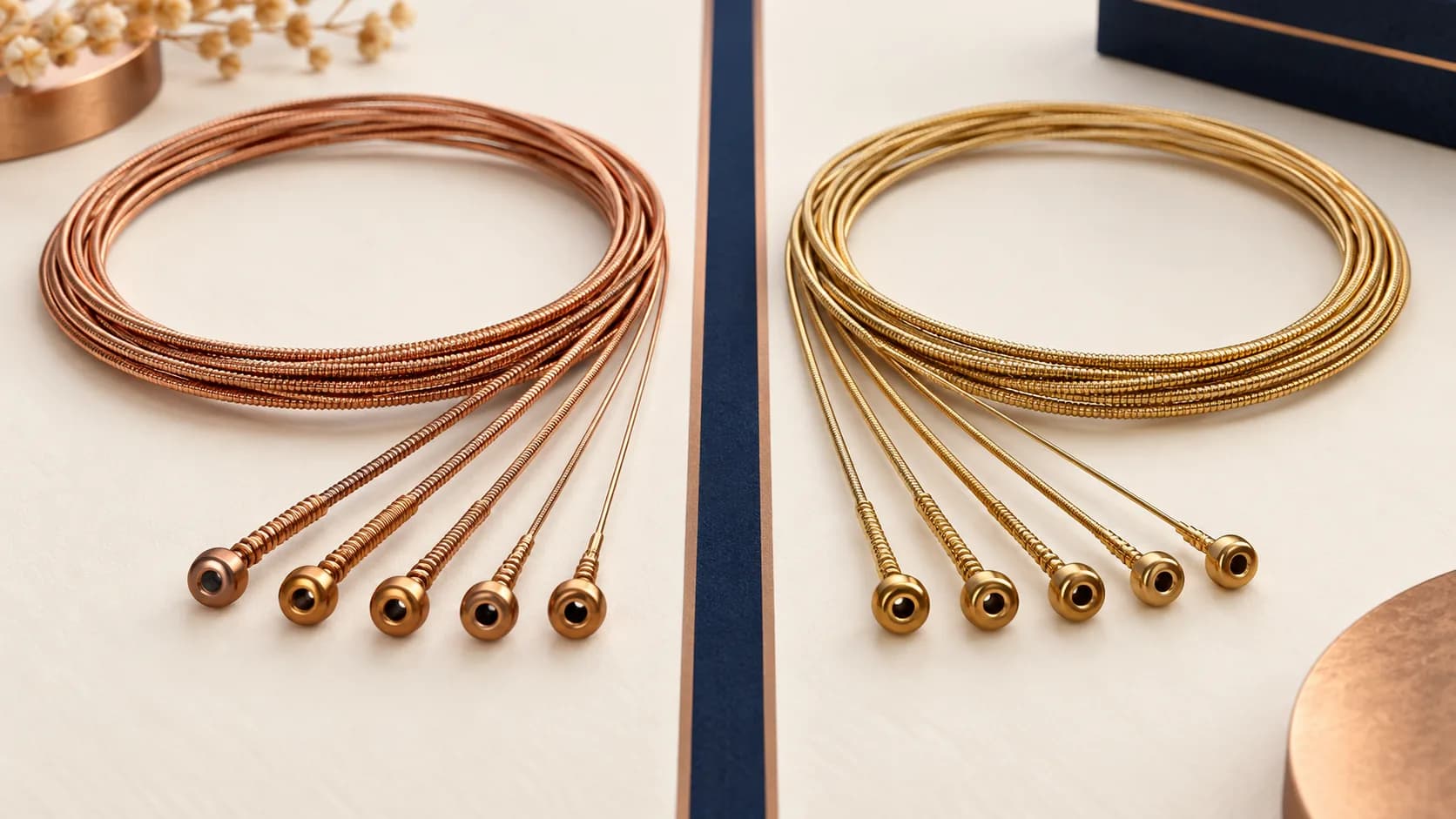
For a wholesale acoustic string range, phosphor bronze and 80/20 bronze should be treated as two material directions to evaluate, rather than a universal good-versus-better ranking. Start with the customer, instrument, intended response and commercial position. Then compare samples with equivalent gauges and controlled installation conditions before deciding how many variants your range needs.
This distinction matters for private-label brands, importers and distributors. A musician can buy another set after an unsuccessful experiment. A purchasing team may have packaging artwork, dealer information and a shipment attached to the same decision. The useful question is therefore not simply which alloy sounds best. It is which specification you can explain, evaluate, order and replenish consistently.
This guide provides a purchasing framework. The example decisions and evaluation methods are recommendations, not claims about StringCrest test results, confirmed stock, minimum quantities or delivery performance. For an actual project, confirm the complete specification and available options through the acoustic guitar string category.
What the two material names actually tell you
On a wound acoustic string, an alloy description normally refers to the wrap wire, not to every component in the set. A buyer still needs to identify the core, the plain strings, any coating or surface treatment, the end construction and the full gauge sequence. An alloy name alone is not a finished purchase specification.
The conventional name 80/20 bronze describes a copper-zinc wrap alloy. Elixir's acoustic string information identifies the familiar 80% copper and 20% zinc composition. Keep that market terminology distinct from a supplier's detailed material declaration. Do not assume a trade name specifies every element or manufacturing variable.
Phosphor bronze describes a different alloy family. Ask the supplier how that material is defined for the proposed product instead of importing another brand's formulation into your specification. If composition matters to your approval process, request supporting documentation associated with the offered material and revision.
Tone descriptions are starting points
D'Addario's acoustic alloy guide presents 80/20 toward brightness and phosphor bronze toward warmth and balance. Those descriptions help frame a comparison; they do not establish the sound of every supplier's set on every guitar.
Your customer's response also depends on the instrument, setup, gauge, playing approach and condition of the strings. Translate broad words into listening tasks: clarity during strumming, separation in fingerpicked passages, response to a light attack and the relationship between bass and treble. Record the tasks before opening the samples.

Decide what each product must do in your range
Before comparing quotations, write a short role statement for each proposed SKU. For example, one candidate could serve a general acoustic replacement-string range, while another offers a contrasting response for customers who want a different listening result. These are commercial hypotheses to validate with your dealers, not evidence that a particular alloy will sell faster.
Ask your sales team which questions repeatedly appear at the counter. Do customers ask for a brighter response, a different feel, a particular gauge sequence or a familiar replacement? Does the retailer want fewer choices with clearer explanations, or an assortment that supports detailed consultation? These answers should influence the number of variants you test.
Avoid launching two nearly indistinguishable products merely because the material names are available. Each additional variant needs an ordering code, artwork, stock allocation and a reason for a dealer to recommend it. A smaller range with a clear explanation can be easier to manage than a broad range whose differences have not been evaluated.
Compare the complete specification, not just the label
| Purchasing question | Record for both candidates | Why it matters |
|---|---|---|
| Instrument fit | Steel-string acoustic, string count and intended scale | Prevents an unsuitable comparison |
| Gauge sequence | Every string diameter and the stated unit | A range name does not define the set |
| Construction | Core, wrap, plain strings and end type | Separates material from construction differences |
| Treatment | Coated, uncoated or another defined treatment | Avoids attributing a treatment difference to alloy |
| Commercial format | Sets, individual strings, packaging and labels | Makes quotations comparable |
| Approval reference | Sample ID, revision and unresolved items | Connects evaluation to the eventual order |
Treat light, medium and similar names as product labels until the full sequence is confirmed. Two suppliers can use the same label for different configurations. A comparison becomes difficult to interpret if the bass string changes diameter while the coating, packaging and alloy also change.
Do not infer tension from an alloy label or a gauge name. If tension is relevant to the project, obtain data for the proposed construction and the stated instrument conditions. Another company's published tension chart is a technical reference, not a certified specification for your proposed private-label set.
Build a comparison your team can repeat
Prepare the instruments and record the setup
Installation preparation should start with a clear instrument record: identification, scale length, tuning, current setup and any visible condition that could affect the evaluation. Use suitable steel-string acoustic guitars and follow their makers' guidance. Do not fit steel strings to an instrument that is not designed for them.
When two guitars are used, document their differences rather than assuming they are interchangeable. When one guitar is used sequentially, record the order of testing and recognize that a direct memory comparison has limits. The objective is a useful purchasing decision, not a claim that informal listening has isolated every physical variable.
Keep handling and listening tasks consistent
Use a consistent fitting procedure, tuning reference and approach to initial stabilization. Give evaluators the same short tasks and ask them to record observations independently before discussing a group preference. If the samples are coded, keep the code-to-product mapping available to the project owner.
A simple scorecard can separate response, feel, installation observations and commercial suitability. Include a notes field explaining the reason behind a preference. “Preferred on instrument A for light fingerstyle” is more useful than “best strings,” because it identifies the conditions and the product application behind the judgment.
Evaluate the product beyond the first listening session
A newly installed sample offers only one observation point. If your buying decision depends on how the product changes during use, define additional evaluation points that fit your intended application. Record usage conditions and handling rather than turning a few impressions into a universal lifespan claim.
Distinguish visual change, feel, tuning behavior and tonal preference in the record. A description such as “surface appearance changed” is not automatically a demonstrated cause of an audible difference. If the cause matters, agree on an appropriate investigation with the supplier or a qualified testing resource.
Avoid comparisons in which one sample receives different cleaning, storage or playing exposure. When a participant cannot follow the planned conditions, note the deviation. That information is valuable: it prevents a purchasing team from interpreting an uncontrolled difference as an alloy advantage.
Keep coating and packaging separate from alloy selection
If you compare a coated phosphor bronze candidate with an uncoated 80/20 candidate, you are comparing two product systems. That may be appropriate for a commercial range decision, but it does not isolate the alloy. State the purpose of the comparison and avoid using its results to make broader material claims.
Ask which components receive the proposed treatment and how the product should be described on the package. Words such as coated, treated and protected need an agreed meaning. Do not borrow another brand's trademarked technology name or lifetime claim to describe a different supplier's construction.
Packaging also deserves a separate brief. Identify the individual-string arrangement, inner protection, retail presentation and outer carton. Ask how the proposed pack supports handling and identification through your distribution route. If a protective performance claim is required, define the evidence needed before writing that claim into artwork.
Turn dealer feedback into a disciplined range decision
Give participating dealers enough information to evaluate the intended product role without directing them toward a preferred answer. Ask who they would recommend the candidate to, which existing choice it might complement and what explanation their staff would need. Separate their own playing preference from the needs of their customers.
Keep the feedback connected to the exact sample revision. If one dealer receives a changed gauge sequence, that response should not be pooled with feedback on the earlier set as though the products were identical. A compact version register prevents this common ambiguity.
Use the feedback to decide whether to retain one material family, introduce both with distinct roles or request a more focused comparison. A mixed response does not necessarily mean the test failed. It may show that the candidates suit different applications, or that the purchasing brief needs a clearer target customer.
Make the quotation comparison commercially useful
Request quotations on an equivalent basis: complete set specification, quantity, packaging, artwork work, sample requirements and the stated delivery basis. List optional treatments or alternative packaging separately. This avoids treating a lower headline price as a saving when the quoted products differ.
Ask which items remain subject to confirmation. MOQ, sample charges, production timing and packaging choices should be confirmed for your project rather than inferred from a category page. Clarify whether an artwork change or a new gauge sequence changes the quotation or sampling requirements.
A useful comparison sheet includes the offered revision, open technical questions, the commercial basis and the evidence still required for approval. Keep speculative sales forecasts outside the supplier specification. They may inform your initial order, but they do not change what the supplier has agreed to make.
Connect sample approval to shipment inspection
After selecting a candidate, create an approval record that brings together the product specification, approved sample reference and packaging artwork. Identify who may approve later changes. A supplier should not have to decide whether an informal message supersedes the signed or otherwise agreed brief.
Define shipment inspection around agreed criteria. These can include product identity, quantities, gauge identification, visible condition, packaging version and carton labeling. Where measurements or performance checks are required, agree on the method, sampling approach and acceptance criteria before the bulk order.
Factory testing is useful only when the record answers a defined question about the supplied product. A generic photograph of equipment is not evidence that your batch passed a particular test. Ask for records that can be connected to the relevant product or shipment without requesting unsupported guarantees.

Build a practical first-order decision sheet
Use one row per proposed SKU and keep the decision concise enough that purchasing, product and sales colleagues can all use it. Include the intended customer, the product role, the full specification, the selected package, the evidence reviewed and the questions that remain open.
Give each open question an owner and a resolution condition. For example, “confirm outer-pack labeling before artwork release” is actionable; “check quality” is not. A specific unresolved item can remain visible without preventing unrelated preparation work from continuing.
Once the order is placed, preserve that sheet as the baseline for replenishment. A later change in gauge, treatment or packaging should trigger a deliberate review of affected labels and dealer information. The benefit is continuity between the sample that your team evaluated and the product that customers are subsequently offered.
FAQ
Is phosphor bronze always better than 80/20 bronze?
No. The appropriate choice depends on the intended response, instrument, customer and complete construction. Compare controlled samples and define the role of each candidate in your range. A preference on one guitar does not establish a universal ranking, and a material name does not verify the finished product's quality.
Should a new private-label range include both alloys?
Only when the products have distinct, useful roles and your distribution plan supports them. Start with dealer requirements and a manageable comparison. Launching both without a clear explanation can add complexity without helping buyers. Confirm practical order and packaging requirements before deciding on the final assortment.
Can the same gauge name describe different sets?
Yes. Labels such as light and medium do not replace the complete diameter sequence. Request every string's gauge, the unit and the construction details. For a meaningful comparison, identify any differences rather than assuming the same package label means that all relevant specifications match.
Can I use another brand's tension chart for my product?
Use it to understand the topic, not as your product's verified data. A useful tension value requires the relevant construction and stated instrument conditions. Ask for applicable information or agree on a suitable evaluation method. Do not print a competitor's figures on private-label packaging as if they described your own set.
How should I describe durability to dealers?
Use claims supported by the proposed product's evidence and conditions. Avoid promising a fixed number of playing hours or a multiple of another string's lifespan without an appropriate basis. Explain any confirmed treatment accurately, and keep storage, handling and evaluation guidance separate from unverified performance promises.
What should I send before requesting samples?
Send the instrument category, full gauge sequence if known, material candidates, treatment preferences, target customer, packaging direction and questions to resolve. Mark unknown values as open items. A reference sample can help, but it should accompany a written brief rather than replace one.
Conclusion
Choosing between phosphor bronze and 80/20 bronze is most useful when it produces a clearer product range and a controlled purchase specification. Define the customer, separate alloy from other variables, evaluate samples consistently and connect approval to the shipment requirements. This makes the decision explainable to your supplier and your dealers without relying on exaggerated material claims.
FROM GUIDE TO PRODUCT
Connect this guide to Acoustic Guitar Strings.
Review the relevant range, then bring the instrument, complete specification and open questions into one project brief.
YOUR PRODUCT · YOUR BRAND
Discuss your next string project with Frank.
Share your instrument category, target market, gauge or material direction and private-label packaging requirements.

ABOUT THE AUTHOR
Frank Zou
Frank works directly with musical-instrument brands, importers and distributors on string specifications, product selection and private-label project requirements.
Meet Frank