
Product Selection
Product Selection
Half-Round Guitar Strings: A Dealer’s Guide to Feel, Finger Noise and Set Design
An electric-guitar dealer guide to surface construction, relevant playing demonstrations and evidence-led range descriptions.
Introduction
Half-round guitar strings are a candidate for players seeking a different wound-string surface without choosing a conventional flatwound set. Confirm how the supplier defines the construction, identify the complete set and compare it on the intended electric guitar. A smoother surface description does not guarantee silent playing, a particular bending feel or identical tension to another product.
For a retailer, the decision is whether the proposed set answers a specific customer need that the existing range does not serve. For a private-label buyer, it is whether the accepted construction and demonstration support a clear product description. Those decisions require more than placing “half-round” between roundwound and flatwound on a shelf.
This guide focuses on electric-guitar demonstrations, plain and wound positions, finger-noise observations and useful sales language. Bass scale and taper planning belong to the separate half-round bass guide.
Confirm what half-round means for the proposed product
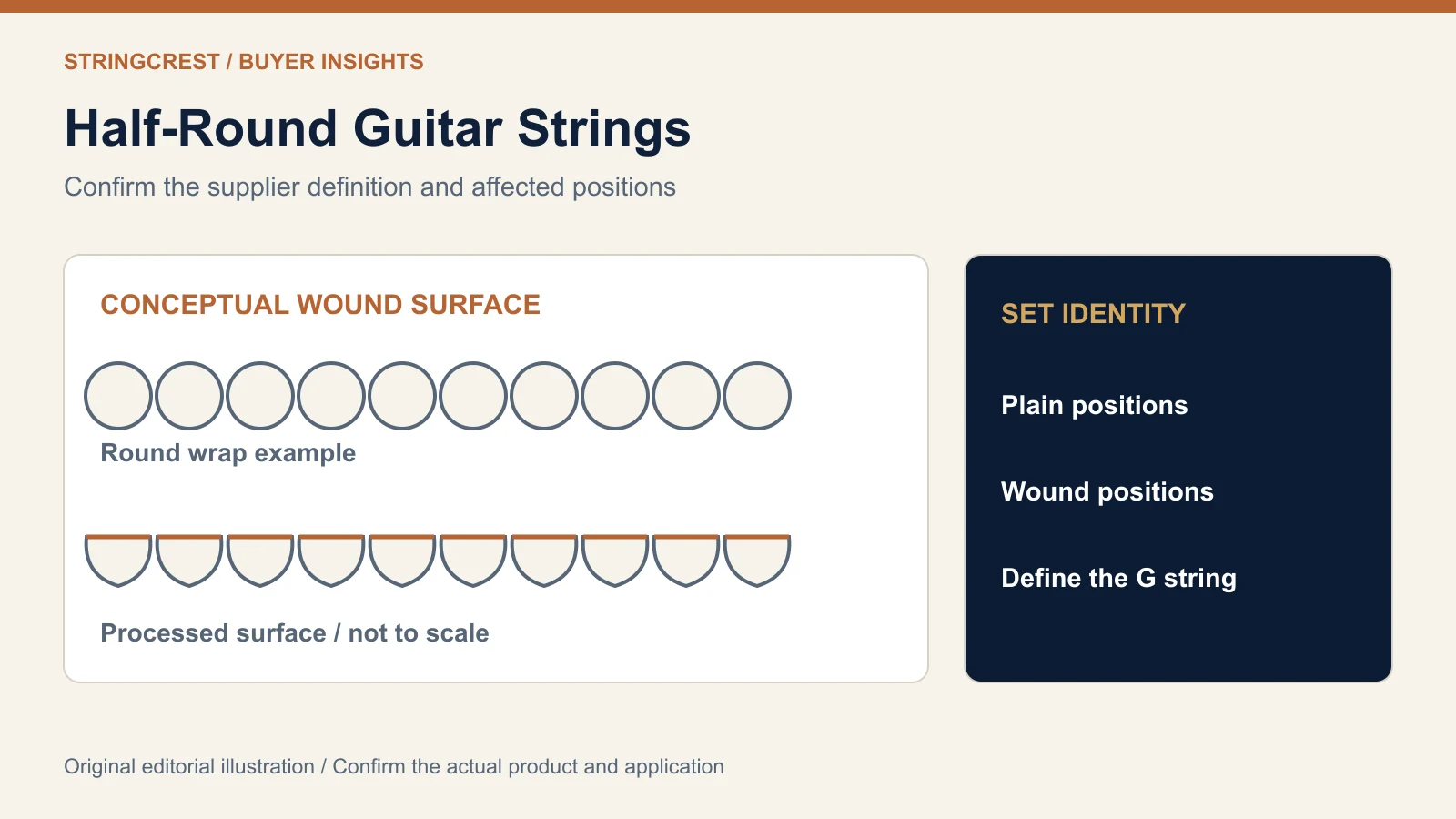
A supplier should describe both the wound construction and the subsequent surface treatment. D’Addario publishes an electric half-round example in which stainless-steel round winding is ground to produce a smoother outer surface. That is an identifiable manufacturer example; it does not establish that every product using the term has the same wrap, core or process.
Ask whether the proposed product is ground, polished or described by another finishing method. Obtain the exact definition before writing the packet. “Semi-flat” can describe a surface direction without explaining enough for a purchase specification.
Keep the official half-round product reference separate from the product you are developing. A competitor’s material, published gauges or performance language is not evidence of StringCrest’s confirmed offering.
This distinction also matters when a supplier proposes a changed surface process during replenishment. The old label may remain readable while the finished product needs a new sample comparison. Ask which parts of the accepted definition have changed.
Separate half-round from roundwound and flatwound
Fender’s electric-string guide describes roundwound construction using round wrap wire and flatwound construction using flat wrap wire. Half-round products need an additional supplier definition explaining the processed surface. A visual resemblance between finished strings does not establish the same manufacturing route.
A retailer can explain the comparison as a choice of construction and surface, then invite the customer to assess identified samples. Avoid a universal ranking from “rough” to “smooth” to “best.” The useful choice depends on the customer’s playing tasks and the actual products being compared.
| Construction question | What the label should clarify | What needs a sample review |
|---|---|---|
| Roundwound | The declared wrap and complete construction | Feel and response in the intended application |
| Half-round | The supplier’s finishing method and affected positions | Surface preference and relevant handling noise |
| Flatwound | The declared flat-wrap construction | The actual set’s playing response |
The flatwound and roundwound electric guide helps plan those two established range roles. A half-round addition should answer a more specific gap than simply increasing the number of packet types.
Identify which positions are affected
An electric set can combine plain strings with wound strings. Surface finishing on the wound positions does not give the plain positions a winding they do not have. Inspect the proposed position list before making a set-wide feel or noise statement.
The G-string position deserves explicit attention. Record whether it is plain or wound in each candidate. A comparison that changes both surface treatment and G-string construction cannot isolate the effect of the finishing method.
For a player who bends particular notes or moves frequently between strings, the entire set experience matters. Ask which positions are involved in the desired task, then demonstrate those positions. A customer concerned about movement along a wound bass string may ask a different question from one comparing bends on a plain treble.
The plain versus wound G-string guide covers that position in more detail. Keep its construction decision visible when discussing half-round sets.
Turn the customer's complaint into a demonstration task
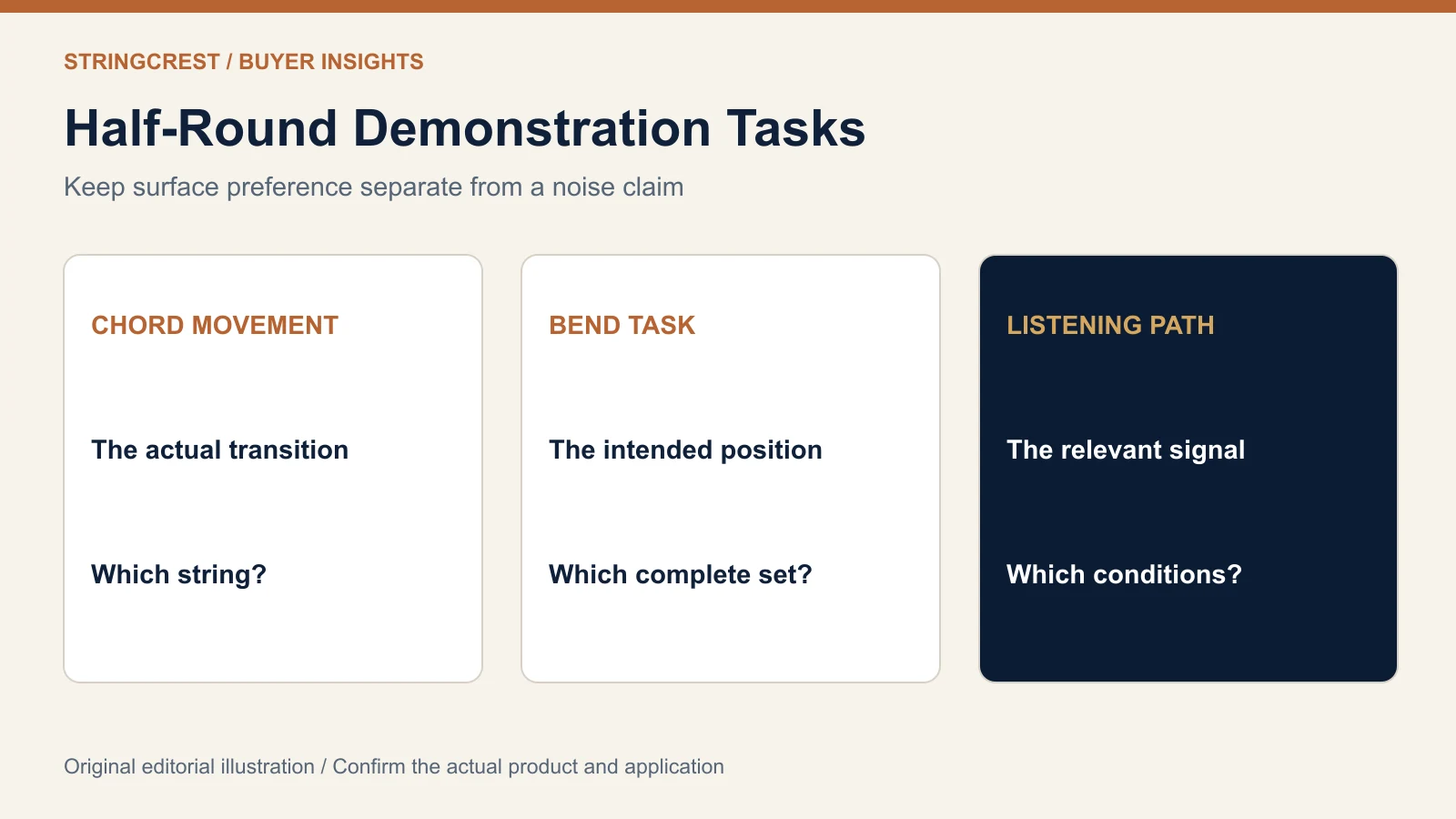
Ask the customer to describe the movement or sound they want to change. “Too noisy” may refer to audible finger movement, an amplifier noise, fret contact or another observation. The proposed string surface addresses only the questions for which an actual comparison is relevant.
A useful demonstration request might be: “Play the chord change that produces the sound you want to reduce, then repeat it with the identified candidate.” Keep the guitar, listening path and task documented. If the sound cannot be reproduced, explain that the comparison has not yet answered the original question.
For recording-related enquiries, establish what is being recorded and how. A room microphone, an amplified guitar and a recorded track provide different listening contexts. Record the context actually used rather than describing a shop demonstration as a studio performance result.
Chord movement
Use the transitions that matter to the customer. Preserve the same movement and reasonable playing approach across the comparison. Ask separately about surface preference and the audible observation so a pleasant feel does not become an unsupported noise claim.
Bends and sustained notes
Use the intended positions and the player’s normal task after fit and setup are assessed. Ask whether the response is acceptable for that application. Do not infer the full set’s flexibility from touching an uninstalled wound sample.
Slide or other specialist use
Treat specialist techniques as their own application question. Identify the instrument, setup and actual task, and seek appropriate guidance where needed. A smoothness adjective does not establish universal suitability for every slide setup or playing style.
Keep finger noise separate from other guitar sounds
A product demonstration should preserve the distinction between string handling and instrument or electronic concerns. A noisy amplifier connection, a fret-contact problem or an insecure attachment needs the appropriate assessment. Changing the string surface should not be offered as the automatic cure.
Ask where and when the sound occurs. If it follows movement along a particular wound string, that observation can inform a surface comparison. If it occurs without the relevant movement, keep the original question open and route it appropriately.
Even when the customer prefers the candidate, describe the actual observation. “The reviewer preferred this surface for the recorded chord movement” is a usable sample note. “Eliminates all finger noise” is a much broader statement that the demonstration has not established.
Design a comparison that preserves the question
Start with a reference product the customer or buyer can identify. Record its complete position list, tuning, guitar and setup condition. Define which candidate difference is under review and which differences cannot be held constant.
If construction or intermediate gauges also change, keep that fact in the notes. The comparison may still identify a preferred finished set, but it should not be presented as proof of what surface finishing alone does. This is especially important when a private-label sample differs from the reference in several ways.
Allow for installation preparation and any competent setup work needed for the proposed set. Record that intervention before interpreting the playing result. Compare the approved installed configurations, and avoid presenting an unsuitable installation as evidence against a construction family.
A useful listening record describes a moment in the task. For example, the reviewer can identify the transition between two chord shapes and note which string movement prompted the observation. Preserve the original recording when one exists, together with the instrument and signal-path details. A processed excerpt without those details may be unsuitable for comparing the original concern.
The retailer should also ask whether the difference matters to the intended use. A detectable change in one demonstration is not automatically a reason to replace the customer's preferred set. A player may prioritize a familiar bend response, the existing G-string construction or another feature. Record the trade-off so the eventual recommendation reflects that player's decision.
For a wholesale comparison, invite reviewers to separate description from selection. First describe what they experienced under the defined task; then record which complete set they would choose and why. Preserve disagreements. An unresolved preference can support a narrower shelf explanation even when it does not justify a broad claim about reduced noise.
A practical outcome record
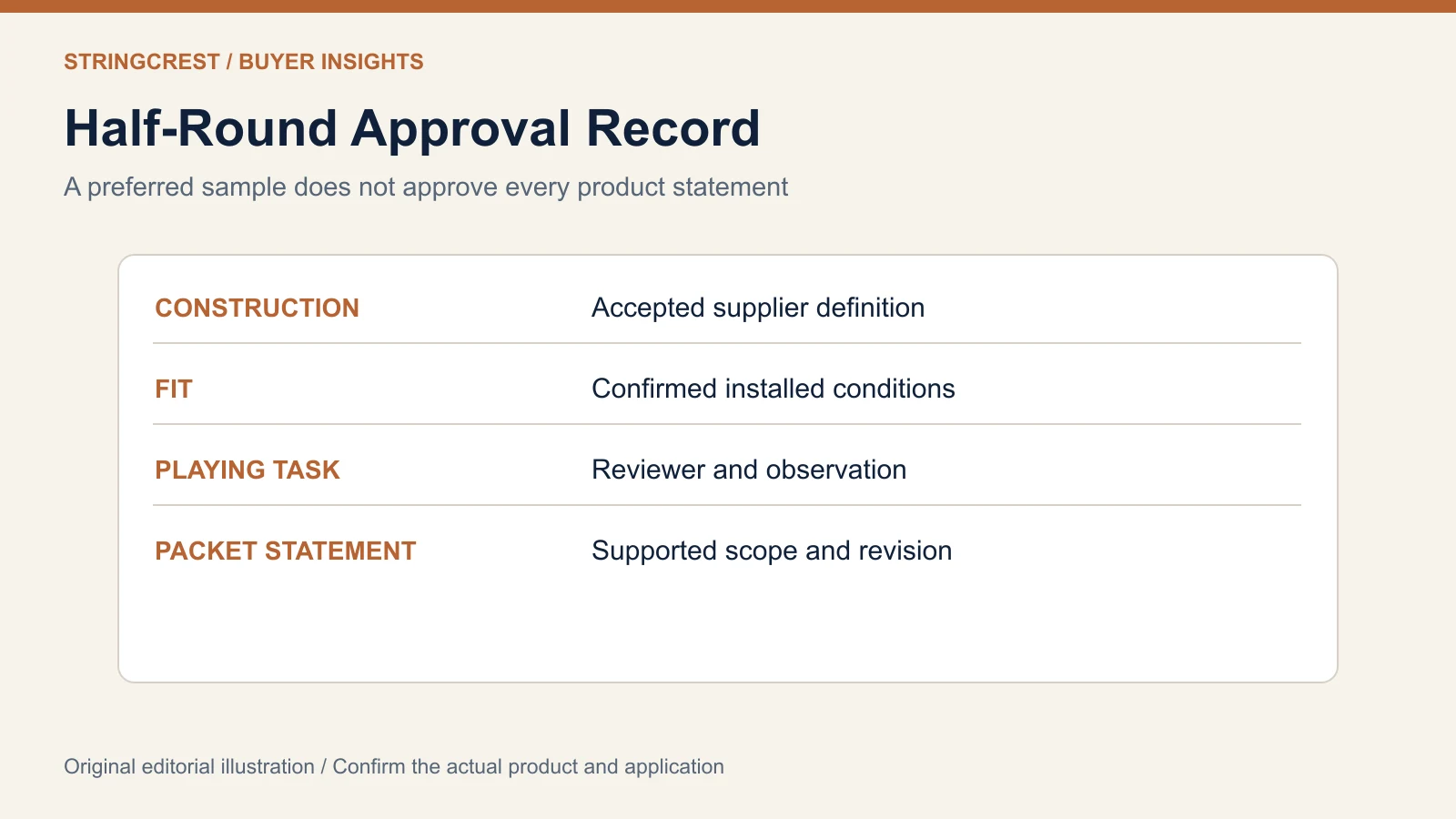
Use separate fields for fit, playing preference and the scope of the proposed description. A candidate can pass fit while leaving a preference question unresolved. It can also be preferred by one reviewer without supporting a broad performance claim. The record should allow each outcome to remain visible.
Do not assume equal gauge means equal tension
A printed diameter does not identify all the material and construction information needed for a tension comparison. Ask for product-specific data when numerical tension matters, including the defined pitch and scale conditions. Another manufacturer’s chart is a reference for its declared product.
For an electric-guitar demonstration, the practical issue is whether the complete installed set is appropriate for the instrument and task. A supplier description such as “similar to roundwound” should not be translated into an exact numerical equivalence or a no-setup-required promise.
The balanced-tension electric guide explains how to keep tension questions product-specific. Keep comfort and feel observations distinct from force data; neither substitutes for the other.
Decide whether the product has a useful retail role
A retailer needs a concise answer to “Who should compare this set?” Define the relevant application from the sample review, such as a customer seeking a different wound-string surface for identified chord movement. Keep the wording conditional on trying an appropriate set rather than promising a genre-wide result.
Compare the proposed role with products already on the shelf. If staff cannot explain when to recommend the candidate instead of an existing roundwound or flatwound option, review the range decision before adding variants. A separate packet should provide a separate, supported purchasing choice.
For an illustrative shop trial, staff offer the candidate to customers who have raised a specific surface question and record the requested task. They preserve comments that favor the reference as well as those that favor the candidate. This procedure is suggested; it is not a report of StringCrest sales or a measured conversion improvement.
Record what customers ask after the demonstration. A recurring question about the G-string construction may indicate that the product information needs clarification. It does not by itself show demand for another gauge or justify a new performance claim.
Write packet language the demonstration can support
Lead with the confirmed construction, intended instrument family and complete set identity. Add plain or wound G information where it affects selection. Explain the surface direction in the supplier’s accepted terms rather than borrowing a competitor’s product description.
A proposed description could invite comparison for a smoother wound-string feel. Its final wording still needs review against the accepted product. Avoid printing “silent,” “same tension” or “best for recording” merely because one reviewer preferred a sample.
The packaging claims and evidence guide helps distinguish a construction statement from a performance statement. Keep each accepted claim attached to the evidence and conditions that support it.
Have a second staff member use the proposed packet to select the correct sample from the development record. Check whether they can identify the construction, G-string choice and intended application without being told which packet to pick. This is a proposed artwork check, not a claim of formal consumer testing. Any ambiguity should be resolved in the written identity before printing.
Where the page includes a listening example, identify the sample and conditions in its caption. Avoid combining audio from one set with a photograph or product description for another. A later product revision may require updating the demonstration even when the commercial product name remains the same. The page should show what was actually compared.
For online product information, show enough specification for a customer to recognize the set. A close-up image can illustrate surface direction, but it cannot prove the whole construction, material identity or universal playing response. Label diagrams as illustrations and use actual product records for purchasing decisions.
Connect approved samples to receiving checks
A buyer should retain the accepted sample identity and the specification that defines it. Include the finishing description, position list, attachments and relevant package text. That makes a later shipment comparison more specific than asking whether the strings “feel premium.”
Receiving checks can compare the supplied product and labeling with the accepted requirements. If the project needs a measurable surface characteristic, agree the method and acceptance limits during development. This guide supplies no invented roughness target or StringCrest factory testing result.
Separate a shipment discrepancy from an application preference. A packet with the wrong G-string identity is a conformance question. A player who prefers another surface presents a different question, which may need the original demonstration context.
StringCrest discusses strings made to the customer specifications agreed for an order and packaging customized to customer requirements. Ask the team to confirm the feasibility, availability and commercial requirements of the actual proposed half-round brief. This educational article is not a declaration that every half-round construction is available.
FAQ
Are half-round guitar strings the same as flatwound strings?
They should not be treated as the same construction. Obtain the supplier’s definition of the wrap and surface-finishing method. A smoother appearance alone does not identify the manufacturing process or complete set.
Do half-round strings eliminate finger noise?
A surface comparison may answer a particular handling-noise question, but it does not establish silent playing in every context. Record the movement, listening path and actual products used before describing the result.
Does half-round construction change every string in the set?
Check the position list. Plain positions have no outer winding to process in the same way as wound positions. Specify whether the G is plain or wound before making a set-wide description.
Can I use a half-round bass specification for electric guitar?
Use an electric-guitar specification and application review. Bass scale, taper and position assumptions do not define an electric set. Industry construction references can inform the questions without replacing product-specific data.
Are half-round strings suitable for bends or slide?
Evaluate the intended task on a correctly fitted candidate and suitable instrument. Record the relevant positions and setup. A surface term does not establish a universal playing recommendation or guarantee the desired response.
What should a dealer ask before adding this range?
Ask for the complete construction and position list, an identified sample and proposed customer wording. Establish the shelf role and demonstration task. Confirm that the supplier can support the accepted brief before ordering or printing packaging.
Conclusion
A half-round electric set earns a clear range role when buyers can identify its construction and demonstrate the question it is intended to answer. Keep plain and wound positions visible, use the customer’s actual playing task and distinguish preference from a general performance claim.
For wholesale development, connect that application decision to the accepted specification, sample and packet wording. A specific brief gives the supplier a useful question and gives the dealer a product explanation grounded in the selected set.
Sources and interpretation limits
D’Addario’s electric half-round product page and Fender’s electric-string guide were checked on 11 October 2026. Their construction descriptions concern their own examples. No competitor specification, lifespan, noise result or production capability is transferred to StringCrest. Demonstration and shop-trial examples here are proposed procedures, not measured company case studies.
FROM GUIDE TO PRODUCT
Connect this guide to StringCrest product ranges.
Review the relevant range, then bring the instrument, complete specification and open questions into one project brief.
YOUR PRODUCT · YOUR BRAND
Discuss your next string project with Frank.
Share your instrument category, target market, gauge or material direction and private-label packaging requirements.

ABOUT THE AUTHOR
Frank Zou
Frank works directly with musical-instrument brands, importers and distributors on string specifications, product selection and private-label project requirements.
Meet Frank