
Materials & Construction
Materials & Construction
Half-Round Bass Strings: A Wholesale Construction, Fit and Range Guide
A wholesale guide to half-round surface construction, four-position specifications, scale and taper fit, controlled comparison and range planning.
Introduction
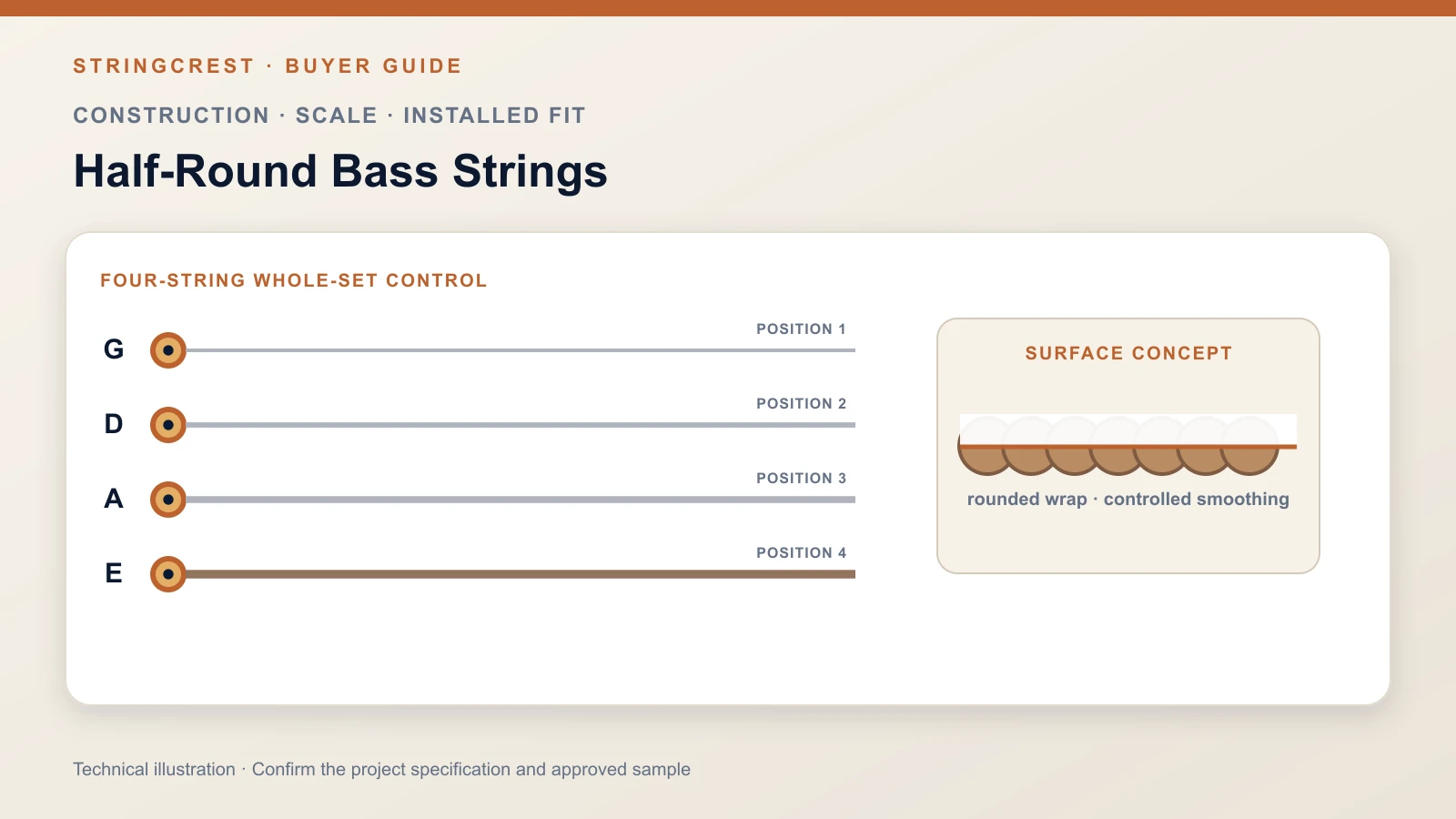
Half-round bass strings occupy a specific construction space between conventional roundwound and flatwound products. A round outer wrap is processed to create a smoother external surface while retaining a wound-string structure. That description is useful, but it is not a complete purchasing specification. A wholesale buyer must still define string count, tuning, scale and installed length, gauge sequence, core and wrap direction, surface target, ball end, taper, sample method, packaging and change control.
The category is often described with tone and feel words such as smooth, warm, bright or balanced. Those terms can help organize a sample review, yet they are subjective and depend on the instrument, electronics, player and comparison set. They should not replace measurable construction information or be turned into universal performance claims.
This guide shows distributors, brands and product managers how to prepare a half-round bass-string brief, compare supplier proposals, evaluate installed samples and decide whether the category belongs in a focused range. It uses official product information from established string manufacturers to explain category conventions. Those references do not establish a StringCrest formula, gauge availability, MOQ, lead time, capacity or compatibility. Confirm all project-specific details in the current quotation and approved sample.
Define half-round construction accurately
Distinguish surface families before requesting a quote
Roundwound bass strings normally retain the rounded profile of the outer wrap. Flatwound strings use a flat outer ribbon or another construction intended to create a smoother surface. Half-round strings begin with a wound structure and receive an additional surface-processing step that reduces the peaks of the round wrap. Manufacturers may use terms such as semi-flat, ground-wound or pressure-wound for related ideas, but the construction behind those labels can differ.
Do not assume that every “half-round” proposal uses the same process, core, wrap alloy or finished profile. Ask the supplier to describe the declared construction and which surface is being modified. The product master should use the approved term consistently across the technical sheet, artwork and sales page.
| Range family | Surface concept | Buyer question | Sample focus |
|---|---|---|---|
| Roundwound | rounded outer wrap remains | What material and winding specification? | familiar baseline, articulation, finger noise |
| Half-round | wound surface is partly flattened or smoothed | How is the final surface controlled? | surface feel, transition, installed response |
| Flatwound | flatter external winding profile | What is the exact construction family? | smoothness, flexibility, range role |
This table describes general categories. It does not imply that one family has a fixed tone, lifespan or tension across all products.
Make the surface target inspectable
“Smoother than roundwound” is a useful direction, but it needs an approval reference. Ask for identified samples and retain an approved piece or set. Where the project requires a measurable surface parameter, agree on a suitable method and tolerance with the supplier before presenting the result as a specification.
Visual inspection alone cannot prove the exact processing method or material. It can, however, identify obvious inconsistency, damaged wrap or mixed constructions. Combine identity records, supplier documentation and the approved sample according to the risk of the claim.
Start with the instrument and range role
Record string count, tuning and scale
State whether the set is for four-, five- or another string count, then list the pitch for every position. Record the nut-to-saddle scale and the full installed path from ball seating point to each tuner. Note top-load, through-body or other bridge routing and any taper requirement.
Nominal labels such as “long scale” are not enough because suppliers can define scale families by different ball-to-taper or winding-length conventions. A bass with a familiar speaking scale may still require a different usable length because of bridge construction and tuner placement.
Photograph the reference bass at the bridge, saddle, nut and tuner. Indicate where the full-diameter winding must remain, where a taper may begin and whether a heavy string can wrap safely on the intended post.
Give the SKU a clear commercial purpose
A half-round set can serve as a bridge between a brand’s roundwound and flatwound families, or it can stand as a specialist option for buyers seeking a smoother surface without moving directly to another construction family. The range brief should state the intended comparison, channel and user problem.
Avoid promising that the set is “the best of both worlds.” That phrase is attractive but vague. Instead, say what the project will examine: surface feel relative to the named baseline, attack and note separation on the reference bass, compatibility with the measured path, and retailer clarity beside existing SKUs.
Build a position-by-position specification
Define every string, not only the endpoints
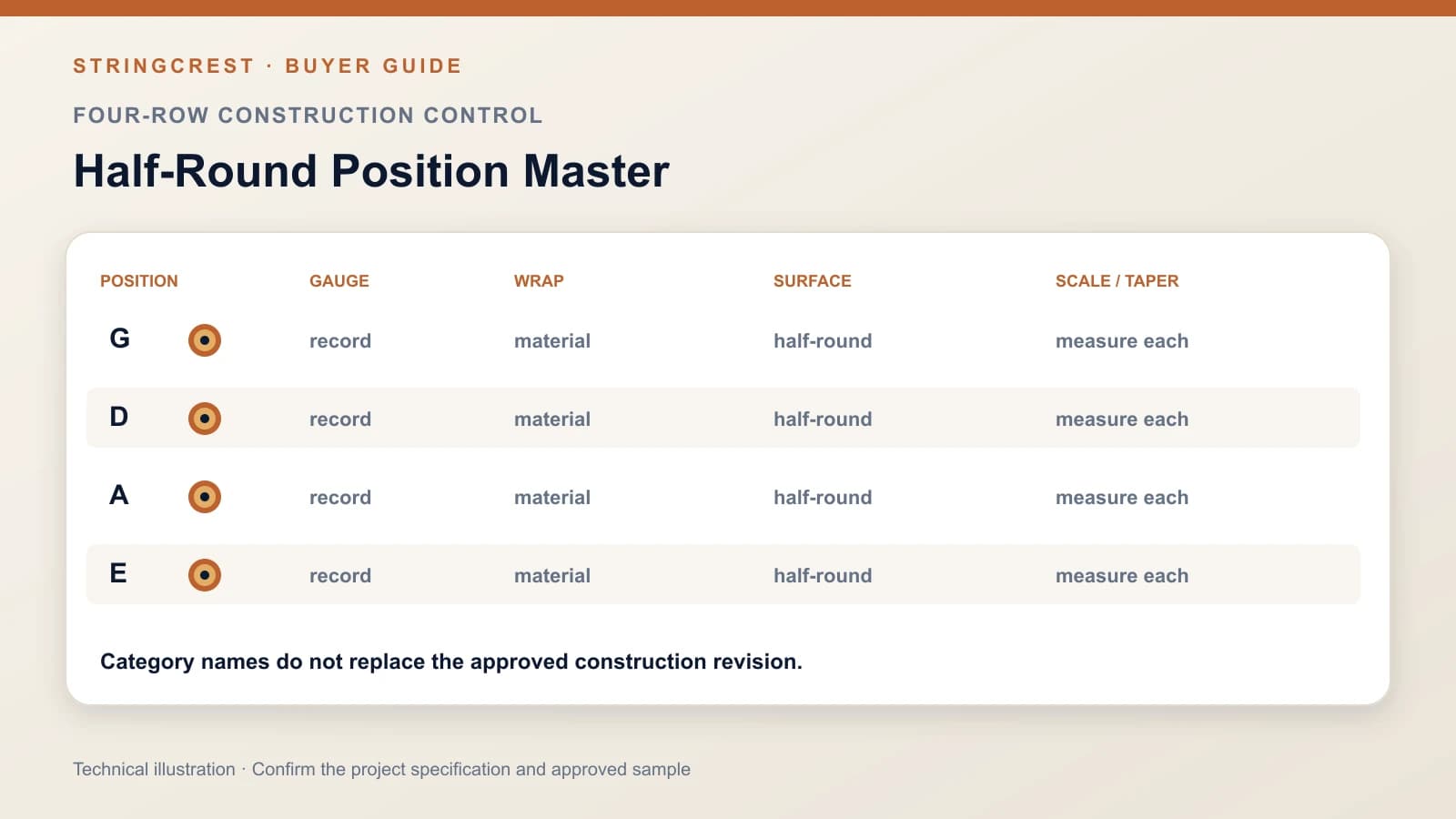
Create a row for G, D, A and E in a four-string set; add B, C or other positions explicitly when needed. Each row should contain pitch, finished gauge and unit, core direction, wrap material, half-round surface process description, ball end, overall length, full-diameter winding length, taper zone and any treatment.
Two half-round strings with the same outside gauge can differ in unit weight, flexibility and surface because their core, wraps and processing differ. The gauge sequence therefore cannot stand in for a complete construction identity.
Assign a development code to every sample revision. Put the same code on the position table, sample pack and evaluation form. When the supplier proposes a change, record it as a new revision so that feedback never becomes detached from the actual strings.
Keep supplier examples in context
D’Addario’s official half-round bass pages are useful evidence that the category exists in established product ranges and that scale, gauge and string count remain explicit selection variables. Their stated process, materials, gauge sets and length definitions belong to D’Addario products. They should not be copied into a StringCrest specification or treated as an industry-wide result.
Use published examples to ask better questions: Which gauges are common in the target market? How does the supplier define scale? Does the low position have a taper? Which surface description can be supported? The final answer must come from the actual proposal and sample.
Compare material and surface without mixing variables
Create a controlled sample ladder
If the first question is surface family, keep scale, tuning, approximate gauge family, wrap material and reference bass as stable as practical. Compare an identified roundwound baseline with a half-round sample. A later stage can compare two half-round surface directions or materials.
Changing alloy, gauge, core, taper and surface at once may create a strong difference, but it produces weak information. The team cannot tell which change matters or how to reproduce the selected outcome. Controlled comparisons make feedback more useful and reduce the risk that a later reorder drifts from the approved concept.
Treat tone words as evaluation prompts
Ask evaluators to use consistent tasks: open notes, fretted lines, sustained notes, muted passages, slides, position changes and dynamics across all strings. Record the instrument, pickup selection, amplifier or recording path and comparison set when those factors matter.
Instead of writing “warmer,” ask what was heard relative to the baseline and in which task. Instead of “less finger noise,” record the slide or position-change passage and the observer. These are still subjective notes, but they are more reproducible than an unsupported headline.
Review gauge and tension under controlled assumptions
Use unit weight when available
Tension depends on pitch, vibrating length and unit weight. Finished gauge influences the construction but does not uniquely define unit weight. Processing a wound surface can also be part of a design whose internal structure differs from the buyer’s roundwound reference.
When verified data exist for the proposed string, calculate each position using the same pitch and scale basis. Label the result with its source and construction revision. If exact unit-weight information is unavailable, do not invent precise numbers. Use installed comparison and ask the supplier what can be documented.
Examine transitions between G and D, D and A, A and E, and E and B where relevant. A set-total number can hide one abrupt change. The desired progression is a product decision; it does not need to be numerically equal, but it should be deliberate and approved.
Check setup effects before assigning blame
Different gauges or construction can interact with nut slots, action, relief and intonation. Record the starting setup and any adjustment made during sampling. A low note that rattles on one bass may indicate a setup interaction rather than a manufacturing failure.
Likewise, a smoother surface can feel different under the left hand without proving a lower numerical friction value. Keep tactile observations separate from laboratory claims unless an agreed method produces supporting data.
Control scale, taper and installed length
Measure from an agreed reference point
Ask how ball-to-taper, ball-to-silk, winding length and overall length are measured. A diagram should define the ball reference and transition point. For each position, verify the required section at the nut and the tuner-side transition against the installed path. Check any bridge taper or exposed-core section separately: a reduced section may intentionally contact the saddle, so the correct geometry depends on the string and bridge design.
The thickest string may require special attention at the tuner. The sample should show whether the taper reaches the post correctly or whether a full-diameter section creates an unsuitable wrap. Do not claim that a generic “long scale” product fits all basses with a similar catalog scale.
Include five-string and alternate-scale projects separately
Adding a low B is not merely putting a fifth piece in the pack. Gauge, unit weight, taper, usable length and tuner fit may require a separate decision. A short-scale project should likewise have its own installed reference rather than inheriting a long-scale approval.
Build separate sample and product masters where geometry changes. Shared materials do not make two scale families automatically interchangeable.
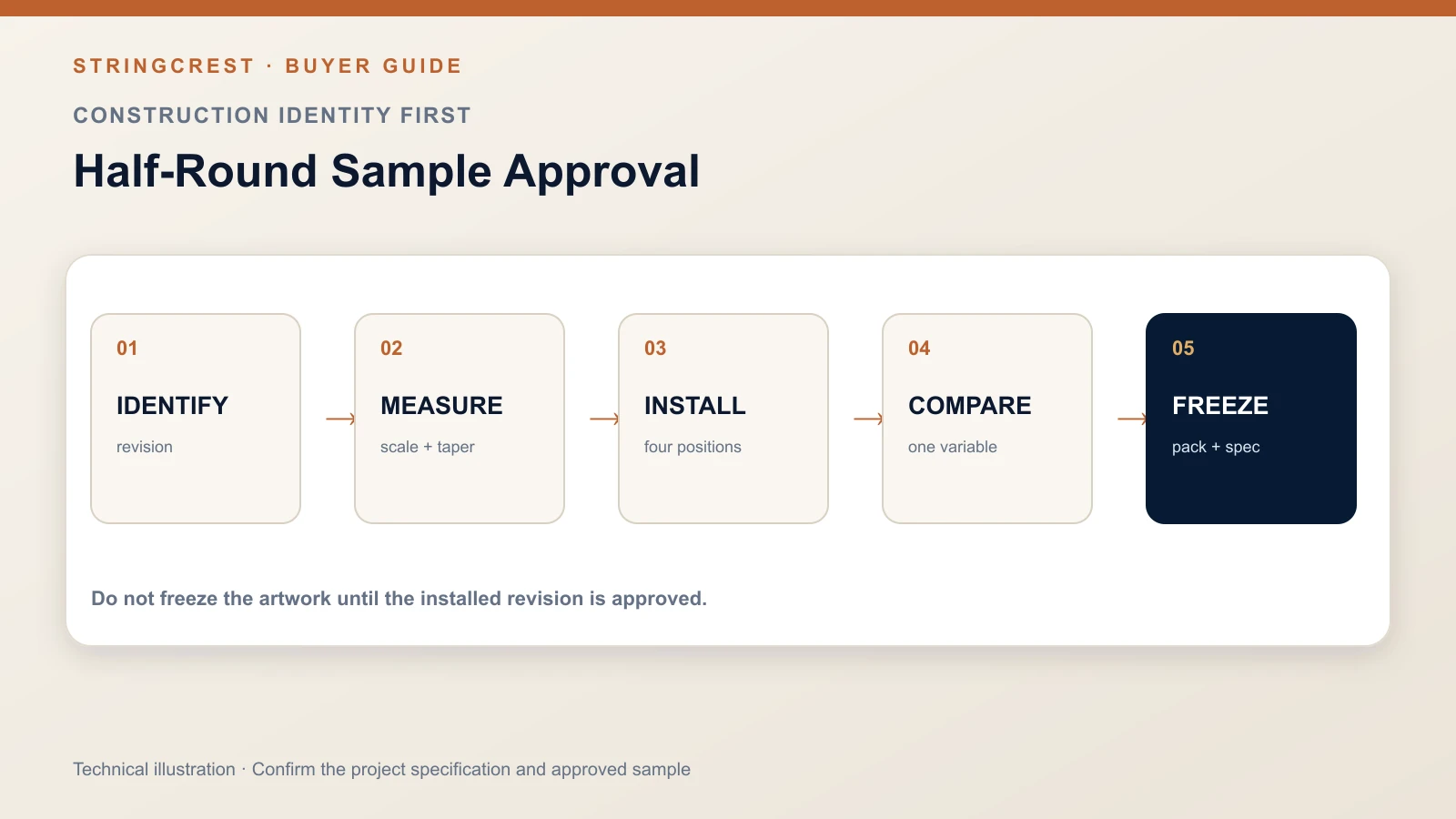
Approve samples in two stages
Stage one: identity and installed fit
Count positions and verify labels. Inspect ball seating, bridge clearance, saddle contact, full-diameter coverage, taper location, nut entry, tuner path and spare length. Confirm the package contains the same gauge sequence as the sample master.
Photograph each end and any transition. Record the bass, setup and revision. If a string is damaged during installation, separate that event from the evaluation of an undamaged sample.
Stage two: comparative playing review
Use the predetermined tasks and compare the half-round sample with the identified baseline. Review surface feel during slides, articulation across positions, perceived output balance, sustain in the chosen passage and the coherence of the gauge progression. The outcome can be “approve,” “revise one defined variable” or “not suitable for this range role.”
Do not conceal disagreement between evaluators by averaging adjectives. Record differing preferences and return to the intended buyer segment. A specialist product can be successful without satisfying every player.
Decide how half-round strings fit the assortment
Position the product beside roundwound and flatwound
Create a comparison card using factual fields: string count, complete gauges, scale definition, wrap material, declared surface construction, treatment and verified fit basis. Then add carefully worded sample observations that are clearly contextual.
This card helps sales teams explain the range without reducing it to “bright versus dark.” It also gives dealers a way to distinguish the three surface families. Avoid suggesting that half-round is automatically an upgrade. It is an alternative construction for a specific preference and use case.
Start with a manageable SKU plan
A four-string core set and a clearly justified five-string extension may be more useful than many near-duplicate gauges. Decide whether replacement singles are needed, especially for the lowest position. Map which component specifications are shared and which require separate approval.
Record sales and support feedback after launch, but do not present forecasts as established demand. New variants should respond to a clear gap supported by actual inquiries, returns or reorder data.
Create packaging that describes the product honestly
State construction and fit facts clearly
The front or primary panel should identify bass guitar, string count, complete gauges and half-round construction. The back or technical area can include the declared wrap material, scale definition and any verified setup guidance. Use the same gauge order and terminology across the package, product page and catalog.
Avoid claims such as “zero finger noise,” “lasts twice as long,” “perfect vintage tone” or “fits every long-scale bass” without suitable evidence. A good B2B pack reduces uncertainty instead of replacing it with exaggerated promises.
Link artwork to the approved revision
The item code, barcode, gauge sequence, scale wording and construction statement should match the final product master. If the surface process or material changes, marketing and technical teams must determine whether the artwork still describes the product accurately.
Inner envelopes or separators should identify each position and gauge. Five-string sets should make the additional low position unmistakable. A receiving inspector should be able to compare the pack with the purchase order without guessing.
Establish receiving and change-control checks
Separate conformance from development
Development testing answers which sample the buyer wants. Shipment inspection asks whether delivered goods match that approval. Receiving checks can cover lot identity, count, package condition, gauge sequence, position labels, ball-end appearance, selected dimensions and a periodic installed comparison.
A visual check cannot verify metallurgy or hidden core construction. Critical claims need documentation or appropriate testing agreed for the project. Describe every record according to what it actually proves.
Define when requalification is required
Require notice before changing gauge, core, wrap alloy, surface process, treatment, ball, winding length, taper or package components. A material or construction change normally deserves a new identified sample. A print-only change may need artwork review without repeating the full musical evaluation.
Store the approved sample revision, specification, artwork and purchase-order reference together. This makes later reorders easier to audit.
Prepare a half-round bass-string RFQ
A useful inquiry includes:
- target four-, five- or other string count;
- pitch and tuning for every position;
- complete gauges and units;
- core and wrap material direction;
- description of the desired half-round surface and comparison baseline;
- scale, ball-seat-to-saddle and ball-seat-to-tuner measurements;
- bridge route, tuner constraints and taper target;
- reference basses and repeatable sample tasks;
- packaging, barcode, position labels, singles and case-pack needs;
- request for current availability, price, sample terms, MOQ, lead time and quotation validity.
Keep open questions marked as supplier proposals. Do not freeze the artwork until the selected construction and complete position table are approved.
FAQ
Are half-round bass strings the same as flatwound strings?
No. Half-round generally describes a wound string whose outer surface is further processed to become smoother. Flatwound is a different construction family. Ask for the supplier’s exact definition.
Do half-round strings always sound between roundwound and flatwound?
That is a common market description, but sound depends on the actual construction, bass, electronics and player. Compare identified samples rather than treating the phrase as a guaranteed result.
Can gauge alone predict the tension of a half-round set?
No. Pitch, scale and unit weight are required. Unit weight depends on the full construction, not only finished diameter.
Is a “long scale” label enough for ordering?
No. Confirm the supplier’s measurement method and provide the installed path, bridge route and tuner location. Approve the taper and winding length on the intended bass.
Should a wholesale range carry many half-round gauges?
Only where each SKU has a clear buyer and role. Begin with a focused architecture, then use real inquiry and reorder evidence to justify extensions.
What should shipment inspection check?
Check identity, quantity, pack condition, gauge sequence, labels and selected agreed dimensions. Use supplier records or appropriate tests for claims that visual inspection cannot prove.
Conclusion
Half-round bass strings deserve their own specification and sample process. The surface family is central, yet scale, taper, gauges, internal construction and installed fit remain equally important. A category name cannot substitute for a complete position master.
Wholesale buyers can reduce ambiguity by controlling one variable at a time, evaluating fit before preference and tying the selected sample to packaging and change control. That creates a product the sales channel can explain accurately and the supply chain can reorder against a stable reference.
Explore StringCrest bass guitar strings · Send your half-round bass-string brief
Sources and interpretation limits
- D’Addario: XL Half Rounds bass-guitar string collection
- D’Addario: XL Half Rounds single-string examples
- D’Addario: bass-guitar string construction families
- D’Addario: String Tension Specifications
These sources support general category distinctions and supplier-specific product examples. Their process wording, gauges, lengths, material details and calculations apply to the cited products. They do not confirm StringCrest construction, surface measurements, availability, sample performance, compatibility, MOQ, capacity or delivery time.
FROM GUIDE TO PRODUCT
Connect this guide to Bass Guitar Strings.
Review the relevant range, then bring the instrument, complete specification and open questions into one project brief.
YOUR PRODUCT · YOUR BRAND
Discuss your next string project with Frank.
Share your instrument category, target market, gauge or material direction and private-label packaging requirements.

ABOUT THE AUTHOR
Frank Zou
Frank works directly with musical-instrument brands, importers and distributors on string specifications, product selection and private-label project requirements.
Meet Frank