
Materials & Construction
Materials & Construction
Stainless Steel vs Nickel-Plated Bass Strings: A Wholesale Range and Sample Guide
A B2B framework for comparing stainless and nickel-plated bass-string materials while controlling construction, gauges, fit, samples and packaging.
Introduction
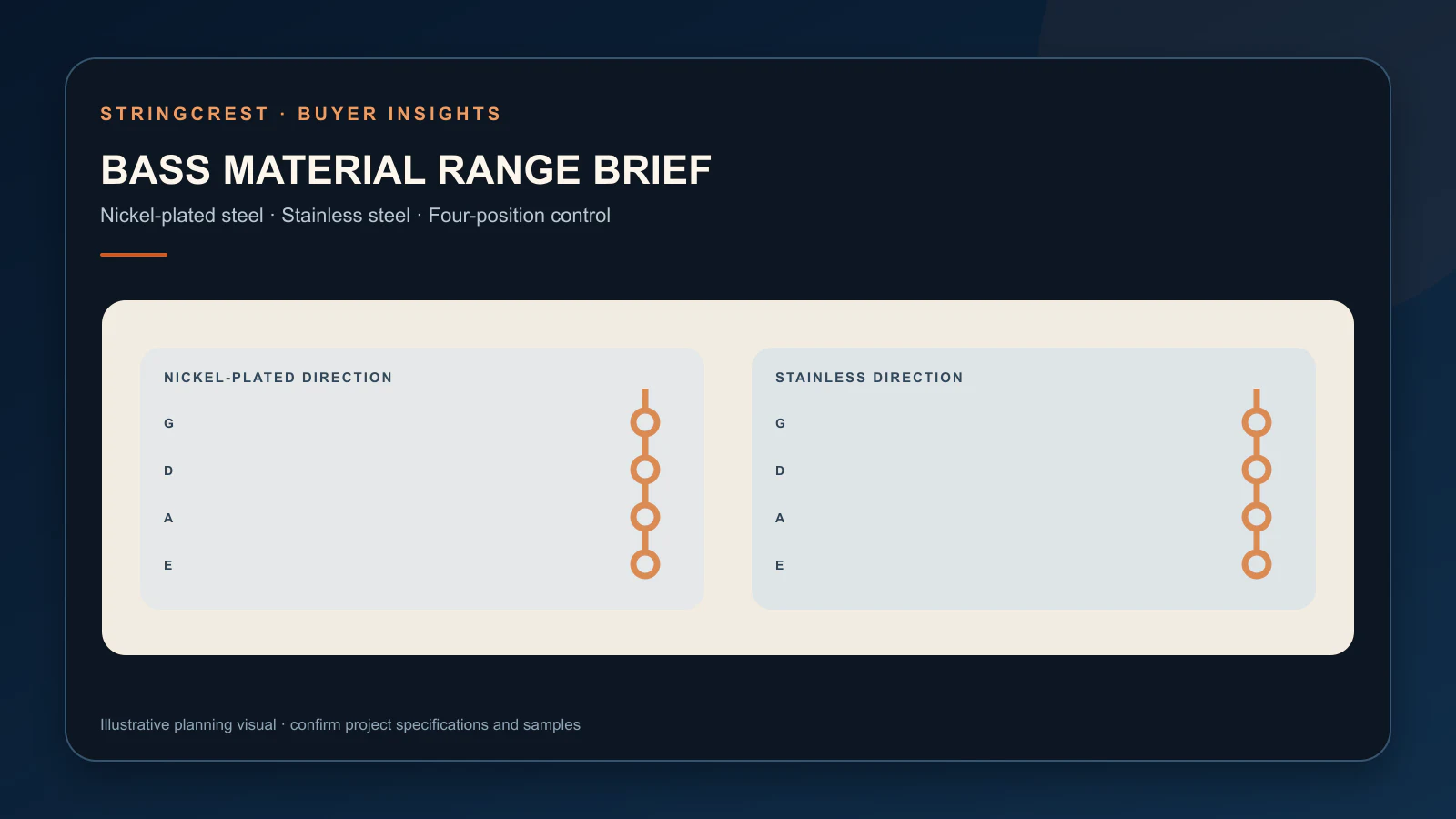
Choosing between stainless steel bass strings wholesale and nickel-plated steel alternatives is a range decision, not a contest with one universal winner. Both materials are established in the electric-bass market, yet the wrap material alone does not determine whether a set will fit a bass, balance across four or five positions, suit a dealer’s customers, or perform consistently from one production revision to the next.
For a B2B buyer, the useful question is: which documented construction, gauge sequence and installed length should represent each range position? The answer should combine a declared wrap material with the core, winding construction, string count, full gauge sequence, ball-end geometry, usable winding length, taper location, tuning and reference instruments. A supplier quote that says only “stainless” or “nickel” leaves too many variables uncontrolled.
This guide gives distributors, music retailers and private-label teams a practical comparison method. It explains how to separate material from construction, plan an assortment without inventing sales claims, approve samples on real basses, and turn the approved result into packaging and purchase-order data. It does not claim that StringCrest has a fixed stainless formula, published MOQ, confirmed lead time or universal performance advantage. Those points must be confirmed in a current project quotation and approved sample record.
Start with the market distinction, then define your own specification
What official product categories can establish
D’Addario’s current bass-string category identifies nickel-plated steel and stainless steel as electric-bass wrap-material options. Its buyer guidance describes nickel-plated steel as a versatile direction and stainless steel as a brighter direction with more presence. That is useful evidence that the two materials occupy recognizable market positions. It is not a specification for another supplier, and it should not be turned into a guaranteed tonal outcome.
Tone words depend on more than metal. Core diameter, core shape, wrap diameter, number of layers, winding tension, surface finish, gauge, scale, pickup type, setup and playing method can all affect the installed result. The same material label can therefore cover noticeably different products. Use market language to define the comparison you want customers to understand, then ask the supplier to document the construction that creates each proposed set.
| Decision field | Nickel-plated direction | Stainless direction | Buyer control |
|---|---|---|---|
| Intended role | Broad or core range position | Distinct alternative range position | Define the channel job, not a universal ranking |
| Wrap declaration | Exact nickel-plated steel description | Exact stainless-steel description | Obtain approved wording for artwork |
| Construction | Core, wrap and winding method | Core, wrap and winding method | Keep non-material variables comparable |
| Set format | Four, five or other confirmed count | Four, five or other confirmed count | Do not infer count from a family name |
| Fit | Scale and usable winding length | Scale and usable winding length | Check on named reference basses |
| Claims | Evidence-limited description | Evidence-limited description | Avoid unsupported durability or output promises |
Do not compare materials while changing every other variable
Build a controlled baseline
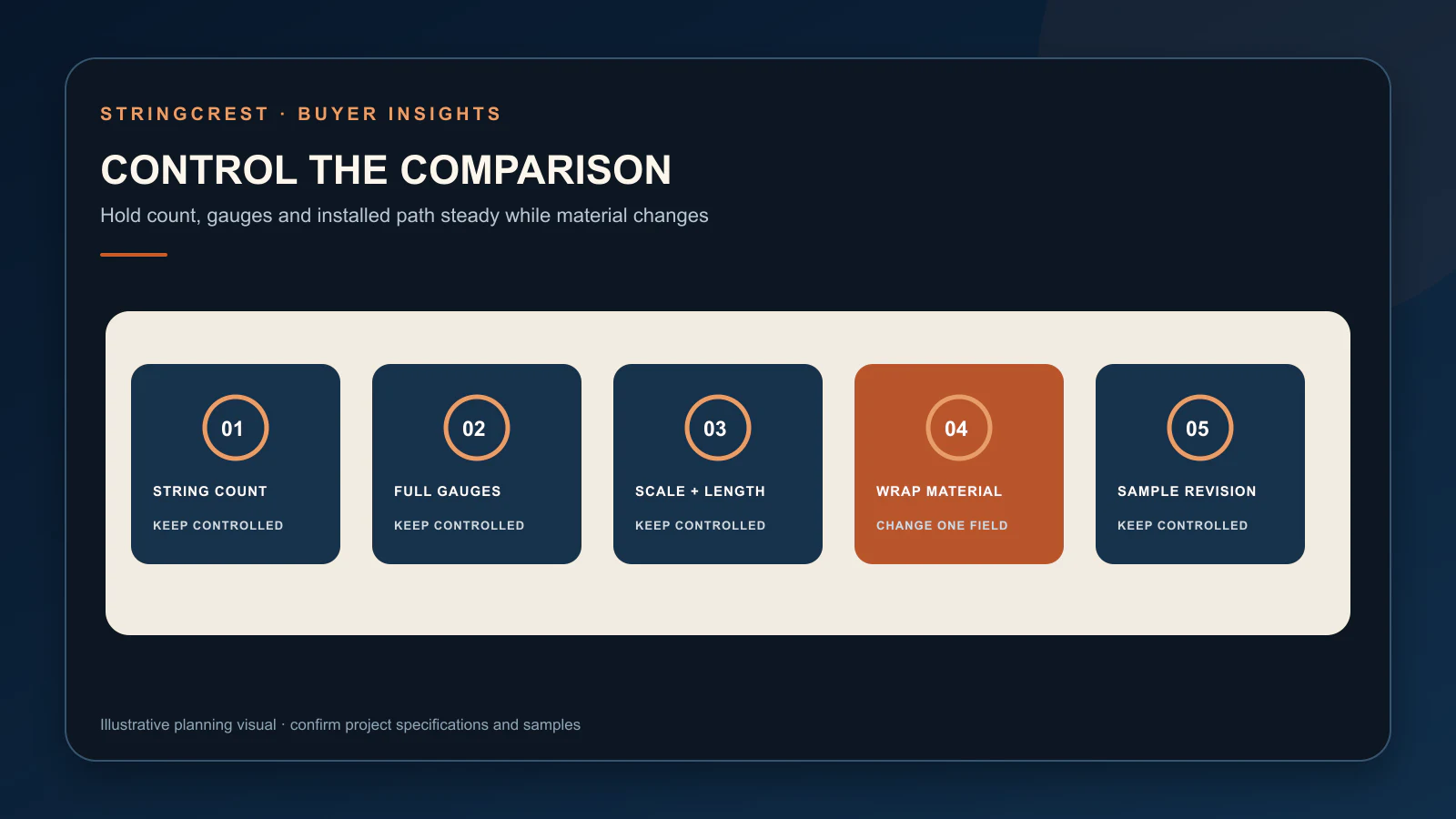
A useful sample comparison holds as many fields constant as possible. If the nickel-plated sample is 45–100 long scale and the stainless sample is 50–105 with a different core ratio and taper, buyer feedback cannot isolate the wrap-material direction. The heavier set may feel firmer simply because of gauge, and a different taper may alter fit independently of material.
Create a baseline sheet before requesting samples. Record the same string count, notes, tuning, gauge sequence, speaking length, ball-seat-to-nut distance, usable full-diameter length and packaging state for both material directions. If an exact parallel construction cannot be offered, require the supplier to identify every difference. The sample can still be useful, but the buyer must interpret it as a comparison between two complete products rather than a laboratory test of one metal variable.
Separate material, construction and treatment
“Nickel,” “stainless,” “coated” and “roundwound” answer different questions. The first two concern outer wrap material. Roundwound describes the surface construction. Coating or another protective treatment is a separate field. A buyer who combines them into one dropdown risks ordering the wrong product or approving artwork that does not match the set.
Use independent fields in the master specification:
- outer wrap material and approved name;
- core material and shape;
- winding construction and number of layers where applicable;
- coating or surface treatment, including whether it applies to wound strings, plain strings or both;
- individual gauges, finished diameters and tolerances to be confirmed;
- string count, tuning and scale designation;
- ball end, color coding and any silk or winding at the ends;
- full-diameter length, taper point and overall usable length.
Design a wholesale assortment with a clear job for each SKU
Begin with customer and instrument coverage
Adding a second material is justified only when it serves a defined group. Review the basses and players your dealers actually encounter: four-string or five-string, common scale families, standard or alternative tunings, fingerstyle or pick use, and the demand for familiar versus more pronounced response. These are planning inputs, not promises about sales volume.
A small range can start with one well-documented nickel-plated baseline and one stainless alternative using the same count and similar gauge architecture. That allows dealers to explain the difference without managing a large matrix. Additional gauges, scales or five-string versions should follow confirmed demand and sample evidence. Publishing every possible combination at launch creates slow-moving inventory and makes replacement-string support harder.
Use range roles rather than “good, better, best”
Material alternatives are easier to sell when the packaging states who should compare them and what has been specified. A core line might emphasize a familiar, versatile direction. A stainless alternative might emphasize its distinct material and sample-approved response. Neither needs to be labeled superior.
Define each SKU with a one-sentence role, such as “four-string long-scale nickel-plated roundwound baseline” or “four-string long-scale stainless roundwound alternative.” Then connect that role to the exact gauge sequence and installed-length record. This language helps sales teams, inventory staff and customers discuss the same product without relying on a color name or internal factory code.
Treat scale and winding length as separate fit controls
A scale label is not enough
Two basses described as “long scale” can route strings differently at the bridge and headstock. The speaking length runs from the bridge witness point to the nut, while the string must travel from the ball seat through the bridge to the tuner. The wound section and any taper must land in appropriate places on that path.
Request measurements from the actual reference instruments. At minimum, record ball-seat-to-nut distance, nut-to-tuner distance for each position, bridge type and any through-body path. Confirm whether the full-diameter wound section crosses the nut and how much wrap reaches the post. A set that tunes to pitch can still be a poor fit if a taper reaches the speaking area or a thick wound section creates unsuitable tuner wraps.
Keep fit identical across the material comparison
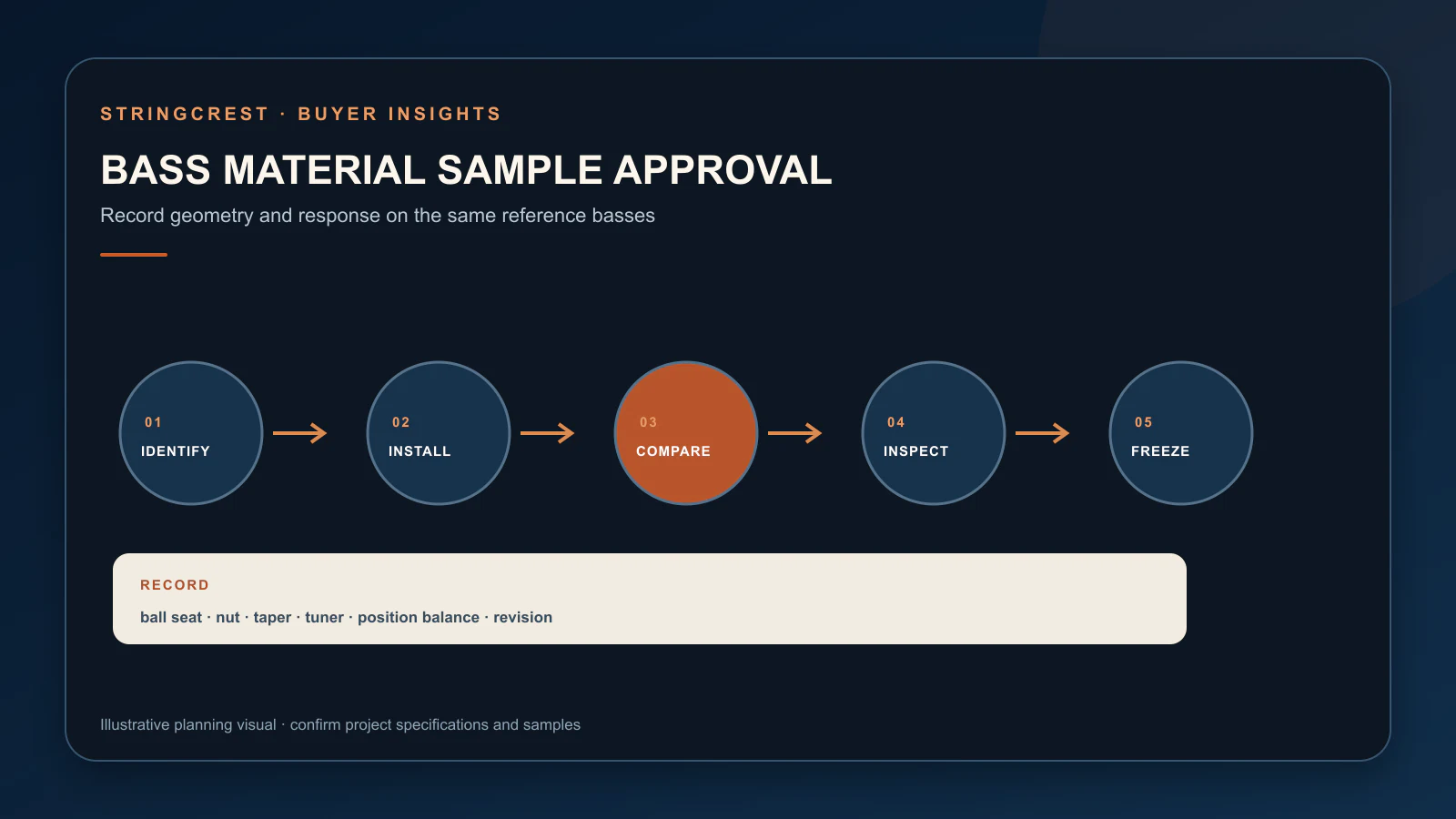
If both material directions are intended for the same bass group, compare them on the same installed path. Mark each sample string by position and revision so that a mixed set cannot be mistaken for a complete approved set. Photograph the ball seat, bridge exit, nut and tuner wraps for the record. The photos document geometry; they do not prove tone or lifespan.
Use a fit result with three states: pass, conditional and fail. “Conditional” is useful when the set fits one named bridge path but not another. That prevents a limited result from becoming a universal compatibility claim on packaging.
Evaluate feel and response with repeatable tasks
Write the test before playing the sample
A listening session becomes more useful when the team uses the same bass, setup, amplifier state, player and task order. Record the date, sample code, tuning and stabilization period. Then evaluate open strings, fretted notes across the neck, transitions between strings, sustained notes, muted passages, pick attack and fingerstyle attack as relevant to the intended range.
Use comparative language rather than absolute scores. Reviewers can note that Sample S presents more upper-frequency emphasis than Sample N on Reference Bass A under the recorded setup. They should not convert that observation into “stainless always sounds brighter on every bass.” The former is traceable evidence; the latter exceeds the test.
Include tactile and operational checks
For a wholesale product, the evaluation should cover more than preference. Note surface feel, noise during position shifts, bending resistance where relevant, balance between strings, tuning behavior after installation, intonation adjustment needs and whether the gauge sequence creates an unexpected jump. Check that the ball ends seat cleanly and that no wrap separates during normal installation.
If corrosion or life is important, define a separate protocol before making any claim. A short playing session cannot validate months of service. Comparative storage or use testing requires controlled conditions, dates, inspection criteria and enough samples to support the wording. Until that evidence exists, packaging should identify construction without promising a fixed lifespan.
Build a position-by-position specification table
Record the complete sequence
The first and last gauges do not define the middle strings. “45–105” can hide different D and A gauges, and those differences can affect balance. A five-string set adds another position whose gauge, taper and winding length need explicit approval. Record each string from highest to lowest pitch with note, gauge, construction, material, finished length and end details.
| Position | Note/tuning | Gauge | Wrap material | Full-diameter length | Taper/end detail |
|---|---|---|---|---|---|
| 1 | Confirm | Confirm | Nickel-plated or stainless | Confirm | Confirm |
| 2 | Confirm | Confirm | Nickel-plated or stainless | Confirm | Confirm |
| 3 | Confirm | Confirm | Nickel-plated or stainless | Confirm | Confirm |
| 4 | Confirm | Confirm | Nickel-plated or stainless | Confirm | Confirm |
| 5, if used | Confirm | Confirm | Nickel-plated or stainless | Confirm | Confirm |
The table is deliberately incomplete until the project is defined. It is safer than publishing a borrowed gauge sequence as StringCrest data. When a sample is approved, freeze the exact revision and connect it to the quotation, packaging item number and purchase order.
Approve packaging language after the product
Put verifiable identity on the front and back
The pack should help a buyer distinguish the two materials without making the rest of the specification difficult to find. Include instrument, string count, complete gauge sequence, material wording, scale or usable-length identity, tuning if nonstandard, item code, lot or traceability field and any handling information supported by the packaging system.
Material names must match the approved specification. Do not shorten “nickel-plated steel” to “nickel” if the change could imply a different composition. Do not claim “nickel free,” hypoallergenic, corrosion proof or extended life without suitable documentation for the final product and its intended market. Regulatory and allergy statements need specialist review; they are not ordinary tonal copy.
Link artwork to the sample revision
Packaging approval should reference the same product code and revision as the approved string set. Use a proof checklist that verifies front, back, side panels, barcode, gauge table, material statement and case-pack label. A correct sample in an incorrect pack is still a shipment error.
Plan receiving inspection around identity and fit
Check what can be verified without destructive testing
At receiving, confirm carton count, case labels, item codes, lot identifiers, packaging condition, set count and visible gauge or color coding against the approved reference. Select samples according to the buyer’s inspection plan and verify string count, obvious winding defects, end construction and key installed-fit dimensions.
Do not describe a visual check as chemical verification of the alloy. Material composition requires appropriate documentation or testing. When traceability matters, require the supplier to connect the shipment lot to the production record and approved bill of materials. Keep inspection photos and results with the purchase order rather than using them as anonymous marketing images.
Define the response to a mixed or mislabeled lot
The inspection plan should state what happens when a carton, pack or string does not match the approved record. Quarantine the affected lot, preserve samples, document codes and measurements, and obtain a written disposition before relabeling or shipping. This process protects both the buyer and the supplier from solving a product-identity problem through guesswork.
Prepare an RFQ that produces comparable quotations
Send each supplier the same structured brief. Include:
- target material direction and whether two controlled alternatives are required;
- instrument type, string count, tuning and full gauge sequence;
- speaking length, ball-seat-to-nut distance, tuner path and bridge type;
- core, winding, coating and taper fields to be declared;
- sample quantities and the reference bass list;
- packaging format, artwork language, barcode and pack-out needs;
- inspection points, revision controls and required documents;
- commercial questions for MOQ, sample cost, lead time and payment terms.
Keep supplier recommendations visibly separate from buyer requirements. A recommendation can become part of the specification only after it is reviewed and approved. This creates a fair comparison and makes later production changes easier to detect.
FAQ
Are stainless steel bass strings always brighter than nickel-plated steel?
Stainless steel is commonly positioned as a brighter, more present material direction, while nickel-plated steel is often positioned as versatile. The installed result also depends on construction, gauges, bass, pickups, setup and player. Compare controlled samples before writing a product claim.
Can two sets with the same 45–105 label feel different?
Yes. The intermediate gauges, core-to-wrap relationship, construction, finished diameters and winding process can differ. Record all four gauges and the complete construction rather than treating the outer numbers as a full specification.
Should a distributor launch both materials in every gauge?
Not automatically. Start with a defined channel role and a manageable baseline. Expand only when dealer feedback, inquiry patterns and inventory performance support another gauge, scale or string count.
Does “long scale” guarantee that a bass string will fit?
No. Measure the installed path and confirm the usable full-diameter length, taper location and tuner wraps on named instruments. Bridge routing can change the required total length.
Can packaging claim that stainless strings last longer?
Only if the final product has suitable evidence under defined conditions and the wording has been reviewed. Material identity alone does not prove a universal service-life advantage.
What should be approved before bulk production?
Approve the position table, material and construction declaration, identified installed sample, packaging artwork, item code, case pack, inspection points and commercial quotation. Keep all references on the same revision.
Conclusion
A reliable stainless-versus-nickel bass range begins with controlled variables. Material gives the buyer a useful market direction, but the sellable product is the complete system: core, wrap, gauge sequence, length, taper, end construction, packaging and approved sample.
When each SKU has a clear channel role and a traceable specification, dealers can explain the difference without exaggerated claims. The buyer can also compare quotations, approve revisions and inspect shipments with far less ambiguity.
Explore bass guitar string options · Send your bass-string material and fit requirements
Sources and interpretation limits
- D’Addario bass guitar string category and material guidance
- D’Addario string-tension specifications reference
These sources describe one manufacturer’s product taxonomy, examples and calculation framework. They do not establish StringCrest material composition, product availability, tonal performance, service life, factory testing, MOQ or delivery terms. Confirm all project specifications and commercial details through a current quotation and approved samples.
FROM GUIDE TO PRODUCT
Connect this guide to Bass Guitar Strings.
Review the relevant range, then bring the instrument, complete specification and open questions into one project brief.
YOUR PRODUCT · YOUR BRAND
Discuss your next string project with Frank.
Share your instrument category, target market, gauge or material direction and private-label packaging requirements.

ABOUT THE AUTHOR
Frank Zou
Frank works directly with musical-instrument brands, importers and distributors on string specifications, product selection and private-label project requirements.
Meet Frank