
Wholesale Buying
Materials & Construction
Coated Bass Strings Wholesale: A Specification, Sample and Range-Planning Guide
A B2B framework for defining coated bass construction, scale fit, position data, comparison samples, defensible claims and reorder controls.
Introduction
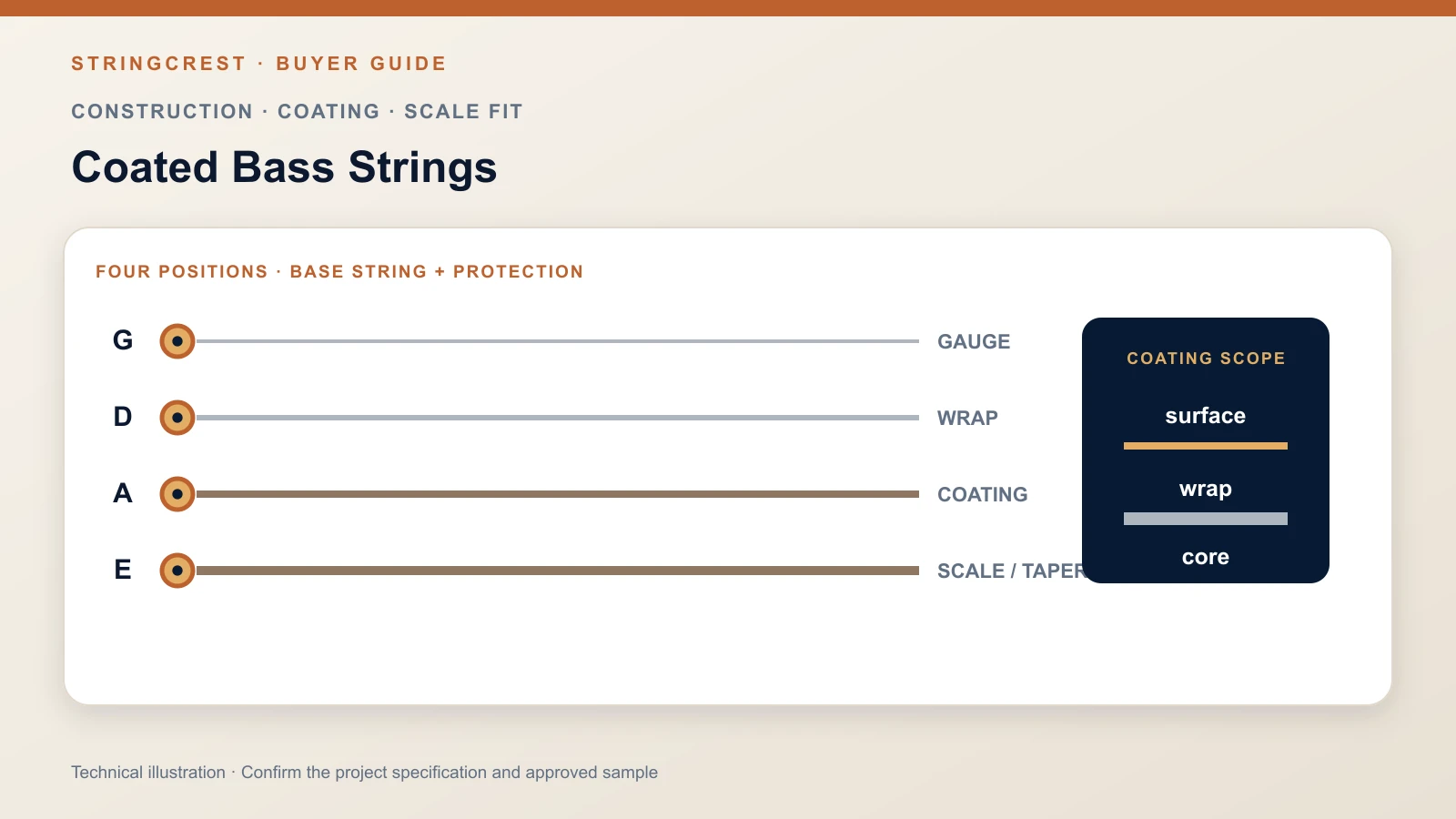
Coated bass strings can fill a useful role in a dealer or private-label range, but the word “coated” is not a complete product specification. It does not identify which parts receive protection, the underlying wrap material, the winding construction, the string count, the gauge sequence, the scale fit or the installed feel. A buyer who requests “long-life coated bass strings” without those fields leaves several product decisions unresolved.
This guide turns the category into a controlled B2B brief. It covers four- and five-string position mapping, coating scope, substrate construction, scale and taper measurements, comparative samples, packaging, shipment inspection and reorder control. It does not assume that StringCrest offers every construction discussed. Availability, commercial terms and test methods must be confirmed for the specific project.
Public product structures show why the details matter. The D’Addario bass-string collection separates number of strings, construction, wrap material, coating and scale length. Its pages distinguish XT-treated and XS film-coated bass ranges. Those are D’Addario’s product systems, not specifications or performance claims for StringCrest. For a buyer, they provide evidence that “coated” can describe more than one protection method.
Define the commercial role before requesting samples
Start with the buyer problem, not a lifetime promise
A coated SKU may be intended for players who want less exposure of the string surface to perspiration and environmental contaminants, dealers who want a premium step within a familiar gauge family, or touring users who value a different maintenance profile. Express the role as a comparison to the range’s own uncoated reference. Avoid promising a fixed number of playing hours, months of service or immunity from corrosion unless a test protocol and representative evidence support the statement.
Service life varies with body chemistry, climate, storage, wiping habits, playing time, instrument condition and the definition of failure. A claim such as “lasts three times longer” requires a named baseline and a reproducible method. During sourcing, a safer objective is to compare identified coated and uncoated samples under the same installation, handling and evaluation schedule.
Give the coated set a clear place in the assortment
Decide whether the new SKU is the core premium option, an alternative to the standard nickel-plated roundwound set, or a specialist choice. A range becomes difficult to explain when two packs use almost the same gauges and construction but differ only through vague terms such as “advanced,” “professional” and “premium.”
Write a one-sentence range role that a sales team can verify. For example: “a four-string long-scale roundwound set with the approved protection treatment and a smoother evaluated surface than our uncoated reference.” Every part of that sentence must point to a product record or sample observation. Tone and longevity language should remain comparative and qualified.
Separate coating scope from the base string
Record what is underneath the protective system
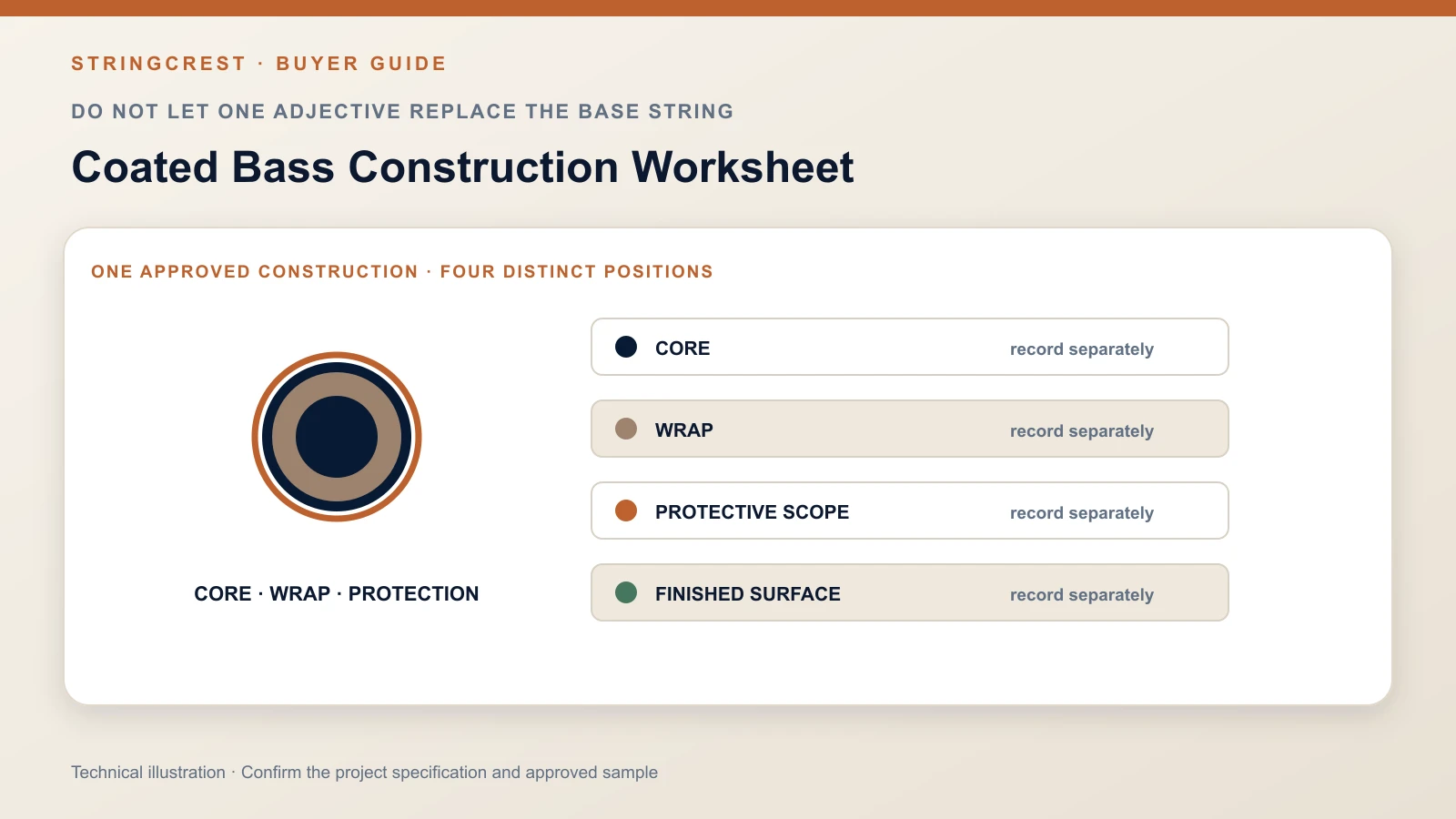
The base construction still controls the identity of the product. Record core type if known, wrap material, winding profile, gauge, twist area, ball end, winding length and finished surface. A coating cannot turn nickel-plated steel into stainless steel, or a roundwound string into a flatwound string. If the supplier proposes a special alloy or core-to-wrap ratio, keep it as a separate field rather than hiding it inside the coating description.
The official D’Addario XS bass example publishes coating, number of strings, wrap material, construction and scale length as distinct fields. Its data belong only to that product. The useful purchasing lesson is that a coated bass set should preserve the same level of identity in its own specification.
Identify the protection method and coverage
Ask whether the system is a film over the finished wound string, a treatment applied to wrap wire, a treatment applied at another stage, or a combination. Confirm whether every wound position receives the same method and whether any plain position in an extended set is treated. Request the supplier’s approved terminology for packaging and technical records.
Do not infer coating thickness, chemistry or coverage from appearance. Clear protective systems may be difficult to see, while colored surfaces do not automatically prove a particular process. When chemistry or restricted-substance compliance matters, request the appropriate supplier document and define the standard; a photograph cannot establish it.
Build a complete position master
Map every string in low-to-high or high-to-low order
Choose one sequence and label it. A standard four-string bass is commonly tuned E–A–D–G from low to high; a common five-string extension adds low B. Some workflows list G–D–A–E or G–D–A–E–B from high to low. Either convention can work if the order is explicit in the specification, sample tags, package and receiving sheet.
For each position, record:
- position number and pitch;
- nominal gauge with unit;
- core and wrap construction;
- wrap material;
- coating or treatment scope;
- ball-end type and color only if controlled;
- overall length, winding length and taper location;
- approved sample code and revision.
Never describe a five-string set by adding only “plus B” to a four-string pack. The fifth position needs its own gauge, construction, taper, length and fit review. The same principle applies to six-string and multiscale sets.
Treat gauge names as labels, not specifications
Terms such as light, regular light and medium vary by brand. They can help merchandising after the exact gauges are fixed, but they do not replace the position table. Preserve the full sequence on the outer pack, technical page and purchase order. If the gauge name changes while the physical set does not, update the artwork revision without creating a false product change.
Measure scale, winding and taper on the instrument
Use physical distances rather than the model label alone
“Long scale” is a category, not a full fit drawing. Measure from the ball seating point to the saddle, nut and tuner post on the reference bass. Record where full-diameter winding must begin and end. A set may reach the tuner yet place a thick winding in an unsuitable tuner area, or a taper may start before the saddle.
For multiscale instruments, measure each position. Do not apply the longest path to every string. If the bridge uses a string-through-body path, include the extra route and bends. Photograph the installed witness points with a ruler or controlled reference when practical.
Keep coating and fit as separate approval questions
The protective layer should not distract from fundamental installation checks. Confirm that ball ends seat, windings remain intact through the bridge path, the speaking length is fully wound where required, the nut path is appropriate, and the tuner receives a usable section. Inspect for flaking, peeling, bunching or visible damage after installation without claiming the observation predicts long-term life.
If a sample does not fit, stop the performance comparison. A fit failure cannot be repaired by favorable tone comments. Record whether the issue concerns overall length, winding length, taper location, gauge or instrument setup.
Design a controlled coated-versus-uncoated sample plan
Change one main variable at a time
The strongest comparison keeps string count, gauges, scale, wrap material and winding construction aligned while changing the protection method. If those variables cannot be held constant, document the differences and call the exercise a product comparison rather than a coating-only test.
Use coded samples so the review form refers to exact revisions. Install fresh sets on the same reference bass or on closely matched instruments. Record instrument, setup, date, evaluator, playing time or defined sessions, cleaning practice and storage conditions. Do not combine observations collected under incompatible conditions into one performance number.
Evaluate practical attributes with repeatable tasks
A useful review can cover initial surface feel, finger noise in a defined passage, tuning stabilization, string-to-string balance, visible condition and change over scheduled checkpoints. Ask the evaluator to use the same short passages and pickup settings. Free-form comments are still valuable, but they should follow the controlled tasks rather than replace them.
Inspect the strings before installation, immediately after installation and at agreed intervals. A visual record can show condition at those moments; it does not prove chemistry, coating thickness or universal lifespan. Keep photos labeled with sample code, date and position.
Define the decision rule before the test starts
State what must be true for the coated revision to move forward: complete fit, no obvious surface defect, acceptable balance against the reference, packaging compatibility and a consistent identity across repeated sample sets. The rule may also include a minimum evaluation window, but that window is a project decision, not a public guarantee.
Avoid selecting the winner from a single player’s adjective. Summarize where evaluators agree, where they differ and whether the differences matter to the intended range role. When results are mixed, retain the uncoated reference or prepare a narrower follow-up rather than rewriting the claim.
Translate approval into packaging and sales copy
Use only terminology supported by the product record
The pack can identify instrument, string count, scale category, gauges, wrap material, winding construction and the approved coated or treated descriptor. A short explanation may describe the protection objective. Do not state “rust proof,” “never loses tone,” “all-weather” or a numerical lifespan unless the company has suitable substantiation for the actual production product.
Keep competitor process names off private-label artwork. Terms such as XS and XT identify another company’s systems. The private-label pack should use the supplier-approved generic description or a legally reviewed proprietary name tied to the correct construction.
Plan the information hierarchy for quick dealer use
Put the category and gauge sequence where buyers can find them quickly. Include a unique SKU, barcode, lot or traceability reference and revision-controlled artwork. If four- and five-string versions share a design, make the string count visually unmistakable. A small diagram can show E–A–D–G or B–E–A–D–G without making tone promises.
Do not let a coating message hide the scale. A wrong-scale return is still a wrong product even if the protective system is correct. Link the product page to the same specification order used on the pack.
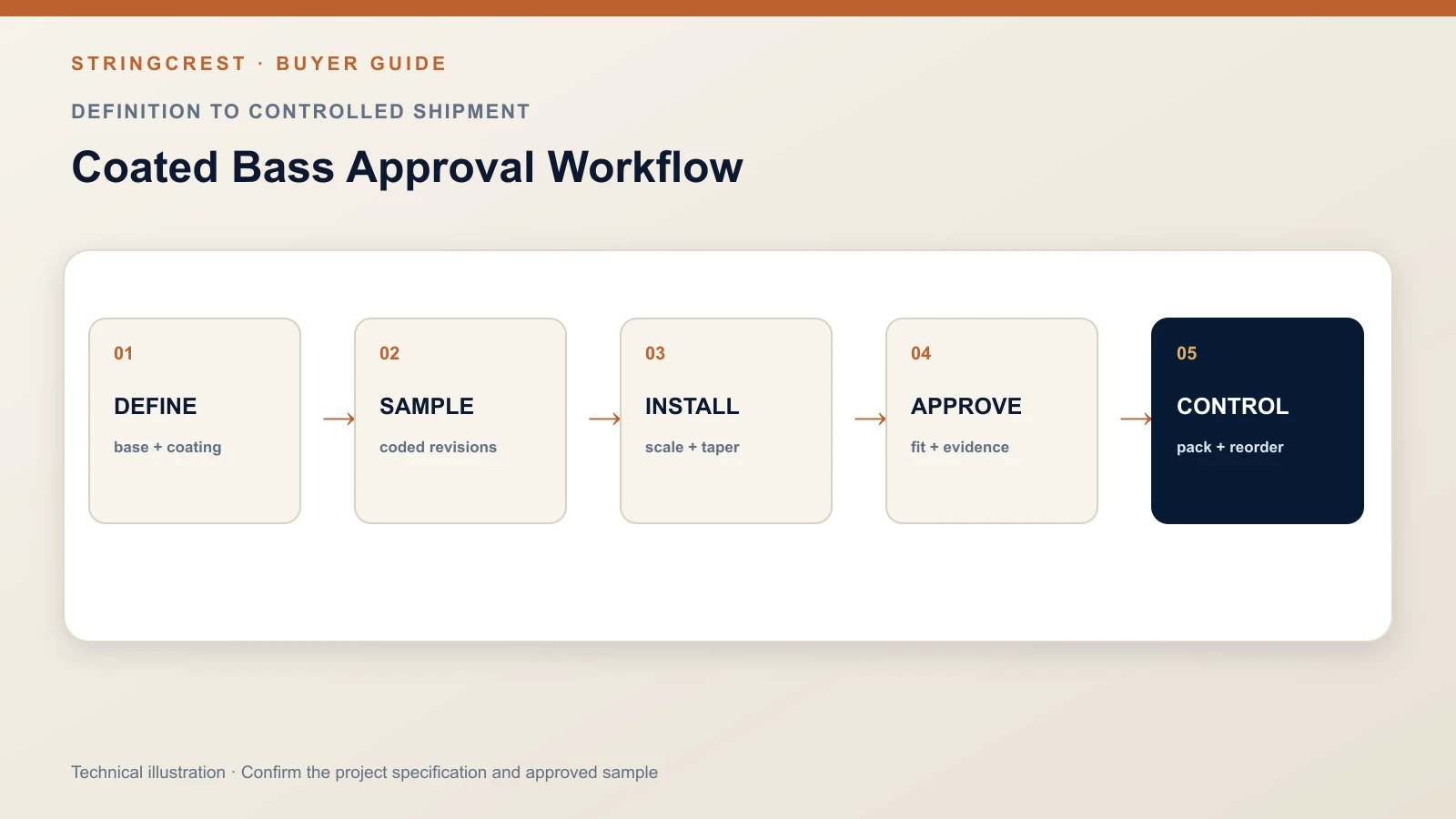
Plan inspection from sample to shipment
Establish incoming material and in-process identity checks
Ask how the supplier distinguishes base wrap material, coating route, gauge wire and approved revision. The answer may involve labeled material lots, travelers, work orders or another traceability method. Record the agreed evidence without claiming a particular factory system exists until it is documented.
Critical process checks depend on the construction and supplier capability. They may include selected diameter measurements, length and taper checks, surface-condition review, end attachment review and sample installation. A brand owner should agree which records are delivered, retained or available on request.
Make final inspection prove only what it can observe
Shipment inspection can verify item code, lot code, quantity, package revision, seal condition, printed gauges, string count, visible surface condition and selected dimensions. A sample pack can be opened under an agreed plan to confirm contents and position sequence. Installation on a retained bass may confirm fit against the approved reference.
Final inspection cannot usually prove long-term service life from one visit. It also cannot identify an invisible coating chemistry by sight. Keep durability evidence, material declarations and visual shipment records as separate evidence types.
Protect the reorder with change control
The purchase agreement should require notice before changing core, wrap, gauge, winding construction, coating system, ball end, length, taper, packaging material or print file. Decide which changes require documents, dimensional samples or a full installed comparison. Preserve the approved sample, position master and artwork as one release package.
For reorders, compare the incoming lot with the approved identifiers rather than relying on memory. If the coating supplier or process changes, re-evaluate the claims that depend on it.
Build a compact wholesale range
Start with the most defensible set architecture
A focused launch may begin with one four-string gauge sequence and one five-string extension, both based on the same documented construction and protection concept. Add scale variants only when fit evidence and commercial demand justify them. A large matrix of untested combinations increases artwork, inventory and replacement-single complexity.
If the coated set uses a different feel or construction from the uncoated core line, explain the distinction through verifiable fields. Let actual inquiries determine whether a lighter sequence, heavier sequence, short-scale version or multiscale option deserves a development project.
Plan replacement singles carefully
Replacement singles can support dealers, but the single must match gauge, scale, construction, coating and position identity. An uncoated single is not automatically an accurate replacement for a coated set. Decide whether singles are commercially available before printing a service promise.
The inventory record should link each set position to the correct single SKU where offered. If singles are not available, say so internally and avoid suggesting otherwise on the product page.
Prepare an RFQ that can be quoted accurately
Include the following information:
- electric bass application and intended range role;
- four-, five- or other string count;
- tuning and complete position order;
- all gauges and units;
- core, wrap material and winding construction;
- requested coating or treatment scope;
- scale path, winding length, taper and bridge route;
- reference bass and uncoated comparison set;
- sample quantities, coded comparison plan and acceptance method;
- inner labels, retail pack, barcode, carton and artwork requirements;
- requested current MOQ, sample terms, price, lead time and quotation validity.
Ask the supplier to mark unknown fields and alternatives explicitly. An early quotation based only on “coated bass set” may need revision once scale, gauge and process scope are confirmed.
FAQ
Are all coated bass strings made with the same process?
No. Public product ranges show treatments applied to wrap wire and film systems applied to finished strings, among other approaches. Request the method, coverage and approved wording for the actual project.
Do coated bass strings always last longer?
Coating is intended to reduce exposure to contaminants, but actual service life depends on process, player, climate, care, use and the definition of end of life. Compare controlled samples and avoid unsupported numerical promises.
Can a coated string use any wrap material?
The available combinations depend on the manufacturer and construction. Keep wrap material and coating as separate specification fields, and confirm the proposed combination before artwork.
Does coating determine scale fit?
No. Scale fit depends on overall length, winding length, taper, bridge path and tuner geometry. Measure the reference instrument for every position.
Should a five-string coated set use the four-string specification plus a low B?
The four positions can share a construction direction, but the low B needs its own gauge, taper, length, fit and sample approval. Document all five positions.
What can shipment inspection confirm?
It can verify identity, count, package revision, visible condition and agreed measurements. Long-term life and invisible chemistry require different evidence.
Conclusion
A coated bass string is a system, not a single adjective. The buyer must specify the base construction, protective scope, every position, scale and taper fit, sample comparison, artwork and evidence path. That structure makes the product easier to quote, approve, explain and reorder.
The safest commercial language begins with the approved sample and stays within what the records show. A controlled coated-versus-uncoated comparison can support a distinct range role without turning one test into a universal guarantee.
Explore StringCrest bass guitar strings · Request a coated bass-string review
Sources and interpretation limits
- D’Addario: Bass Guitar Strings collection and category guide
- D’Addario: XS Coated Nickel Bass Strings collection
- D’Addario: 45–100 Long Scale XS Nickel product specification
- D’Addario: XT coating overview
These sources show how one manufacturer separates coating method, construction, material, string count and scale. Their named technologies, measurements, performance descriptions and manufacturing claims apply only to their products. They do not establish StringCrest coating chemistry, lifespan, availability, test results, MOQ, capacity, price or delivery time.
FROM GUIDE TO PRODUCT
Connect this guide to Bass Guitar Strings.
Review the relevant range, then bring the instrument, complete specification and open questions into one project brief.
YOUR PRODUCT · YOUR BRAND
Discuss your next string project with Frank.
Share your instrument category, target market, gauge or material direction and private-label packaging requirements.

ABOUT THE AUTHOR
Frank Zou
Frank works directly with musical-instrument brands, importers and distributors on string specifications, product selection and private-label project requirements.
Meet Frank