
Materials & Construction
Materials & Construction
Tapewound Bass Strings Wholesale: A Scale, Construction and Sample-Approval Guide
A B2B method for defining tapewound construction, scale and taper, four- and five-string fit, controlled samples, packaging and replacement singles.
Introduction
Sourcing tapewound bass strings wholesale requires more than choosing a black outer surface and a gauge range. Tapewound describes an outer construction category, but it does not guarantee one core, one tape material, one scale definition or one installed response. A B2B buyer must define the instrument, string count, tuning, core and under-wrap system, tape material, ball-seat-to-taper length, gauge sequence, bridge and tuner fit, sample controls and package claims before quotations can be compared.
The most common sourcing risk is to approve the appearance of a sample while leaving its installed geometry undefined. Bass strings are long, and the relationship among ball end, speaking length, taper and tuner post can decide whether a set is usable. A visually correct string may put full winding on the tuner, taper before the nut or fail to seat properly at the bridge. A second risk is to describe every tapewound set with the same feel or tone promise even though construction, tension and instrument setup vary.
This guide is for distributors, bass specialists, importers and private-label brands planning tapewound sets or singles. It explains how to define the product, measure fit, evaluate samples and design a clear assortment. It does not publish a StringCrest tapewound specification, availability promise, MOQ, lead time or performance guarantee. Those details require a current technical proposal, identified sample and quotation.
Define the tapewound construction
Outer tape is only one layer of the string system
An official D’Addario product example describes a tapewound bass string with a steel core and a flattened black nylon outer wrap. Its current specification labels the construction as flat wound and the wrap material as nylon. This is useful evidence that a commercial tapewound set can combine a metal core with a nonmetallic outer layer. It is not a universal formula, and the brand’s material, tone and production claims must not be transferred to StringCrest.
Ask the supplier to describe the string from the center outward. The controlled specification should state the core material and shape, any intermediate metal winding, the outer tape material, surface color and finish, and the method used to secure transitions. If the supplier uses the word “nylon,” confirm whether it refers to the final outer wrap or another component. If another polymer or color is proposed, identify it accurately rather than continuing to use a copied category description.
The buyer should also distinguish tapewound from conventional flatwound. Both can present a smooth surface, but their outer construction is not necessarily the same. A flat metal ribbon and a polymer tape should not be treated as interchangeable materials. The technical sheet should use the supplier’s verified construction terms and the sample should match them.
| Layer or feature | Required record | Procurement purpose |
|---|---|---|
| Core | Material and geometry | Defines the structural base |
| Intermediate winding | Material and coverage, if used | Explains mass and construction |
| Outer tape | Material, color and surface finish | Identifies the tapewound category |
| Gauge | Method and nominal value by position | Makes proposals comparable |
| Ball end | Shape, dimensions and attachment | Confirms bridge fit |
| Taper | Distance from ball seat and transition details | Confirms nut and tuner placement |
Measure scale by the installed string path
Bass scale labels depend on the supplier’s measurement system
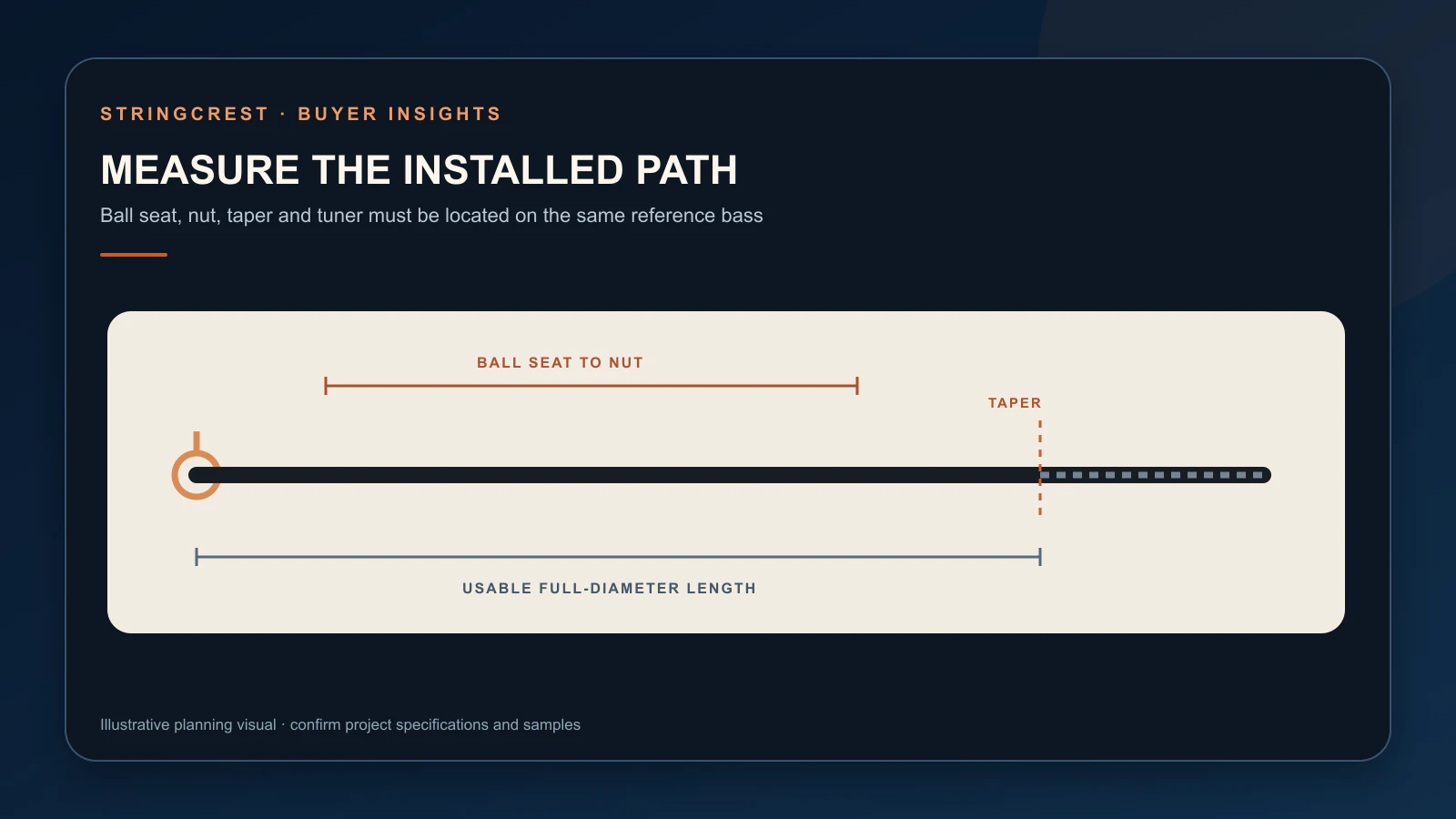
Official D’Addario support documentation states that its bass scale length is measured from where the string meets the ball end to the taper, and publishes brand-specific short, medium, long and super-long transition positions. That method is a useful example of why buyers must ask where a supplier measures from. It is not a universal conversion chart for every maker.
For each reference bass, measure from the ball-seat location at the bridge to the top of the nut. Then record the path from the nut to the tuner post and the bridge routing method. A through-body instrument, top-loading bridge or unusually distant tailpiece can change the required total length even when the advertised playing scale is the same. State whether the reference instrument is fretted or fretless and record the number of strings.
The taper should normally sit in the intended zone relative to the nut and tuner system defined by the supplier. Full-diameter winding may not be appropriate around every post, while a taper that begins too early can place a smaller section inside the speaking length. The buyer should photograph the installed transition and count practical post wraps rather than approving a loose string on a table.
Specify four- and five-string sets position by position
Gauge ranges do not replace a complete set table
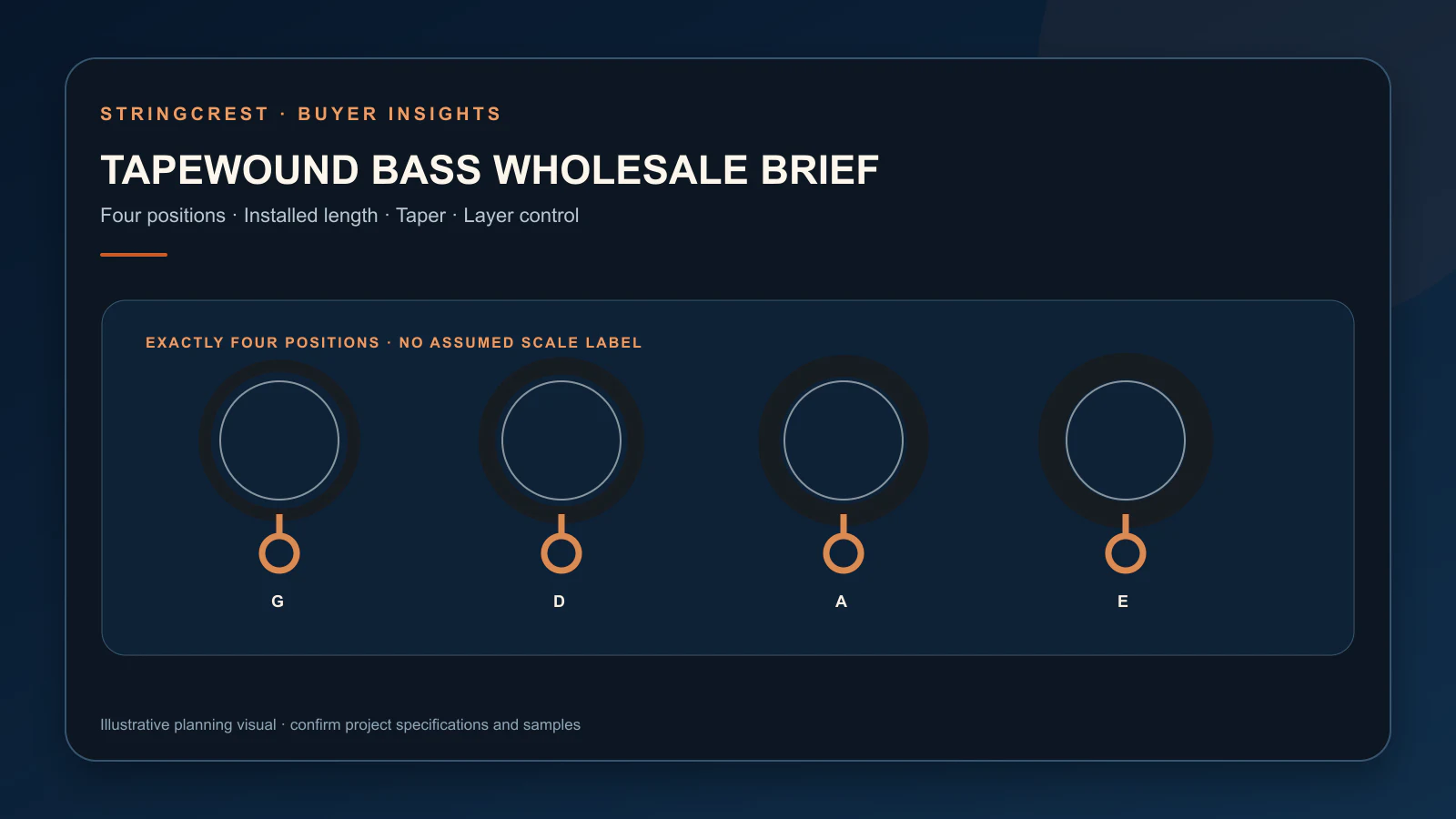
A four-string set should list G, D, A and E positions with tuning, nominal gauge, construction and taper length. A five-string set adds a defined low or high position according to the project. Do not assume that the extra string can be taken from an unrelated family. Its core, tape thickness, flexibility and taper must integrate with the approved set.
Gauge measurement deserves care because the outer tape contributes to overall diameter. Ask the supplier how nominal gauge is defined and measured. A tapewound string with the same listed diameter as a roundwound or flatwound string may not have the same unit weight, tension or feel. The set should be reviewed as a system on the target bass, not selected by matching package numbers alone.
For each position, record the declared speaking scale, ball-seat-to-taper distance and total usable length. If singles will be sold for replacement, keep the same revision references used by the complete set. A replacement E string with a different taper or tape finish can create fit and appearance problems even if the nominal gauge matches.
Confirm bridge, nut and tuner compatibility
Smooth appearance does not guarantee mechanical fit
At the bridge, inspect ball seating and the first bend. The ball should locate securely without passing through the anchor or binding against an unintended edge. On through-body instruments, check the ferrule path and bend radius. Tape and transition areas should not scrape or separate during normal installation.
At the nut, verify that the string sits correctly without excessive binding or unsupported height. A different outer diameter or surface can interact with an existing slot differently from the previous set. Record any nut or setup change needed for the sample. Do not approve a retail claim that the set is a direct fit for every bass based on one installation.
At the tuner, confirm that the intended section reaches the post and can be wrapped using the normal installation method. The outer tape should remain intact through the wrap. If the supplier specifies a trimming or preparation method, include it in the sample instructions and packaging content. Incorrect trimming can affect a wound string, so the approved installation guidance should be based on the actual construction.
Evaluate samples with controlled reference instruments
Separate receiving, fit and playing observations
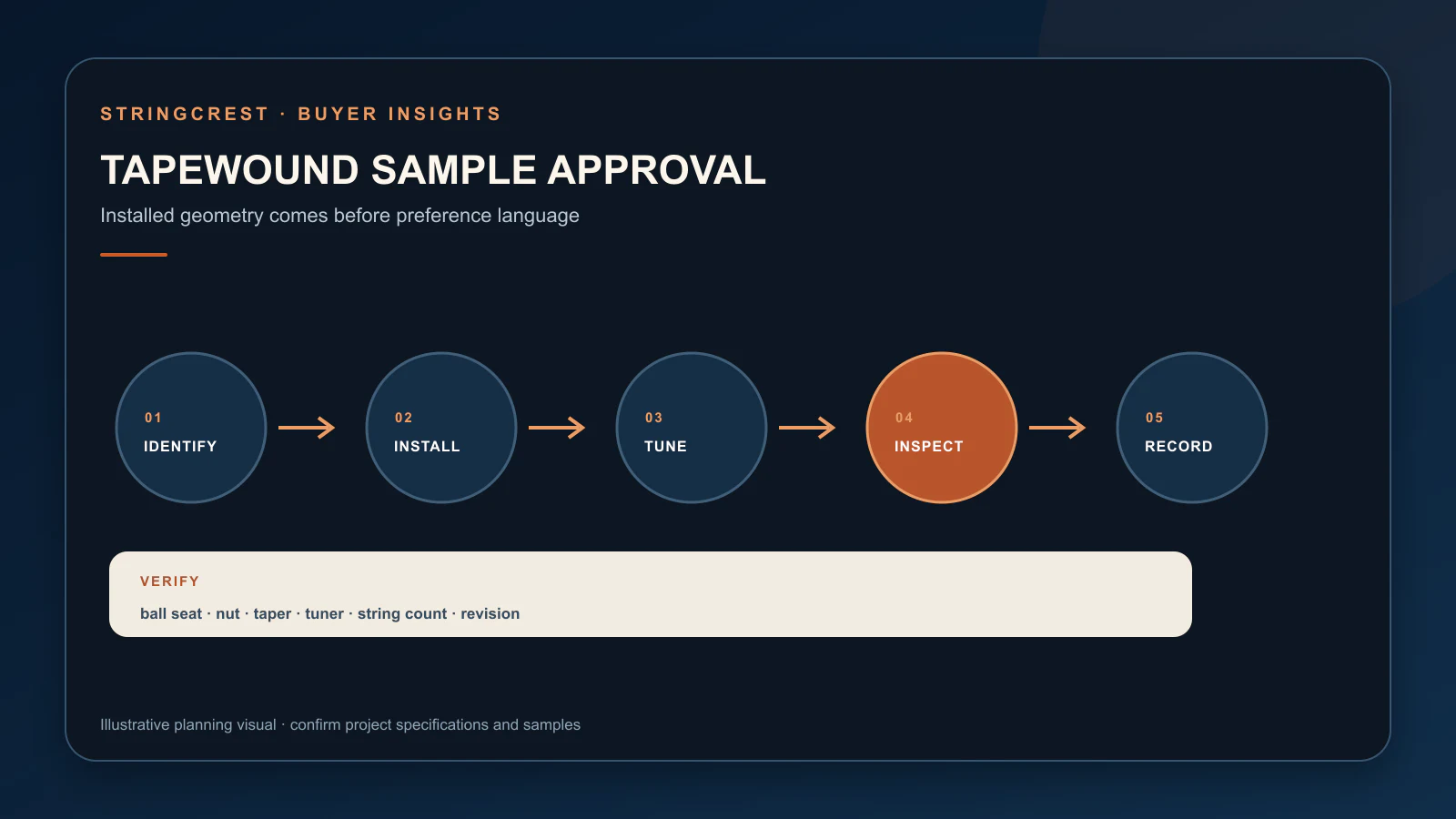
Every sample set should carry a code linked to a dated specification. Receiving inspection should confirm string count, position labels, gauge sequence, surface color, tape continuity, ball attachment and transition locations. Photograph the samples before installation. If the tape shows lifting, cuts or inconsistent overlap, preserve the code and isolate the sample for supplier review.
Install the set on the declared reference bass. Record bridge type, nut-to-bridge scale, ball-seat-to-nut distance, tuner path, setup values and previous string category. Tune using a consistent procedure and note whether the string twists or the tape shifts. Check basic intonation and setup before making conclusions about response.
Playing evaluation can include left-hand feel, surface noise, attack, sustain, position balance and interaction with pickups. These are observations under the recorded conditions, not universal outcomes. If the project targets both fretted and fretless instruments, evaluate both because contact surface and setup differ. Do not turn one player’s preference into a promise such as “no finger noise” or “perfect for fretless.”
| Gate | Questions | Evidence |
|---|---|---|
| Identity | Does the code match the requested construction and scale? | Label and technical sheet |
| Surface | Is tape continuous and undamaged? | Macro photos by position |
| Fit | Do ball, taper, nut and tuner sections land correctly? | Installed path photos |
| Setup | Were relief, action and intonation reviewed? | Before-and-after notes |
| Playing | Is the set coherent on the target instruments? | Structured evaluator form |
| Approval | Can production and packaging reproduce this revision? | Signed release record |
Plan a useful wholesale assortment
Scale and string count create real SKU boundaries
A tapewound range can quickly multiply into short-, medium- and long-scale versions, four- and five-string sets, and singles. Each additional SKU needs its own fit definition, artwork, barcode, forecast and sample approval. Begin with the applications actually supported by the target channel.
If most customers use four-string long-scale basses, one clearly defined entry can be a rational first SKU. A five-string version should be added only after the low-string construction and fit are approved. Short- or medium-scale versions require more than cutting a long string shorter; taper placement and total construction must match the intended instruments.
Singles can support service and replacement, but they increase inventory complexity. Define which positions will be stocked and how a single is identified with the parent set revision. Do not assume demand is equal across positions. A distributor can begin with complete sets and add selected singles after observing replacement patterns.
The range also needs a channel explanation. Tapewound can be positioned as a distinct construction and feel option alongside roundwound or metal flatwound sets. Avoid presenting it as an automatic upgrade. Provide a clear comparison of surface, construction, intended applications and setup considerations so retailers can guide customers without repeating unsupported tone or durability claims.
Build packaging around fit and installation
The front panel should identify the exact application
Packaging should state bass guitar strings, tapewound construction, string count, gauge sequence, scale definition, tuning where needed and brand. If the outer material and color are verified, include them accurately. “Nylon tapewound” should not be used when the approved material is different.
The back panel can provide the scale measurement method, instrument compatibility limits, trimming or installation guidance, storage advice and contact path. Make the ball-seat-to-taper definition visible enough that a buyer can compare it with an instrument. Short, medium and long labels without dimensions or a defined method invite returns.
Claims about warmth, smoothness, noise reduction or durability require careful wording. A sample review can support a product direction, but it does not create a universal measurable guarantee. Use restrained descriptions and invite customers to confirm fit. If the packaging makes a material, coating or corrosion-protection claim, retain supporting supplier documentation and approved test evidence.
Lot and revision identification should connect the package to the approved technical sheet. Define inner protection, individual envelopes, carton count and barcode separately. A tapewound article does not verify packaging barrier performance or shelf life.
Prepare a complete quotation brief
Ask suppliers to disclose deviations and open variables
The RFQ should include target market, fretted or fretless applications, four- or five-string format, tuning, gauge sequence, core direction, intermediate winding, outer tape material and color, ball-end requirement, ball-seat-to-taper dimension, total length, reference instruments, packaging format, artwork state, sample quantity and order forecast structure.
Mark fixed requirements and supplier-recommendation fields. If the supplier proposes a different core or tape, request the reason and a revised sample code. If their scale terminology differs, require actual dimensions. Commercial terms such as MOQ, sample charges, price and lead time must be confirmed against the final configuration in the current quotation.
Before a bulk order, make sure the technical sheet, approved physical sample, packaging proof and purchase order carry the same revision. A change in outer tape, taper position or low-string construction should trigger controlled reapproval rather than a silent substitution.
Common tapewound sourcing mistakes
The first mistake is equating tapewound with every smooth-surface bass string. The second is selecting by a short, medium or long label without knowing the measurement method. The third is treating nominal gauge as a reliable predictor of tension across different constructions.
Buyers also create risk by inspecting appearance but not installing every position. A taper error may be invisible in a coiled sample. Another error is using a four-string approval to launch a five-string set without evaluating the added position. Finally, copying another brand’s material, tone or factory claim creates inaccurate private-label content.
FAQ
Are tapewound and metal flatwound bass strings the same?
No. Both can have a smooth surface, but tapewound commonly refers to an outer tape layer, while a conventional flatwound uses flattened metal wrap wire. Request the complete layer construction for the proposed product.
How should a buyer choose the correct scale?
Measure the actual path from the ball seat at the bridge to the nut, then record the taper and tuner requirements. Use the supplier’s defined dimensions instead of assuming all “long scale” labels are equivalent.
Are tapewound strings only for fretless bass?
No. Official product examples describe use on both fretted and fretless instruments. Each project should still test the specific construction on its target basses and avoid universal suitability claims.
Can a four-string sample approve a five-string range?
No. The added position needs its own core, tape, gauge, taper and playing review. The complete five-string set also needs separate packaging and SKU approval.
What should be approved before production?
Approve the position table, scale and taper dimensions, identified samples, installation guidance, packaging artwork, pack configuration and purchase-order revision. Confirm current commercial terms in the quotation.
Conclusion
Tapewound bass sourcing becomes predictable when construction and installed geometry are documented together. A buyer needs the layer system, gauge sequence, ball-seat-to-taper length and total path for each position. Controlled installation and playing review then show whether the set fits the declared fretted or fretless applications.
The best wholesale range is a clear one: a limited set of scale and string-count SKUs, traceable samples, accurate packaging and no borrowed claims. That structure helps suppliers quote consistently and helps distributors explain the product without promising results the evidence does not support.
Explore bass guitar string options · Send your tapewound bass string requirements
Sources and interpretation limits
- D’Addario XL Black Nylon Tapewound bass set
- D’Addario bass string scale-length guidance
- D’Addario Nylon Tapewound bass singles
These official pages document one manufacturer’s construction examples and measurement system. They do not establish StringCrest specifications, availability, performance, tests or commercial terms. Confirm all project dimensions, materials and samples before ordering or publishing claims.
FROM GUIDE TO PRODUCT
Connect this guide to Bass Guitar Strings.
Review the relevant range, then bring the instrument, complete specification and open questions into one project brief.
YOUR PRODUCT · YOUR BRAND
Discuss your next string project with Frank.
Share your instrument category, target market, gauge or material direction and private-label packaging requirements.

ABOUT THE AUTHOR
Frank Zou
Frank works directly with musical-instrument brands, importers and distributors on string specifications, product selection and private-label project requirements.
Meet Frank