
Wholesale Planning
Wholesale Planning
Private-Label Guitar String Packaging Claims: An Evidence and Approval Guide
Build an approval file for guitar string packaging claims covering claim wording, evidence scope, artwork revisions, samples, responsible owners and release checks.
Introduction
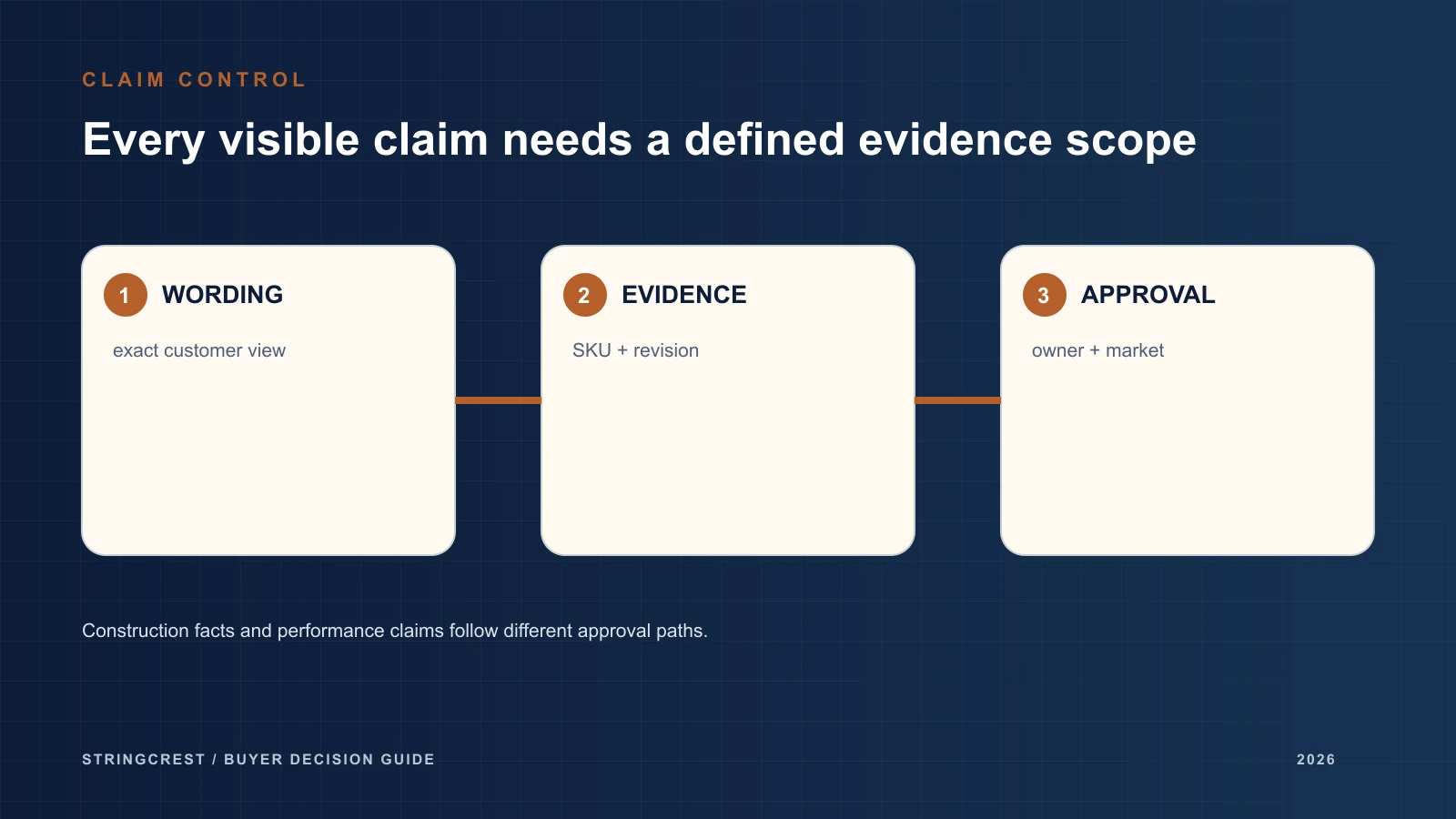
Approve a guitar-string packaging claim only when the exact wording and its reasonable implied meaning match the evidence for the identified product. Record the SKU and revision, supporting file, necessary qualification and responsible approver before releasing the artwork. When support is missing, narrow the statement to a verified fact or keep that claim out of the release.
For US advertising, the FTC Policy Statement Regarding Advertising Substantiation says objective express and implied claims need a reasonable basis before dissemination. This guide uses that principle for internal packaging control. It does not clear an individual pack legally or cover every destination market; the brand owner remains responsible for the appropriate market review.
For an instrument-string brand, importer or distributor, the decision is specific: which proposed words can proceed with the current evidence, which need more support, and which should be held? An attractive proof or a familiar supplier slogan cannot answer that question. Keep claim review distinct from approving the package's appearance or barcode.
Read the whole message before assigning evidence
Capture the exact headline, supporting sentence, badge, image and nearby qualification together. “Coated wound strings” and “Coated set” can communicate different product coverage. A shield graphic beside “longer lasting” may also imply protection that the underlying construction description does not establish.
The FTC's Advertising FAQ's: A Guide for Small Business explains that an ad is assessed in context, including words and pictures, and that both express and implied claims matter. Review the reasonable message of the complete panel, rather than checking each word in isolation.
For internal artwork control, inventory every visible statement, then classify it. A construction description, a measurable performance promise, a comparison and subjective brand language do not call for identical support. “Premium” does not automatically require a particular laboratory test, nor does it make nearby objective claims exempt from review. Identify the message before deciding what evidence is relevant.
Give each proposed claim a short ID and one owner. Write its product scope explicitly: a named set, selected wound strings, a particular treatment, the outer sleeve or the whole package. Record the destination, language and channel as well. A retail envelope, distributor listing and catalog may show the same sentence with a different layout and implication.
Use four claim types as review cases
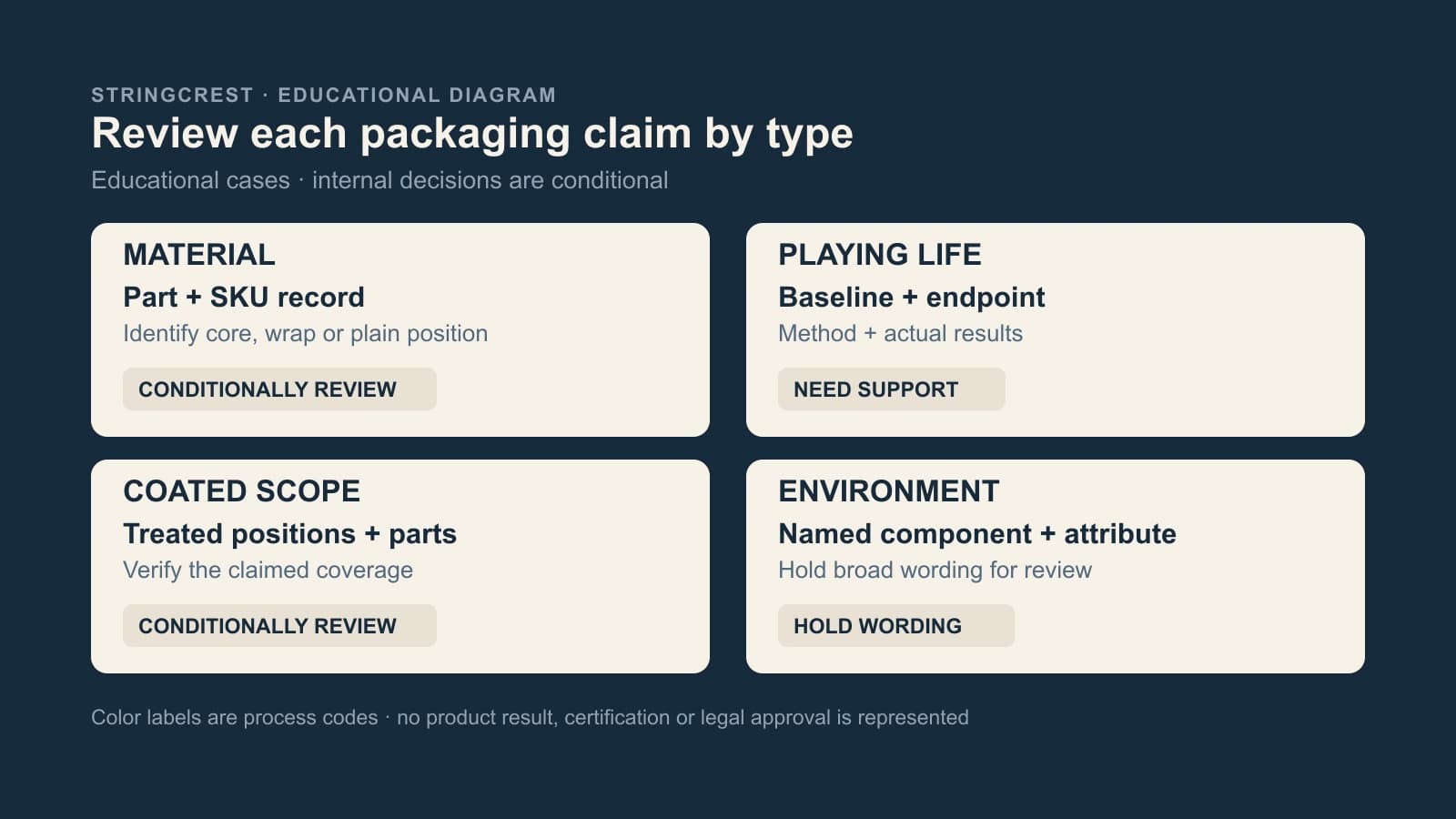
The following matrix contains educational copy examples, not approved StringCrest statements, test results or legal conclusions. “Conditional release” means the specified evidence and owner approval must still be confirmed. “Needs evidence” leaves the statement unresolved. “Hold” keeps that wording out of the proposed artwork release.
| Claim type and example wording | Reasonable message to review | Product scope and support needed | Qualification or correction | Internal decision |
|---|---|---|---|---|
| Material: “Nickel-plated steel wrap on wound strings” | The specified wound strings use that wrap material; the words do not identify the plain strings or core. | Named SKU/revision and a position-specific construction record identifying core, wrap and plain-string materials. | Keep “wrap” and “wound strings” visible. Do not turn the statement into “pure nickel strings.” | Conditional release only if records and owner approval match the narrow description; otherwise needs evidence. |
| Lifespan: “Longer playing life than our uncoated version” | The offered product outlasts an identifiable comparison in actual playing use. | Exact candidate and baseline revisions, a defined life endpoint, comparable conditions, method and actual results supporting the intended message. | Name the baseline and meaningful limitations; storage condition or corrosion observations cannot silently become playing-life results. | Needs evidence. Hold this comparison until the appropriate support and wording are accepted. |
| Coating: “Coated wound strings” | Coating applies to the wound-string scope reasonably conveyed by the panel. | Named SKU/revision and verified treatment records showing which positions and parts receive which coating. | State the treated scope accurately. A treatment on selected positions does not support an unqualified whole-set message. | Conditional release of precise construction wording if verified; any accompanying lifespan or protection promise needs its own support. |
| Environmental: “Eco-friendly strings and packaging” | The product and package offer a broad environmental benefit. | Evidence matching the full reasonable message, rather than a record for one paper component. | Consider a specific supported attribute of a named component instead of the broad slogan; review the complete revised context. | Hold the broad wording for this review. A narrower statement is a separate candidate, not automatic approval. |
Material statements: identify the part being described
A material record should answer what is made from the named material. For a wound guitar string, the wrap and core are separate parts; plain strings need their own description. Match the final words to the approved SKU construction record, including any relevant material supplier documentation.
A competitor's page is useful vocabulary, but it is not evidence of your product. Nor is a document headed “nickel strings” enough if it leaves nickel-plated steel, pure nickel and the covered positions unresolved. Ask the product owner to identify the offered construction before the designer shortens the description.
Material wording also has limits. A verified alloy or wrap description does not by itself establish a longer life, a preferred tone or a performance ranking. Keep those additional messages in separate claim rows with their own support.
Lifespan comparisons: define what “life” measures
Before commissioning a comparison, define the question the wording will ask customers to believe. Playing life, time before a specified corrosion endpoint, tonal preference over time and unopened storage life are different outcomes. Choose a relevant endpoint and method; do not select a favorable observation afterward and rename it “longer life.”
Identify the comparison product by SKU and revision. If coating is the variable under review, document which other features and use conditions are matched and which differ. Retain the actual sample identities, method, dates, observations and results. The evidence reviewer must judge whether that work supports the proposed comparison and its breadth; this guide supplies no universal test duration or sample count.
Words such as “tests prove” also make a claim about the strength of the support. The FTC substantiation policy requires at least the level of evidence that the advertising communicates. A few favorable comments cannot be relabeled as a controlled lifespan test. If the file supports only a narrow outcome under stated conditions, assess that narrower wording instead of adding a sweeping headline.
Coated statements: map the treatment before writing the benefit
Make a treatment map for the offered revision: string position, treated part, coating identity or description, and the record confirming coverage. Distinguish treatment of a wrap wire from treatment of the completed string when that difference affects what the words mean. Do not assume that plain and wound strings have the same treatment.
Use this map to review “coated wound strings,” “coated set” and any accompanying protection sentence separately. A verified coating description is a construction fact. A claim that it resists corrosion or extends playing life adds a performance message and needs suitable evidence for that outcome. If the process changes, check whether the existing claim file still describes the supplied revision.
Environmental statements: separate the strings from the package
The FTC's Environmental Claims: Summary of the Green Guides cautions against broad, unqualified benefit claims such as “green” or “eco-friendly,” and calls for clear, specific qualifications.
Identify whether a proposed attribute belongs to the strings, an outer paper sleeve, an inner protective layer or the package as a whole. A paper record does not establish an environmental benefit for the strings or every packaging layer. The Green Guides, 16 CFR Part 260, distinguish product and package scope and address qualifications for partly recycled material.
For a proposed recycled-content statement, obtain the relevant component record and the basis for the stated amount. Recycled content, recyclability and overall environmental impact answer different questions. Do not let an image of a leaf or an unexplained seal broaden a precise component fact into a whole-product benefit. Check the guidance and target-market requirements again when approving the final words.
Outline your proposed wording, product scope and available evidence references to discuss the packaging requirements with StringCrest. Include the comparison or treatment question that remains open.
Keep one claim record from evidence to artwork
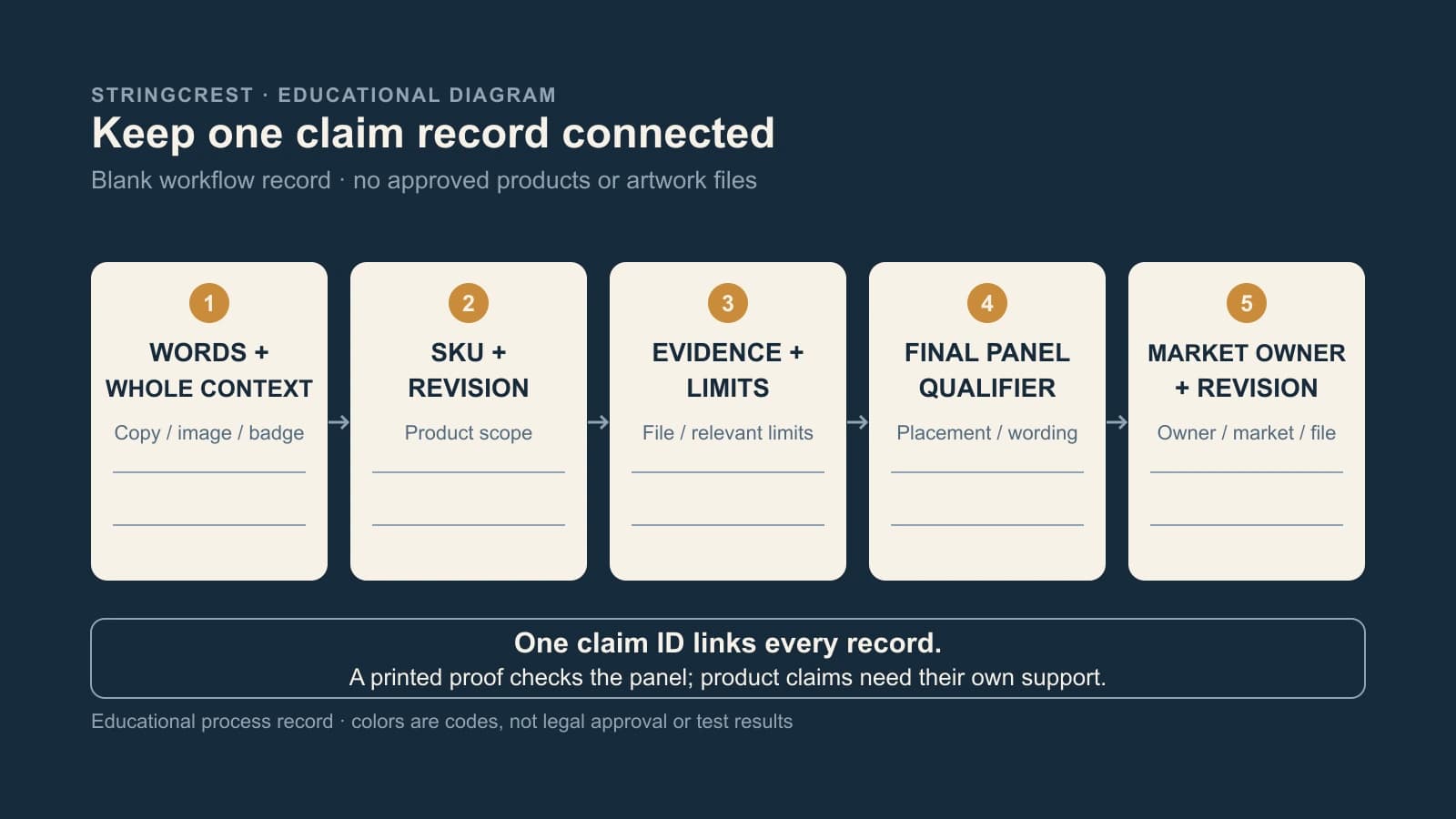
Use one row per proposed message. The record should let another reviewer see what was accepted and why without reconstructing an email conversation.
| Claim-record field | What belongs in it |
|---|---|
| Exact words and context | Final sentence, panel or channel, badge/image and nearby qualification |
| Reasonable meaning | The product fact, comparison or benefit a customer could understand |
| Covered product | SKU, construction/treatment revision and any excluded positions or components |
| Evidence reference | File ID/location, date/version, owner, method or source, relevant result and limits |
| Comparison, if any | Identified baseline, endpoint, conditions and the basis for scope |
| Wording limit | Required qualification and where it appears in the final view |
| Approval | Evidence review owner, brand/market reviewer, decision, date and artwork revision |
An internal conditional approval should name the open condition and who will resolve it. It is not permission to print unsupported copy while a report is being prepared. The release owner should be able to distinguish evidence accepted for this wording from evidence still requested.
Use the private-label packaging brief for the format, protective layers, dieline and design handover. Keep this claim record attached to that brief.
Approve the final panel and each market version
Once the support and wording are settled, review the final-size panel. The FTC advertising FAQ explains that necessary qualifications should be noticeable and understandable, close to the qualified claim; fine print cannot contradict the main message. If a condition cannot remain clear in the design, narrow the headline or change the layout.
Then confirm that the physical proof uses the approved words and artwork revision. This checks identity and presentation, not the truth of a lifespan or material claim. The separate barcode proofing checklist covers product-to-code identity and finished print evidence. A successful barcode scan is not claim substantiation.
Give a translator the approved meaning, product scope and qualification together. Review the translated panel for a stronger promise, a missing comparison or a changed environmental implication. A US English decision does not automatically approve another language or destination. Record which owner accepts each intended market version.
Keep the approved copy with its permitted channel list. If a distributor adds a stronger sentence, or a product revision changes the evidence scope, route the changed message back to the claim owner before accepting it as current copy.
FAQ
Can one report cover several SKUs?
Only when the reviewer has a documented basis for that scope. Identify the relevant similarities and differences, the products the report actually evaluated and the reason the proposed statement remains supported for each included SKU. A shared brand or similar package is not that basis.
What if the comparison product changes?
Record the new baseline revision and reassess the comparison. Evidence against an earlier version should not silently become a statement about the revised product. The claim owner decides whether the wording, qualification or evidence needs updating before the new comparison is used.
What if evidence no longer matches copy already in use?
Identify the affected claim, product revision and channels, and refer the discrepancy to the brand's responsible reviewer. Hold new releases of that wording while the issue is resolved. Record the decision for current packs and digital uses, preserve the old version and coordinate any correction; a later report is not automatic retroactive approval.
Conclusion
A useful claim decision connects the customer's message to the exact product and the evidence that supports it. Keep verified construction descriptions separate from performance comparisons and environmental benefits, and release the final artwork only within the accepted wording, scope and market decision.
Illustrations in this guide are educational claim-control diagrams. They are not evidence of product testing, certification, legal approval or a completed packaging order.
Outline your proposed packaging copy, SKU scope and the supporting records you can identify for a StringCrest project discussion. Keep unresolved claims visible so the next step addresses the actual evidence gap.
FROM GUIDE TO PRODUCT
Connect this guide to private-label string development.
Review the relevant range, then bring the instrument, complete specification and open questions into one project brief.
YOUR PRODUCT · YOUR BRAND
Discuss your next string project with Frank.
Share your instrument category, target market, gauge or material direction and private-label packaging requirements.

ABOUT THE AUTHOR
Frank Zou
Frank works directly with musical-instrument brands, importers and distributors on string specifications, product selection and private-label project requirements.
Meet Frank