
Private Label
Private Label
Private Label Guitar String Packaging: What to Include in an Artwork and Protection Brief
A practical handover framework linking product specifications, retail presentation, protective requirements and artwork approval.
Introduction
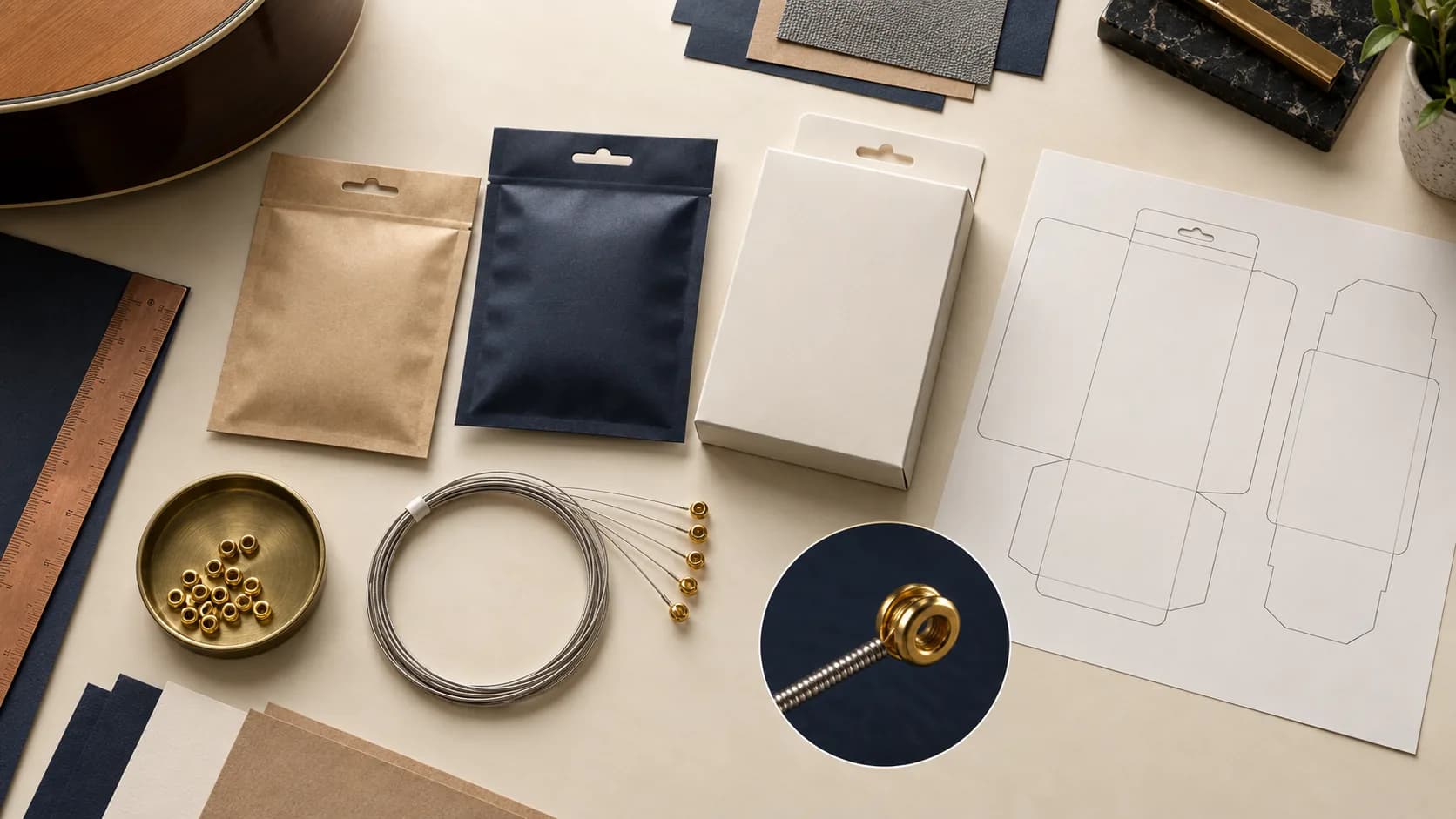
A private-label guitar string package must identify the correct product, present your brand clearly and protect the agreed contents through the intended distribution route. Before commissioning artwork, define the set, inner arrangement, retail format, labeling information and approval process. Packaging appearance is only one part of a purchase-ready brief.
For importers, distributors and music brands, this work connects several teams. Product specialists know the string specification; purchasing manages quantities and quotations; designers control the visual files; warehouse colleagues need reliable identification. A brief should bring these requirements together before a production artwork file is released.
This guide explains how to organize that handover. It proposes checks and decision records, rather than claiming that a particular package has passed a test or that StringCrest offers every format described. Confirm materials, protective options, printing capabilities, quantities and timing for your project through the private-label discussion.
Start with a product record, not a blank design canvas
Give each proposed package a product identifier and a revision. Record the instrument family, number of strings, complete gauge sequence, material description, construction information that affects labeling and whether the sale unit is a full set or an individual string. The designer needs approved product data, not assumptions based on a reference photograph.
Distinguish consumer-facing information from the internal specification. A compact front panel may show the instrument, material and gauge range. The purchasing record still needs the complete set details and any agreed treatment. Keep both records linked so a simplified retail description does not replace the manufacturing brief.
Decide which facts remain open. If a coating description, product code or country-specific label requirement has not been settled, assign it to a named owner before final approval. An attractive draft can be reviewed while technical questions remain open, but it should not silently become production-ready artwork.
Define the unit that customers are buying
Make the distinction between one set, one string and a multipack unmistakable. Record how many retail units belong in an inner box and how many inner boxes belong in a shipment carton, where those formats are used. Do not assume that a quotation for a box means the same quantity to every participant.
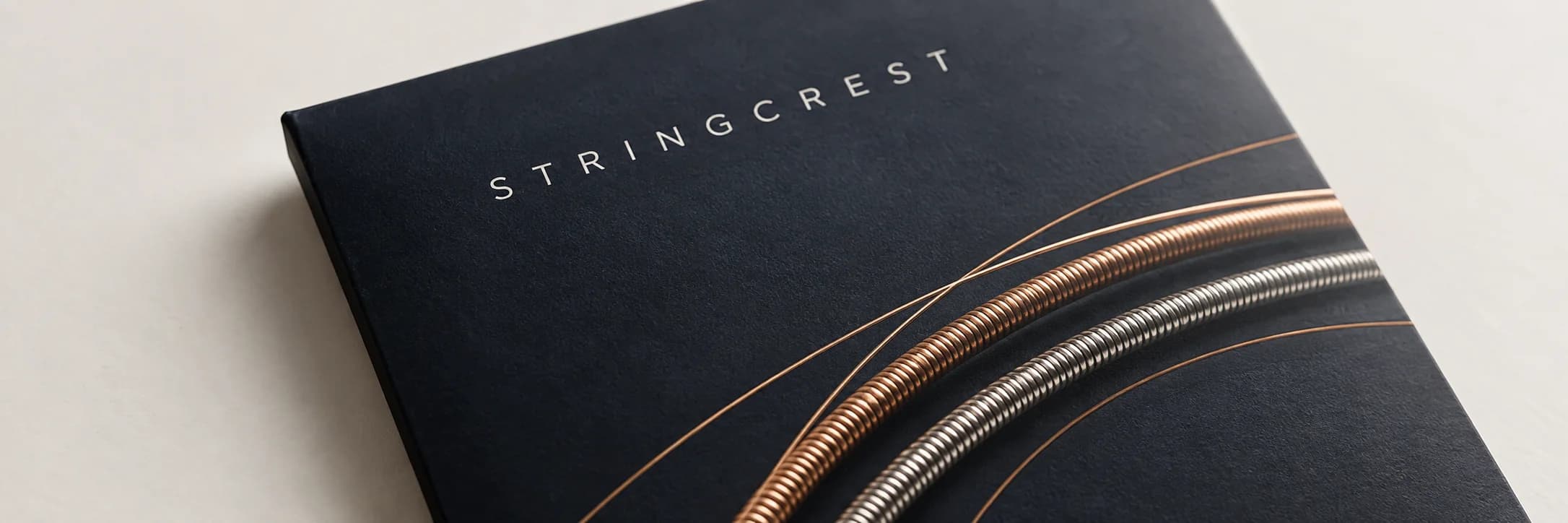
For a range with several instrument families, use a consistent information hierarchy while preserving clear product differences. A six-string electric set and a four-string bass set may share brand elements, but customers and warehouse staff should not have to infer the contents from color alone.
Describe the packaging layers separately
| Layer | Questions to resolve | Approval evidence |
|---|---|---|
| Individual string arrangement | How are strings separated and identified? | Labeled sample or agreed diagram |
| Inner protection | What material, closure and handling instructions are proposed? | Defined material and sample reference |
| Retail presentation | Sleeve, envelope, box or another confirmed format? | Dieline and physical or agreed production proof |
| Distribution pack | How are retail units grouped and counted? | Pack-out specification |
| Shipping carton | What marks, quantities and handling details are needed? | Carton label and packing record |
Avoid describing all these layers with a single phrase such as premium packaging. That phrase does not tell a supplier whether you want an individually identified string arrangement, a particular retail footprint or a defined protective material. Separate requirements make quotation changes easier to understand.
Ask the supplier to identify which choices are established options and which require development. A different retail size may affect printing layout, material use and packing. A change to the inner protection can require a separate evaluation even when the outside artwork stays the same.
Turn protection expectations into questions that can be checked
Specify the distribution situation: intended storage, handling stages, transport route and whether the pack will be opened and resealed before sale. Provide known requirements without inventing a worst-case condition that your business has not actually defined. The supplier can then propose an appropriate approach for discussion.
Words such as sealed, moisture-resistant and corrosion-resistant describe different ideas. Ask what the proposed package is intended to do, which components provide that function and what evidence supports any performance claim. A sealed appearance does not by itself establish a quantified barrier property or a guaranteed storage life.
If a protection requirement is important to acceptance, agree on the method, conditions and acceptance criteria before testing. Record the exact package construction being evaluated. A result for a different film, closure or arrangement should not automatically be transferred to the offered package.
Separate a demonstration from a performance claim
A sample can show how the package opens, how the strings are identified and whether the retail unit fits its intended display. It cannot, by appearance alone, prove a particular service life or shipment outcome. Keep a visual approval distinct from a documented protective evaluation.
Factory testing or shipment inspection should answer a stated question. Ask for an applicable record when one is required, rather than relying on an equipment photograph or a general statement that packaging is tested. Define what remains unverified so marketing copy does not overstate the evidence.
Prepare artwork on the confirmed dieline
Obtain the supplier's current dieline for the chosen format. Confirm the dimensions, folds, closure areas, safe zones and bleed requirements with the printing contact. Use the production file specification supplied for the actual process; a reference image or an exported presentation slide is not a substitute.
Keep structural guides on clearly identified layers according to the printer's instructions. Confirm whether text should remain editable or be outlined, how linked images should be supplied and which file format is required. Avoid generic export rules that conflict with the selected printer's workflow.
Check the design at its intended physical size. A product name may look balanced on a large monitor while a gauge sequence becomes difficult to read on a small envelope. Review contrast, line spacing and the hierarchy between instrument, material, gauge and brand.
Build an information checklist for every SKU
Create one source sheet for product names, gauge sequences, material descriptions, internal codes and approved marketing statements. Populate artwork from this record and review any manual changes against it. A visual family can remain consistent while the underlying data changes correctly between variants.
For each SKU, identify the front-panel essentials and the secondary information. Do not bury the instrument type or the distinction between a set and an individual string beneath decorative copy. A dealer should be able to identify the product quickly without opening the pack.
Include a language review in the process when the same design serves several markets. Product terms should be natural for the intended audience, and the approved technical meaning should remain consistent. Do not assume that changing a headline translates the complete package or satisfies local labeling obligations.
Treat barcodes as functional artwork
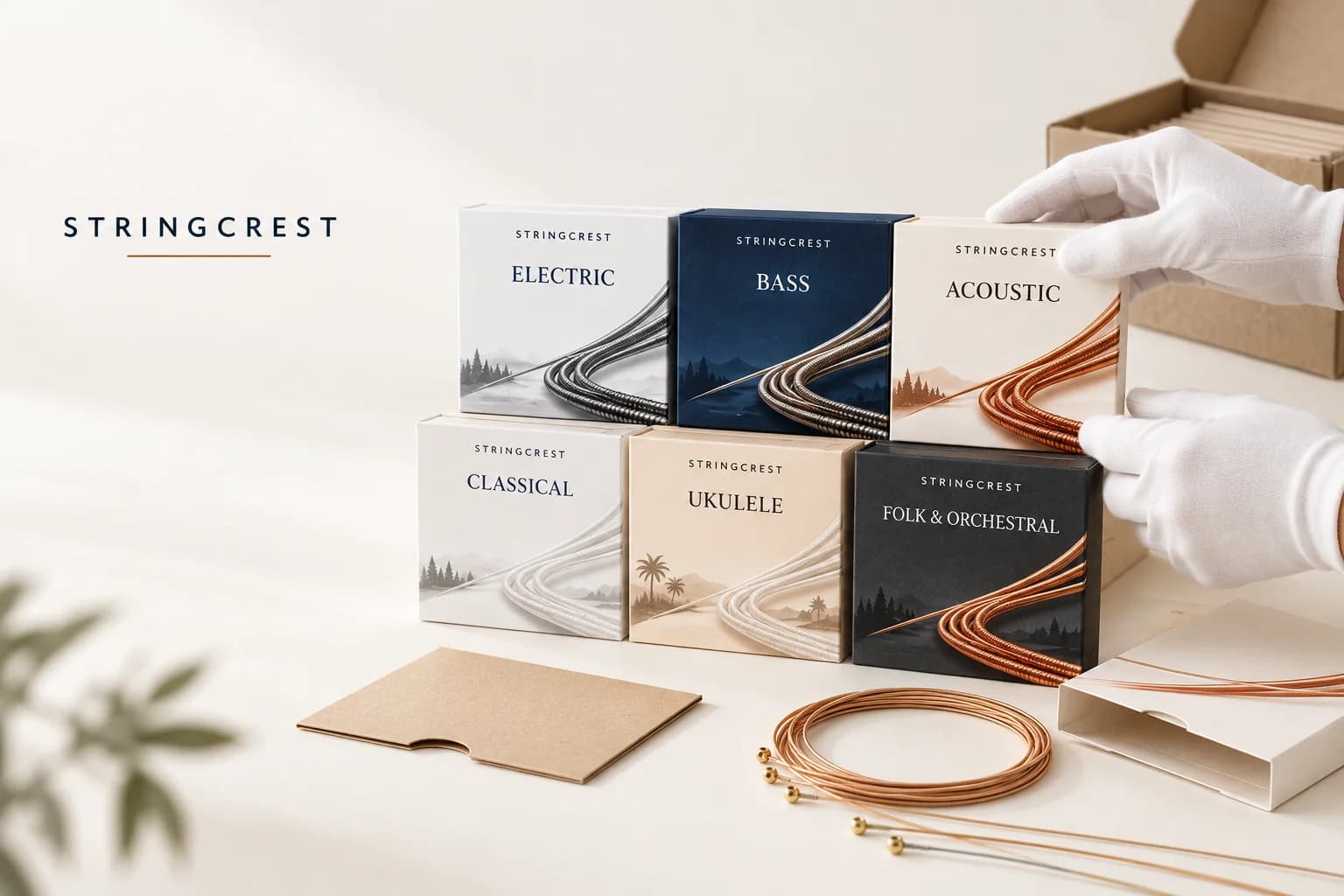
If a retail partner requires a barcode, confirm the identification system and responsibility for assigning the code before the designer inserts a symbol. Obtain the correct data from the responsible brand or organization. Do not copy a barcode from a competing product or reuse an unrelated code because it scans.
The GS1 barcode implementation guide emphasizes practical factors including symbol size, contrast, placement and clear areas around the code. Follow the guidance applicable to the selected symbol and printing process. Decorative elements should not intrude into those clear areas.
Test the final printed result through the agreed verification process. A phone recognizing a screen image is not equivalent to assessing the production print for its intended scanning environment. Keep the code data, SKU mapping and approved artwork revision together so a later design change does not introduce a mismatch.
Review color and finish without relying on screen appearance
Agree how color will be specified and approved for the chosen printing process. Screens, office printers and production materials can show the same file differently. If a particular brand color is important, discuss the appropriate reference and proofing method with the supplier before approving bulk printing.
Treat finishes as explicit options with their own confirmation. A matte appearance in a rendered image does not define the actual substrate or finish. Ask which effects are available, what limitations apply to small text or folded areas and how the proposed sample represents the final package.
When reviewing a physical proof, note the lighting and the revision. Record the decision and any exceptions rather than sending a vague instruction to make it look more premium. Specific observations about legibility, color reference or surface appearance can be acted on and checked again.
Plan pack-out and warehouse identification
Packaging development should include the people who receive, store and dispatch the goods. Ask how they distinguish similar gauge variants, count retail units and identify a mixed carton. The most attractive retail design can still create operational problems if the carton information is ambiguous.
Specify whether cartons contain one SKU or an agreed mix. Record quantities at each packaging level and the relationship between the carton label and the packing list. If batch or lot identification is part of the agreed process, define where it appears and how the receiving team uses it.
Include an example pack-out record in the approval package. This can be a simple diagram or table rather than a complex system. Its purpose is to ensure that the person packing the goods and the person receiving them interpret the order in the same way.
Use a staged approval process
First approve structure and product information
Confirm the physical format, package contents and source data before refining decorative details. Correct an unsuitable size or a wrong gauge sequence while changes are still easy to make. Record which decisions are provisional and which are settled.
Then approve artwork and the relevant proof
Review the full artwork for text, imagery, codes and version consistency. Use the agreed proof type to assess what it can actually demonstrate. A digital proof may support layout approval while a physical proof is needed for another requirement; define that distinction in the project plan.
Finally release a controlled production version
Name the person authorized to release the artwork and identify the exact file revision. Archive the approved package, source data and decision record together. A later email attachment should not replace the approved version without a clear change instruction and a review of affected items.
Include packaging in shipment inspection
Agree what will be checked before dispatch and what records will accompany the shipment. Relevant checks can include SKU identity, quantities, artwork revision, visible print defects, package closure, barcode mapping and carton labels. Any measurement or performance requirement needs its own defined method and acceptance basis.
Distinguish a minor appearance observation from a product-identification error. The consequences differ, and the acceptance decision should follow the agreed criteria rather than an improvised judgment at the end of production. Escalate unresolved discrepancies to the named project contact before release.
Keep inspection records connected to the shipment and approved revision. This supports a focused investigation if a receiving discrepancy appears later. It also helps a reorder start from the last approved specification instead of rebuilding the brief from scattered messages.
Prepare a useful request for quotation
Send the product list, quantities by SKU, proposed packaging layers, dieline status, artwork status and protection requirements. Ask suppliers to separate confirmed options from items needing development. Identify which price elements change when the format, material, printing or quantity changes.
Confirm sample costs, minimum quantities and timing for the actual combination requested. Do not assume one packaging option has the same commercial conditions as another. Keep the agreed delivery basis clear so quotation comparisons reflect equivalent work.
If part of the brief is unresolved, state the question rather than filling it with a guessed requirement. A supplier can respond to alternatives more usefully when the decision is explicit. The result should be a workable development conversation, followed by a controlled specification and approval record.
FAQ
Can I start with a logo and a reference package?
Yes, as a design starting point. Also provide the product specification, sale unit, intended format and known distribution requirements. A reference helps communicate visual direction, but it should not be copied or treated as proof of materials, protection or printing feasibility.
Does a sealed pack guarantee corrosion protection?
No. The appearance of a seal does not establish a particular protective performance or storage life. Ask what construction is proposed and which evidence supports the claim. Agree on evaluation conditions and acceptance criteria when protection is a defined purchasing requirement.
Who should provide the barcode number?
The organization responsible for product identification should provide the approved data under the system being used. Confirm responsibilities with your retail partners and supplier. Keep the code-to-SKU mapping controlled; copying a competitor's code is not an acceptable shortcut.
Is a digital proof enough for approval?
It depends on what is being approved. A digital proof can help review layout and text, but it does not necessarily demonstrate physical fit, material feel or production color. Define the proof required for each important decision before releasing artwork.
Can one design cover several string gauges?
A shared design system can cover a range, but every variant needs correct product data and clear identification. Review gauge sequences, product codes, barcodes and packing records separately. Do not rely only on color to distinguish products that otherwise look similar.
What should be checked before a repeat order?
Confirm the approved product and artwork revisions, quantities, any changed labels and the current commercial terms. Review whether a material, printing or pack-out change affects prior approval. A repeat order should reference a controlled baseline rather than an old image alone.
Conclusion
A strong private-label packaging brief connects product identity, protection expectations, artwork and shipment handling. Define each layer, review functional details at actual size and keep the final approval traceable. Clear requirements help purchasing, design, suppliers and dealers work from the same information without relying on vague premium claims.
FROM GUIDE TO PRODUCT
Connect this guide to private-label string development.
Review the relevant range, then bring the instrument, complete specification and open questions into one project brief.
YOUR PRODUCT · YOUR BRAND
Discuss your next string project with Frank.
Share your instrument category, target market, gauge or material direction and private-label packaging requirements.

ABOUT THE AUTHOR
Frank Zou
Frank works directly with musical-instrument brands, importers and distributors on string specifications, product selection and private-label project requirements.
Meet Frank