
Private Label
Private Label
Guitar String Packaging for Humid Climates: A Wholesale Protection and Inspection Guide
A buyer’s framework for surface preparation, barrier envelopes, seals, qualification, export cartons, claims and shipment inspection.
Introduction
Guitar string packaging for humid climates must do more than carry attractive artwork. Steel and copper-alloy surfaces can be affected by moisture, oxygen, salts, handling residues, temperature changes and storage time. A sealed-looking envelope may still have an unsuitable barrier, weak seams or an internal material that contributes moisture or acidity. For a distributor or private-label brand, package protection therefore needs its own specification, sample plan and shipment inspection record.
Published industry examples show why buyers ask these questions. Ernie Ball describes airtight individual foil packs and seal checks for its own products. ZERUST documents VCI music-string packaging and cyclical humidity testing for specific systems. Elixir discusses corrosion and humidity in the context of its coated strings. These sources illustrate possible controls; they do not prove that an untested StringCrest package has the same performance. Any shelf-life or corrosion-resistance claim must be tied to the exact string, package, seal, storage conditions and applicable evidence.
This guide provides a practical framework for specifying primary protection, artwork, packing, verification and receiving checks without inventing a test result or universal storage life.
Define the distribution environment first
Begin with the route the product must survive. Record production and packing location, destination markets, transport mode, expected transit and warehouse stages, retail channel and likely storage conditions. A shipment moving through warm coastal ports, an air-conditioned distributor warehouse and an open retail display experiences different exposures. Do not reduce all of those conditions to one broad phrase such as “tropical packaging.”
Ask the buyer what problem has been observed or must be prevented: visible oxidation on plain steel, discoloration on bronze winding, stale-looking stock, damaged seals, damp cartons, odor, mixed labels or uncertain shelf rotation. Photographs and lot records can help define the failure, but avoid assuming that every surface change has the same cause.
Agree who owns each control. The string supplier may manage product preparation and sealing; the print or pouch vendor controls material consistency; the freight provider manages loading and transit; the distributor controls receiving and storage. Put those responsibilities in the project record so a later investigation uses evidence from the correct stage.
Build a risk register instead of guessing a solution
| Risk | Questions to record | Possible control to evaluate |
|---|---|---|
| Ambient humidity | Where and for how long is stock exposed? | Barrier and seal specification |
| Temperature cycling | Will packs move between conditioned and warm areas? | Condensation-aware handling and testing |
| Handling residue | Are strings touched after cleaning? | Controlled handling and primary enclosure |
| Pack leakage | Which seam, closure and seal width are used? | Seal-process control and integrity test |
| Carton moisture | What board, liner and storage are used? | Dry storage, liners and pallet protection |
| Long inventory cycle | How will lots be rotated and dated? | Batch identity and stock management |
The register separates evidence from assumptions. If the risk is unknown, mark it for investigation rather than selecting a packaging claim first.
Specify the complete packaging system
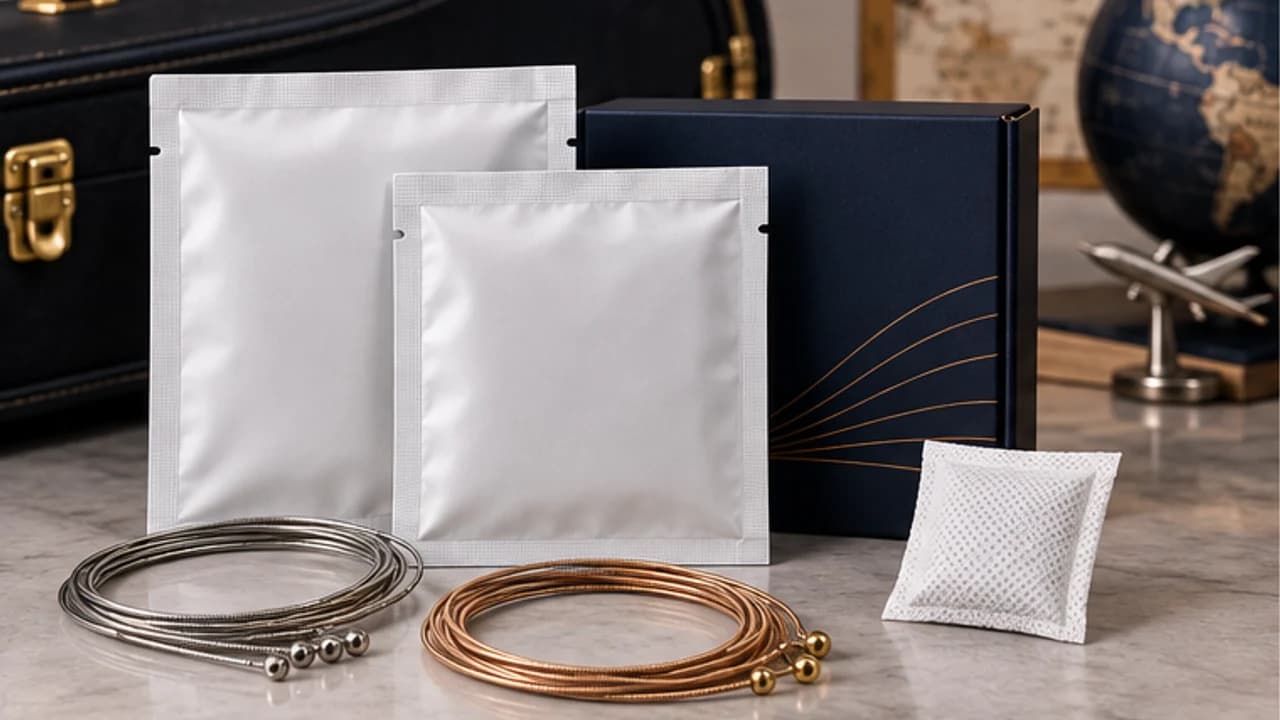
Packaging is a system of product preparation, primary enclosure, labels, retail carton, inner packs, outer cartons and storage instructions. Define every layer. The primary envelope provides the closest environmental separation; the printed carton provides identity and physical organization; the shipping carton helps resist handling and compression. One layer cannot automatically compensate for an undefined weakness in another.
For the primary enclosure, request material construction, thickness where applicable, barrier properties relevant to the project, closure or heat-seal method, seam geometry, print or label compatibility and evidence supporting any claim. If VCI, desiccant, anti-tarnish paper or another active element is proposed, confirm material compatibility, required amount or area, placement, enclosure volume, expected conditions and safe handling.
Do not place a loose desiccant inside a retail package without a documented design and labeling review. A sachet can create contamination, abrasion or customer confusion if used casually. Decide whether it belongs in an inner carton, master carton or primary enclosure only after assessing the actual system.
Keep the string preparation process controlled
A high-barrier pouch cannot correct contamination already on the string. Define handling from the final process step to sealing. Ask how surfaces are cleaned or protected, how operators or equipment avoid residue, how long product can remain exposed before packing and how work-in-process is stored.
Where the project uses oil, treatment or coating, obtain the applicable description and confirm compatibility with the envelope, ink, adhesive and label. An oily surface can affect seals or customer perception. A treatment claim must describe the offered product; do not borrow wording from a coated-string brand.
Record coil diameter, tie or retention method and contact materials. Avoid bare cardboard or wood in direct contact with strings unless compatibility has been evaluated. ZERUST’s technical guidance, for example, cautions against direct contact with moisture- or acid-containing materials for its system. Treat that as system-specific guidance and verify requirements for the packaging selected.
Choose barrier and sealing requirements together
Barrier material and seal quality are inseparable. Even an appropriate film can fail if the sealing window, contamination control or seam width is inconsistent. Define the approved material code and supplier, seal equipment, temperature/pressure/time window where applicable, seam location and acceptable appearance. Keep production settings controlled without publishing proprietary process data unnecessarily.
Ask what integrity test is suitable for the pack. Options can include visual seam inspection, peel or burst evaluation, vacuum or pressure methods, dye or bubble techniques, and water-based challenge methods. The correct method depends on package design and risk. A buyer should not prescribe a dramatic test simply because another manufacturer uses it; agree a method that is validated for the actual pouch.
Avoid unsupported “airtight” and shelf-life language
Terms such as airtight, hermetically sealed, waterproof, five-year protection or corrosion-proof are strong claims. Use them only when definitions, test methods, product configuration and conditions support them. A supplier declaration about film alone does not automatically prove the sealed retail pack’s performance.
For planning, use qualified wording: “sealed barrier envelope,” “packaging direction under evaluation,” or “designed for controlled storage and distribution.” Final public wording should be reviewed against evidence for the approved production revision.

Design a useful packaging test plan
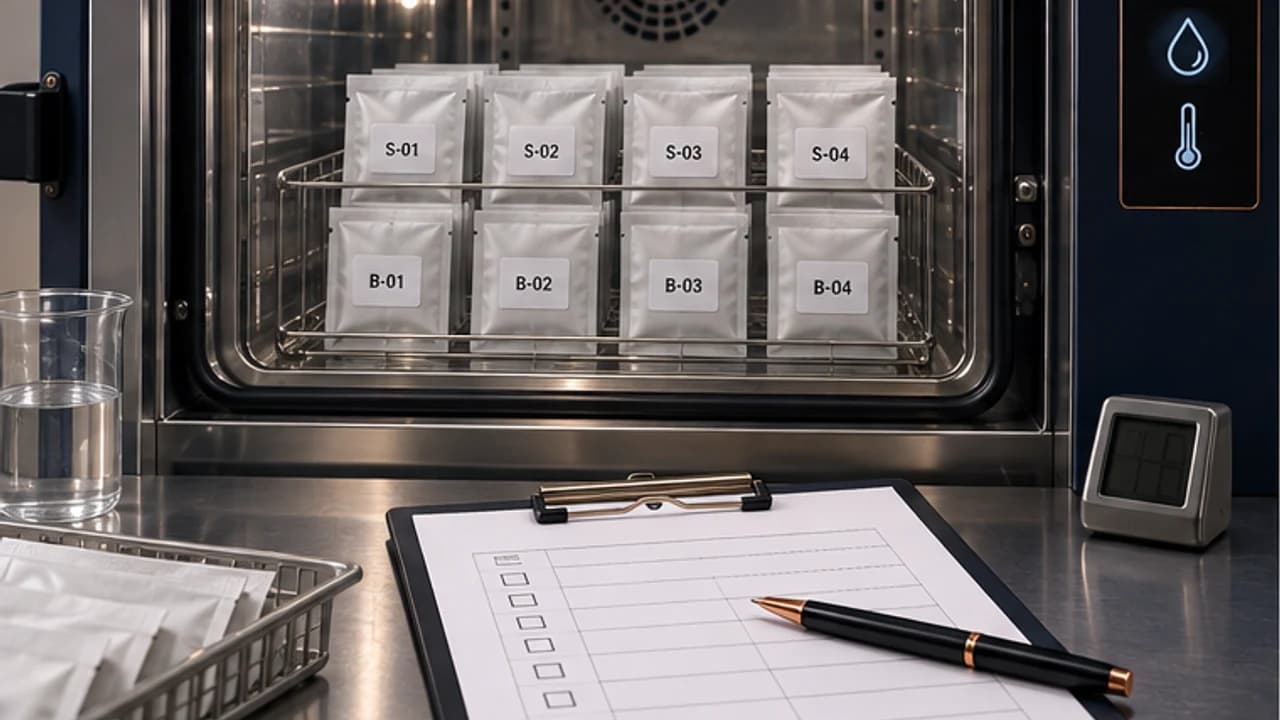
Start with a baseline and defined failure criteria. Record the exact string set, material, surface treatment, envelope, seal revision and secondary packaging. Decide which observations matter: red rust, blackening, staining, visible residue, pack delamination, seam opening, label damage, odor or other product-specific changes.
Use controls that help interpret the outcome. A candidate package can be compared with the current package and, where appropriate, an unprotected control. Keep strings from the same controlled lot when possible. Define sample count, conditioning, exposure, inspection intervals and decision rule before the test begins.
Accelerated humidity or temperature cycling can compare packaging directions, but it does not automatically equal a fixed number of real-world years. If an IEC, ASTM or other method is used, cite the exact edition, test conditions and deviations. Explain what the result demonstrates and what it does not.
Separate package qualification from shipment inspection
Qualification asks whether a design can meet a defined protection objective. Production control asks whether packs are made to the approved design. Shipment inspection samples a specific lot or order. These are connected but not interchangeable. A good qualification report cannot excuse a damaged seal in a later shipment.
Plan artwork around verified information
The package must help a dealer identify instrument, material, gauges, quantity and product code. It can also provide storage or opening instructions when those are supported. Keep technical statements aligned with the approved specification and evidence. Marketing copy should never outrun the qualification record.
Avoid printing a long service-life number because a film supplier lists a general property. Actual performance can change with metal type, surface condition, seal, package volume, storage, temperature and handling. If a claim is still under evaluation, leave it out of production artwork or reserve space until approval.
Use revision control for dielines, copy, barcodes, colors and technical fields. The purchase order should name the approved artwork revision. Proof approval should include language checks and a comparison against the final product matrix.
Protect inner and outer cartons
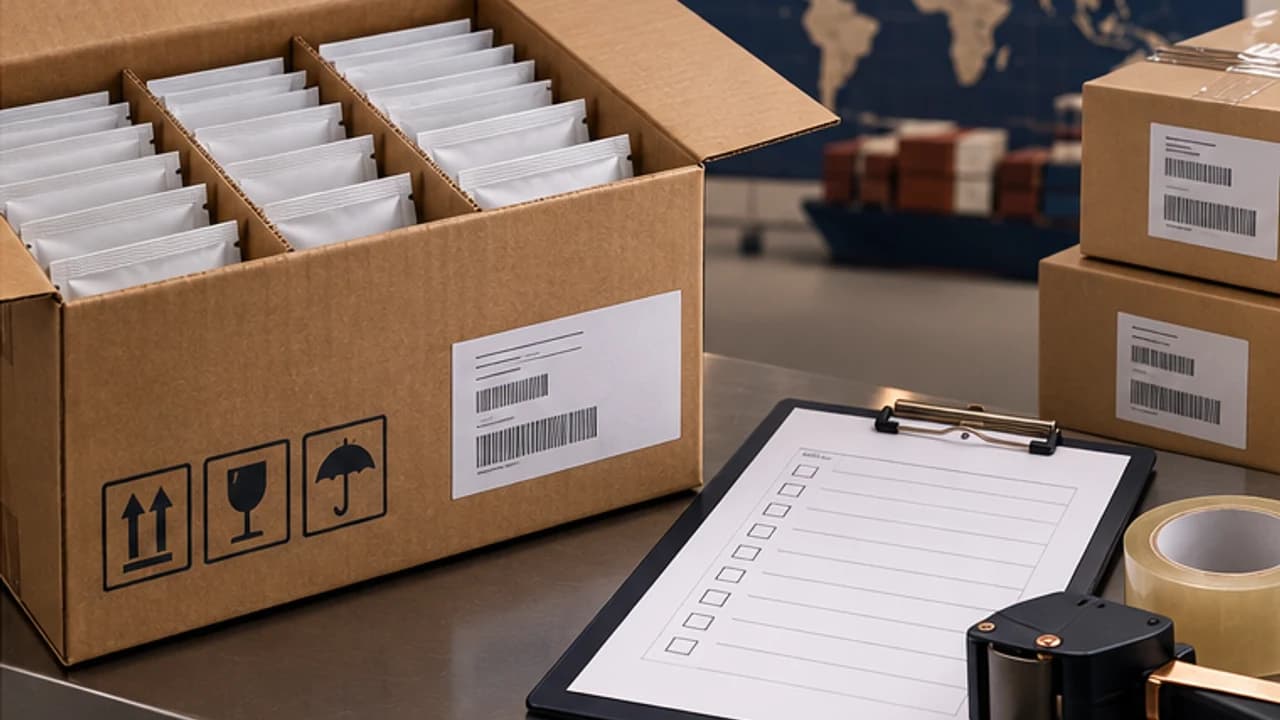
Primary packs still need dry, correctly arranged transport packaging. Define packs per inner, inners per master carton, dividers, liners, carton strength, tape or closure, pallet pattern and maximum stacking or handling requirements where applicable. Keep cartons off wet floors and protect them during container loading.
Consider condensation risk when goods move between temperatures. A liner or desiccant used in the master carton must be sized and placed for the actual volume and route; it is not a substitute for a defined primary package. Ask the logistics provider about container condition, loading timing and storage practices.
Carton labels should connect the shipment to SKU, quantity, purchase order and traceable lot or packing identifier. If mixed SKUs are allowed, define separation and label rules. A buyer should be able to locate affected stock without opening every carton.
Inspect packing before shipment
Create an inspection checklist from the approved specification. Verify product and artwork revision, string count and identity, visible surface, primary-envelope material code where traceable, seal appearance, print, barcode, pack quantity, inner arrangement, carton label and carton condition.
Use a defined sampling plan and decision rules. If seal integrity is tested, document the method and sample handling. If a pack is opened for product inspection, it cannot be returned to sale as though untouched. Distinguish destructive and non-destructive checks in the plan.
Photographs should show representative evidence and link to the order or lot. They do not replace measured results. Record nonconformities, containment, rework or disposition. Shipment release should refer to the approved revision and inspection status.
Establish receiving and storage controls
The destination warehouse should inspect cartons promptly for wetness, crushing, puncture or label mismatch. Sample retail packs for seal and appearance. Record the arrival date, shipment identity and storage location. Isolate damaged cartons rather than mixing them into good stock.
Use first-in, first-out or another documented stock-rotation method appropriate to the business. Monitor actual warehouse conditions if humidity risk is material. Keep packs closed until sale or evaluation. When complaints occur, capture SKU, lot, purchase date, package condition, photographs and storage context so the investigation can compare cases.
Do not promise that packaging will overcome uncontrolled outdoor storage, open envelopes or severe contamination. Clear limitations improve trust and help distributors set realistic handling instructions.
Compare suppliers on evidence and control
Ask each supplier to quote the same package construction, print scope, quantity scenarios, packing plan and destination. Request a sample of the complete sealed pack, not only an empty printed envelope. Review how material and artwork revisions are identified, how seal settings are controlled and what inspection evidence can be provided.
MOQ and lead time can depend on custom film, printing method, color count, pouch size, carton artwork and component sourcing. Keep early figures as project estimates until the packaging bill of materials and proof are approved. Separate one-time artwork or tooling costs from recurring unit costs where possible.
The lowest package price can be expensive if it creates corrosion, rework or unclear inventory. Compare the complete risk-control system and the evidence available for the actual configuration.
FAQ
What packaging is best for guitar strings in humid climates?
There is no universal best package. The correct system depends on string materials, surface preparation, barrier, seal, distribution route and storage. Define the risks, compare complete sealed samples and validate the chosen revision under applicable conditions.
Is a foil-looking pouch automatically moisture-proof?
No. Appearance does not establish barrier or seal performance. Obtain the material construction and relevant data, then evaluate the finished sealed pack. Seam quality and handling are part of the system.
Should desiccant be placed inside every string package?
Only when a documented design shows it is suitable, compatible, correctly sized and safely labeled. Placement in a retail envelope, inner carton or master carton has different effects. Do not add loose sachets casually.
Can an accelerated humidity test prove a five-year shelf life?
Not by itself. Accelerated exposure can compare designs under stated conditions, but translating it into real-time shelf life needs a justified model and supporting evidence. State the method, limits and exact tested configuration.
What should shipment inspection check?
Verify product and artwork revision, visible string condition, pack material identity, seal appearance or integrity per the plan, print and barcode, quantities, inner arrangement, carton labels and carton condition. Link results to a lot or order.
Can packaging claims be copied from a competitor?
No. Competitor claims apply to their products and evidence. Use them to identify questions, then substantiate wording for the offered StringCrest project and approved package.
Conclusion
Effective guitar string packaging for humid distribution starts with a defined risk and a complete packaging system. Control the product before sealing, specify barrier and seam together, qualify the finished pack, and keep public claims within the evidence available.
Carry the approved revision into artwork, production, cartons, shipment inspection and receiving records. That approach protects product identity as well as physical condition, and it gives buyers a defensible basis for comparing suppliers.
FROM GUIDE TO PRODUCT
Connect this guide to private-label string development.
Review the relevant range, then bring the instrument, complete specification and open questions into one project brief.
YOUR PRODUCT · YOUR BRAND
Discuss your next string project with Frank.
Share your instrument category, target market, gauge or material direction and private-label packaging requirements.

ABOUT THE AUTHOR
Frank Zou
Frank works directly with musical-instrument brands, importers and distributors on string specifications, product selection and private-label project requirements.
Meet Frank