
Wholesale Planning
Wholesale Planning
Guitar String Carton Pack-Out and Lot Traceability: A Private-Label Buyer Checklist
Connect each retail string SKU to its carton quantity, lot evidence and receiving record.
Introduction
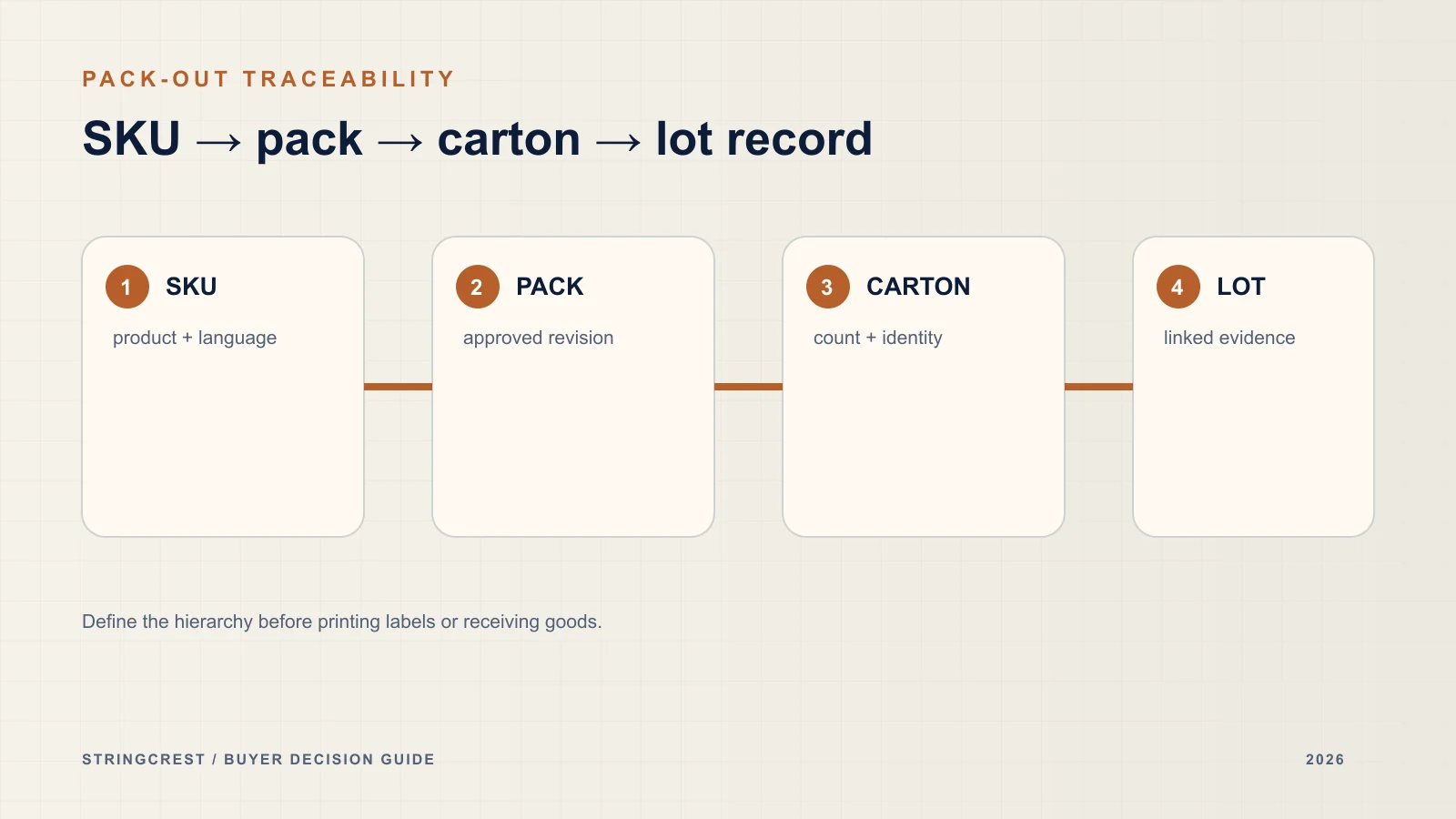
A private-label guitar string order can contain the right strings and still become difficult to receive if the retail pack, inner quantity, carton label and lot record do not describe the same hierarchy. Traceability begins by defining what each identifier refers to. A SKU identifies a commercial configuration; a lot identifies a group produced or packed under a defined record; a carton contains an agreed quantity of identified units. None of those fields proves product quality by itself.
This checklist helps importers, distributors and string brands prepare a traceable pack-out. It does not prescribe one barcode system, carton quantity, lot size or legal label for every market. The buyer and supplier must confirm the applicable commercial and regulatory requirements for the actual destination.
Freeze the commercial unit before carton planning
Define what the SKU represents
Write whether one SKU means a complete set, an individual string, a multipack or another sale unit. Record instrument family, position matrix, gauge or tension family, material direction, end construction, packaging language and artwork revision. A short product name is not enough when two packs look similar but contain different gauges or languages.
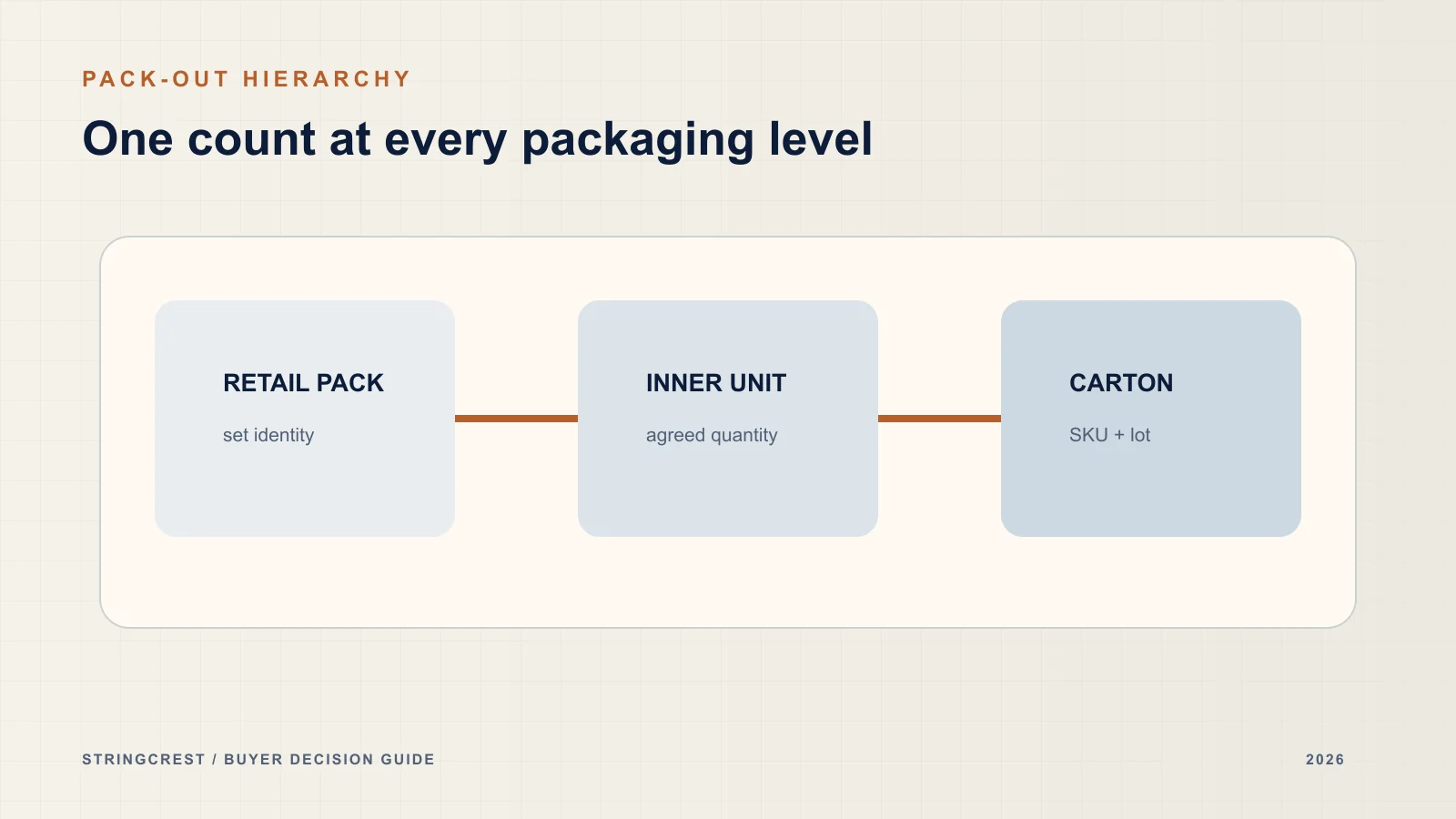
Then define the unit conversions: sets per retail pack, retail packs per inner unit, inner units per carton and cartons per shipment. If no inner unit is used, say so. Keep promotional bundles separate from standard pack-out rather than allowing a warehouse to infer the conversion.
Build one approved pack-out table
Create one row per SKU and include the buyer item code, supplier item code if used, barcode owner, artwork revision, units per carton, allowed mixed-carton rule and lot-marking location. Add gross or net weight only when the parties have agreed the measurement and tolerance. Avoid copying values from another supplier or from an earlier product family.
Treat language and artwork as controlled variants
If the same string set has English, French and German retail packs, those are separate inventory identities even when the strings are identical. Decide whether they use separate SKUs, shared production lots or separate cartons. The answer should be visible in the purchase order and packing list, not held only in an email thread.
Separate product identity from logistics identity
A retail barcode normally identifies a trade item or configuration. A carton or pallet may require a different logistics identifier. A lot or batch code adds production or packing traceability. These fields serve different purposes and should not be collapsed into one unexplained number.
GS1 guidance distinguishes class-level, batch or lot-level, and instance-level identification. Buyers do not need to adopt every GS1 option for every project, but the distinction is useful: decide whether the business needs to distinguish only the product, a production group, or each individual unit. Record the chosen level and who assigns each identifier.
Connect the lot across documents
The same lot reference should be readable or retrievable from the agreed packaging level, packing list, inspection record and complaint or hold record. If a carton contains multiple lots, define how that fact is represented. Do not print a single lot on a carton when it would falsely imply that every inner pack belongs to that lot.
Decide where dynamic data is applied
Artwork is usually approved before production, while lot codes and some dates are generated later. Mark which fields are static artwork and which are variable print. Specify location, human-readable format, data carrier if used, contrast, permanence and verification responsibility. A barcode scan is useful evidence, but the decoded value still has to match the approved SKU and lot record.
Reconcile counts before shipment
Use the approved pack-out table to calculate ordered units, produced units, packed units and shipped units by SKU. Reconcile partial cartons explicitly. If mixed cartons are allowed, list every contained SKU and quantity. A total shipment count can balance while an individual SKU is short or overpacked, so do not net differences across products.
Check a representative set of finished cartons against the purchase order, final artwork proof and packing list. Record the person, date, carton identifiers and findings. This is a release record, not a promise that every unit was opened.
Prepare exception rules before goods arrive
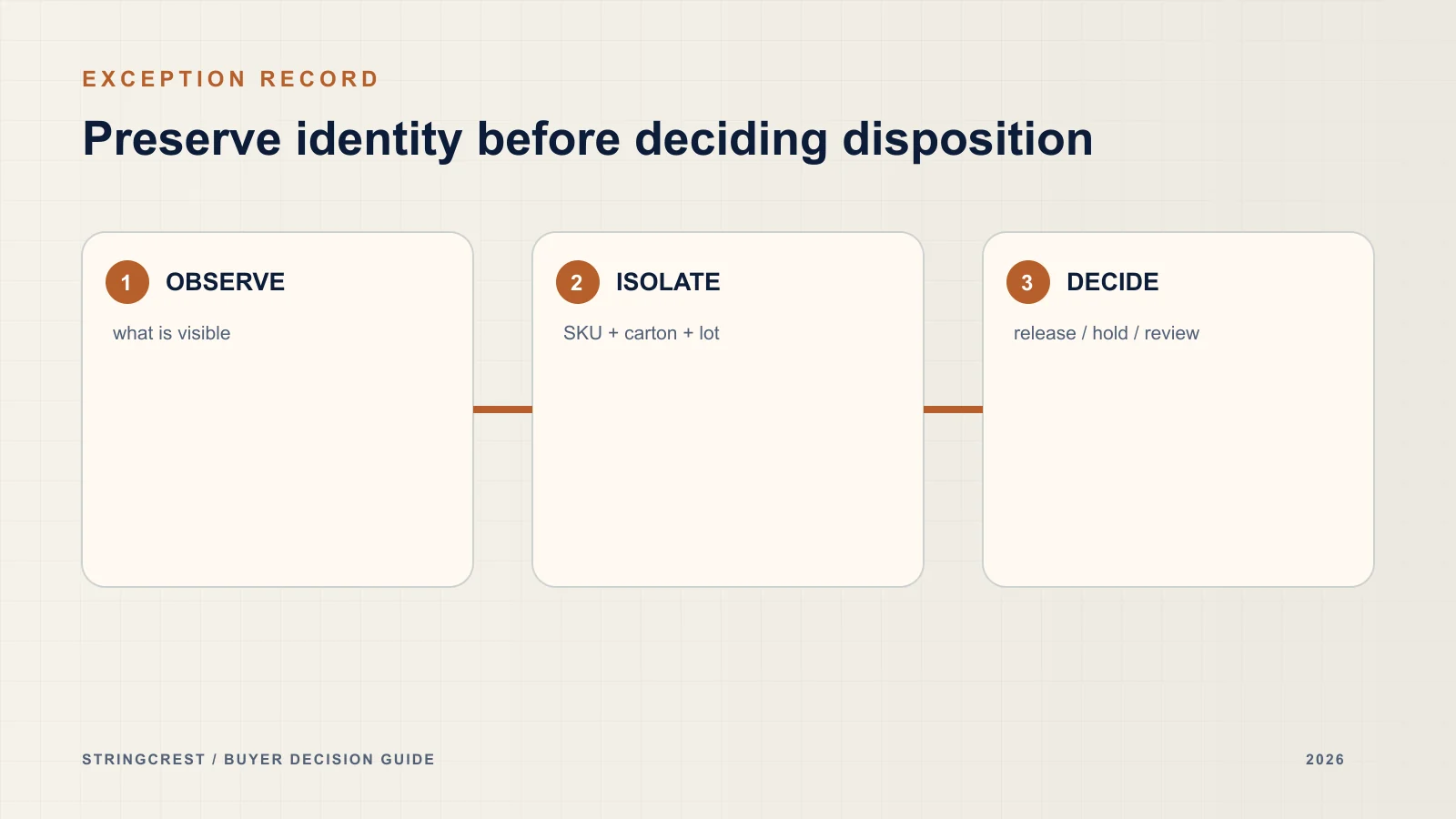
Define how the receiving team handles an unreadable label, wrong language, unexpected carton quantity, duplicate barcode, mixed lot or damaged pack. Use observable descriptions and preserve photographs, carton identity and affected quantity. A hold protects traceability while the parties investigate; it is not automatically a rejection.
Keep released and held stock separate
If only part of the delivery is affected, separate it physically and in the inventory system. Record who can release a hold and what evidence is required. Avoid relabelling cartons until the original evidence has been captured and the correction has been approved.
Validate the label without overclaiming
Test human-readable fields and any barcode or data carrier using the devices and systems that matter to the buyer. Confirm that the encoded data resolves to the intended SKU and does not contain an obsolete revision. Legal or retailer-specific label compliance must be reviewed for the destination; this article is not a compliance certification.
FAQ
Does every guitar string carton need a unique serial number?
Not necessarily. The required identification level depends on the buyer's traceability objective, channel and applicable rules. Product plus batch or lot identification may be sufficient for some workflows; other systems may require a logistics-unit or serial identifier.
Can different SKUs share one production lot?
They can share a related production context only if the supplier's records preserve the distinct product identities and the buyer approves the arrangement. Never let a shared lot replace the SKU-level pack-out record.
Is a successful barcode scan proof that the carton is correct?
No. It proves that a symbol can be decoded by the tested device. The decoded value, visible label, contained SKU, quantity and lot evidence still have to agree.
What should a buyer retain after approval?
Retain the signed pack-out table, final artwork proof, example variable-data format, purchase order, packing list, sample carton or photographs, inspection record and any approved correction.
Conclusion
A traceable guitar string carton begins with a defined commercial unit and ends with documents that connect SKU, quantity, packaging revision and lot. Keep static artwork separate from dynamic data, reconcile every SKU and define exception handling before shipment. That structure makes receiving and investigation faster without pretending that a label replaces product inspection.
To prepare a project-specific hierarchy, send StringCrest your SKU matrix, packaging languages, carton quantities and traceability requirements. The team can identify which fields still need agreement before quotation or artwork release.
Sources
FROM GUIDE TO PRODUCT
Connect this guide to StringCrest product ranges.
Review the relevant range, then bring the instrument, complete specification and open questions into one project brief.
YOUR PRODUCT · YOUR BRAND
Discuss your next string project with Frank.
Share your instrument category, target market, gauge or material direction and private-label packaging requirements.

ABOUT THE AUTHOR
Frank Zou
Frank works directly with musical-instrument brands, importers and distributors on string specifications, product selection and private-label project requirements.
Meet Frank