
Wholesale Planning
Wholesale Planning
What Affects MOQ for Private-Label Guitar Strings? A Buyer’s Cost-Driver Map
Map product, packaging and SKU decisions before comparing private-label guitar string minimums.
Introduction
“What is your MOQ?” sounds like one question, but a useful answer depends on what the buyer is asking the manufacturer to make, pack and identify. A standard set in a plain inner bag, a custom gauge matrix in printed envelopes and a mixed carton of several languages do not create the same production or packaging task. A headline number without a defined unit can make two quotations look comparable when they are not.
This guide helps brands, distributors and retailers prepare a private-label guitar string MOQ discussion. It does not state a universal StringCrest minimum, price, lead time or capacity. Those terms must be confirmed for the actual product family, set construction, packaging revision, order quantity and delivery plan.
Define the MOQ unit before comparing numbers
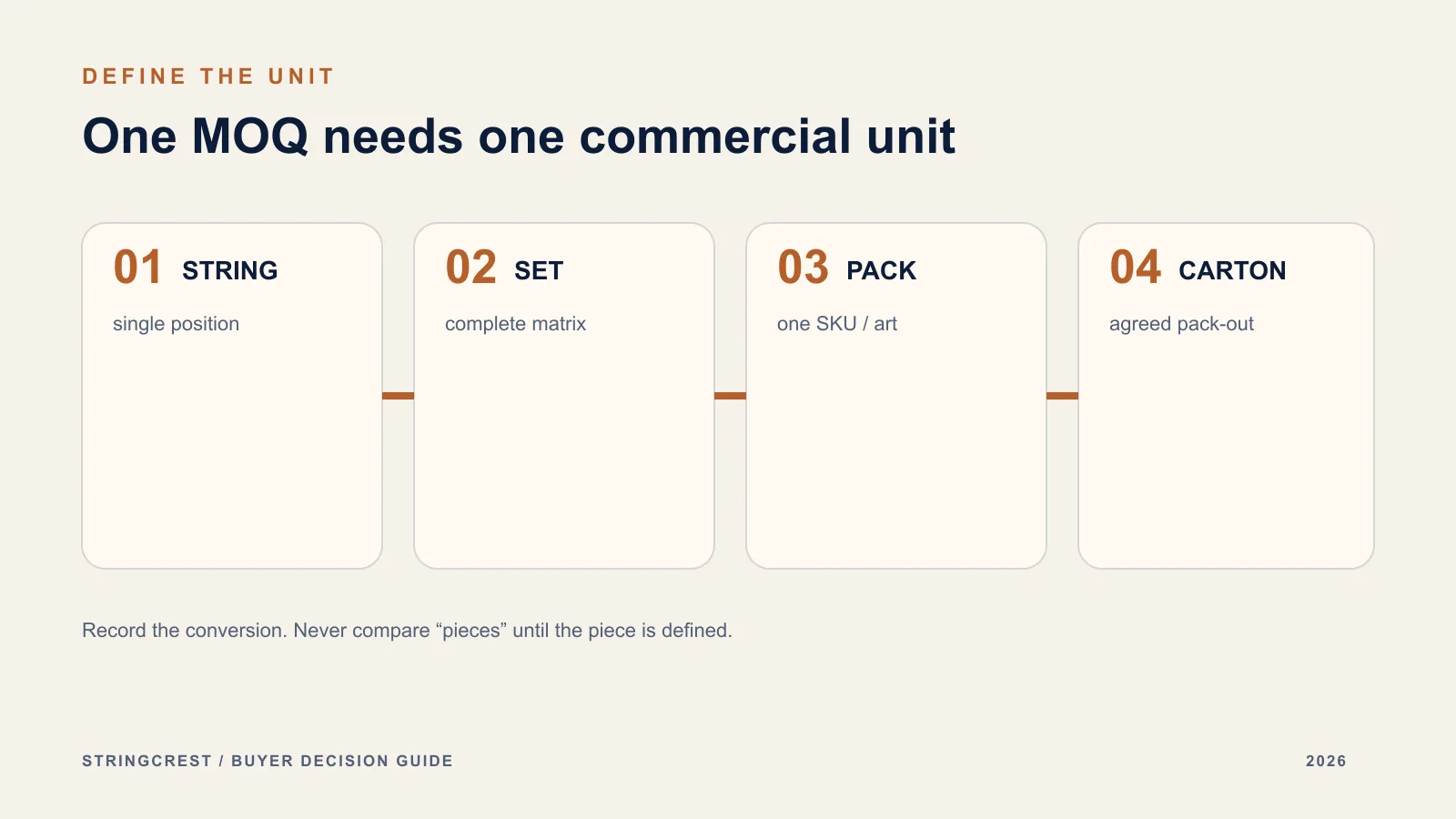
Separate strings, sets, packs and cartons
Ask whether the stated minimum applies to individual strings, complete six-string sets, one printed pack design, one gauge, one material direction, one language version or the total order. Record the conversion between units. “5,000 pieces” could mean 5,000 single strings or 5,000 retail sets; the commercial difference is too large to leave implicit.
Create one row for each sellable SKU. List the instrument family, full position matrix, material or construction direction, end format, inner protection, retail pack, language, barcode supplied by the buyer and outer-carton quantity. If several SKUs may share a component, mark that as a question rather than assuming the manufacturer can pool them.
Product complexity can split one order into several runs
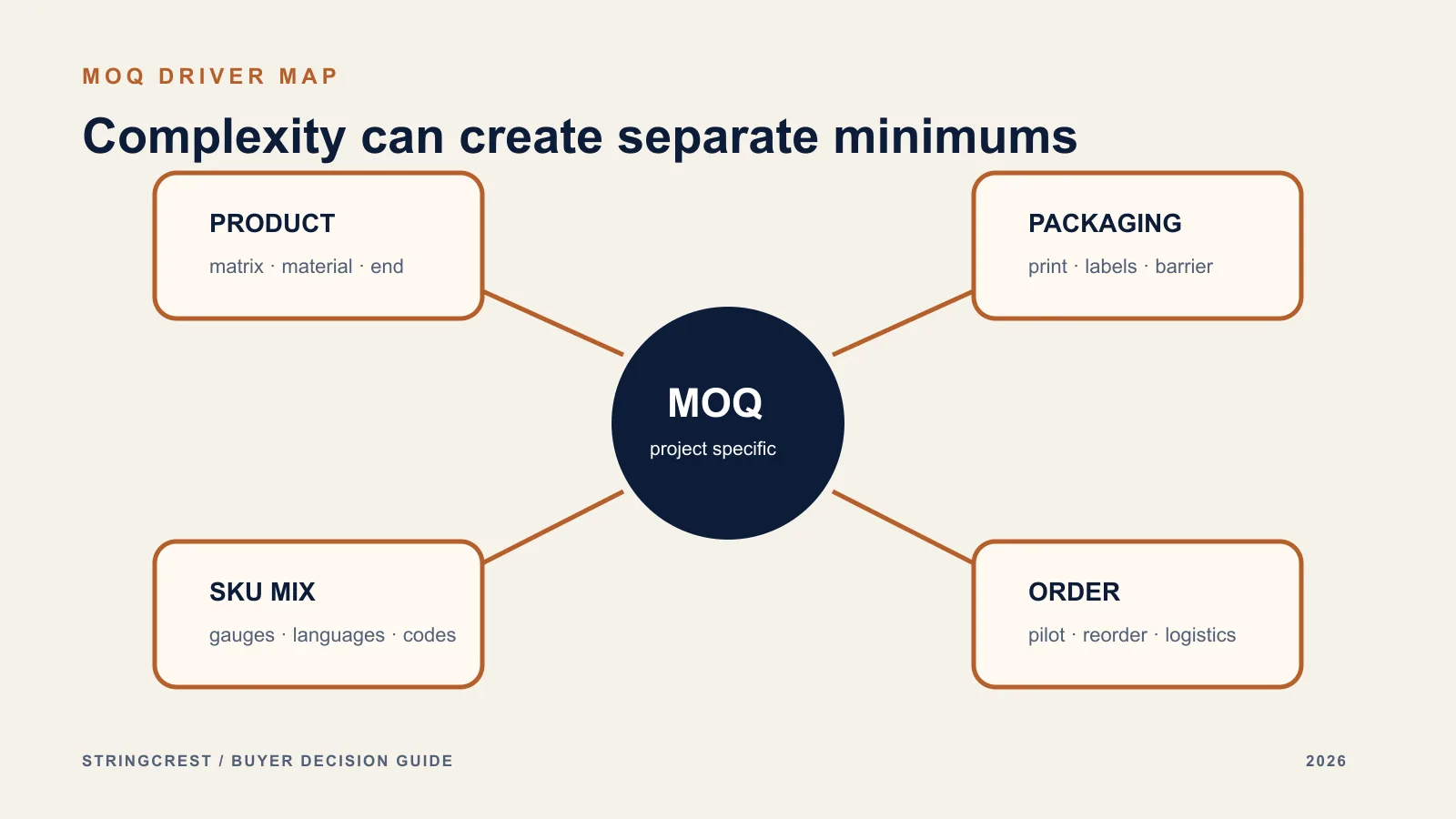
A buyer may think of “electric guitar strings” as one range, while production planning sees several wire combinations, gauge schedules, end constructions and pack identities. A light and a regular set cannot automatically share an MOQ merely because the front artwork uses the same brand. The same is true when acoustic, classical and electric families are placed on one purchase order.
Freeze the technical matrix first
Before requesting a lower minimum, reduce ambiguity. State all string positions, proposed materials, winding direction where relevant, end type, usable length or fit boundary, and the approved sample revision. If a field is open, label it “to confirm.” A manufacturer can then explain which choices are standard, which require a separate setup and which are not currently available.
Do not copy another brand’s middle gauges or construction into a quotation and present them as confirmed StringCrest data. Competitor products can be market references, but the proposed specification still needs a supplier response and a physical sample.
Packaging often has its own economic minimum
Printed envelopes, individual sleeves, labels, barrier bags, inserts, display boxes and shipping cartons may be supplied through different processes. Their practical minimums, setup charges, leftovers and revision risks may not match the string-set quantity. Ask for each layer separately.
Separate permanent and changeable information
Keep stable brand elements apart from variables such as gauge, material, language, regulatory text supplied by the buyer, barcode and importer details. A shared outer design with controlled labels may reduce obsolete stock in some projects, but only if the identity remains clear and the supplier confirms the workflow. Do not assume a sticker can correct an unsuitable or legally incomplete pack.
Use a revision table linking the approved sample, technical panel, artwork filename, barcode and purchase-order line. If one language version requires a new print run, its quantity should not be hidden inside a combined total.
Order mix changes the meaning of a total quantity
A total order of 10,000 sets divided across ten SKUs is not operationally identical to 10,000 sets of one specification and one pack. Ask the supplier to show the minimum by SKU and the minimum for the combined order. Also ask whether a family can share raw material, inner protection or carton formats, but keep the answer tied to the proposed matrix.
When the assortment is still uncertain, compare a focused launch with a broader launch. The focused version may use fewer gauges or one language-ready packaging structure. The broader version may serve more channels but creates more artwork, stock locations and reorder decisions. The right choice depends on channel evidence, not on a belief that more variants are automatically better.
Sample, setup and first-order terms need separate lines
Do not force every early cost into the production MOQ. Request separate lines for development samples, pre-production samples, artwork or plate setup where applicable, testing requested by the buyer, retail packaging, master cartons and freight. Ask which charges are one-time, revision-specific or repeated on reorders. The answer is project-specific and should be written into the quotation.
A small trial order can reduce inventory exposure, but it may carry a different unit price or packaging method. Treat it as a controlled commercial option, not an entitlement. If the supplier proposes neutral packaging for a pilot, confirm how the pilot identity will connect to the final printed SKU and whether customer-facing use is permitted.
Build three quotation scenarios
Compare a common specification, not three incomplete offers
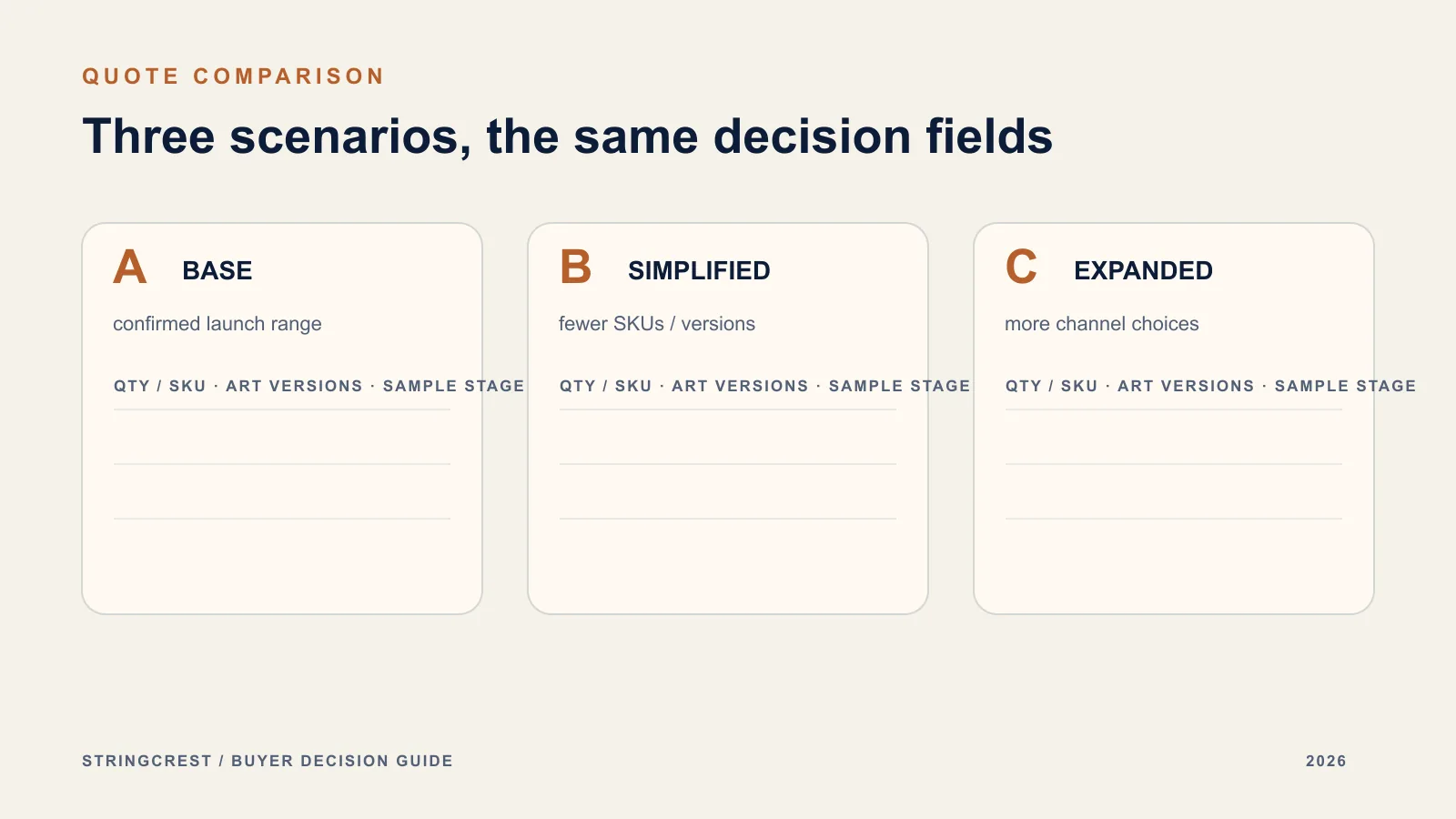
Create a base scenario, a reduced-complexity scenario and a wider-assortment scenario. Keep product quality requirements fixed unless the purpose is explicitly to compare a technical alternative. For each scenario, record quantity per SKU, packaging version count, sample stage, confirmed unit, incoterm or delivery boundary, payment terms, estimated schedule and every exclusion.
The lowest headline quantity is not necessarily the lowest launch cost. Extra labels, manual sorting, obsolete artwork, mixed-carton errors and fragmented freight can move cost elsewhere. Use the same assumptions for each supplier and keep blank fields blank until confirmed.
Plan reorders and change control before launch
Ask whether reorder terms depend on unchanged specifications and artwork. Define what happens to unused packaging components, who owns them, how long they may be stored and whether the supplier must notify the buyer before substitution. These questions do not guarantee a particular answer; they prevent the first order from hiding future constraints.
Set a rule that gauge, material, end construction, protection method, artwork or pack quantity changes require documented review. A new component may affect samples, pricing or minimums even if the product name stays the same. The product code and customer-facing listing should follow the approved revision.
FAQ
Is there one standard MOQ for private-label guitar strings?
No. The relevant unit and quantity depend on the confirmed product, SKU mix, packaging, artwork and commercial terms. Request a project-specific quotation rather than treating a general number as a standing policy.
Can several gauges share one MOQ?
Possibly, but only if the supplier confirms which materials, processes or packaging components can be combined. Record the minimum per SKU and for the total order.
Does simple packaging always reduce the MOQ?
Not always. It may reduce print complexity, but protection, identification and channel requirements still apply. Compare confirmed options rather than assuming one packaging format is universally cheaper.
Should I print packaging before sample approval?
Avoid committing final technical artwork until the product specification and sample revision are approved. If an early proof is needed, mark it clearly as a draft and control the filename and revision.
Can a low first-order MOQ guarantee the same reorder terms?
No. Ask how unchanged reorders, revised artwork, component changes and leftover packaging will be handled. Put the agreed terms in the quotation or supply agreement.
Conclusion
A useful MOQ is attached to a defined unit, technical matrix, SKU count, packaging structure and commercial boundary. By separating product, print, setup and logistics questions, a buyer can compare quotations without inventing a universal factory minimum. The objective is not simply to push the number down; it is to choose a launch structure that can be approved, packed, reordered and explained without ambiguity.
If your range outline is ready, send the SKU matrix, packaging layers and target markets. StringCrest can respond to the actual configuration and identify which MOQ, sample and timing fields still require confirmation.
Sources
FROM GUIDE TO PRODUCT
Connect this guide to private-label string development.
Review the relevant range, then bring the instrument, complete specification and open questions into one project brief.
YOUR PRODUCT · YOUR BRAND
Discuss your next string project with Frank.
Share your instrument category, target market, gauge or material direction and private-label packaging requirements.

ABOUT THE AUTHOR
Frank Zou
Frank works directly with musical-instrument brands, importers and distributors on string specifications, product selection and private-label project requirements.
Meet Frank