
Wholesale Planning
Wholesale Buying
Choosing a Bulk Guitar Strings Supplier: Sets, Singles and Pack-Out Control
A B2B supplier-selection guide to complete sets, single gauges, quantity units, pack-out, samples, receiving and inspection.
Introduction
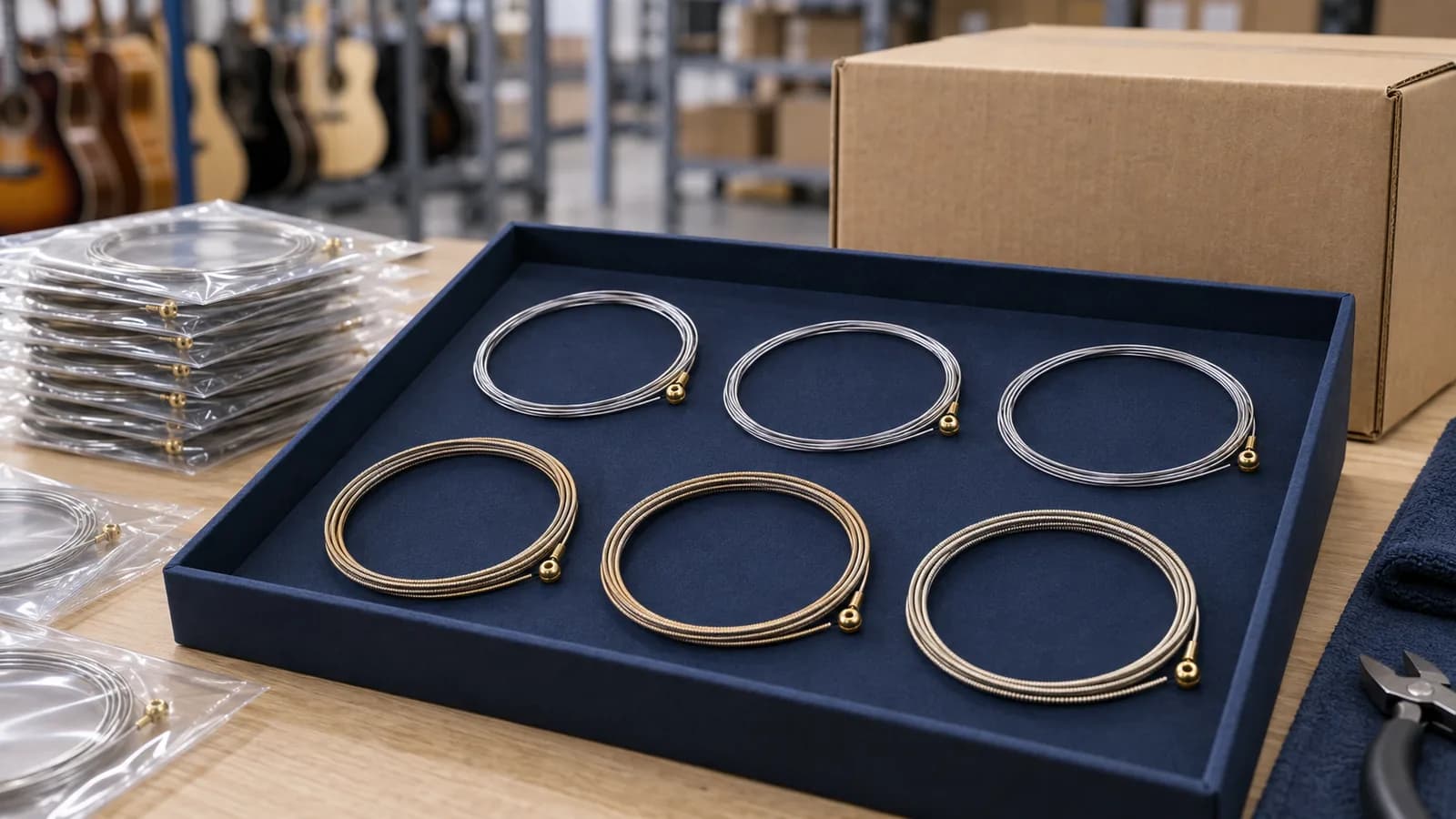
“Bulk guitar strings” can mean several different buying models: multiple complete sets in one larger pack, individually packaged single gauges, loose strings prepared for a buyer’s own set assembly, or private-label sets ordered in larger commercial quantities. A useful supplier conversation begins by defining which model the buyer needs.
The distinction matters because each model changes inventory, traceability, packaging, assembly and inspection. A pack of identical retail-ready sets is not the same product as position-specific singles assembled later into custom sets. A carton of unbranded inner sleeves is not the same as finished consumer packaging. Price per string cannot be compared fairly until the scope is identical.
D’Addario’s official bulk guitar string collection describes multi-set packs with one selected set-gauge configuration per pack. That does not mean every string within a set has the same diameter. Ernie Ball maintains separate official pages for electric guitar single strings and acoustic guitar single strings. These examples show why buyers must distinguish complete sets from individual gauges. They do not define StringCrest order quantities, pricing or product performance.
Screen the supplier before comparing prices
A bulk guitar strings supplier should be assessed against the exact supply model, not a generic catalogue. Start by checking whether the supplier can repeat your product matrix, identify every quantity unit, provide samples in the proposed pack-out and explain how revisions remain traceable. The purpose is to build a shortlist for the project; it is not a permanent supplier endorsement.
| Screening area | Evidence to request | Useful decision signal |
|---|---|---|
| Scope match | Written response to instrument, construction, gauge and end-format fields | The quotation repeats the same product and open questions |
| Quantity clarity | Price unit and conversion between strings, sets, bundles and cartons | Counts can be reconciled without hidden assembly assumptions |
| Pack-out control | Inner protection, labels, grouping and carton hierarchy | Similar gauges remain identifiable after a carton is opened |
| Sample discipline | Coded samples linked to a specification and packaging revision | Changes between rounds are isolated and documented |
| Change and lot control | Proposed notice fields, lot identity and deviation path | The buyer can locate affected stock and approve changes before use |
Ask every candidate to answer the same brief. A supplier that offers a low unit price but cannot define the unit, packaging scope or approved revision has not provided a comparable quotation. MOQ, lead time, capacity and test claims must be confirmed for the actual project rather than inferred from a website or a sample pack.
Define the bulk model before requesting a price
Start the RFQ with a plain-language description of the desired flow. Who will assemble the set? Who will print and apply the final label? Does the buyer need resale-ready packs, service-stock singles or protected components for later conversion?
Four common sourcing models
| Model | What the buyer receives | Main control question |
|---|---|---|
| Multi-set bulk pack | Multiple identical complete sets | Are all sets the same approved gauge matrix and revision? |
| Single-gauge service pack | Several strings of one gauge/construction | Is every string clearly identified and protected? |
| Buyer-assembled custom sets | Position-specific strings supplied for later set assembly | How are gauges, materials and lots kept separate? |
| Private-label finished sets | Complete sets with approved inner and retail packaging | Does pack-out match the artwork and product specification? |
Do not use “bulk” as the only line-item description. State instrument, construction, the full gauge matrix or singles list, quantity unit, packing level and final use. The electric guitar category and acoustic guitar category provide product-family starting points; they do not establish a particular bulk format or pack count.
Separate quantity units
Specify whether the quotation unit is one string, one set, one bundle or one carton. A protective sleeve is not automatically a separately counted commercial unit. Write the quoted unit beside the quantity and price; then record what that unit contains.
Use the blank table below for one finished SKU and revision. Copy the string row for every component SKU in its bill of materials (BOM). The set, bundle and carton rows must refer to that same finished product revision, even if each packaging level has its own packaging code. Fill every applicable quantity; a blank means unresolved, not zero.
Product/set SKU and revision: ____
Component-list/BOM revision: ____
Quote quantity and selected quote unit: ____ Packing revision/reference: ____
| Parent unit | Product identity | Contained unit and identity | Quantity per parent | Quoted unit? | Packing/assembly scope and owner |
|---|---|---|---|---|---|
| String (copy per component) | Component SKU/revision: ____ | Base unit; no smaller commercial unit declared | Not applicable | ____ | Protection/label: included or excluded ____; owner ____ |
| Set | Finished SKU/revision: ____ | Strings by component SKU/BOM: ____ | Each component quantity qᵢ: ____ | ____ | Set assembly and sleeves: included or excluded ____; owner ____ |
| Bundle | Same finished SKU/revision: ____ | Sets of that SKU/revision: ____ | Sets per bundle S: ____ | ____ | Grouping and bundle label: included or excluded ____; owner ____ |
| Carton | Same finished SKU/revision: ____ | Bundles of that SKU/revision: ____ | Bundles per carton B: ____ | ____ | Carton and count label: included or excluded ____; owner ____ |
Mark only the unit actually priced as the quoted unit. If the shipment has an inner carton, add its own row. If a carton contains sets directly, record sets rather than inventing a bundle level.
For a single-gauge order, mark the set row not applicable and record the actual singles-per-bundle and bundles-per-carton arrangement for that single SKU/revision. For a mixed carton, list each contained SKU/revision and its quantity on a separate line. Do not convert the carton into an average set count or combine different gauges into one undifferentiated string total.
A symbolic conversion makes the agreed hierarchy checkable: C cartons × B bundles per carton × S sets per bundle = N sets. This applies only to the same SKU/revision, with the stated units and constant counts throughout. For component i, the planned string requirement is N × qᵢ, using qᵢ from the approved BOM. These are educational relationships, not StringCrest pack quantities, assembly yields or stock availability. A set's string count alone cannot supply missing gauges, component quantities or packing levels.
A price that excludes individual sleeves, labels or set assembly may look lower while transferring work to the buyer. Compare the same product, unit hierarchy and included scope.
Build the product matrix first
The bulk model does not reduce the need for a product specification. It makes position identity more important because one mixed carton can affect many later sets.
For electric guitar strings, record plain and wound positions, core material and form, wrap alloy, gauge, overall length, wound length, end format and surface treatment when applicable. For steel-string acoustic products, record the specific wound-string material and any coating or treatment as project-specific fields. Do not combine electric and acoustic wound strings simply because their nominal gauge matches.
| Field | Complete sets | Single gauges |
|---|---|---|
| Instrument and family | One approved set identity | Required on every gauge SKU |
| Gauge sequence | Complete matrix | Position or compatible uses documented |
| Core and wrap | Position specific | String specific |
| End format | Confirmed for every position | Confirmed for each SKU |
| Lengths | Checked across the set | Checked for every gauge |
| Protection | Set-level plus outer pack | Individual or grouped without mix risk |
| Lot identity | Links all positions in the set | Links each gauge pack to records |
Choose between complete sets and singles
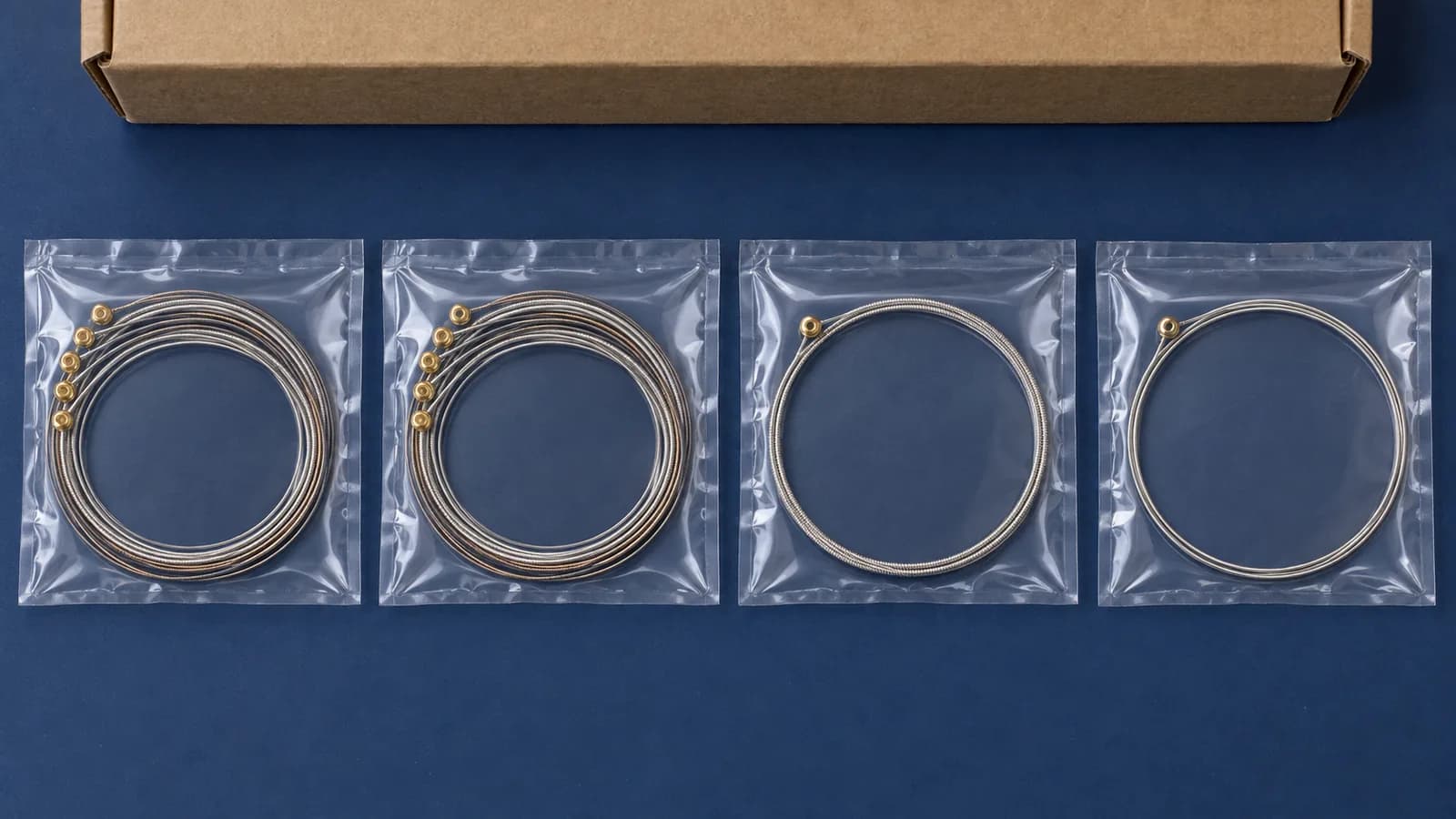
Complete sets can simplify the buyer’s handling and reduce the chance of combining the wrong positions when their contents match the approved matrix. Singles give repair shops, technicians and custom-gauge programs more flexibility. The right mix depends on the channel.
When complete sets are easier
Complete sets are usually easier when the buyer sells standard gauge families, wants one consumer SKU per set and does not have a controlled internal assembly operation. The supplier’s assembly and pack-out scope still needs to be agreed against that matrix.
The buyer still needs to confirm whether each string has an inner sleeve, whether all positions share a protective envelope, how the set is identified and what records link it to a lot.
When singles add value
Singles can support replacement sales, repair benches, artist technicians and custom-set programs. They also increase the number of SKU and storage decisions. Each gauge needs an unambiguous identity; visually similar plain strings cannot be distinguished reliably after labels are lost.
If the buyer will assemble sets, define a controlled pick list, second-person verification where appropriate, pack-out record and reconciliation method. These are recommended workflow controls, not claims about an existing StringCrest facility.
Control gauge identity and prevent mixing
Several gauges can look nearly identical during bulk handling, so keep their identities attached to the stock. Use a written SKU, gauge, construction and lot reference on every primary pack. Color coding can support picking but should not be the only control.
Label each handling level
Use the unit table above as the pack-out record. Each level needs information for its handling role: a warehouse bundle may need gauge, count, SKU, lot and stock status; a consumer pack may need instrument, gauge sequence, material, installation guidance and barcode; an export carton needs purchase-order and logistics identity. Agree which labels belong at which level rather than assuming every sleeve represents a set.
Reconcile counts
For buyer-assembled sets, planned usage by gauge should reconcile with completed sets, approved scrap and remaining stock. A count difference is an investigation signal. Do not invent a universal yield target; set the method and tolerance for the actual operation.
Keep retained samples of each approved gauge and complete set when feasible. Photograph packaging and labels, but use measurements and specification records for identity.
Protect strings without making unsupported shelf-life claims
A proposed bulk format may use less decorative packaging, but the strings still need protection during storage and transport. Define cleanliness, handling, inner material, sealing, grouping, carton, storage instruction and inspection. The protective requirement may differ between finished sets and singles that will be repacked.
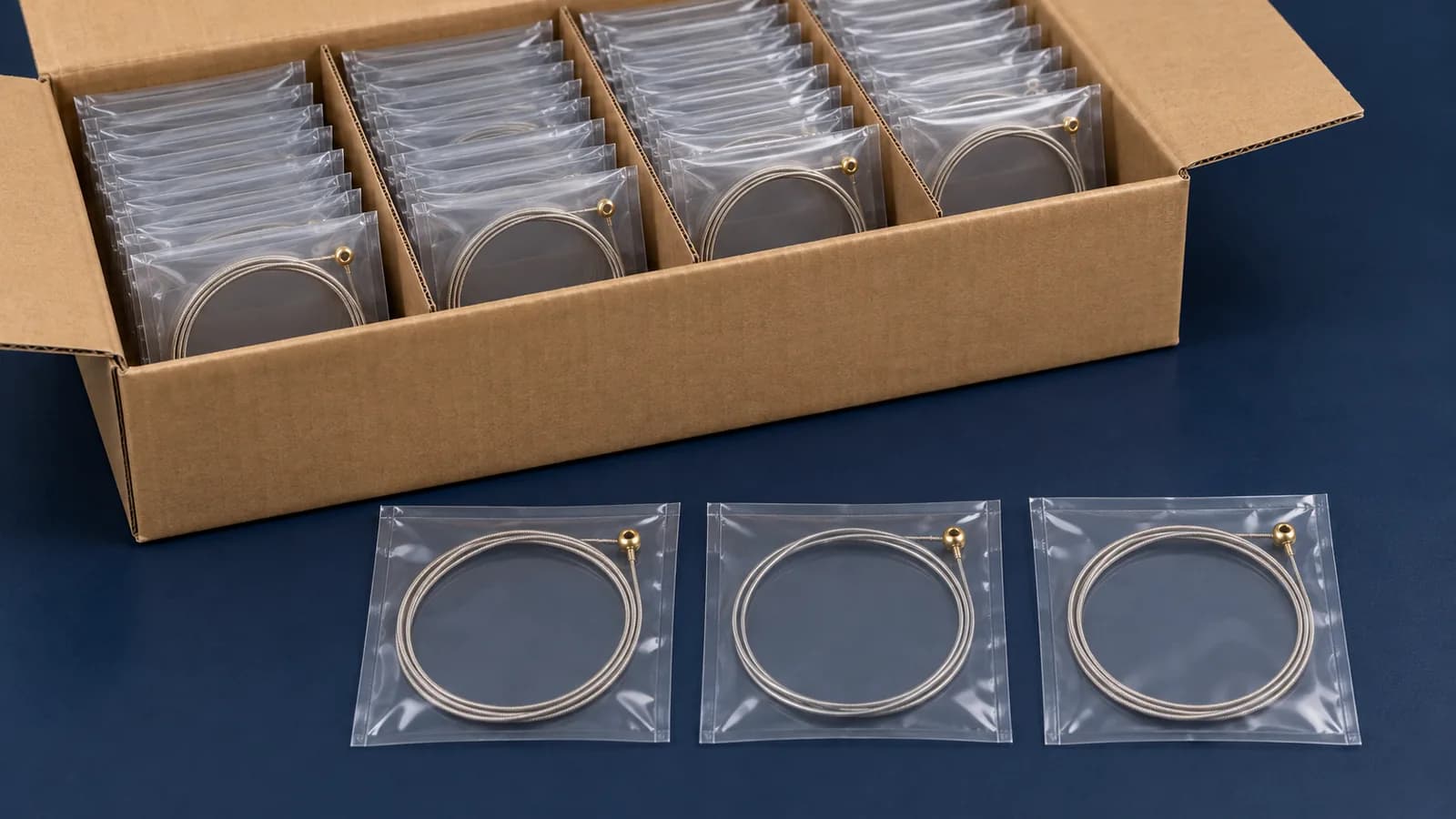
A metallic-looking envelope does not prove a particular barrier level. If a desiccant or corrosion-inhibiting system is proposed, request evidence for its compatibility and performance in that packaging system. Do not turn the appearance of a sample pack into a fixed shelf-life or corrosion promise. The humidity packaging guide covers the protection specification and evidence in more detail.
Keep artwork separate from protection
Artwork communicates product identity. The inner packaging manages physical protection. Specify them separately so a graphic change does not silently change the protective system. For unbranded bulk stock, a plain label can still carry the essential SKU, gauge, material, lot and count. Use the private-label packaging brief to define artwork inputs and packaging responsibilities.
Sample the actual supply format
A beautiful retail sample does not validate a bulk pack-out. Ask for samples in the proposed supply format: the same inner sleeve, grouping method, count unit and carton logic expected for the order. Check whether strings remain identifiable after the master pack is opened.
Review samples in two stages
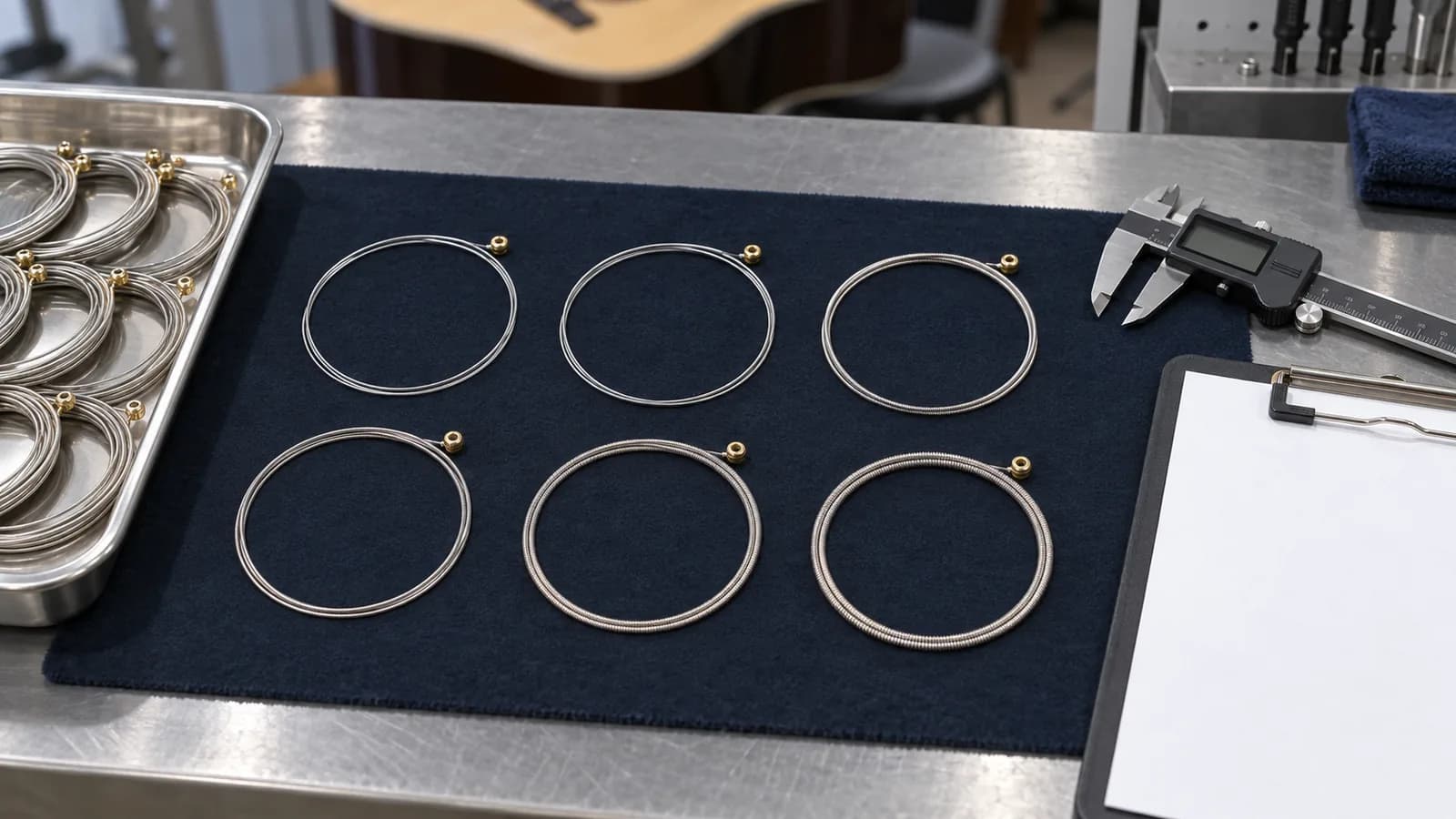
First, confirm product identity and fit. Measure gauges using an agreed method, inspect winding and the specified end format, check usable lengths and assess representative strings on the intended instrument using its applicable instructions. Second, review the pack-out: count accuracy, sleeve integrity, label clarity, separation and ease of picking.
Use coded samples and a revision form. Record project, sample code, instrument, string matrix, packaging level, reviewer, observations, open points and decision. Link an approved construction or packing change to the revised specification and sample reference.
Compare supplier quotations fairly
Send the same revision to each supplier and ask for a line-by-line response. Separate strings, set assembly, individual sleeves, bundle labels, retail printing, tooling, samples, inspection documents, cartons and logistics.
Ask these scope questions:
- Is the quoted quantity measured in strings, sets, bundles or cartons?
- Does the price include assembly into the final gauge matrix?
- Are individual gauges protected and labeled?
- Which packaging levels are included?
- Are artwork setup and printing separate?
- What sample format will be supplied?
- Which dimensions and tolerances are proposed?
- How will lots and revisions be identified?
MOQ, sample cost and schedule vary by construction, number of gauges, pack-out and artwork. Request values for the actual project with a validity date. Do not publish an assumed global MOQ or delivery time.
Inspect and release the received bulk stock
Agree the receiving checks, sample selection and release responsibility before shipment. Keep received stock identified as pending while purchase-order, SKU/revision, unit hierarchy and lot identity are checked. Select samples from more than one carton when the agreed plan requires it; a closed-carton count alone cannot confirm gauge sequence or inner labeling.
| Product identity checks | Pack-out and count checks |
|---|---|
| Declared plain/wound positions, core and wrap | Component, set, bundle and carton identity against the agreed hierarchy |
| Gauge and length measurements by the agreed method | Quantities per parent unit and complete-set position sequence |
| Winding, transition, specified end attachment and surface condition | Sleeves, seals, labels and artwork/barcode revision |
| Match to the approved specification and sample reference | Lot/carton linkage and the agreed sample-selection record |
Record observations, discrepancies, disposition, the release owner and date. Keep unresolved stock separate with its original carton, inner-pack, SKU and lot references. Do not relabel uncertain gauges from appearance. Identify the affected unit and scope so the response can address that stock rather than rely on an unexplained shipment-wide rejection.
For buyer-assembled sets, release each component SKU before picking and link the component lots in the assembly record. Reconcile completed sets and remaining components using the same unit definitions. This is a recommended control sequence; it does not describe a verified StringCrest inspection or warehouse system.
Plan inventory and conversion costs
Compare the proposed buying model with the buyer’s current workflow. Include receiving, storage, picking, set assembly, printing, quality checks, rework, stock discrepancies and obsolete gauges as cost fields where relevant; do not assume a saving or loss rate.
A high-volume standard set may suit multi-set packs. A low-volume custom gauge may be safer as single stock or a smaller project-specific run. Use actual demand history where available. Blank search-volume data or a competitor’s pack size does not prove the buyer’s sales mix.
Create a simple decision table
| Buyer condition | Likely starting model | Validate before order |
|---|---|---|
| Standard gauge sets, no internal assembly | Finished complete sets | Matrix, pack-out and consumer identity |
| Repair shop or technician channel | Single-gauge service packs | Gauge clarity, protection and replenishment |
| Controlled custom-set program | Singles for buyer assembly | Pick controls, reconciliation and records |
| Private-label retail launch | Finished private-label sets | Product revision, artwork, barcode and carton |
This table is a planning aid, not a universal prescription. The final model should match the buyer’s systems and channel. The sets-versus-singles inventory guide covers replenishment and component consumption after the sourcing model is defined.
Design a change-control handover
Across repeat orders, small undocumented changes can accumulate. A proposed change to core wire, wrap alloy, gauge tolerance, length, end format, sleeve, label or carton should name the affected SKUs and effective revision.
Review the impact beyond the string
A gauge change can affect the set matrix, product copy and inventory compatibility. A sleeve change can affect protection, print layout and warehouse scanning. A new carton quantity changes purchasing units and receiving counts. Review the full workflow before approving the change.
Keep old and new revisions physically separated during transition. Decide whether they can be sold under the same consumer claim, require a visible revision or must use a new SKU. Update retained samples, inspection documents and assembly instructions at the same time.
If the supplier proposes a substitution because a material is unavailable, request a sample and revised specification. Commercial urgency does not turn an unapproved material into an equivalent. The buyer can make a documented exception, delay, change the order or reject the substitution based on evidence and business needs.
FAQ
Does “bulk guitar strings” always mean loose individual strings?
No. It can mean multi-set packs, single-gauge packs, loose protected components or commercial quantities of finished sets. Define the unit and pack-out in the RFQ.
Are bulk strings cheaper than retail-ready sets?
The unit price may differ, but compare the total workflow. Add assembly, sleeves, labels, printing, storage, picking, inspection and logistics before deciding.
Can electric and acoustic strings of the same gauge be combined?
Do not assume they are interchangeable. Core, wrap alloy, treatment, length and intended application may differ. Specify instrument family and construction for each SKU.
How can a warehouse prevent gauge mix-ups?
Use gauge-specific SKUs, readable labels, separated storage, controlled pick lists, verification and count reconciliation. Color can support but should not replace written identity.
Should samples arrive in the final bulk format?
Yes, at least one sample stage should represent the proposed inner protection, grouping, labeling and carton logic. Product-only samples do not validate pack-out.
What information should I send for a quotation?
Send instrument family, complete gauge matrix or single-gauge list, materials, lengths, end format, the required quantity with its unit, and the proposed packing hierarchy. State who handles set assembly, labels and retail artwork, plus destination and sample needs. Mark unknown counts or responsibilities as unresolved.
Conclusion
Bulk guitar string sourcing works when the buyer defines both the string and the handling model. Separate complete sets from singles, specify every gauge and construction, and connect the quoted unit to the actual contents at each packing level. Use that same record for pack-out samples, receiving checks and changes so quantities remain comparable.
Review the StringCrest product categories, then send your bulk string sourcing brief with the instrument family, gauge matrix or singles list, quantity and explicit unit. Describe the packing hierarchy and included work in the form message, and list specification or sample references that can be discussed by email. Actual supply formats, quantities, prices and schedules need project confirmation.
FROM GUIDE TO PRODUCT
Connect this guide to private-label string development.
Review the relevant range, then bring the instrument, complete specification and open questions into one project brief.
YOUR PRODUCT · YOUR BRAND
Discuss your next string project with Frank.
Share your instrument category, target market, gauge or material direction and private-label packaging requirements.

ABOUT THE AUTHOR
Frank Zou
Frank works directly with musical-instrument brands, importers and distributors on string specifications, product selection and private-label project requirements.
Meet Frank