
Wholesale Buying
Wholesale Planning
Bulk Guitar String Inventory Planning: Complete Sets vs Single-String Replenishment
Plan bulk guitar string inventory with complete-set demand, single-string replacement, SKU depth, reorder points, pack identity and exception controls.
# Bulk Guitar String Inventory Planning: Complete Sets vs Single-String Replenishment
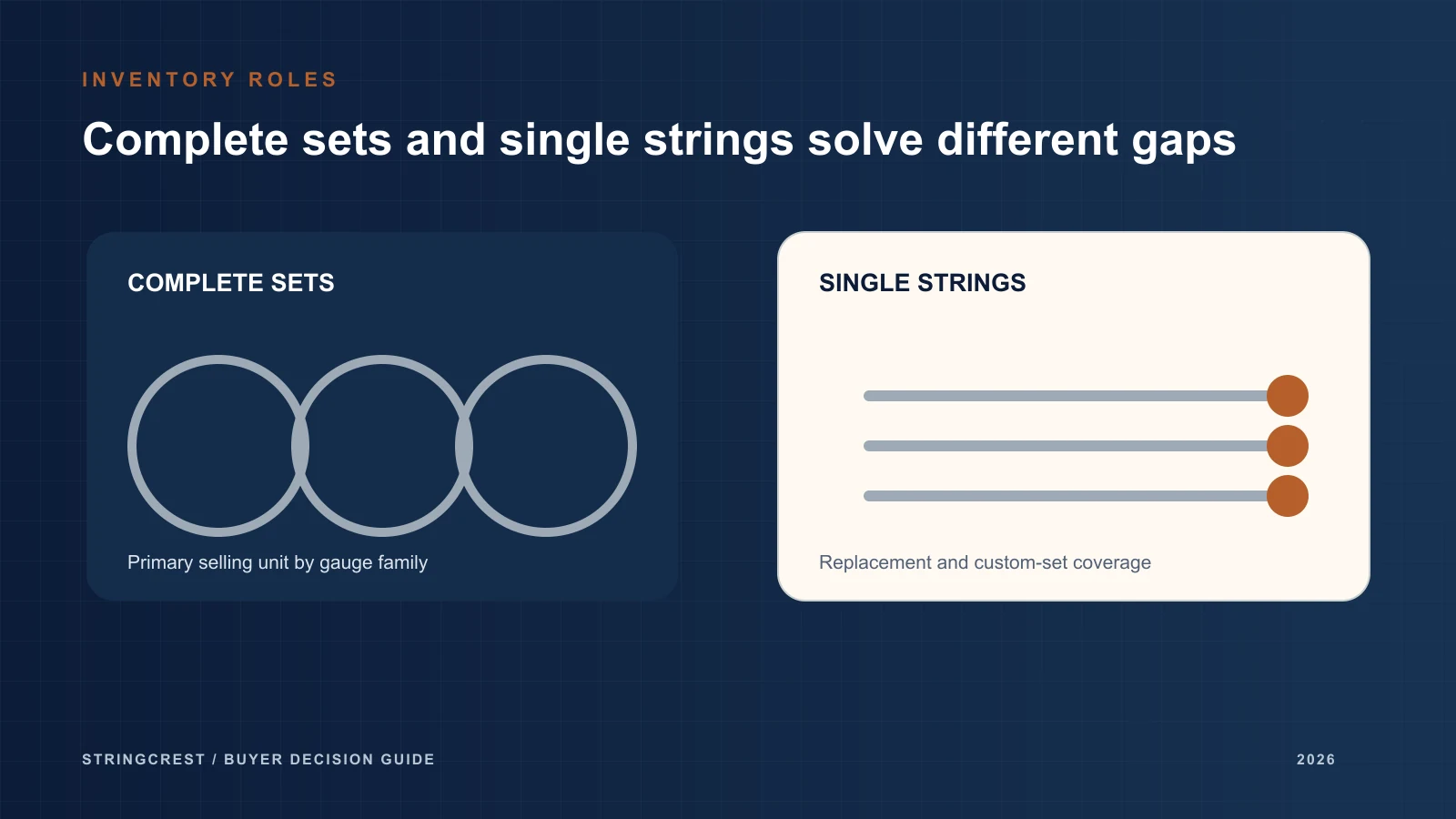
Separate the sale unit from the stock unit
Complete sets support routine restringing; single strings support replacements and selected custom configurations. For a dealer, the purchasing question is how much of each to hold without using complete sets as an unrecorded source of singles.
Start with separate demand records for set SKUs and single-string SKUs. Link a single to a set position only after its construction and fit have been approved. When a set is opened, remove it from saleable-set stock and record every component that remains. These steps make shortages and leftover strings visible before another bulk order hides them.
The models below are planning examples. They are not StringCrest sales, stock, order quantities, availability or delivery data.
Define what a purchase quantity means
“Bulk strings” is not a sufficient unit of measure. Ten individual strings, ten complete sets and ten multipacks create different stock positions. D’Addario's bulk collection illustrates one supplier's set-pack format; it does not define a universal case quantity.
For each quoted item, record the purchase unit, the number of retail units inside it and the retail unit's contents. A case-to-retail conversion belongs in the stock system, with a revision when the pack configuration changes. Keep carton counts separate from saleable-set counts.
| Stock record | Unit that must be explicit | Typical issue to prevent |
|---|---|---|
| Complete-set SKU | One unopened set of the approved configuration | Treating individual strings as complete sets |
| Single-string SKU | One string of the approved specification | Grouping incompatible strings by gauge alone |
| Multipack or case | Defined number of retail units | Confusing case quantity with set quantity |
| Opened-set components | Individual identified strings | Leaving a broken set available for full-set sale |
Build a component map before combining stock
A nominal gauge is one matching field. A replacement may also need the right material, coating, plain or wound construction, length, end and approved set revision. A single that fits a tuner is not automatically the replacement specified for a branded set.
Keep a map from each set position to an approved single SKU or a documented alternative. Record a restriction when a candidate is only suitable for another tuning, scale or product family. Do not silently combine a similar-looking single with a set under the original label.
| Set-to-single field | Required record |
|---|---|
| Set identity | Set SKU and approved revision |
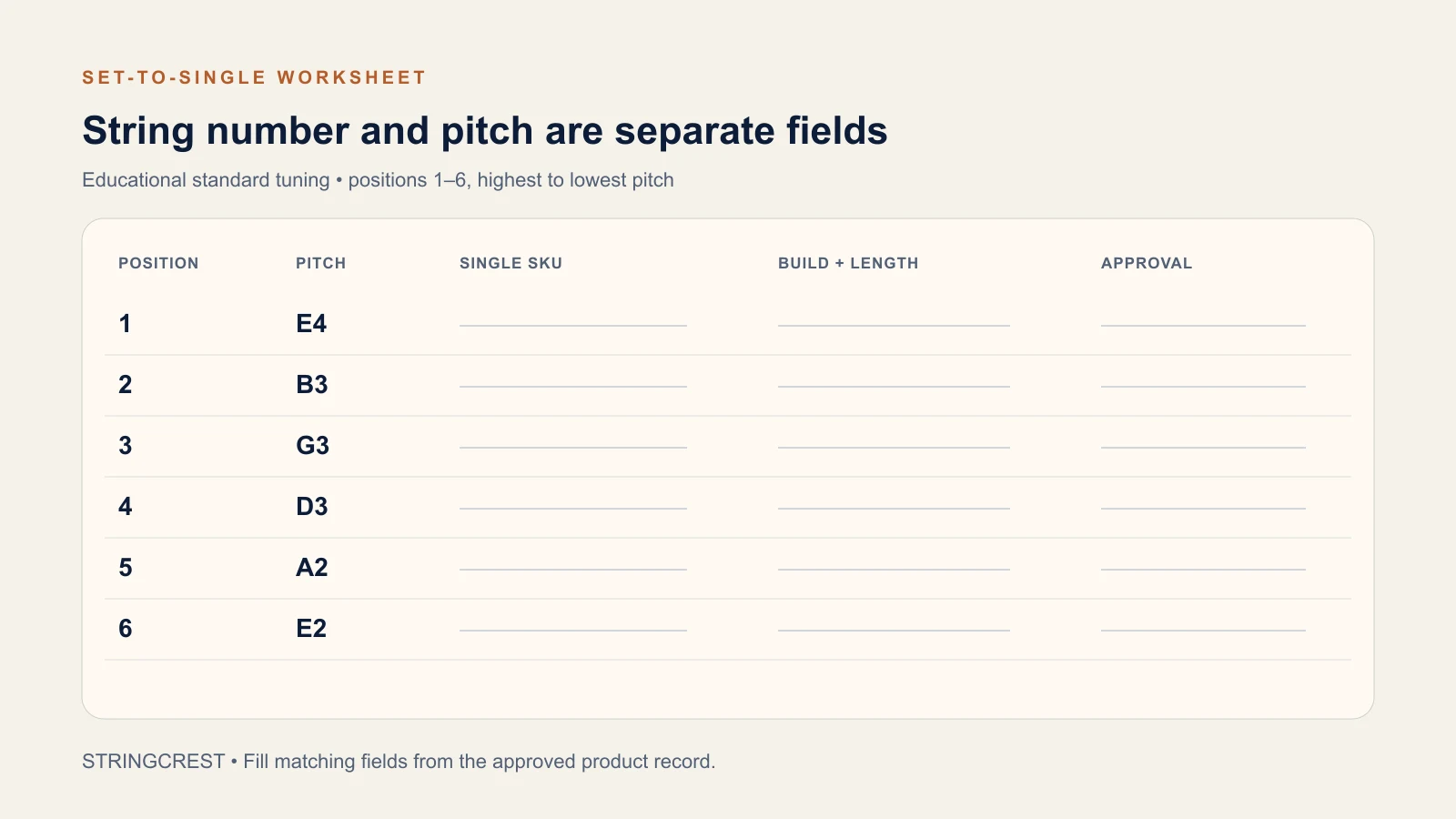
| Position | String number and intended note, recorded separately |
| Construction | Gauge, plain/wound, core and wrap where relevant |
| Surface and fit | Coating, end, usable length and instrument requirements |
| Replacement identity | Approved single SKU or explicitly approved alternative |
| Sale condition | Whether repacking is permitted and how it must be labelled |
For a six-string guitar in standard tuning, positions 1 through 6 are E4, B3, G3, D3, A2 and E2. These note registers are educational references, not a proposed gauge matrix. Build the stock relationship from the product record rather than from a note name alone.
Make the cost of opening sets visible
Suppose a dealer opens eight six-string sets to supply eight first-string replacements. This hypothetical action removes eight complete sets from saleable stock. It leaves forty strings from the other five positions, not eight nearly complete saleable sets.
The stock adjustment should be explicit:
| Movement | Quantity in this example |
|---|---|
| Unopened sets converted to components | −8 sets |
| First-position strings issued | 8 strings |
| Components remaining | 40 strings across five other positions |
| Complete sets still available from this group | 0 sets |
Those forty components may be usable if their identities and permitted sale conditions remain clear. Their value is not automatically the retail value of forty individually packaged singles. Add repacking work, identification requirements and the likelihood of demand to the decision about whether to open sets.
If replenishing the first position would restore the sets, confirm exact component compatibility and whether the resulting packs may be offered under the original set identity. A supplier's technical match does not by itself approve a dealer's relabelling or warranty representation.
Calculate a reorder trigger with consistent units
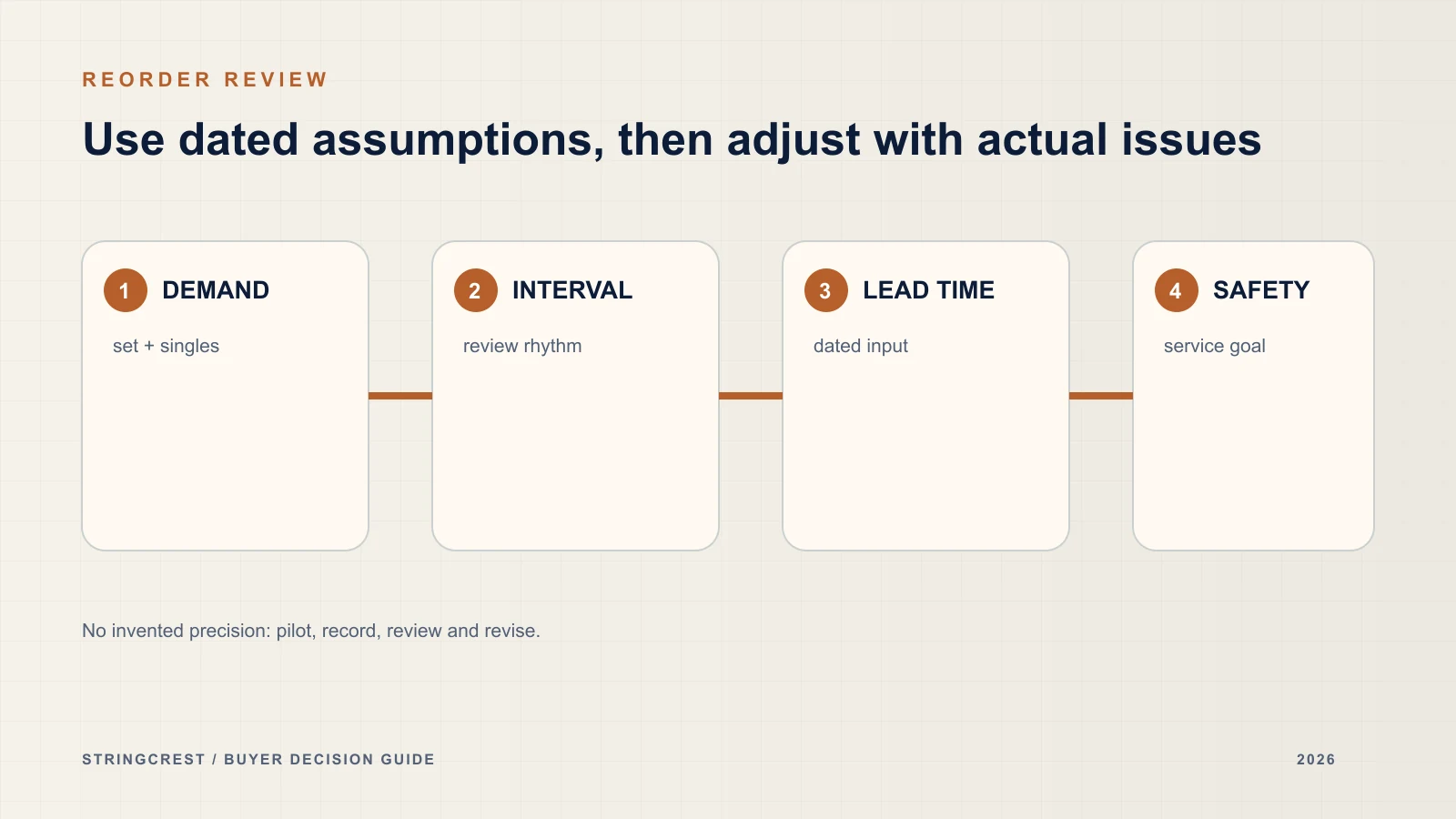
A simple continuous-review model can use demand during replenishment lead time plus a safety allowance. It is a trigger for review or ordering, not the order quantity itself. A periodic-review policy also has to consider the time until the next review.
Here is a deliberately simplified example for one approved single-string SKU:
- Assumed demand: 2 strings per calendar day.
- Assumed replenishment lead time: 21 calendar days.
- Selected safety allowance: 14 strings.
- Reorder trigger: 2 × 21 + 14 = 56 strings.
If the same SKU has 38 saleable strings on hand, 18 on confirmed replenishment and 5 allocated, its simplified inventory position is 38 + 18 − 5 = 51 strings. That is below the hypothetical trigger of 56. The next task is to determine an order quantity using the target stock level, purchase-unit increments, available commitments and cash or space constraints.
The fourteen-string allowance is an assumption, not a statistically calculated service level. The example assumes the incoming eighteen strings will arrive within the relevant planning horizon. An overdue or uncertain purchase order should not be treated as dependable coverage merely because it appears in the system. Use business days or calendar days consistently throughout the actual calculation.
Read demand without hiding service failures
Track full-set sales, single-string sales, workshop issues and component conversions separately. Lost requests during a stockout matter: recorded sales alone can make an unavailable item appear to have no demand. Conversely, a temporary promotion can make a one-off spike look like a permanent need.
A short review should identify which SKU ran out, which customers could not be served, whether another approved item covered the request and how many sets were opened. Record leftover components by position and age. Choose a pilot range that staff can identify reliably, then adjust from observed issues rather than applying a universal ratio of sets to singles.
When an item changes construction or approved revision, separate the stock until interchangeability has been decided. For the sample-approval process behind that decision, use the guitar string sample evaluation guide. For the available instrument families, start at Products; specific set and single supply remains a project discussion.
FAQ
How many singles should we buy for every set?
There is no useful universal ratio. Start with demand and service requests by approved single SKU, including shortages hidden by stockouts and sets opened to cover repairs.
Does reaching a reorder point determine the order quantity?
No. The trigger says the stock position needs action. The order quantity also depends on the replenishment policy, target coverage, purchase increments and commitments.
Can strings left from opened sets be pooled together?
Only when their identity, compatibility and permitted sale conditions remain established. A shared gauge does not establish all three. Keep unverified or mixed-revision components separate.
Conclusion
A useful stock plan shows both the service benefit of singles and the consequences of breaking complete sets. Clear units, approved component relationships and dated replenishment assumptions give purchasing staff a plan they can revise as real demand arrives.
Build your replenishment brief. Send the set SKUs, replacement positions, intended sale units and demand assumptions you want to review.
FROM GUIDE TO PRODUCT
Connect this guide to StringCrest product ranges.
Review the relevant range, then bring the instrument, complete specification and open questions into one project brief.
YOUR PRODUCT · YOUR BRAND
Discuss your next string project with Frank.
Share your instrument category, target market, gauge or material direction and private-label packaging requirements.

ABOUT THE AUTHOR
Frank Zou
Frank works directly with musical-instrument brands, importers and distributors on string specifications, product selection and private-label project requirements.
Meet Frank