
Buying Guides
Supplier Selection
How to Choose a Classical Guitar String Supplier: A Specification and Sample Guide
A procurement framework for comparing classical string construction, tension direction, samples, packaging and supplier controls.
Introduction
Choosing a classical guitar string supplier is easier when the buying team treats the project as a controlled specification exercise. A useful supplier comparison covers the instrument, the complete set construction, the tension direction, packaging, sample identity, inspection questions and commercial terms. A shortlist based only on a generic “normal tension nylon” description leaves too many variables unresolved.
This matters for importers, distributors and private-label brands because classical sets combine two visibly different string groups. Trebles may use clear nylon or another polymer direction, while bass strings commonly use a flexible core with metal wrap. Their behavior, appearance and packaging must still form one coherent six-string set. A change in one component can affect how the complete sample is judged.
The aim of this guide is to help a buyer prepare comparable requests, evaluate samples and preserve the approved result through the first bulk order. It does not publish StringCrest minimum order quantities, lead times or guaranteed constructions. Those points depend on the confirmed project. Start with the classical guitar string category and use the framework below to prepare a precise inquiry.
Start with the market role, not a material label
Before asking for prices, write one sentence explaining the proposed product’s commercial role. Is it a dependable replacement set for general music retail, a more focused classical option, a student-oriented offer, or a private-label line for an existing dealer channel? The role guides the questions that follow.
Avoid turning a broad player preference into a market fact. Terms such as warm, clear, comfortable and projecting can help organize a sample discussion, but they need a defined instrument and evaluator. They do not prove that one construction will be preferred across countries, playing styles or price segments.
Ask your sales partners what customers currently request. Record the names of competing sets only as market references; do not ask a supplier to copy proprietary packaging or unsupported performance claims. Useful observations include the tension labels customers recognize, common complaints, preferred pack format, and whether stores need individual-string replacements as well as full sets.
Define the intended customer and channel
A conservatory shop, a general musical-instrument retailer and an online marketplace seller may need different amounts of explanation. The first may ask detailed questions about treble response and bass transition. The general retailer may need a clearly labeled core option. The online seller needs complete attributes, accurate images and wording that reduces mistaken orders.
Record the sales channel, intended price position and expected support level. These inputs do not determine the string construction by themselves, but they prevent the project from becoming a disconnected list of materials and packaging ideas.
Build a complete classical string specification
The phrase “classical guitar strings” is a category, not a purchase specification. A useful request identifies the instrument size, number of strings, intended tuning, tension direction, treble material, bass core and wrap direction, end type, color where relevant, and packaging unit.
For a standard six-string brief, list each position from first to sixth. The buyer should be able to trace every sample and quoted line back to this list. If an alternative third string, different bass construction or other option is proposed, give it a separate revision rather than changing the meaning of the original request.
| Specification field | What to state | Why it matters |
|---|---|---|
| Instrument | Classical guitar and intended size | Prevents confusion with steel-string acoustic or fractional products |
| Configuration | Six strings, or another confirmed count | Defines the complete set |
| Tuning | Intended standard or alternative tuning | Provides application context |
| Tension direction | Supplier’s named category plus product-specific data if available | Labels are not universal measurements |
| Trebles | Material direction, color and positions | Makes alternatives comparable |
| Basses | Core direction, wrap material and positions | Defines the wound half of the set |
| End type | Tie-end, ball-end or another confirmed format | Must match the product concept and instrument use |
| Packaging | Individual protection, set pack, labeling and outer carton | Affects identification and shipment preparation |
The official D’Addario classical range, for example, separates products by variables such as tension, treble material, wrap material, size and end type. That is useful evidence that a buyer should ask about more than a single “nylon” label. It is not a specification for a StringCrest project, and another brand’s numerical data should never be copied into a purchase order.

Understand tension labels without assuming equivalence
Normal, hard and other tension names are convenient range labels, but buyers should not assume that two suppliers use them for identical force, diameter or construction. Compare product-specific information and samples. Keep the supplier name, construction and set revision attached to any tension data you receive.
String tension depends on more than a marketing label. Scale length, pitch and the physical properties of the string matter. D’Addario’s published tension resources show product-specific diameters and force values and explain the relationship between scale length and tension. Use such references to understand the variables, then request the applicable data for the offered product.
Do not take a tension table for another model and present it as the values of your private-label set. If numerical verification is required, agree on which values are supplied, how they were calculated or measured, and which product revision they describe. If the supplier does not provide a particular data point, leave it unconfirmed rather than filling the gap with a familiar number.
Keep the instrument in the evaluation record
Record the guitar, scale length, tuning and setup condition used for each sample. A sample evaluated on a full-size classical guitar should not automatically be described as suitable for a fractional instrument. If the project includes 1/2 or 3/4 size products, treat them as separate applications with confirmed lengths and packaging identity.
Changing tension or construction may also change the player’s perception of resistance and response. Ask evaluators to describe what they felt and heard in the specified context. Avoid converting a personal preference into a universal claim.
Compare treble and bass construction as one set
Classical guitar trebles and basses need separate specification lines. Trebles can differ in polymer type, surface, color and diameter. Basses can differ in core and wrap material, winding and finish. The transition between the third and fourth string is often part of the player’s judgment, so the complete set should be evaluated rather than selecting each half in isolation.
When the supplier proposes multiple material directions, create a comparison matrix. Keep the tension direction, instrument and evaluator tasks as consistent as practical. Note any component that changed. A sample marked “B” is not useful if the team cannot later identify whether it changed the trebles, basses, tension direction or all three.
Use tone language as an observation, not a laboratory result. “Evaluator 2 perceived a clearer initial response on Guitar A” is more credible than “this material always delivers superior clarity.” The first statement preserves the context and can guide product positioning; the second overstates limited evidence.
Design a sample plan that can be repeated
Ask the supplier to assign a code and revision to every sample set. Your internal log should record the specification, date received, pack condition and any declared deviation. Photograph the label and unopened sample before installation so the evaluation can be connected to the right item later.
For installation preparation, use instruments in serviceable condition and document relevant setup differences. Install each set using a consistent method appropriate to the instrument. Allow evaluators to tune and stabilize the strings under normal use rather than promising a fixed settling time that has not been tested for the proposed construction.
Create a short task list that reflects the target customer. It might include open chords, scale passages, single-note articulation, dynamic changes and observations across the treble-to-bass transition. Record tuning behavior, feel, visible condition and unwanted noises separately. Do not collapse all feedback into one score before the reasons are understood.
Invite more than one evaluator when practical and keep their notes independent at first. Agreement can increase confidence, while disagreement may reveal a difference in instrument, playing approach or product expectation. Neither outcome should be hidden.
Evaluate the supplier, not only the installed strings
A product sample is one part of supplier qualification. Buyers also need to assess whether the supplier can communicate a stable specification, identify revisions, explain alternatives and prepare documents that match the order. A good-sounding anonymous sample is difficult to manage if it cannot be traced to a reproducible specification.
Ask who owns each action: confirming the product, approving artwork, authorizing changes, inspecting the shipment and releasing final files. Record communication in a shared project log. When a technical question is unresolved, give it an owner and due point instead of allowing an assumption to enter the artwork or purchase order.
Compare quotations on the same basis. A price for a plain set in standard packing cannot be compared directly with a price that includes printed inner protection, retail carton, barcode application and different outer-carton requirements. Separate product, packaging, development and freight-related terms where possible.
Questions that reveal process discipline
Ask the following questions during qualification:
- How is the sample revision identified on the quotation and final order?
- Which specification fields are confirmed before artwork begins?
- How are approved files named and controlled?
- What checks can be documented for product identity, string count and packaging?
- How are deviations or proposed substitutions communicated?
- Which minimum quantity, sample charge and schedule applies to this exact configuration?
These questions do not guarantee performance, but the answers show whether the project can be managed without silent changes. Keep claims proportional to evidence. If a supplier says a process is available, request the applicable document or agree on what will be provided for the order.
Prepare packaging around identification and protection
Classical strings can be confused when the package emphasizes a broad family name while hiding size, tension direction or end type. Put the information needed for correct selection where the buyer and warehouse can find it. The set name, instrument, configuration, tension label, material direction and product code should remain consistent across artwork, price list, invoice and website.
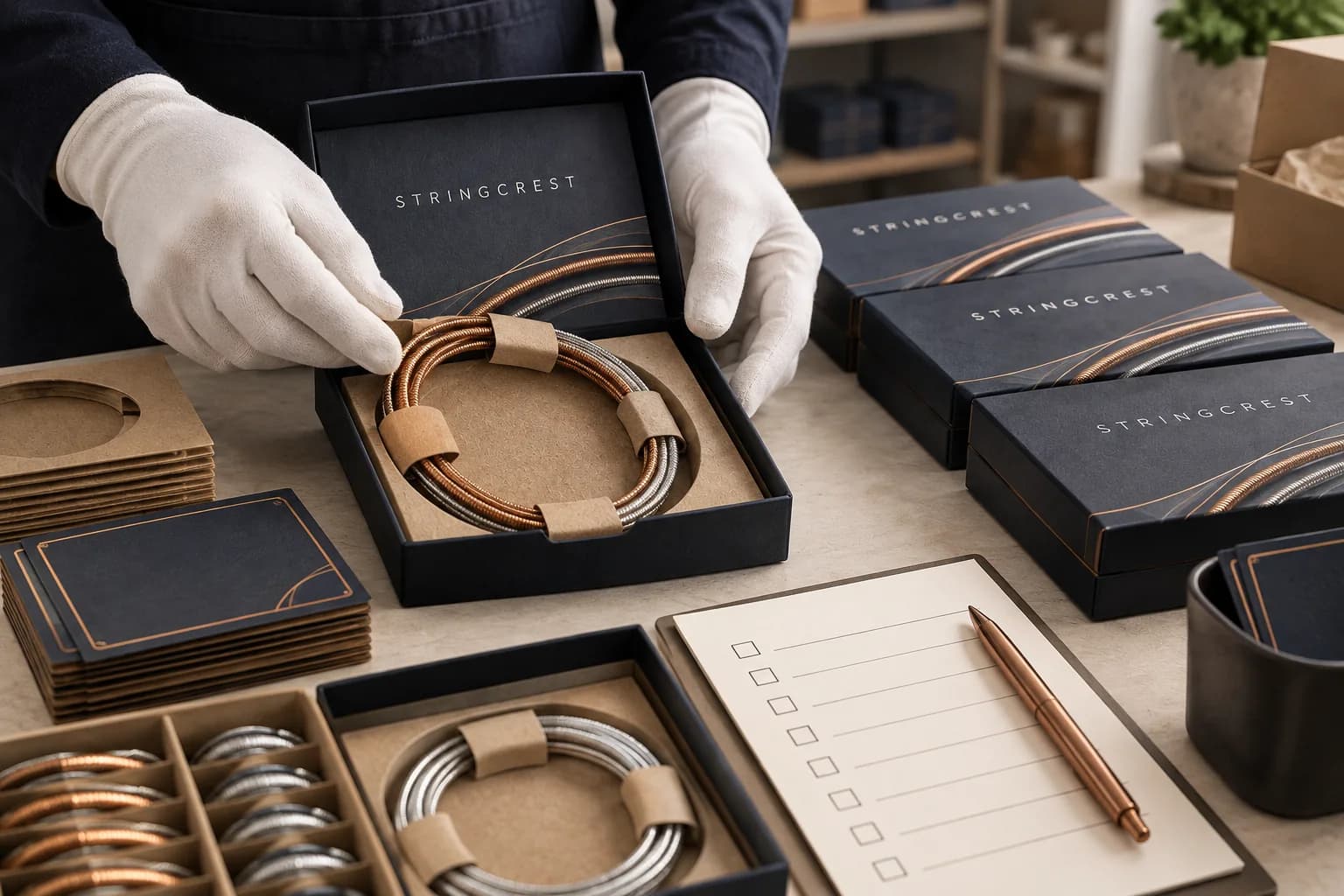
The protective system should be discussed separately from graphics. Ask how individual strings or the set are contained, how moisture exposure is considered, how labels remain legible and how retail packs are arranged in the outer carton. Packaging choices should be confirmed for the actual shipment route and storage conditions.
Use a proofing checklist. Check spelling, units, language, barcode data supplied by the buyer, country or importer information where applicable, warning or recycling elements required by the destination, and alignment between the front claim and the technical panel. Legal requirements vary, so the buyer should obtain appropriate market advice rather than relying on a general template.
Define factory checks and shipment inspection before ordering
Quality language becomes useful only when it is tied to the approved product and a defined check. Begin with identity: correct item, revision, string count, visible construction, label and quantity. If gauge, length, tension-related data or another measurable characteristic will be checked, agree on the instrument, method, sampling plan, tolerance and record format.
Inspection should also cover visible condition and packaging. Examples include damaged or open protective packs, incorrect mixed labels, missing strings, unreadable codes and carton discrepancies. Decide what constitutes acceptance, rework or further review before the goods are ready to ship.
Shipment inspection is not the moment to invent a standard. Reference the approved sample, purchase specification, artwork revision and packing requirements. Record the shipment or lot identity. Photographs can support a record, but a generic photograph of equipment does not prove that a specific order met a criterion.
If batch traceability is required, define the identifier and where it appears. Ask how the buyer can connect a carton, retail pack and production or inspection record. Do not advertise traceability until the applicable method has been agreed and used.
Separate confirmed terms from planning assumptions
MOQ, sample policy, lead time and packing choices are important, but they should be requested for the actual configuration. An MOQ for a standard unprinted product may not apply to multiple tension variants with unique artwork. A schedule discussed before artwork approval may not represent the final production plan.
Use a quotation comparison sheet with four states: confirmed, proposed, buyer decision required and open. Include currency, trade terms, quotation validity, quantity basis, pack scope, sample terms, production timing basis and shipment preparation. The purpose is not paperwork for its own sake; it prevents two teams from agreeing to different versions of the project.
Avoid using a target delivery date as though it were a confirmed lead time. Work backward through specification approval, samples, evaluation, artwork, proofing, order release, production and inspection. Ask the supplier to confirm dependencies and dates once the inputs are ready.
Turn approval into a controlled product record
When the team chooses a sample, create one approval record. It should identify the product revision, complete string construction, sample code, evaluator context, accepted packaging files and remaining conditions. State which elements were observed and which were verified through documents or measurement.
Do not approve only by a nickname such as “normal tension sample 2.” That label may be impossible to interpret six months later. A controlled record makes repeat ordering, investigation and product updates more reliable.
If a later change is proposed, compare it with the approved baseline. Decide whether new samples, artwork changes or customer communication are required. Do not allow a material or component substitution to inherit the earlier approval without review.
FAQ
What should I include in a classical guitar strings RFQ?
Include the instrument and size, string count, tuning, tension direction, treble material, bass core and wrap direction, end type, packaging scope, destination market, requested quantity for quotation and sample purpose. List unknowns as questions. Ask the supplier to identify the exact offered revision and any deviation.
Are normal and hard tension labels standardized across suppliers?
Do not assume equivalence. Compare product-specific construction, applicable data and controlled samples. A familiar label helps organize a range, but it does not by itself prove identical force, diameter, feel or response across different products.
Should I select classical strings by material or by tension first?
Start with the customer and instrument application, then evaluate the combined construction and tension direction. Material and tension interact with the complete set and playing context. A staged sample matrix is more reliable than choosing one isolated label.
How should I compare OEM classical guitar string samples?
Use coded revisions, recorded instruments and consistent evaluation tasks. Document installation, visible condition, tuning observations, feel and application fit. Keep evaluator comments connected to the specific sample and avoid unsupported universal claims.
What should shipment inspection cover?
At minimum, confirm item and revision identity, string count, visible condition, labels, packaging and quantities against the approved documents. Add measurements only with an agreed method, sampling plan, tolerance and record format. Preserve the shipment or lot identifier.
Can a supplier quote MOQ and lead time before the specification is final?
A supplier can provide planning information, but the buyer should ask what configuration and packaging it assumes. Final commercial terms may depend on variants, artwork, packing and quantity. Mark early figures as provisional until the project inputs are confirmed.
Can I use another brand’s tension chart for my private-label product?
No. A chart belongs to the stated product construction and test or calculation context. Use published references to understand variables, then obtain applicable data for the product you are buying. Never present borrowed numbers as measurements of an unverified set.
Conclusion
A dependable classical guitar string supplier comparison begins with a complete, traceable brief. Define the market role, specify trebles and basses, treat tension labels as product-specific, identify samples and compare commercial offers on the same scope. Then connect approval, packaging and inspection to the same controlled product record.
This approach gives purchasing, product development and dealers a shared reference. It also produces clearer website content because every claim can be traced to an approved fact, a documented observation or an open question.
FROM GUIDE TO PRODUCT
Connect this guide to Classical Guitar Strings.
Review the relevant range, then bring the instrument, complete specification and open questions into one project brief.
YOUR PRODUCT · YOUR BRAND
Discuss your next string project with Frank.
Share your instrument category, target market, gauge or material direction and private-label packaging requirements.

ABOUT THE AUTHOR
Frank Zou
Frank works directly with musical-instrument brands, importers and distributors on string specifications, product selection and private-label project requirements.
Meet Frank