
Supplier Selection
Buying Guides
7-String Classical Guitar Strings: Specifying the Seventh String
Define the seventh classical component and its six companions before comparing a complete set or a replacement. Includes a seven-position specification record.
Introduction
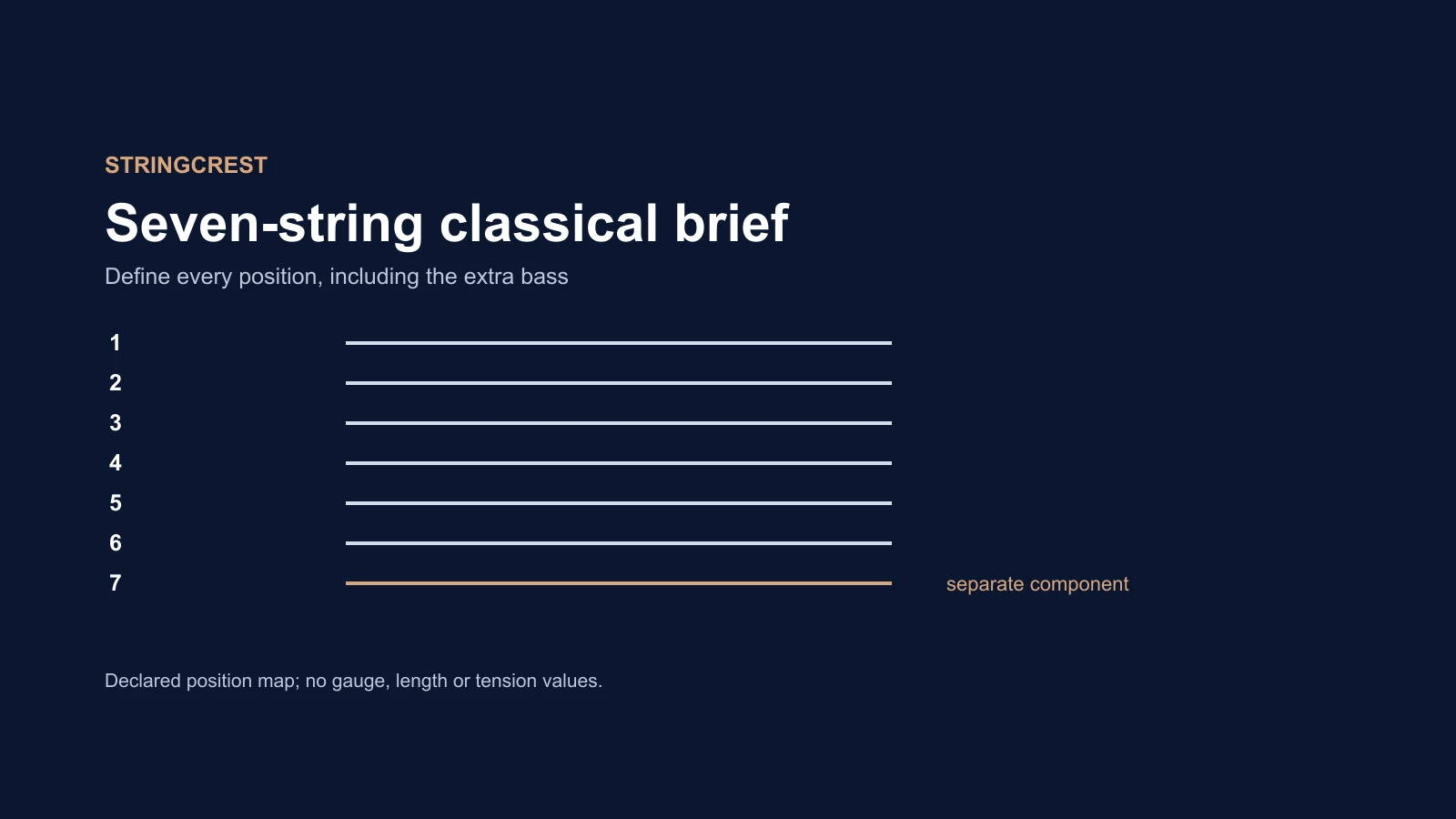
An order for 7 string classical guitar strings needs a seven-position specification, including the exact pitch and construction of the extra string. Start with the instrument maker’s requirements, the intended tuning and the installed lengths. A seventh string selected only because it looks like a heavier classical bass leaves its application unresolved.
This guide is for dealers, importers and private-label buyers handling a seven-string classical request. It explains how to describe the seventh position, check its relationship to the other six and decide whether a complete set or a separately identified replacement makes sense. The worksheet is an original buying tool. It contains no approved StringCrest gauges, tension values or available stock.
Establish which seven-string instrument the customer owns
Record the instrument maker, model, scale and intended string family before discussing a set. Seven strings occur on different instruments. A seven-string electric guitar set and a seven-string classical set belong to different construction and attachment briefs. Their shared string count does not establish interchangeability.
Ask for the maker’s string recommendation and clear photographs of the bridge, nut and tuning arrangement. The photographs identify the application; written dimensions and a declared tuning make it possible to discuss the proposed string. A dealer should refer any uncertain instrument modification or suitability question to the maker or a qualified technician.
Keep this page separate from the extended-range electric guitar string guide. That guide addresses steel-string electric applications. This one concerns a classical construction brief, including the relationship between plain polymer trebles and wound basses.
Give every position a note and octave
“Low B” is more informative than “extra bass,” but the octave is still necessary. Use a note such as B1 when that is the actual requested pitch, and identify the direction of the position list. A different requested pitch needs its own construction review. Do not retune an unidentified component to a new target simply because another set uses a similar diameter.
One documented example is D’Addario’s EJ45-7 seven-string classical set. Its published chart lists E4, B3, G3, D3, A2, E2 and B1, reading from the first to the seventh string. The named product uses tie ends and separates nylon trebles from silver-plated-copper-wound bass construction. This example identifies one manufacturer’s application. It does not prescribe every seven-string tuning or establish a StringCrest counterpart.
For the blank records below, position 1 means the highest-pitched string in the declared layout. Position 7 is its lowest. If the actual instrument uses a different positional convention, state that convention and revise the map before preparing labels. Never rely on an unlabeled row number to communicate a tuning.
Treat the seventh string as a complete component
A seventh-string request needs more than a nominal diameter. Identify its core, wrap, finished outside diameter, target pitch, applicable speaking length and attachment. A wound classical bass is not a solid metal wire merely because its outside surface is metallic. Conversely, the word nylon does not describe every layer of the complete string.
The classical string materials guide explains the treble and bass distinction. Use it to agree the construction language, then request the actual proposed materials for the seventh component. Keep a supplier’s material description attached to the sample or revision it describes. It should not become a general claim that every string offered under the same range name has that construction.
Separate these length questions:
- Speaking length: the vibrating span required by the instrument at that position.
- Installation path: the route through or around the bridge attachment and onward to the appropriate tuning post.
- Usable string length: the amount of the supplied component that can serve that path under the maker’s installation instructions.
- Construction boundaries: any wound-to-unwound transition or end preparation relevant to the proposed component.
The endpoints and measurement condition belong beside each dimension. A photograph taken before installation can show an end arrangement, but it cannot by itself prove that the component’s usable length covers the installed route. Do not cut a sample until the applicable instructions and path have been checked.
Use tension information within its actual conditions
A label such as normal or hard tension identifies a maker’s product category. It is not a universal measurement that makes two seventh strings equivalent. Ask what product, pitch and speaking length the supplier’s description covers. Where numerical data are offered, retain their units, construction reference and calculation or measurement conditions.
The practical question is whether the proposed complete set meets the instrument and player brief. A thicker-looking seventh string does not answer that question. Finished diameter alone cannot establish the string’s tension, core dimensions or balance with the neighboring bass. Without applicable data, record the requested feel or comparison objective as a question for evaluation rather than inventing a force value.
A dealer may receive a request to change only the seventh string. Retain the identity of the six strings that will stay installed, including their range, tension designation and relevant revision. The supplier then knows what the extra component is expected to accompany. If all seven strings are changing, describe that as a complete candidate set, with the comparison conditions recorded separately.
Fill a seven-position specification before accepting a quote
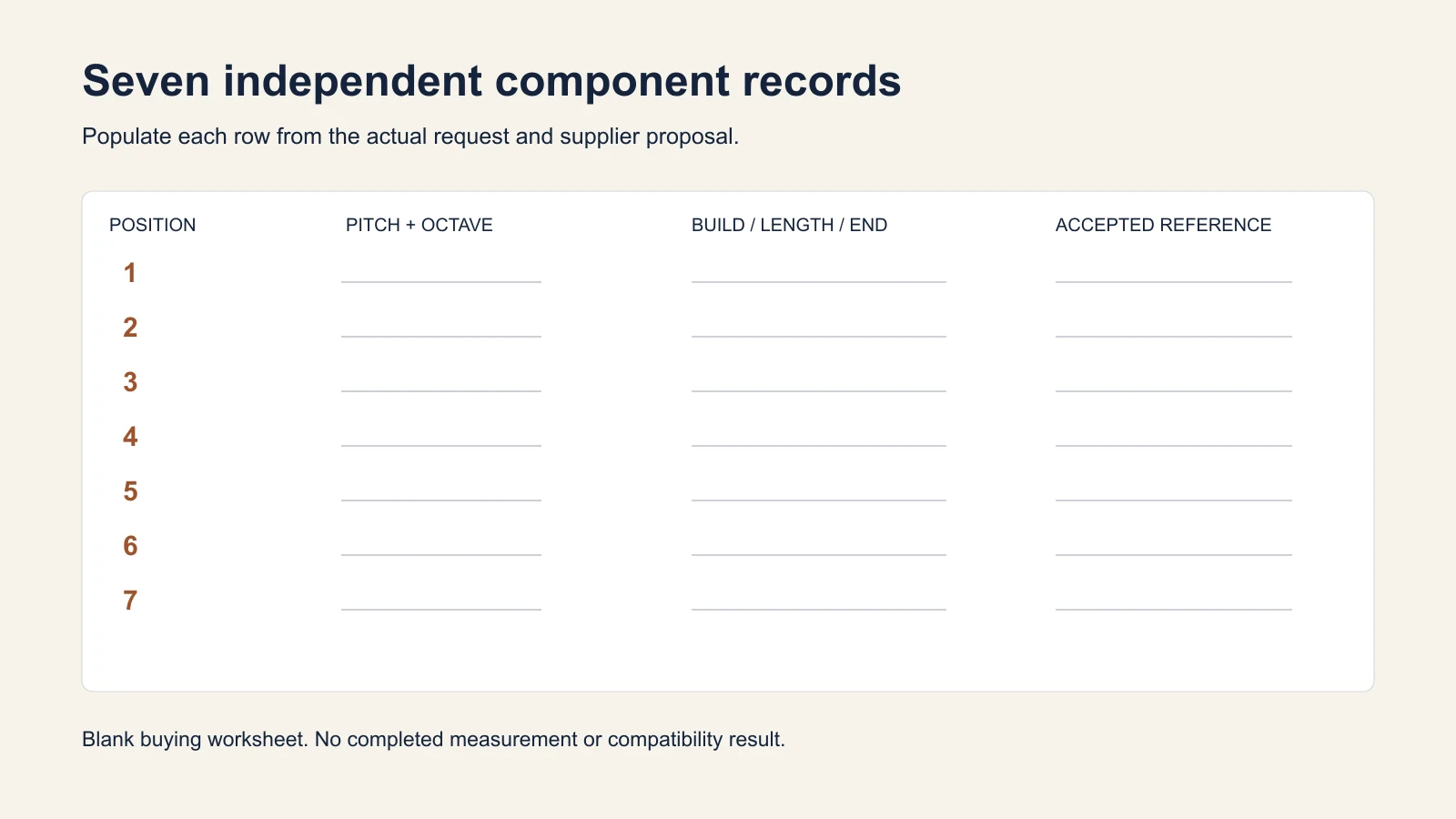
Use the table as a position index. Each blank component record should contain the requested note and octave, core and wrap, diameter with units, length endpoints, end construction and supplier item or sample identity. The supplier proposal is a separate entry from the buyer request. The final approval should reference the actual accepted document or sample, not just a price-list description.
| Position | Requested component record | Supplier proposal | Approval and evidence reference |
|---|---|---|---|
| 1, highest in the declared layout | |||
| 2 | |||
| 3 | |||
| 4 | |||
| 5 | |||
| 6 | |||
| 7, lowest in the declared layout |
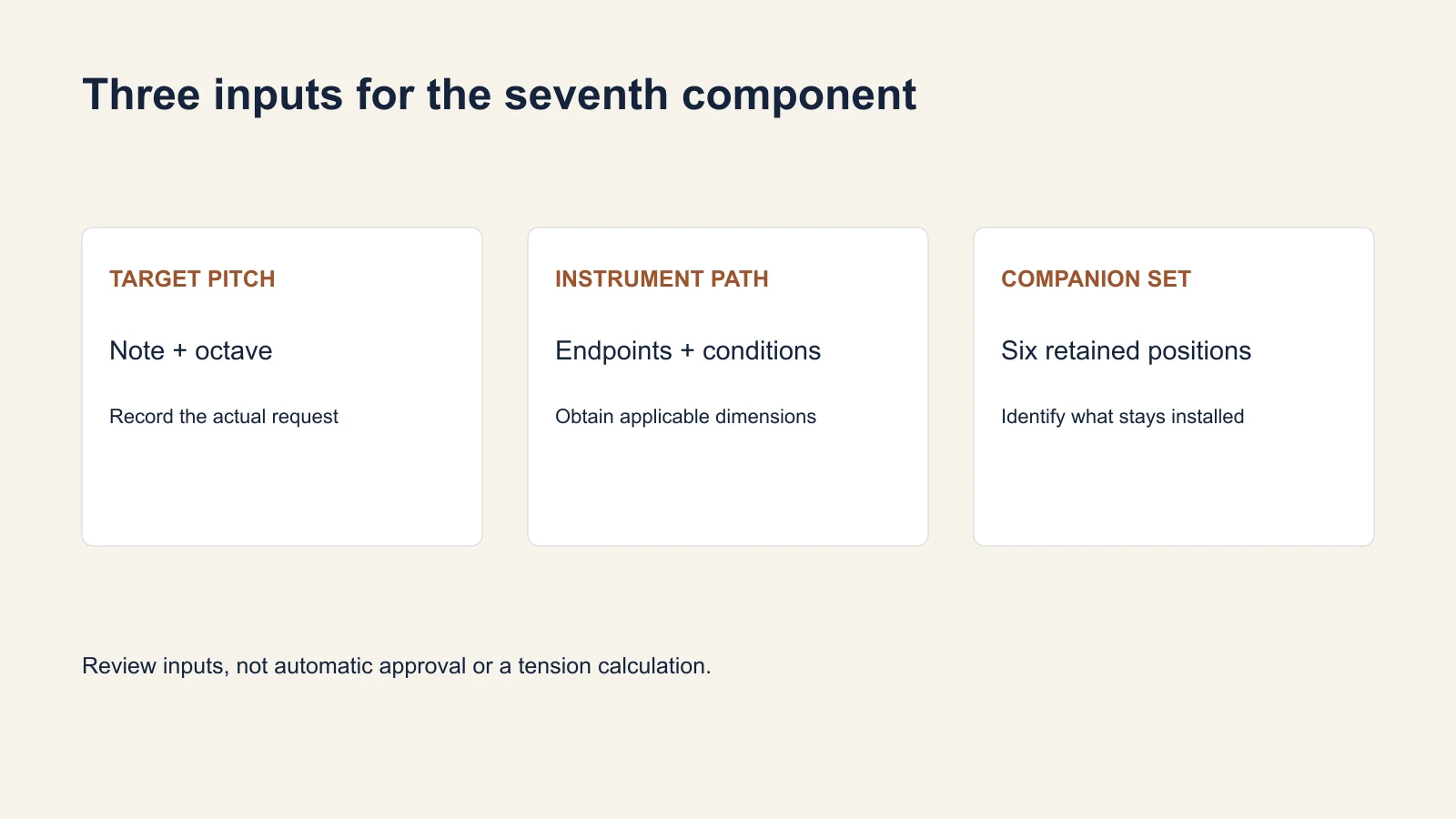
For the seventh position, expand the following questions rather than compressing them into “low string”:
| Seventh-string question | Information to obtain |
|---|---|
| Which pitch is intended? | Note and octave, including any planned alternative tuning |
| Which instrument must it fit? | Model, speaking length and measured installation path |
| What is the proposed build? | Core, winding, finished diameter and declared units |
| What happens at each end? | Attachment, end preparation and relevant construction boundaries |
| What does it accompany? | The identified six-string selection or complete seven-string revision |
| How will it be ordered again? | Component code, sample/document revision and accepted conditions |
Consider a hypothetical dealer request for a B1 replacement to accompany six retained strings. The B1 target answers the pitch question, but the guitar’s measured path and the six companion identities are still needed. If the supplier proposes another core or wrap, show that change on the seventh row before comparing samples.
Blank cells remain unresolved. A supplier can return an alternative proposal, but the alternative must be visible rather than silently replacing the requested component. Avoid filling a missing gauge from another manufacturer’s table. That would create the appearance of a defined set without establishing that the proposed supplier makes it.
Decide between complete sets and separately controlled replacements
A complete seven-string set gives the dealer one range identity, provided all seven positions and their application are actually defined. A single seventh-string replacement can also be useful when the installed six-string choice is already known. Those are different ordering cases and should have distinct descriptions.
For a complete-set request, ask whether the seven supplied components form one declared revision and how each is identified inside the package. For a replacement request, ask how the single is tied to its own construction and intended companion set. A label saying “seventh string” may be too broad if the dealer serves several tunings or scales.
The classical supplier specification guide covers the broader commercial and sample process. Link the seven-position record to that process instead of duplicating every packaging, shipping and supplier-qualification step here. Confirm actual availability, quantities, sample conditions and commercial terms against the proposed project.
Check what the sample can actually establish
Before installation, compare the sample label and component count with the returned specification. Keep the seventh string identifiable throughout the review. Count seven components; verify the position assignment from the supplier’s record rather than arranging them solely by apparent thickness.
Then check the actual fit conditions with a suitable instrument and competent installer. Record which guitar, tuning and installation instructions were used. If the nut, bridge or tuner needs an adjustment, separate that instrument work from the string comparison and obtain qualified advice. A modification made during the trial changes the conditions under which the result was observed.
Listening and playing notes can address response, balance across the basses and usefulness in the intended repertoire. They are observations on that candidate, instrument and session. They do not establish a universal tone advantage, longer life or an inspection certificate. Where the seventh string is being compared on its own, record whether the other six strings were new, used or changed during the review.
A useful outcome can be acceptance of the defined candidate, a request for a revised component, or a decision that the application is still insufficiently specified. Keeping the unresolved field visible is more useful than reporting a successful test that never took place.
FAQ
Can a seventh string be added to a six-string classical guitar?
A string purchase does not authorize an instrument conversion. Confirm the actual seven-string instrument and its maker’s requirements. Bridge, neck, nut and tuning hardware questions belong with the maker or a qualified technician.
Is a seventh classical string always B1?
No universal tuning is established by the string count. B1 is the seventh position in the named D’Addario example above. A request for a different pitch needs the actual instrument, scale and component proposal to be reviewed.
Can a seven-string electric set supply the extra string?
A matching note name or visible diameter does not establish the required classical construction or instrument suitability. Use the intended string family and maker’s requirements, then obtain an applicable component proposal.
Conclusion
Prepare the complete seven-position map before approving the extra bass. Keep pitch, construction, length endpoints and companion-set identity explicit, and use the sample to resolve the particular fit and balance questions that remain.
Review the classical guitar string category as a discussion starting point. Send Your Seven-Position Requirements with the instrument details and returned worksheet. A category page is not confirmation of a seven-string SKU or its availability.
FROM GUIDE TO PRODUCT
Connect this guide to Classical Guitar Strings.
Review the relevant range, then bring the instrument, complete specification and open questions into one project brief.
YOUR PRODUCT · YOUR BRAND
Discuss your next string project with Frank.
Share your instrument category, target market, gauge or material direction and private-label packaging requirements.

ABOUT THE AUTHOR
Frank Zou
Frank works directly with musical-instrument brands, importers and distributors on string specifications, product selection and private-label project requirements.
Meet Frank