
Buying Guides
Materials & Construction
Classical Guitar String Materials: A Buyer’s Guide to Trebles, Basses and Range Planning
A practical guide to clear and rectified nylon, fluorocarbon-type trebles, multifilament bass cores, metal wraps, tension labels and tie-end fit.
Introduction
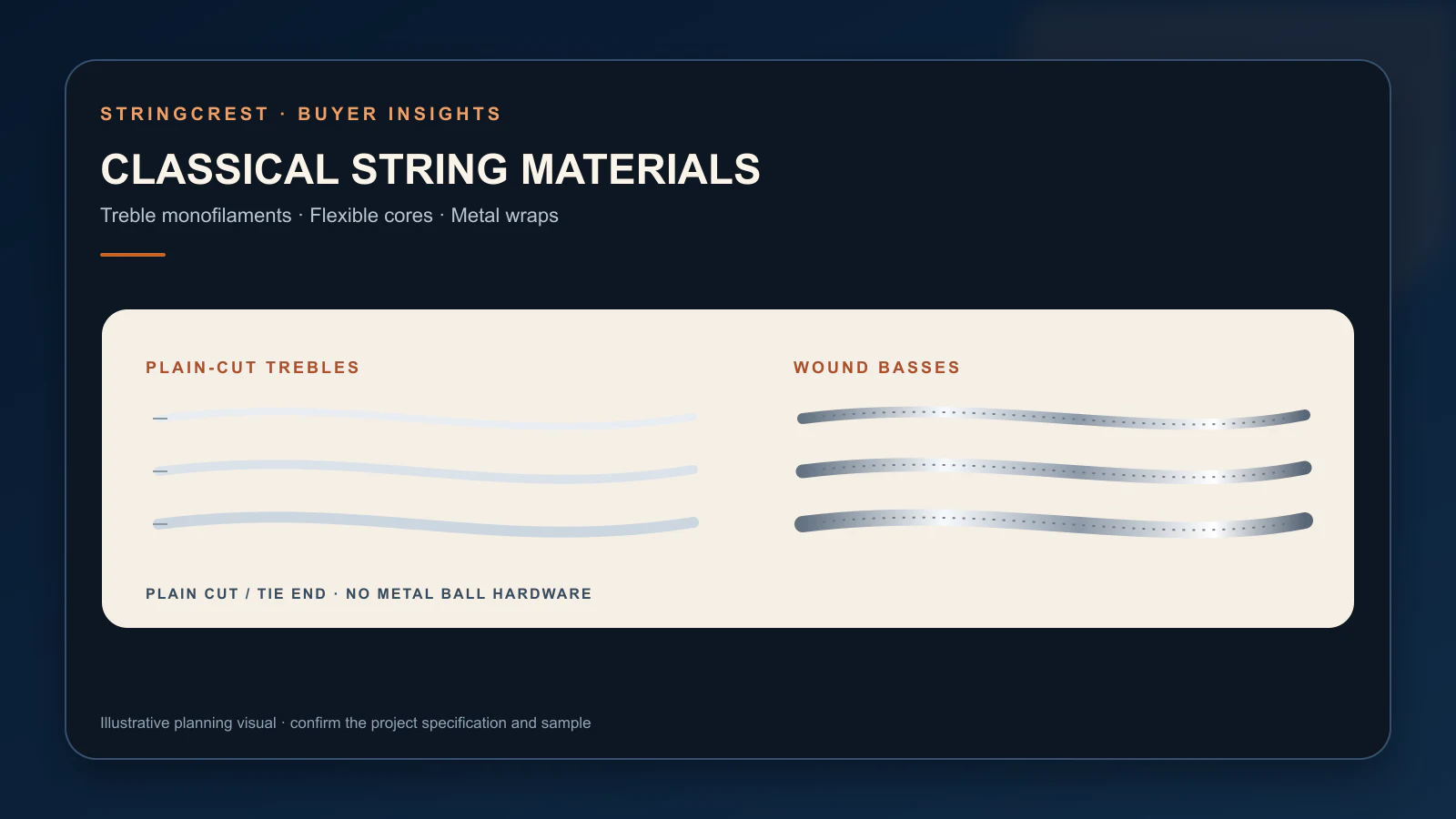
The phrase classical guitar nylon strings is useful for identifying the product family, but it does not mean that every string in the set is a single strand of the same nylon. A typical classical set combines plain monofilament trebles with wound basses built on a flexible multifilament core. Other families may use fluorocarbon-type or proprietary monofilament trebles, different bass-core constructions and different metal wraps.
For a brand, importer or distributor, the buying question is therefore not simply “nylon or carbon?” A responsible brief separates the treble material, bass core, bass wrap, declared tension, surface or diameter characteristics, end construction and target playing response. It also defines how those elements will be compared without turning subjective impressions into unsupported performance promises.
This guide focuses on material architecture and range planning. It complements, rather than replaces, a gauge sheet, tension review and tie-end fit check. It also respects a basic product fact that must remain visible in imagery and packaging: conventional StringCrest classical guitar sets use plain-cut/tie-end strings, not metal guitar ball ends.
Understand the two systems inside a classical set
Trebles and basses need separate material descriptions
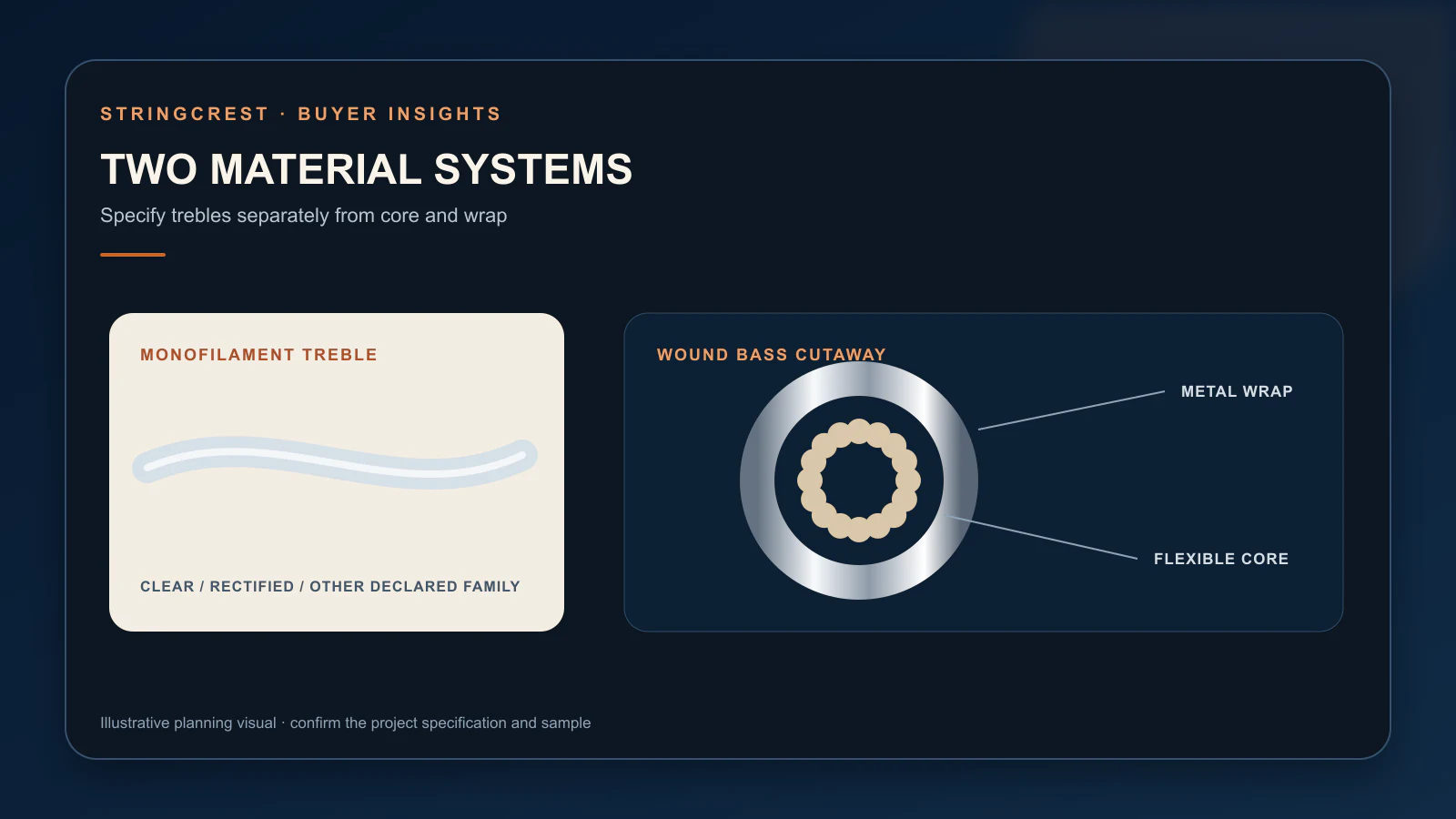
The first, second and third positions are commonly plain monofilament trebles. The lower positions are commonly wound strings with a flexible core beneath a metal wrap. Even when a package is casually described as a “nylon set,” the buyer should ask what material family is used in each group.
That distinction matters because a material change to the trebles does not automatically require the same change to the basses. A brand may evaluate a clear-nylon treble set against a denser monofilament option while keeping the bass construction controlled. It may also compare two bass designs under the same treble group. Separating these decisions makes sample feedback easier to interpret and helps artwork describe the actual build.
Official category information from D’Addario illustrates the breadth of classical-string material vocabulary, including nylon, fluorocarbon or carbon, composite and titanium-named offerings, with variation in core, wrap, coating and end type. These are category examples, not definitions of StringCrest products. A buyer should request the supplier’s exact material declaration and avoid treating marketing family names as interchangeable chemical specifications.
| Set area | Questions for the brief | What to avoid |
|---|---|---|
| Trebles | Monofilament family, surface, nominal diameters, color, declared tension | Calling every clear treble identical “nylon” |
| Bass core | Multifilament material and construction description | Assuming the core is visible from a product photo |
| Bass wrap | Wrap metal, finish and any coating claim | Copying another brand’s alloy wording |
| Ends | Plain-cut/tie-end length and bridge use | Showing or specifying metal ball ends for this classical line |
Compare clear and rectified nylon trebles
Surface and diameter are part of the evaluation
Clear nylon is a familiar reference point for many classical ranges. Buyers should still confirm nominal diameters, consistency, color and the supplier’s tension classification. “Clear” describes appearance, not a complete technical specification.
Rectified nylon is processed to create a more controlled diameter and a textured or matte surface. Some players notice a different left-hand feel or response, but a buyer should describe those observations as sample findings rather than guaranteed outcomes for every player. If the assortment includes both clear and rectified families, the packaging should make the distinction obvious without suggesting that one is categorically superior.
Visual inspection under consistent lighting can identify color variation, surface defects or obvious diameter irregularities. Dimensional checks need an agreed method and suitable measuring equipment. Do not publish tolerances that have not been agreed with the supplier and verified for the specific project.
Evaluate fluorocarbon-type and proprietary trebles carefully
Higher density changes the design conversation
Fluorocarbon-type monofilaments are often discussed as alternatives to conventional nylon trebles. Their material density and diameter relationships can differ, so buyers should not request a direct diameter copy and assume identical feel or tension. The correct comparison starts with the target tuning, scale and tension direction, followed by position-specific sample data.
Terms such as carbon, composite or titanium can be commercial family names as well as material cues. Ask what the supplier means by each term, which positions use it and what can be stated accurately on packaging. If the exact polymer formulation is proprietary, the buyer can still control the product through declared family, nominal dimensions, appearance, tension category and approved reference samples.
A useful test matrix changes one treble group while keeping the bass group stable. Record tuning behavior, surface feel, position-to-position balance and the third-string transition. Because the third string often sits between the upper monofilaments and the wound basses in both feel and perceived response, it deserves a dedicated review rather than being treated as an afterthought.
Read bass-string construction as core plus wrap
The visible metal is only one part of the bass
Classical basses generally combine a flexible multifilament core with a wound metal exterior. D’Addario’s Pro-Arté Composite product page, for example, identifies silver-plated copper wound on a multifilament nylon core and pairs those basses with clear nylon trebles. That description is specific to the cited product, but it shows the level of detail a buyer should request.
The wrap description may refer to silver-plated copper or another material system. The core may be conventional multifilament nylon or another declared construction. A coating may be present in some product families. Each choice can affect feel, appearance, mass, response and claim language, but these effects should be evaluated on identified samples rather than converted into unsupported universal promises.
Ask how the supplier identifies bass-string revisions and prevents mixed construction within a set. During incoming review, compare winding appearance, end finish, length and sample codes. If the project requires a particular corrosion or wear statement, define the evidence and test conditions before placing the claim on retail packaging.
Keep tension labels tied to a declared set
Normal, hard and extra-hard are family labels, not universal units
Tension labels help players navigate a product family, but “normal tension” from one construction should not be assumed identical to another supplier’s normal tension. The buyer should retain the position gauges or diameters, material construction, scale used for calculation and the declared tuning. If actual tension values are provided, the calculation basis and units should be clear.
Material and tension decisions interact. A denser treble material can reach a target pitch at a different diameter. A bass construction can change mass without a simple visual cue. For that reason, a range should not be created by copying gauge numbers from an unrelated material family.
When comparing two tension levels, install them on suitable reference instruments and keep the evaluation method consistent. Record playability, balance and any setup concern as observations. Do not imply that a higher tension is automatically louder, better or more professional. Customer preference, instrument construction and playing style all matter.
Specify plain-cut and tie-end fit correctly
Classical imagery must not introduce metal ball ends
For the StringCrest classical range discussed here, strings should be represented with plain-cut ends intended for tie-block installation. Product illustrations must not add colored metal balls, guitar-style ball ends or decorative terminal hardware. Those details would describe a different construction and can mislead buyers.
The brief should state adequate total length, plain-cut end condition and the intended bridge/tie-block use. Sample installation should check whether the string can be tied securely using the instrument maker’s or technician’s normal method, with enough length for the headstock path. The visual review should also confirm that winding and transitions do not create an unintended obstruction at the tie block, saddle, nut or roller.
Some market products use alternative end constructions, so broad statements that “all nylon strings have no ball ends” are too wide. The accurate approach is product-specific: identify the StringCrest classical set as plain-cut/tie-end and make every image, sample sheet and package agree with that specification.
Design a range buyers can understand
Give each SKU one clear reason to exist
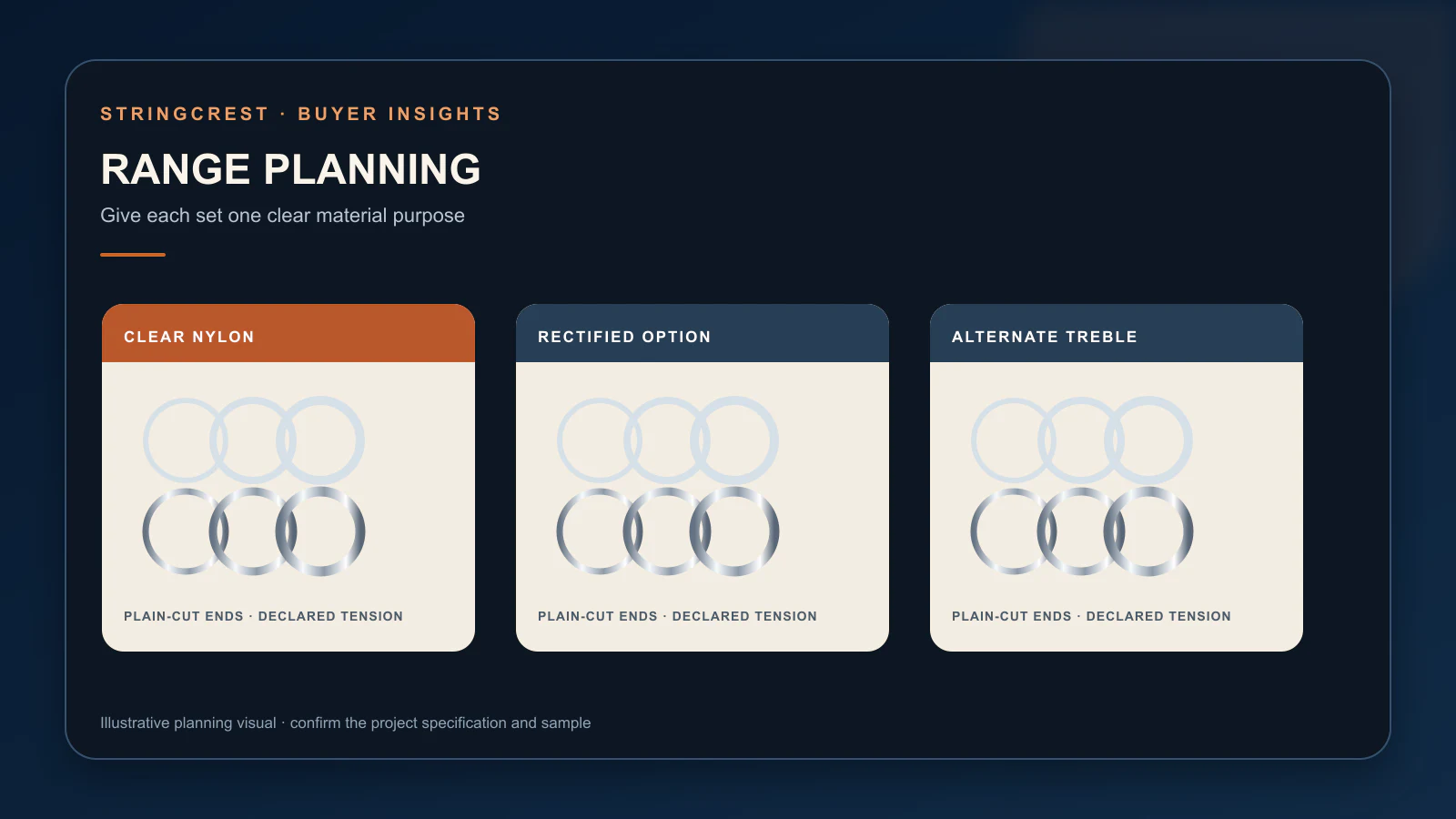
A material range becomes confusing when several sets have nearly identical labels and no defined role. A focused starting architecture might distinguish one familiar clear-nylon reference, one alternate treble material direction and, only if demand supports it, a separate tension option. This is an assortment framework, not a claim that every distributor needs those exact SKUs.
For each proposed set, write a one-sentence product purpose before approving packaging. The sentence should mention the material direction and intended choice, not an unverifiable superlative. “Clear nylon trebles with wound basses for a familiar classical specification” is controllable. “The richest tone and longest life” would require evidence that most projects do not have.
Keep SKU names, inner labels, barcodes and outer cartons aligned. If only the tension changes, make that change visible. If the treble material changes, do not leave an old material statement on the back panel. Revision control protects both the buyer and the supplier.
Range reviews should also consider replacement singles. A retailer may receive requests for an individual first string, a third string with a different material direction or a wound bass. Decide whether singles belong in the program, how their identification matches the full set and whether stocking them is commercially practical. Do not advertise singles until their actual availability and packaging have been confirmed.
Approve samples with an evidence-based worksheet
Combine measurable checks with structured playing observations
Begin receiving inspection by confirming the sample code and pack contents. Verify that the set has the correct number of positions, that trebles and basses match the worksheet and that no metal ball-end hardware is present on the plain-cut classical set. Record nominal dimensions according to the agreed method, then inspect surface, color, winding continuity and end finish.
Installation preparation should use a clean, suitable reference instrument. Record the scale, tuning, relevant setup condition and installation method. Allow the strings to stabilize before drawing conclusions. Track tuning behavior and position balance over a defined internal review period, but do not turn a small sample review into a published lifespan claim.
Player comments are most useful when questions are consistent: How does the treble surface feel? Does the third position connect naturally to the basses? Are the wound strings balanced across the set? Does the chosen tension direction suit the intended customer? Keep open comments, but require reviewers to identify the sample code and instrument.
Photograph samples against a neutral background with the code visible, while keeping images separate from approved consumer photography. The record is meant to prove which revision was reviewed, not to create a staged factory narrative. If a defect is found, mark the exact position and retain the affected sample until the supplier confirms the disposition.
Prepare the material and packaging brief
Use exact, supportable wording
The final technical brief should identify each string position, material family, nominal gauge or diameter, declared tension, core and wrap description for wound strings, end construction, total length and any surface treatment. The artwork brief should use the same terms. If a material name is proprietary or simplified for consumers, record the approved consumer wording alongside the technical description.
Packaging should also state instrument category, string count and installation-relevant information. Avoid implying that a set fits every scale or every instrument. Include care or replacement advice only when it is written as general guidance rather than a guaranteed schedule.
Ask the supplier to flag any wording that does not match the quoted construction. Before production, reconcile the specification, physical sample, artwork proof and purchase order by revision. MOQ, lead time, packaging choices and current availability belong in the project quotation because they can change.
FAQ
Are classical guitar strings all nylon?
Not in the simple sense of six identical nylon strands. Sets commonly combine monofilament trebles with metal-wound basses on a flexible multifilament core. Other treble material families also exist. Confirm each position’s construction.
What is the difference between clear and rectified nylon?
Clear nylon is a familiar smooth monofilament presentation. Rectified nylon is processed for a controlled diameter and typically has a textured or matte surface. Compare identified samples for feel, balance and the intended range position.
Are carbon and fluorocarbon strings the same?
Market terminology varies. “Carbon” may be used as a category label for fluorocarbon-type or proprietary monofilaments. Ask the supplier what the term means in the proposed construction and approve packaging wording accordingly.
Do StringCrest classical guitar strings have ball ends?
The classical set described in this guide uses plain-cut/tie-end strings and should be illustrated without metal ball ends. Confirm the end construction in the project specification and sample.
Does higher tension mean better sound?
No universal ranking applies. Tension direction interacts with material, scale, instrument and player preference. Compare controlled samples and avoid unsupported “better” claims.
What documents should a buyer retain?
Keep the approved technical sheet, identified sample record, evaluation notes, final artwork, barcode list, pack configuration and purchase-order revision. These records make repeat orders and corrections more reliable.
Conclusion
A classical-string range becomes clearer when trebles and basses are specified as separate material systems. Define the monofilament family, bass core and wrap, tension basis, plain-cut/tie-end construction and sample method before writing marketing claims. This approach supports more useful quotations, cleaner assortment decisions and imagery that accurately represents the product.
Explore classical guitar strings · Send your classical-string material brief
Sources and interpretation limits
- D’Addario classical guitar strings collection
- D’Addario Pro-Arté Composite product construction example
The cited official pages explain category vocabulary and a brand-specific construction example. They do not establish StringCrest specifications, availability, test results or performance. Confirm the actual proposal, plain-cut sample and quotation for each project.
FROM GUIDE TO PRODUCT
Connect this guide to Classical Guitar Strings.
Review the relevant range, then bring the instrument, complete specification and open questions into one project brief.
YOUR PRODUCT · YOUR BRAND
Discuss your next string project with Frank.
Share your instrument category, target market, gauge or material direction and private-label packaging requirements.

ABOUT THE AUTHOR
Frank Zou
Frank works directly with musical-instrument brands, importers and distributors on string specifications, product selection and private-label project requirements.
Meet Frank