
Product Selection
Product Selection
Classical Guitar Third-String Balance: A Private-Label Sample Checklist
A practical G3 transition test for buyers evaluating private-label classical guitar strings.
Introduction
The third string can be the awkward point in a classical guitar set. It is the lowest-pitched treble, immediately next to the wound fourth string, and a buyer may hear or feel a discontinuity there even when all six strings are individually serviceable. For a distributor or private-label brand, the useful question is not whether one material is “best.” It is whether the complete proposed set makes a coherent transition on the instruments and in the playing situations its customers actually use.
A sample request that says only “normal-tension nylon” does not answer that question. The buyer needs to know which third string is in the pack, how the other trebles and wound basses are specified, which instrument is used for evaluation, and whether an alternative third string is a separate sample revision. This guide offers a controlled comparison method. It does not imply that StringCrest has approved a particular composite or carbon option, a measured tension value, or a factory test result. Availability and final construction must be confirmed for the project.
Why the G3 transition deserves its own check
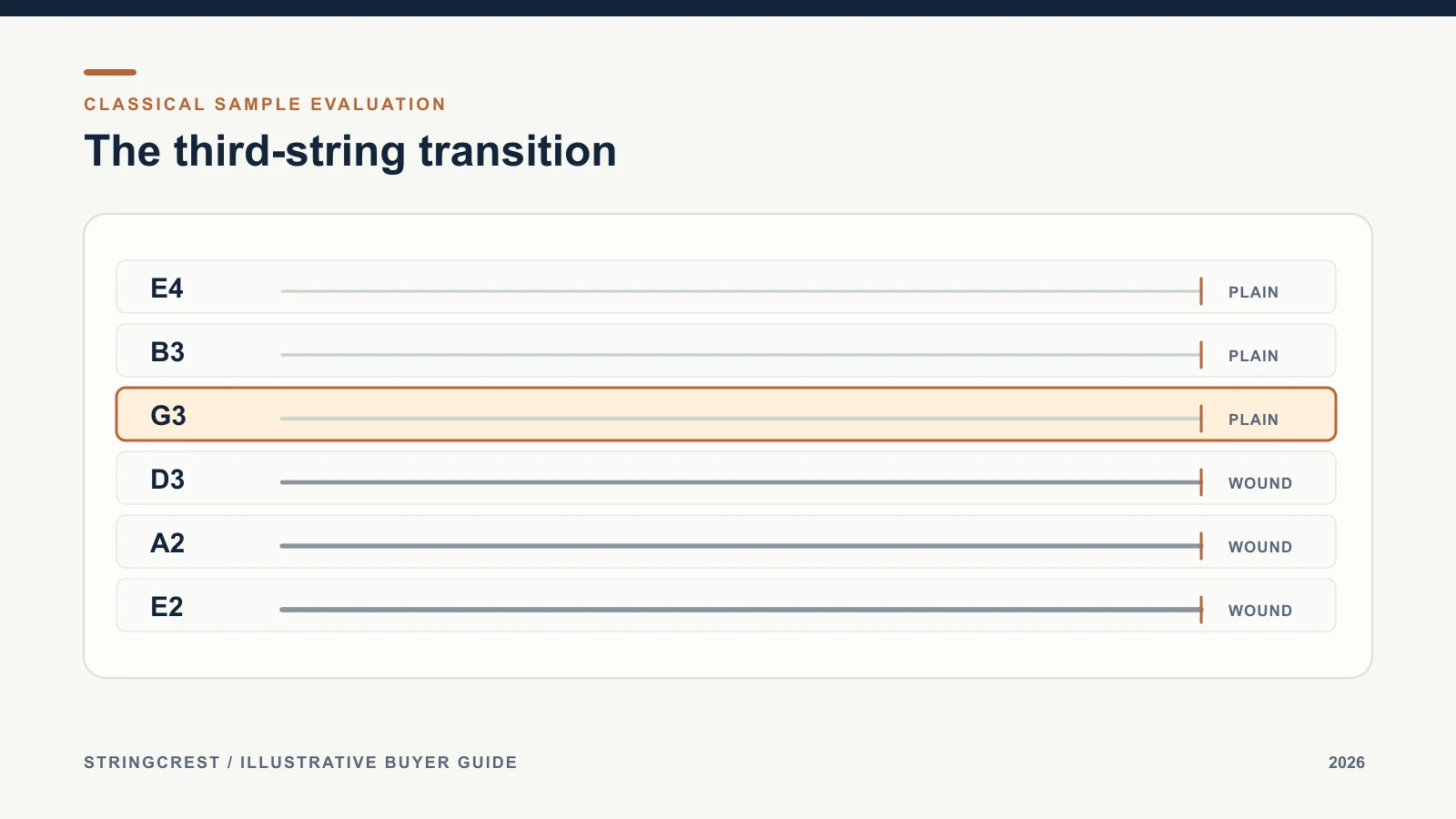
In standard classical tuning, the open strings run E4, B3, G3, D3, A2 and E2 from first to sixth. The third string is usually discussed with the three trebles, yet a player often moves directly between G3 and the wound D3. That makes the transition an audible and tactile comparison, not merely a line on a specification sheet. A third string may have a different surface feel or apparent response from its neighbors; how noticeable that is depends on the set, instrument, setup, technique and listener.
Manufacturers have approached this position in different ways. For example, D’Addario describes a classical set with clear nylon trebles and an optional composite third string. Its published alternative is an example of how one maker defines a product choice; it is not evidence that StringCrest supplies that construction or that it will improve every guitar. D’Addario's broader classical string catalog also separates treble material, tension category, size and end type. Those are useful dimensions for a request for quotation, but the names and performance claims belong to the cited products.
For a buyer, the comparison should begin with a specific complaint or desired role. Perhaps a dealer reports that customers want a more even melody line between second and third strings. Perhaps a school supplier values predictable replacement identification. Perhaps a specialty shop asks for a distinct third-string option. Record the observation and its source. A vague instruction such as “make the G stronger” cannot tell a supplier whether the issue is volume, pitch stability, tactile feel, tonal contrast or an instrument-specific setup problem.
Keep a problem statement separate from a solution
Write the customer's language first: “On our reference guitar, three evaluators noticed a change in attack moving from B3 to G3 during a single-note passage.” That is a testable observation, provided the guitar, strings and evaluators are identified. “Use a different polymer” is a proposed solution and belongs in the next column. If the same complaint disappears after a setup correction, a new string construction may not be needed at all.
Define all six positions before comparing the third
The third string cannot be evaluated fairly when the rest of the set is a moving target. Record a complete six-position specification for each candidate, even if the supplier initially marks some values “to confirm.” The first three rows should identify each treble's material direction, appearance, finished diameter or product code where available, and end format. The last three rows need core and winding direction as well as the same identity fields. Give the set a revision code that appears on the sample bag, evaluation sheet and quotation.
| Position | Open note | Minimum buyer record | Why it matters in this comparison |
|---|---|---|---|
| 1 | E4 | Treble construction and identity | Establishes the upper reference for response and feel |
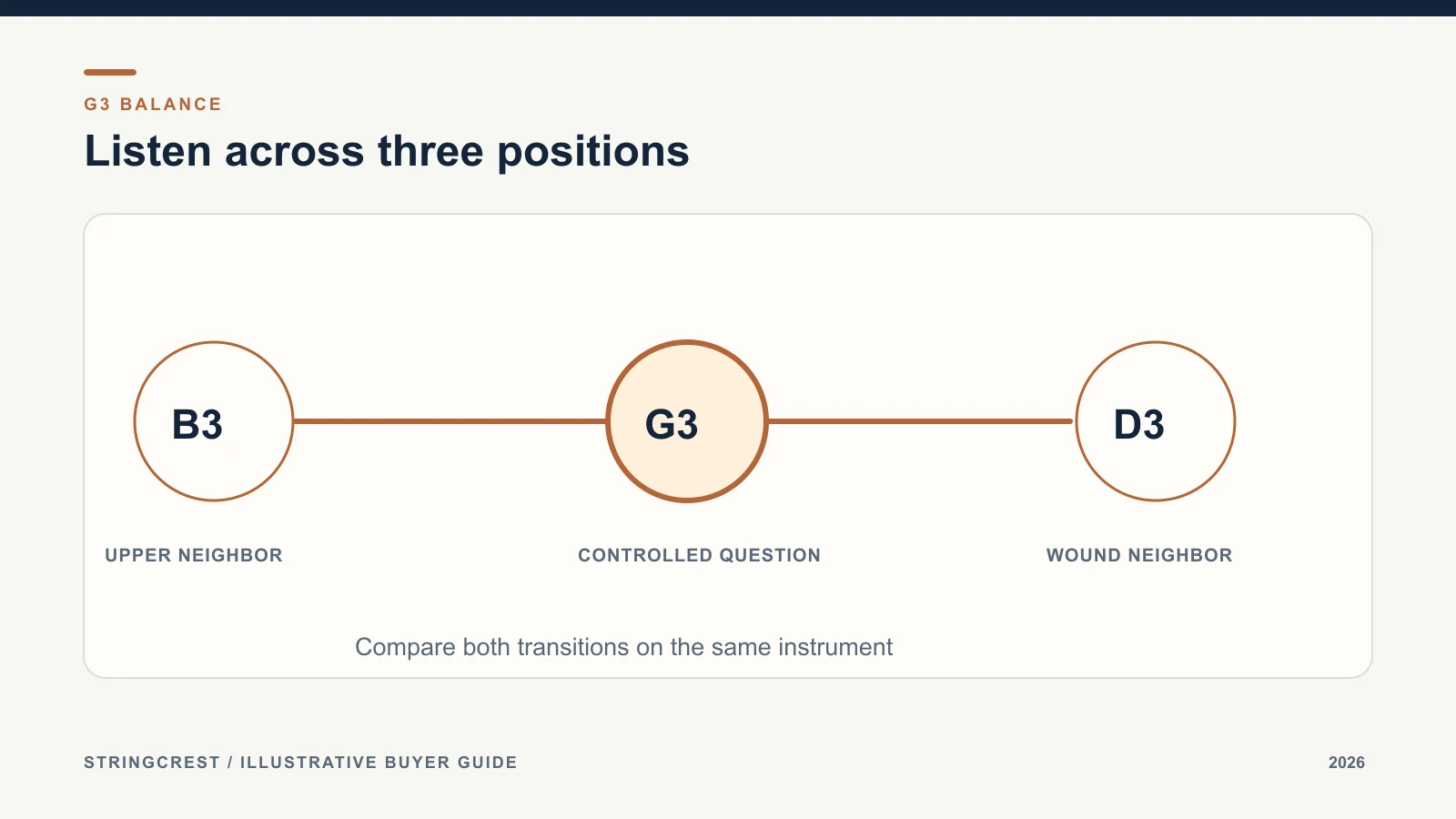
| 2 | B3 | Treble construction and identity | Immediate upper neighbor of the third string |
| 3 | G3 | Treble construction, identity and proposed variant | The controlled variable under review |
| 4 | D3 | Core, wrap and identity | Immediate wound neighbor of the third string |
| 5 | A2 | Core, wrap and identity | Checks whether a perceived change is set-wide |
| 6 | E2 | Core, wrap and identity | Completes the bass balance and pack count |
Do not copy another maker's published diameters or tensions into a StringCrest RFQ as though they describe the proposed sample. Numerical tension varies with construction, tuning and scale, and two sets bearing the same broad “normal” label need not have identical position-by-position figures. Request supplier-specific data and the conditions behind it if numerical comparison is required. Otherwise, state that the approval uses a documented playing trial rather than pretending to have a measured force target.
The current StringCrest classical-guitar product preview identifies a six-string nylon-treble direction and plain-cut ends, while bass construction and final tension class remain to be confirmed. Treat an alternative third-string material as a question to discuss, not as an option already offered. Keep nylon and metal-wound strings visually distinct in product imagery; classical nylon trebles must never acquire an invented metal ball end in an illustration.
Design one controlled sample question
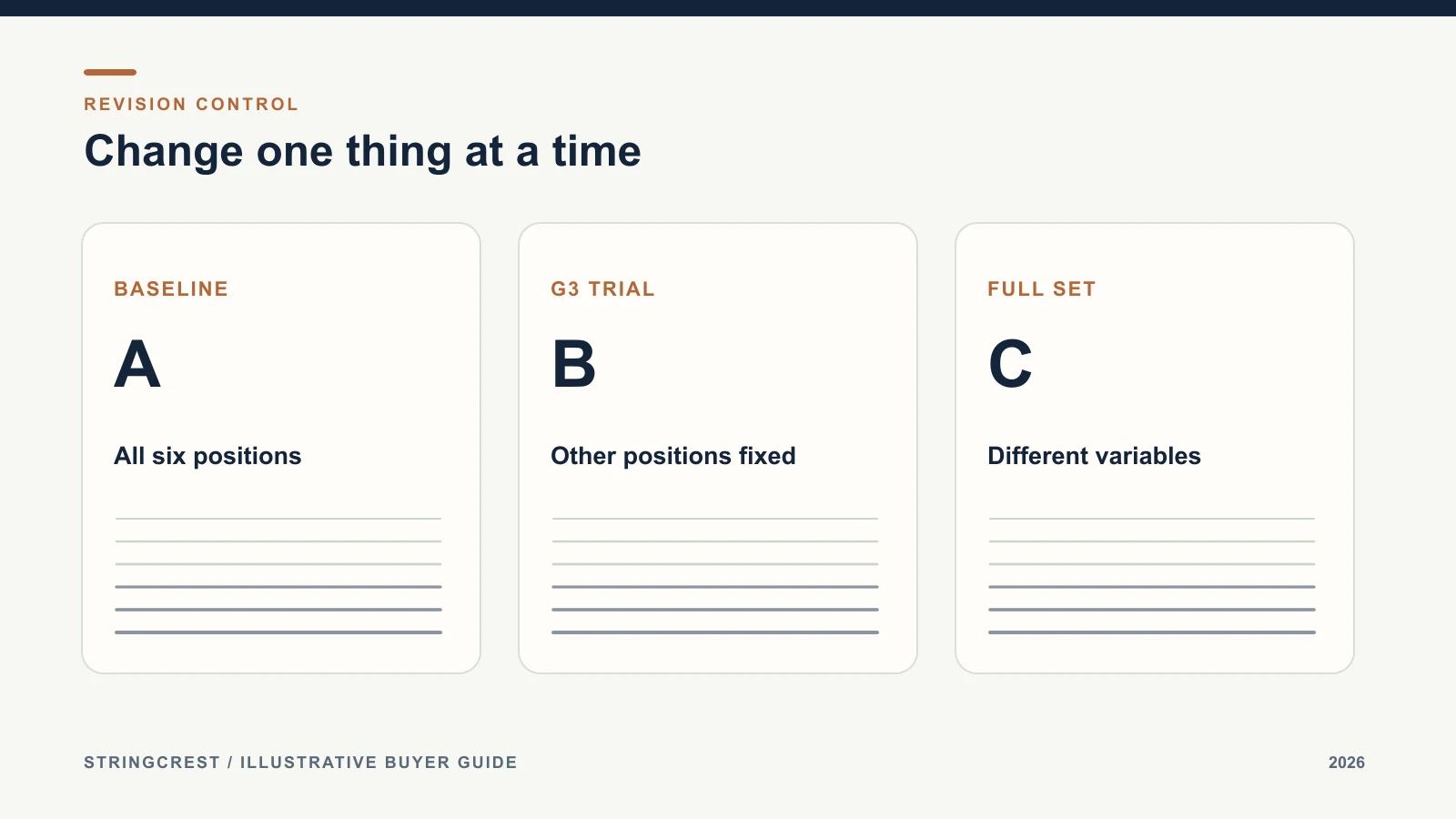
A practical trial can start with a baseline six-string set and one candidate that differs only in the third-string specification, if the supplier can support that controlled change. Ask the supplier to identify every difference rather than assuming the rest of the set is identical. When a new third-string material also changes diameter, tension or appearance, those changes belong in the trial record. If a second candidate changes the basses as well, label it a broader set comparison; it cannot isolate the G3 choice.
Prepare a one-page sample matrix. For each revision, enter the six string codes, treble material direction, bass core and wrap, stated tension category, intended tuning, end type, date received and package condition. Mark data as confirmed, proposed or unknown. “Similar to Sample A” is not a controlled specification because it hides the very differences the buyer is trying to evaluate.
Example of an honest comparison matrix
| Candidate | E4/B3 specification | G3 specification | D3/A2/E2 specification | Decision it can answer |
|---|---|---|---|---|
| A, baseline | Identified and held fixed | Identified baseline | Identified and held fixed | Defines the present reference |
| B, third-string trial | Same as A only if confirmed | Alternate, subject to availability | Same as A only if confirmed | Tests the third-string change |
| C, full-set trial | Separately identified | Separately identified | Separately identified | Compares overall sets, not one cause |
This is an editorial example, not a StringCrest sample history. A candidate should not enter an order simply because a player liked a five-minute demonstration. The buyer should identify the use case, the reference instrument and the criteria for acceptance before asking for the samples. If suppliers cannot provide a controlled alternate, the team can still compare complete sets, but it should report a complete-set preference rather than attributing the result to a single component.
Prepare the instrument and installation record
Before installation, note the reference guitar's size, scale if relevant, general condition, action and any obvious nut, saddle or tuning-machine issue. Use the same instrument for candidates where practical. Record the date, room conditions if they matter to the trial, string identity, installation method and person completing the work. A guitar that receives a setup adjustment between Sample A and Sample B introduces another variable. A second guitar can improve the usefulness of the trial, but it should be a separate row rather than an undocumented swap.
Classical strings normally need a secure bridge tie and appropriate winding at the tuning post for the actual end construction. The current StringCrest preview shows plain-cut ends; do not force a ball-end process onto that sample. Stop and ask for the correct product if the delivered end format conflicts with the intended bridge. Confirm the maker's installation advice for the instrument and use a qualified technician when fit or setup is uncertain.
Allow both candidates the same defined observation window before judging them. Nylon can change its tuning behavior after installation; the important point for this procurement comparison is consistent recording, not a universal “break-in” promise. Note how often retuning was needed at chosen checkpoints without claiming that a short shop trial predicts long-term performance. If a wound bass shows visible damage at receipt or installation, record and resolve it separately rather than masking it as a third-string response issue.
Listen across the transition, not only on open strings
A useful playing protocol includes the same short passage, position changes and dynamics on every candidate. Ask evaluators to play a melody crossing B3–G3–D3, a sustained note on each of those strings, a repeated phrase at soft and stronger attack, and ordinary chord accompaniment. Record the exact guitar and amplifier or microphone setup if one is used. A phone recording may help recall a trial, but it is not a calibrated loudness or frequency measurement.
Separate the observations into categories. “G3 sounded quieter beside B3 on Guitar A” is more informative than “weak G.” “The shift to D3 felt abrupt under the right hand” describes another issue. Pitch drift during early installation, intonation on a particular fret, visible surface condition and left-hand feel are different findings. They may have different causes and should not be rolled into one star rating.
Use at least two evaluators if the brand's normal product-approval process allows it. Have them record their impressions independently before discussing a preference, and identify disagreements rather than averaging them away. A dealer audience may value a particular response that a recording specialist would reject. The target customer and playing context matter more than a generic “premium tone” label.
Read the results without claiming too much
At the end of each session, record fit, response, feel, tuning observations and any visible defect in separate columns. Tag each finding with the evaluator and instrument. A small trial can support a product decision for a defined customer brief; it cannot establish a universal performance hierarchy across all guitars. If the same candidate behaves differently on two instruments, document the difference and revisit whether the range needs one broad product or a more specific application statement.
Ask whether the third-string change creates a new problem elsewhere. A more prominent G3 may make the transition from B3 less abrupt while making the move to D3 more noticeable. It may also require a different package description, individual-string replacement code or customer explanation. The commercial cost of an extra variant includes artwork, warehouse identification, replenishment and dealer education, not just the unit quote.
The decision record should state “approve,” “reject,” or “revise and resample,” with reasons tied to the original problem. If the conclusion is only “several players preferred B,” preserve the instruments, conditions and scope. Do not convert a preference into an unsupported claim about measured tension, volume increase or longer service life. Those would require a defined method and evidence that the trial may not provide.
Carry the approved set into quotation and shipment
Once a candidate is selected, transfer its complete six-position identity to the purchasing record. The final quotation should refer to the sample revision, confirmed construction, end format, pack unit, artwork version and any individually identified alternate third string. Ask for MOQ, sampling terms, lead-time basis and packaging choices for that exact configuration; do not assume a general company-wide term applies. Keep unknowns marked open until the supplier confirms them.
Artwork must not promise a treble material or tension category that the approved specification does not support. A photograph may show the color and arrangement, but the text and product code control the order. If a retail pack includes an extra third string, list that explicitly; if it does not, avoid borrowing another manufacturer's “extra G” language. A buyer may need replacement singles, but those are a separate commercial decision and should not be inferred from a set-only quote.
Before release, agree on the identity checks a shipment record can actually demonstrate: correct set code, six positions, approved pack revision, readable labels, intact protective package and quantity. If measurable characteristics are inspected, define method, sampling and acceptance criteria in the purchase agreement. A general photo of wound strings is not proof that the delivered third string matches the approved candidate. Link any inspection record to the lot or order identifier supplied for the project.
FAQ
Is the classical G string always nylon?
No. Nylon is a familiar classical-treble direction, but manufacturers also publish other constructions and optional third-string variants. A competitor's catalog proves that such product concepts exist; it does not prove StringCrest availability. The buyer should confirm the material and identity of the proposed six-string set.
Does an alternative third string automatically improve balance?
No. Balance is an evaluation on a specified guitar, with a specified complete set and use case. A different material can change several attributes at once. Ask for a controlled sample comparison and record both the B3–G3 and G3–D3 transitions before deciding.
Can I compare two “normal-tension” sets using the label alone?
No. Tension labels are product-family descriptors, not a universal six-position numerical standard. Request supplier-specific figures and conditions if numbers matter, or record a consistent installation and playing comparison without claiming that the labels prove equivalence.
Which information should be on a sample label?
Include a revision code, set or individual-string identity, intended instrument, all six positions, material/construction direction, end type and the date or lot reference available for the sample. Keep the quotation and evaluation sheet aligned with that code so an approved sample is not replaced by an unlabeled later version.
What if players disagree about the preferred G string?
Keep each observation with its instrument and intended customer segment. Disagreement can reveal that the proposed SKU has no single clear role, or that two applications are being mixed. It does not automatically require two retail products; review dealer demand and operational complexity before expanding the range.
Conclusion
The useful way to buy a balanced classical set is to define the six positions, isolate the third-string question where possible, test the same passage and installation conditions, and keep the sample revision connected to the final quote and pack. The result is a defensible purchasing decision, not a claim that one material wins on every instrument. Confirm the actual StringCrest construction and commercial terms for your project before approving artwork or a bulk order.
FROM GUIDE TO PRODUCT
Connect this guide to Classical Guitar Strings.
Review the relevant range, then bring the instrument, complete specification and open questions into one project brief.
YOUR PRODUCT · YOUR BRAND
Discuss your next string project with Frank.
Share your instrument category, target market, gauge or material direction and private-label packaging requirements.

ABOUT THE AUTHOR
Frank Zou
Frank works directly with musical-instrument brands, importers and distributors on string specifications, product selection and private-label project requirements.
Meet Frank