
Specifications & Fit
Buying Guides
Tenor Guitar Strings: A Tuning and Set Selection Guide for Dealers
A dealer guide to identifying four-string tenor-guitar tuning requests and recording the actual instrument, four octave pitches, component identities and fit requirements before choosing a set.
Introduction
Choose tenor guitar strings by the actual instrument, four intended pitches with octave numbers, scale length and complete set specification. CGDA, GDAE and Chicago DGBE describe different configurations; the words “tenor guitar” do not select one interchangeable packet. The steel-string tenor guitars discussed here have four independent string positions, rather than four doubled courses containing eight strings.
For a music store or distributor, the first decision is whether the customer wants a replacement for a documented setup or a change of tuning. Those are different requests. A replacement starts from the existing instrument and accepted set reference. A tuning change needs a recommendation for the new combination before strings are selected or brought to pitch.
This guide provides a tuning comparison and a blank four-position selection card. It does not establish a StringCrest tenor-guitar SKU, gauge recipe or available supply format.
Confirm which four-string instrument is on the counter
Write down the maker and model, then establish that the instrument is a tenor guitar. Include whether it is acoustic or electric and the relevant bridge, tailpiece and tuner arrangement. A whole-instrument photograph and the maker's product page or manual can settle an incomplete description such as “four-string tenor.”
The same tuning letters can appear on another instrument. A tenor banjo may use CGDA, but its string specification and attachment must be checked as a banjo. The four-string tenor-banjo guide covers that separate identification and loop-interface question. Matching the notes does not establish that its packet fits a guitar.
Count physical strings as well as playing groups. A request for four paired courses contains eight members, which is different from the four independent positions here. The mandolin specification guide explains that paired-course record. Do not divide an eight-string packet into two presumed tenor-guitar sets because some note names coincide.
If the instrument identity is uncertain, keep that field unresolved. Choosing a familiar tuning name first can hide the very detail needed to select a replacement.
Read tuning direction and register before choosing a set
Tuning labels below run from lowest pitch to highest pitch. In the position record later, position 1 is the highest string and position 4 is the lowest, so the written direction reverses.
| Tuning request | Low-to-high description | What the dealer still needs |
|---|---|---|
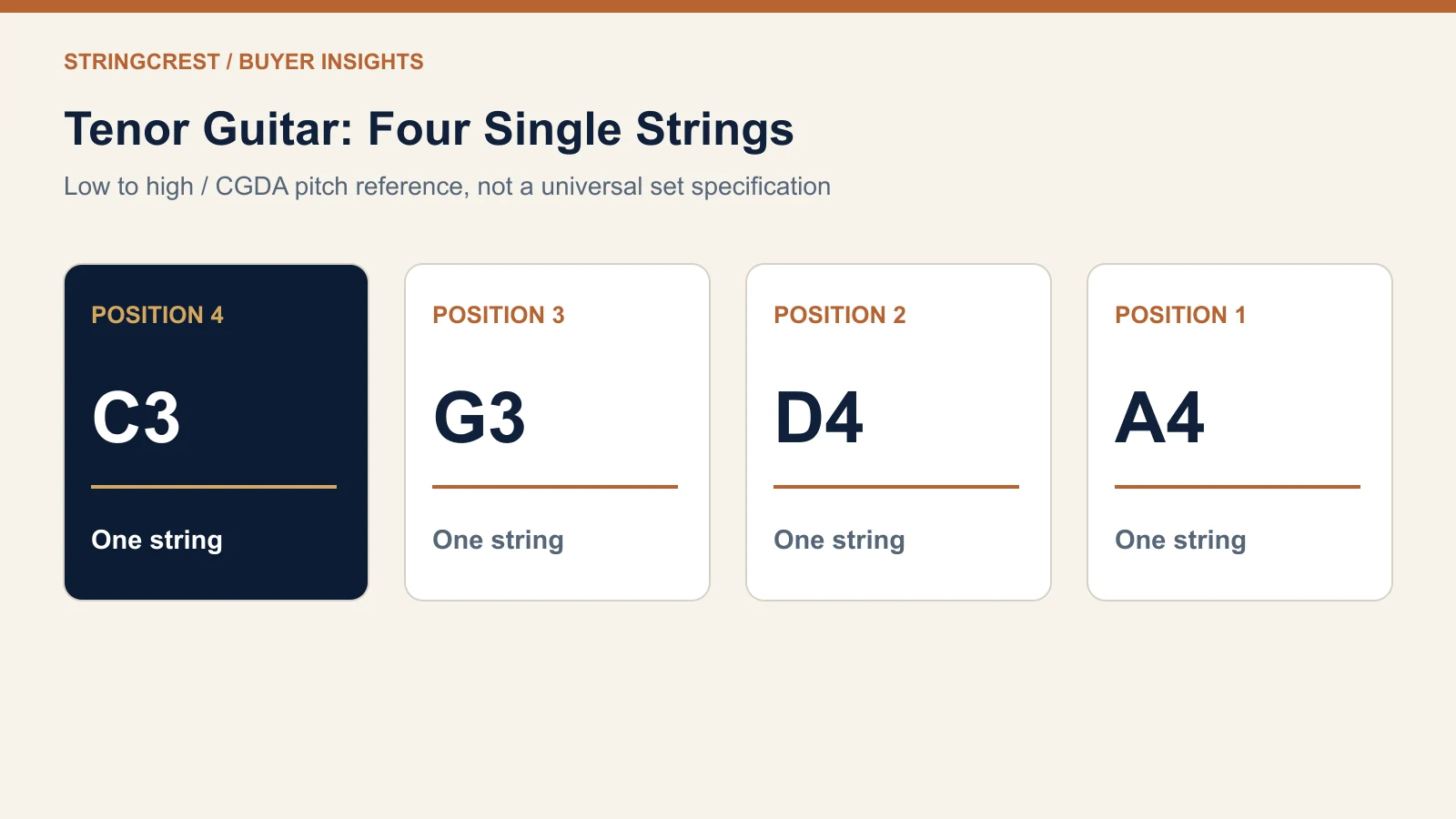
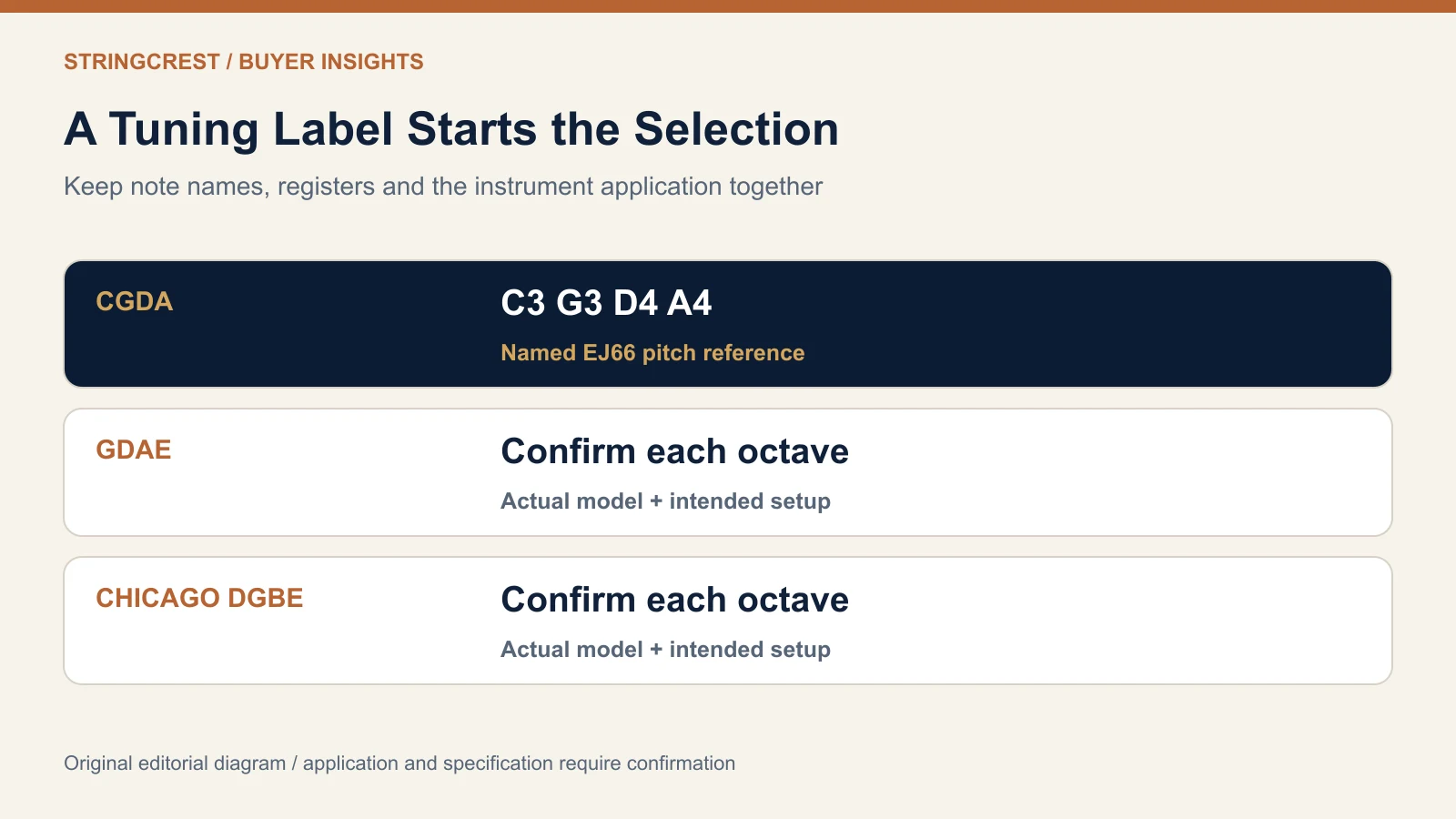
| CGDA | C3–G3–D4–A4 in the EJ66 reference below | Instrument/model, actual scale and an appropriate complete set reference |
| GDAE | G–D–A–E in fifths | The intended octave of every note, confirmed for the actual model and set |
| Chicago DGBE | D–G–B–E, using the highest four standard-guitar string roles | The intended octave map and a suitable tenor-guitar set for the actual instrument |
D’Addario's official EJ66 tenor-guitar set identifies four strings for steel-string tenor guitars. Its note chart runs A4, D4, G3 and C3 from high to low. That establishes the CGDA reference above; it does not make EJ66 a recommendation for every tenor guitar or for the other two tunings.
Eastwood's official tenor-guitar FAQ distinguishes GDAE, CGDA and Chicago DGBE, describing Chicago as the highest four strings of standard guitar. These labels help identify the player's intention. A letter-only listing still needs a confirmed register in the order record; do not silently assign an octave from a mandolin, ukulele or another instrument's chart.
The practical question is: “Which four open-string pitches do you want on this model?” Record the answer beside its source. Identify the actual maker setup sheet and its revision beside the requested GDAE tuning, rather than relying on an unqualified “Irish” or “mandolin tuning” label. If the sheet lacks octave numbers, ask the maker or string supplier to resolve them before using it as a replacement specification.
Separate a tuning label from a complete string specification
A packet's lowest and highest gauges cannot identify its two middle strings. Nor does a shared tuning label establish the same plain/wound allocation, materials or usable length across different sets.
For example, EJ66 identifies its two higher positions as plain steel and its two lower positions as bronze wound. That is a component description for that named set, not a rule that every tenor-guitar tuning must use two plain and two wound strings. Preserve the position-by-position build of the actual proposed set, including any wound-versus-plain choice in a middle position.
Eastwood publishes separate acoustic tenor-guitar sets and electric tenor-guitar sets, with distinct CGDA, GDAE and Chicago options. This is a useful named example of why the instrument application and tuning belong together in a selection record. Its component choices are not StringCrest specifications or a substitute for the customer's maker guidance.
Ask for a complete set or component reference, not just “light tenor strings.” Keep the finished gauge and unit, plain/wound status, declared materials and treatment tied to each of the four positions. If sourcing replacement singles, preserve the component identity from the accepted set rather than treating the same pitch or diameter as a complete match.
Make the scale and attachment part of the selection
A model name and a scale measurement answer different questions. The model identifies the maker's intended configuration; the measurement documents the instrument actually being supplied or serviced. Record the unit and reference used for the nut-to-saddle speaking length, along with the maker's stated scale where available. Do not assume a single scale length for every tenor guitar.
The string also has to reach its attachment and tuner along the installed path. That route extends beyond the speaking portion. Keep the supplier's overall or usable-length specification separate, with its endpoints defined. For wound strings, record the relevant winding or other construction-transition locations and how they relate to the actual contacts.
Document the end requirement from the actual hardware and maker instructions. A tailpiece attachment and a bridge attachment should not be treated as the same interface merely because both instruments are called guitars. A recognizable ball or loop alone does not establish seating, clearance or usable length. The guitar end and bridge fit guide provides a broader vocabulary for that discussion; the tenor instrument's own instructions govern its installation.
This is a selection check, not a conversion procedure. If the proposed change requires nut, saddle, bridge or tailpiece work, have the instrument maker or an appropriate technician assess it. Do not force an end into place, alter hardware to fit a packet, or tune an unidentified string to the target note as a way of finding out whether it is suitable.
Use one selection card for one instrument and tuning
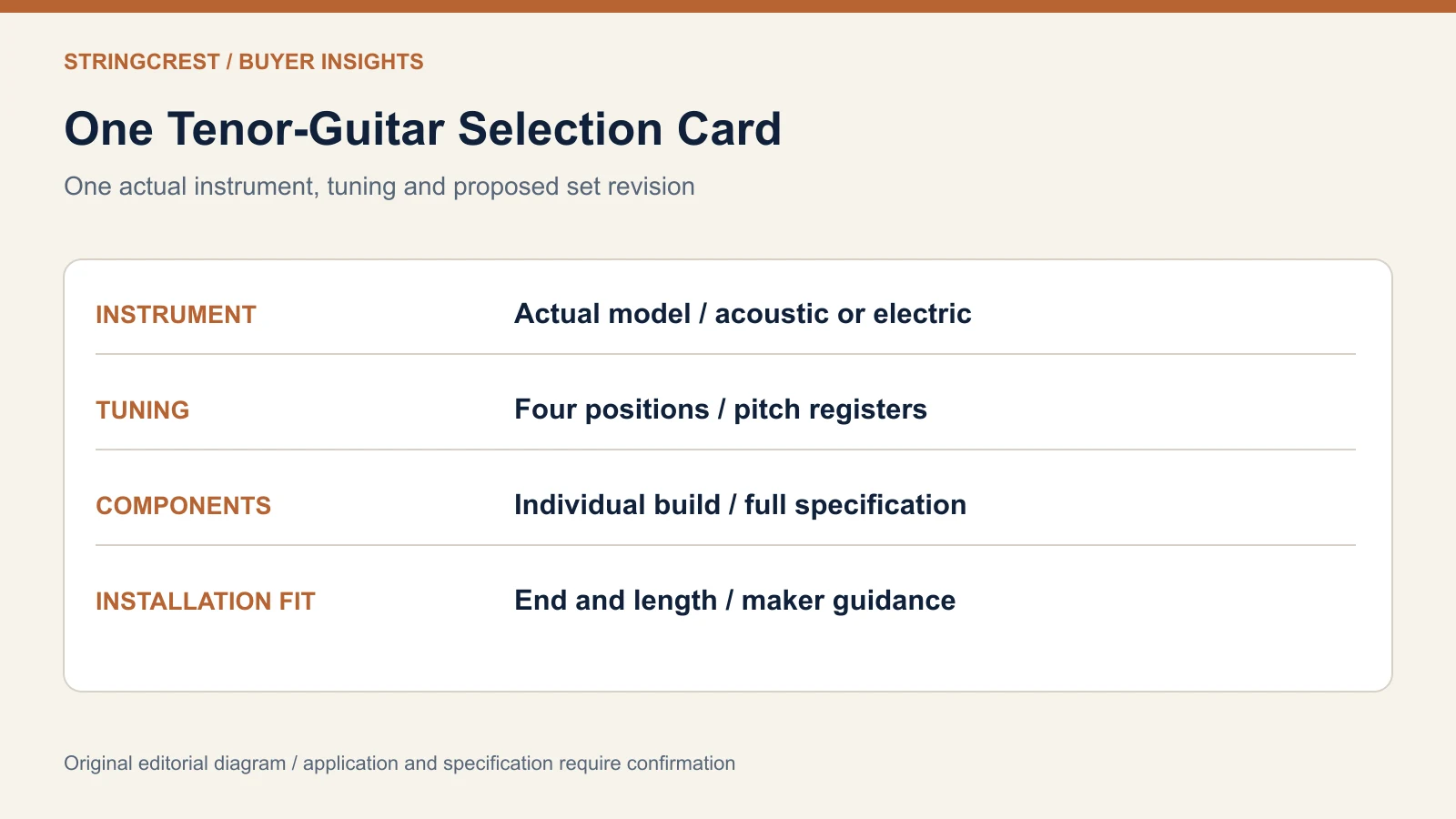
The following blank record is intended for a dealer conversation, not as a completed specification. Use one card for each proposed tuning and set revision. Blank means unconfirmed; enter “not applicable” only when that has been established.
| Instrument-level field | Entry |
|---|---|
| Maker/model; acoustic or electric; instrument ID | |
| Current tuning and current set/component reference | |
| Requested tuning, low to high, with four octave numbers | |
| Maker manual/setup reference and date or revision | |
| Stated scale; actual speaking-length record and unit | |
| Bridge/tailpiece/tuner identification and photo references | |
| Proposed set reference/revision; unresolved question and owner |
Then complete all four rows. Position numbers here identify pitch order, not the orientation of an installation photograph.
| Position | Intended pitch with octave | Component/spec reference | Finished gauge + unit; plain/wound and materials | End + usable-length/path reference |
|---|---|---|---|---|
| 1 — highest | ||||
| 2 | ||||
| 3 | ||||
| 4 — lowest |
For a documented CGDA setup matching the pitch reference earlier, rows 1–4 would read A4, D4, G3 and C3. Leave the other cells for the actual proposed components. An octave map does not fill in a gauge, material or fit result.
Before ordering, the dealer should be able to trace each row to a supplier or maker reference. An unresolved end, missing middle-string specification or unconfirmed octave belongs on the follow-up list. Do not convert it into an assumed match when transferring the request to a purchase order.
Keep the retail identity clear
Use a description that carries the instrument and tuning together: “tenor guitar — [confirmed tuning] — [set reference/revision].” State that the requested unit is one complete four-string set or a named replacement single. Availability and packing options remain matters to confirm with the supplier.
For mixed assortments, give the configurations distinct order lines. A CGDA acoustic set, a GDAE electric set and a Chicago proposal should remain distinguishable even if a supplier uses the same broad family name. When the goods arrive, compare the packet identity and its four-component contents reference with the accepted selection card. This is an identity check; it does not create a performance approval or establish fit on an undocumented instrument.
FAQ
Can I use four strings from a six-string guitar packet?
Only when the instrument or string maker recommends those specific components for the actual tenor guitar, scale and intended pitches. Chicago's relationship to the highest four standard-guitar positions explains the tuning pattern. It does not establish that any six-string packet supplies a suitable tenor-guitar combination.
Does “tenor guitar” always mean CGDA?
No. The official maker references above include CGDA, GDAE and Chicago DGBE configurations. Confirm what the player intends, including register, and select a set for that instrument and configuration. Do not assume a tuning change can use the strings already installed.
Conclusion
A useful tenor-guitar order identifies four independent strings, four confirmed octave pitches, the actual instrument and scale, and a complete component reference with checked end and length requirements. Keep CGDA, GDAE and Chicago requests separate until those details are resolved.
The folk and orchestral string category is an entry point for an instrument-specific discussion. It is not a listing of an approved tenor-guitar set; construction, fit and supply options still need confirmation for the proposed project.
FROM GUIDE TO PRODUCT
Connect this guide to StringCrest product ranges.
Review the relevant range, then bring the instrument, complete specification and open questions into one project brief.
YOUR PRODUCT · YOUR BRAND
Discuss your next string project with Frank.
Share your instrument category, target market, gauge or material direction and private-label packaging requirements.

ABOUT THE AUTHOR
Frank Zou
Frank works directly with musical-instrument brands, importers and distributors on string specifications, product selection and private-label project requirements.
Meet Frank