
Specifications & Fit
Product Selection
Mandolin Strings Wholesale: An 8-String Set Specification and Sample Guide
Specify paired courses, loop ends, gauges, materials, replacements, samples and package identity for an eight-string mandolin range.
Introduction
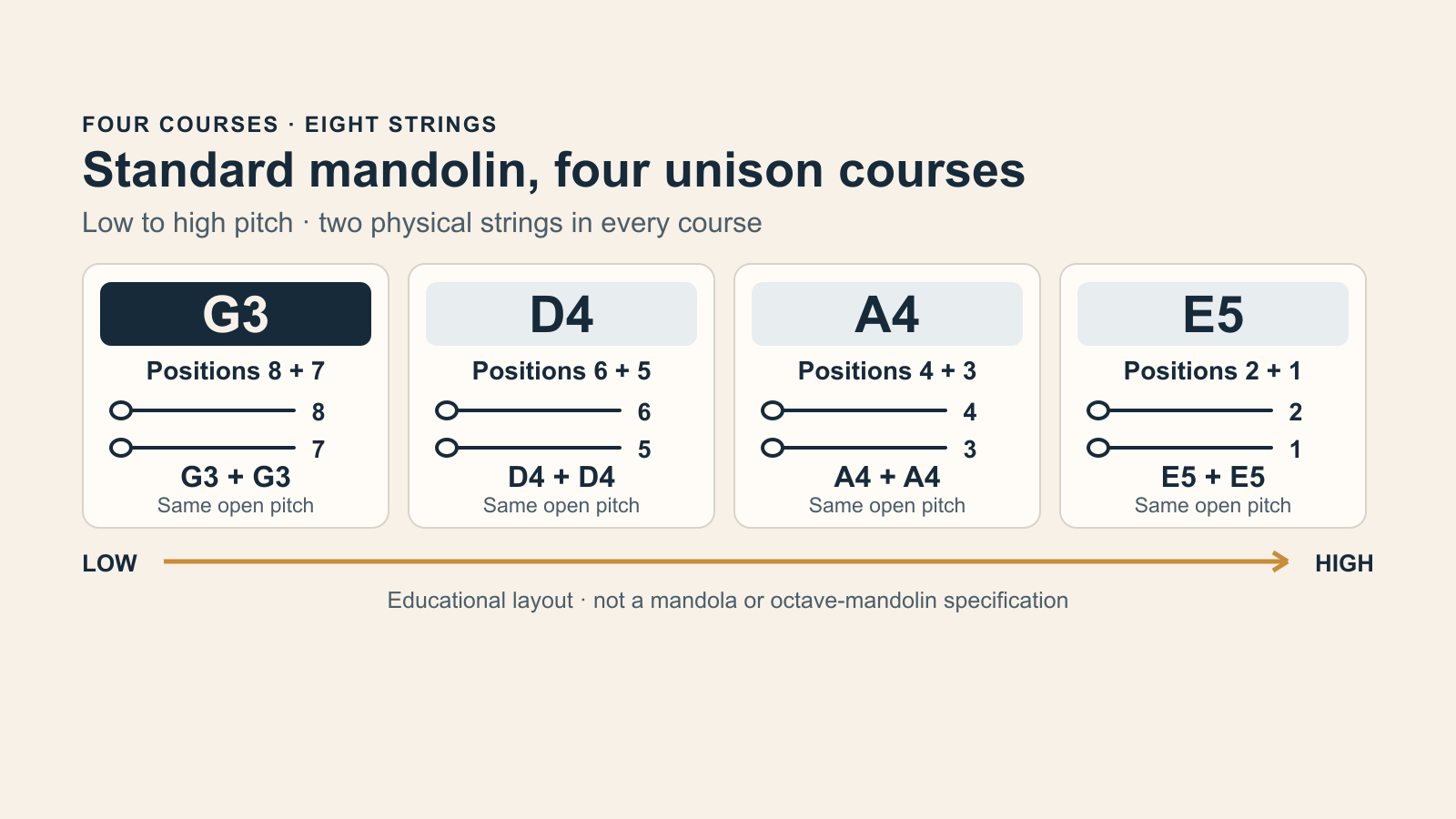
A standard eight-string mandolin set contains four two-string courses: G3, D4, A4 and E5 from low to high. Both strings in each course are tuned to the same pitch. A wholesale specification should identify all eight physical strings, then connect them to the complete set, any replacement pairs and any replacement singles. The course names alone do not define the gauges, construction, lengths or order units.
This guide covers standard mandolin tuning and a proposed loop-end steel-string specification. The table is not a tuning or fit specification for mandola or octave mandolin. Before requesting samples, confirm the instrument category, intended tuning and actual string path.
The paired layout is supported by S.I.T. Strings' official mandolin guide. For an octave-specific reference, D'Addario's EJ74 product chart lists E5, A4, D4 and G3 twice each. These sources establish the educational layout used here; they do not supply StringCrest product specifications.
Map four courses to eight physical strings
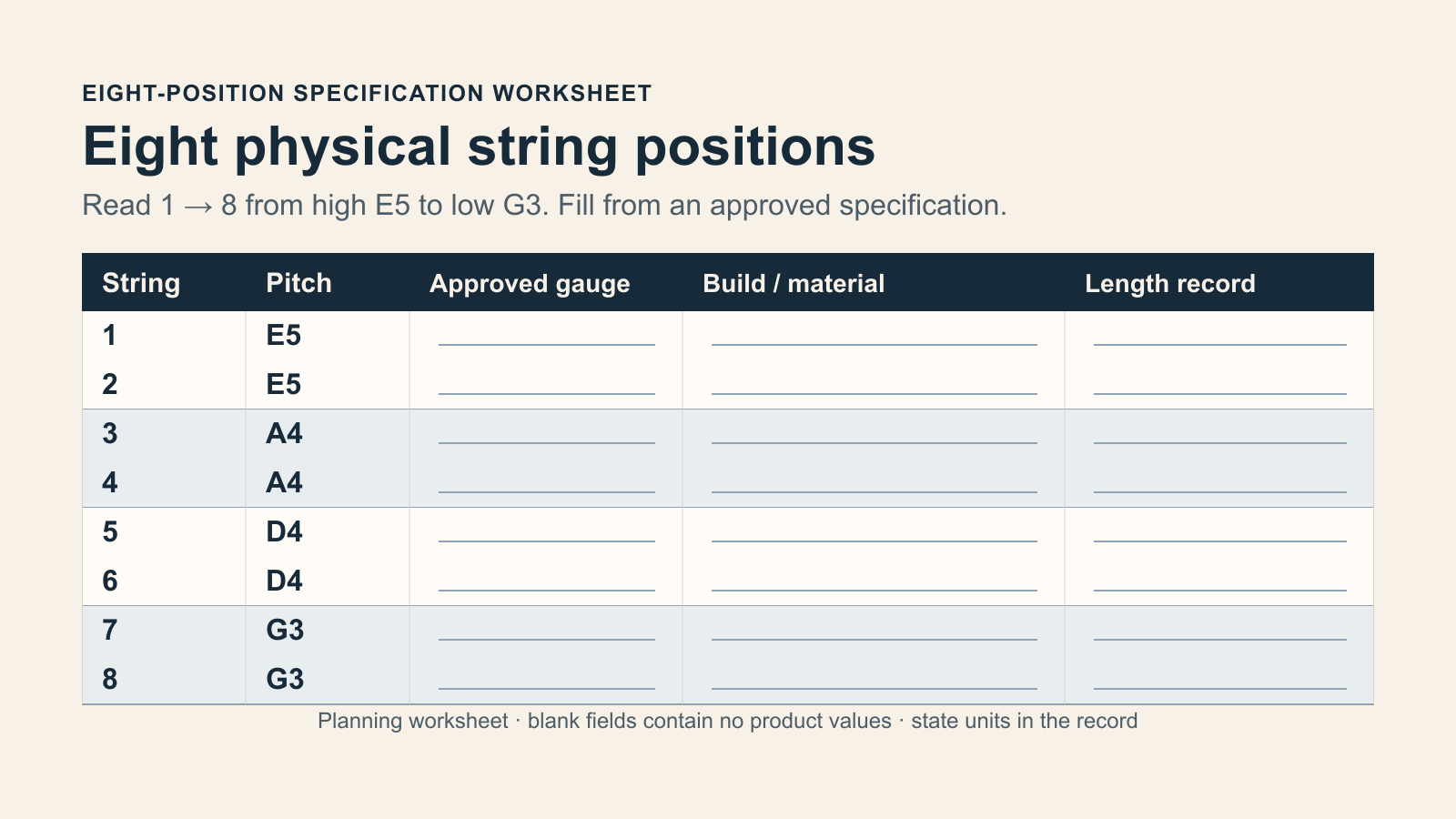
Numbering in this worksheet runs from the highest-pitched side to the lowest: string 1 is a high E5 and string 8 is a low G3. Strings 1–2 form the E course, 3–4 the A course, 5–6 the D course and 7–8 the G course. Each course therefore occupies two rows. Numbering the members separately allows labels, sample bags and installation notes to point to one physical position.
Use the worksheet below for a proposed set. The pitch column is an educational standard-tuning reference. The writable lines are blank product fields, not measured values or a catalog offer.
| Physical string | Course and paired positions | Open pitch | Finished gauge, in or mm | Plain/wound; wire or core; wrap | Length-record ID | Sample or component ID |
|---|---|---|---|---|---|---|
| 1 — highest-pitched side | E, pair 1–2 | E5 | ______ | ______; ______; ______ | ______ | ______ |
| 2 | E, pair 1–2 | E5 | ______ | ______; ______; ______ | ______ | ______ |
| 3 | A, pair 3–4 | A4 | ______ | ______; ______; ______ | ______ | ______ |
| 4 | A, pair 3–4 | A4 | ______ | ______; ______; ______ | ______ | ______ |
| 5 | D, pair 5–6 | D4 | ______ | ______; ______; ______ | ______ | ______ |
| 6 | D, pair 5–6 | D4 | ______ | ______; ______; ______ | ______ | ______ |
| 7 | G, pair 7–8 | G3 | ______ | ______; ______; ______ | ______ | ______ |
| 8 — lowest-pitched side | G, pair 7–8 | G3 | ______ | ______; ______; ______ | ______ | ______ |
For each length-record ID, attach a drawing or measurement sheet identifying the loop seating reference, overall string length, installed path to the relevant tuner and any winding start or end. Record the units. Keep the nut-to-bridge vibrating length separate from the full installation path: the string must also reach its attachment points and tuner.
Put the instrument ID, tuning, specification revision and loop-end drawing reference above the completed table. Confirm the physical-position labels against an instrument diagram before using them on packaging. A pack illustration viewed from another direction can reverse the apparent order, even when its pitch names are correct.
Do not populate missing gauges from a set's two endpoint numbers. A designation such as “11–40” does not describe the whole proposed eight-position specification. If a supplier presents four course gauges, ask which two physical strings each value covers and confirm the corresponding construction and length records.
Specify construction within each course
For a standard unison pair, ask for matching specifications for its two members unless a deliberate alternative is part of the project. Compare finished gauge, plain or wound construction, wire or core material, wrap material, treatment, length and end format. Sharing a target pitch does not make two strings interchangeable.
Material names on a set can describe its wound strings rather than every string in the package. A useful manufacturer-specific example is S.I.T.'s M1036PB and M1140PB: its official guide identifies plain steel A and E courses and phosphor-bronze-wound D and G courses over a steel hexagonal core. That assignment belongs to those S.I.T. products. Confirm each position in the proposed StringCrest specification rather than copying the assignment or gauges as product data. S.I.T. construction reference.
Keep the following fields distinct when completing the worksheet:
- Finished gauge: the outside diameter of the completed string, with the unit stated. It is not the core diameter of a wound string.
- Plain wire or core: identify the wire material for a plain string; for a wound string, identify the core material and shape where confirmed.
- Wrap: record the wrap material and winding construction for a wound string. For a confirmed plain string, write “none” for wrap. An unanswered field is still unknown.
- Treatment: record any coating, plating or other treatment separately from plain/wound construction. A treatment name does not complete the construction record.
- Lengths and end: reference the actual loop drawing and length sheet rather than treating “loop end” as a complete dimension.
The proposal should explain any mismatch within a course. If a sample marked for positions 5 and 6 arrives with different gauges or different wrap descriptions, resolve the difference before treating it as the intended D pair. An undocumented substitution should not enter the set simply because both strings can be tuned to D4.
Check loop seating on the intended tailpiece
Eight correctly identified strings can still fail the intended hardware fit. On the sample instrument, check how each loop seats on its attachment point, whether the string clears the tailpiece cover, and whether the path to the bridge, nut and tuner is suitable for the proposed construction. Record the tailpiece model or clear photographs and any relevant measurements.
The word “loop” does not establish compatibility with every tailpiece. Use the proposed end drawing and an installed sample to assess the actual geometry. The mandolin loop-end and tailpiece-fit guide covers that separate decision in more detail. Keep its fit record attached to the eight-position sheet.
Define the unit behind every set, pair and single
A complete set, one course pair and one physical string are different quantities. Write the order unit before assigning item codes or comparing prices. “E string” can mean one physical E5 string or the two strings needed for the E course; “one pack” also needs a contents count.
This mapping is an empty planning tool. The counts describe the proposed units; they do not announce available StringCrest SKUs, packaging formats or replacement supply.
| Planned stock unit | Physical positions covered | Strings in one defined unit | Confirmed supplier SKU and spec revision | Supplier pack contents / order-unit mapping |
|---|---|---|---|---|
| Complete standard mandolin set | 1–8 | 8 | ______ | ______ |
| E-course replacement pair | 1–2 | 2 | ______ | ______ |
| A-course replacement pair | 3–4 | 2 | ______ | ______ |
| D-course replacement pair | 5–6 | 2 | ______ | ______ |
| G-course replacement pair | 7–8 | 2 | ______ | ______ |
| E5 replacement single | One of 1 or 2 | 1 | ______ | ______ |
| A4 replacement single | One of 3 or 4 | 1 | ______ | ______ |
| D4 replacement single | One of 5 or 6 | 1 | ______ | ______ |
| G3 replacement single | One of 7 or 8 | 1 | ______ | ______ |
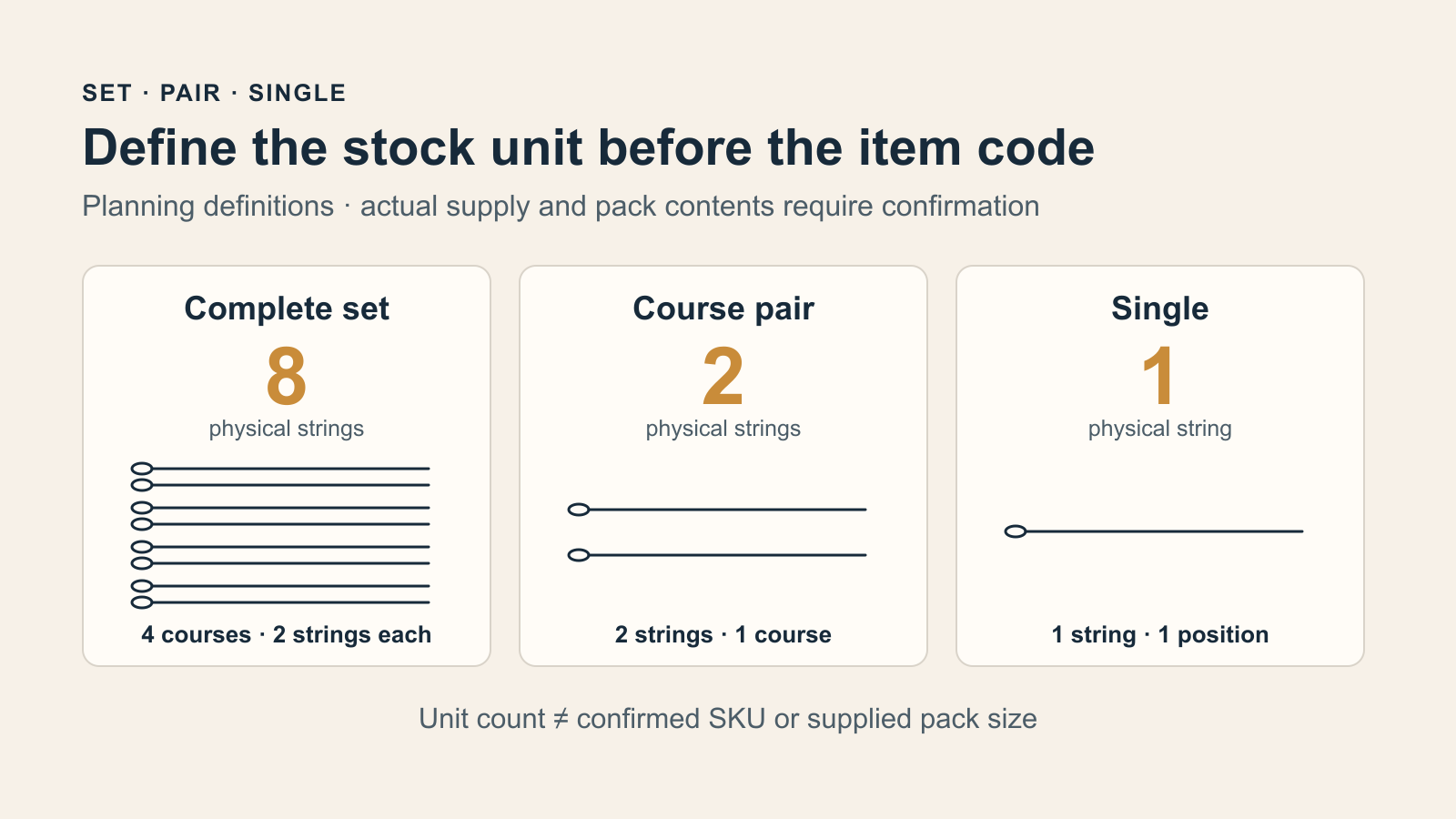
A common single code may cover both members of a course only after their specifications are confirmed to be identical. Otherwise identify them separately. Each replacement code should point back to the set revision it is approved to match, including gauge, construction, length, treatment and loop format.
For a retailer or repair counter, decide whether the customer need is a complete change, a matching course pair or replacement of one damaged string. This defines what to ask the supplier about. It does not prove which unit will sell most or justify a fixed stocking ratio.
If pairs are required, specify two matching strings per pair and verify the proposed inner-pack count. If singles are required, specify one physical string per unit and its compatible course. Confirm whether those units are supplied independently, packed together or require another arrangement before creating inventory records. Record quoted quantities, pack multiples and minimum order terms for the actual proposal.
Opening a complete set for replacements changes its stock status. Remove it from complete-set availability and count the remaining components under confirmed identities. Do not leave a partially opened set available as an eight-string set. Whether to split sets commercially depends on the retailer's process, supplier terms and packaging requirements.
Send StringCrest your eight-position sheet and proposed set, pair or single requirements. Include the instrument, standard tuning or declared alternative, tailpiece reference and desired order-unit definitions so the proposal can be checked against the same scope.
Evaluate the sample as four pairs
The initial count should show eight physical strings and two members for every course. Match the sample labels to the worksheet before installation. A missing string or an unidentifiable label leaves the full set or affected pair incomplete; resolve it before approving that sample unit. A four-envelope pack could contain two strings per envelope, but envelope count alone does not verify its contents.
Focus the trial on the mandolin-specific questions:
- Does each pair match its proposed specification? Check identification and the agreed measurable fields for both members. Record which physical string any observation concerns.
- Does each string fit the declared path? Check loop seating, bridge and nut contact, tuner reach and the wound or plain sections at relevant contact points.
- Can both members be evaluated at their declared unison pitch? Record the tuning reference and instrument condition. When comparing two variants, use the same documented setup and tasks where practical.
- What changes when the pair is played together? Record fit, feel and audible observations for the course, with individual-string observations where needed. Distinguish evaluator preference from a measured or visible difference.
- Can a replacement be identified without opening another set? Compare its code and specification with the approved course record; inspect the proposed labels and contents count.
When testing a changed course specification, evaluate both members as the intended pair. Comparing one new string against an old partner introduces another condition, so record that explicitly if it is part of a replacement trial. A short sample evaluation does not establish lifetime, breakage rate or universal compatibility.
Retain the accepted specification and a clearly identified reference sample where practical. The broader string-sample evaluation and approval guide provides an existing documentation workflow. Its guitar examples need the four-course mandolin checks above; they are not mandolin test results.
FAQ
Does an eight-string mandolin set contain four octave pairs?
In standard G3–D4–A4–E5 mandolin tuning, each course contains two strings at the same pitch, not an octave apart. The eight positions still need individual identification. A mandola or octave mandolin requires its own tuning and fit specification.
Can a four-course gauge list define the entire set?
It can summarize the gauges if it explicitly assigns each value to two identical course members. It does not replace the eight-position construction, end and length records, or confirm what is inside each envelope.
Can one replacement single fit either member of its course?
Only when the two members' specifications are confirmed identical and the replacement is approved for that set revision. The matching pitch alone does not establish the gauge, construction, length or loop geometry.
Conclusion: prepare an eight-position quotation brief
Send the completed eight rows, the intended instrument and tuning, a tailpiece reference, and the length or installation drawings. Add the proposed stock-unit mapping: full sets only, pairs, singles or a combination. For each requested unit, state the physical-string count, packaging idea and quantity basis, with unresolved specifications clearly identified in the inquiry.
The folk and orchestral strings category is the relevant starting point for this instrument family. Category placement does not establish a particular mandolin SKU, gauge sequence or replacement policy. Confirm those details in the project proposal and samples.
Send Your Mandolin String Requirements with the eight-position specification and set-to-replacement mapping to discuss the proposed range.
FROM GUIDE TO PRODUCT
Connect this guide to Folk & Orchestral Strings.
Review the relevant range, then bring the instrument, complete specification and open questions into one project brief.
YOUR PRODUCT · YOUR BRAND
Discuss your next string project with Frank.
Share your instrument category, target market, gauge or material direction and private-label packaging requirements.

ABOUT THE AUTHOR
Frank Zou
Frank works directly with musical-instrument brands, importers and distributors on string specifications, product selection and private-label project requirements.
Meet Frank