
Specifications & Fit
Folk & Orchestral
Mandolin Loop-End Strings: A Wholesale Tailpiece-Fit and Sample Guide
A B2B guide to eight-string, four-course loop-end mandolin specifications, installed tailpiece fit, sample approval and accurate pack-out.
Introduction
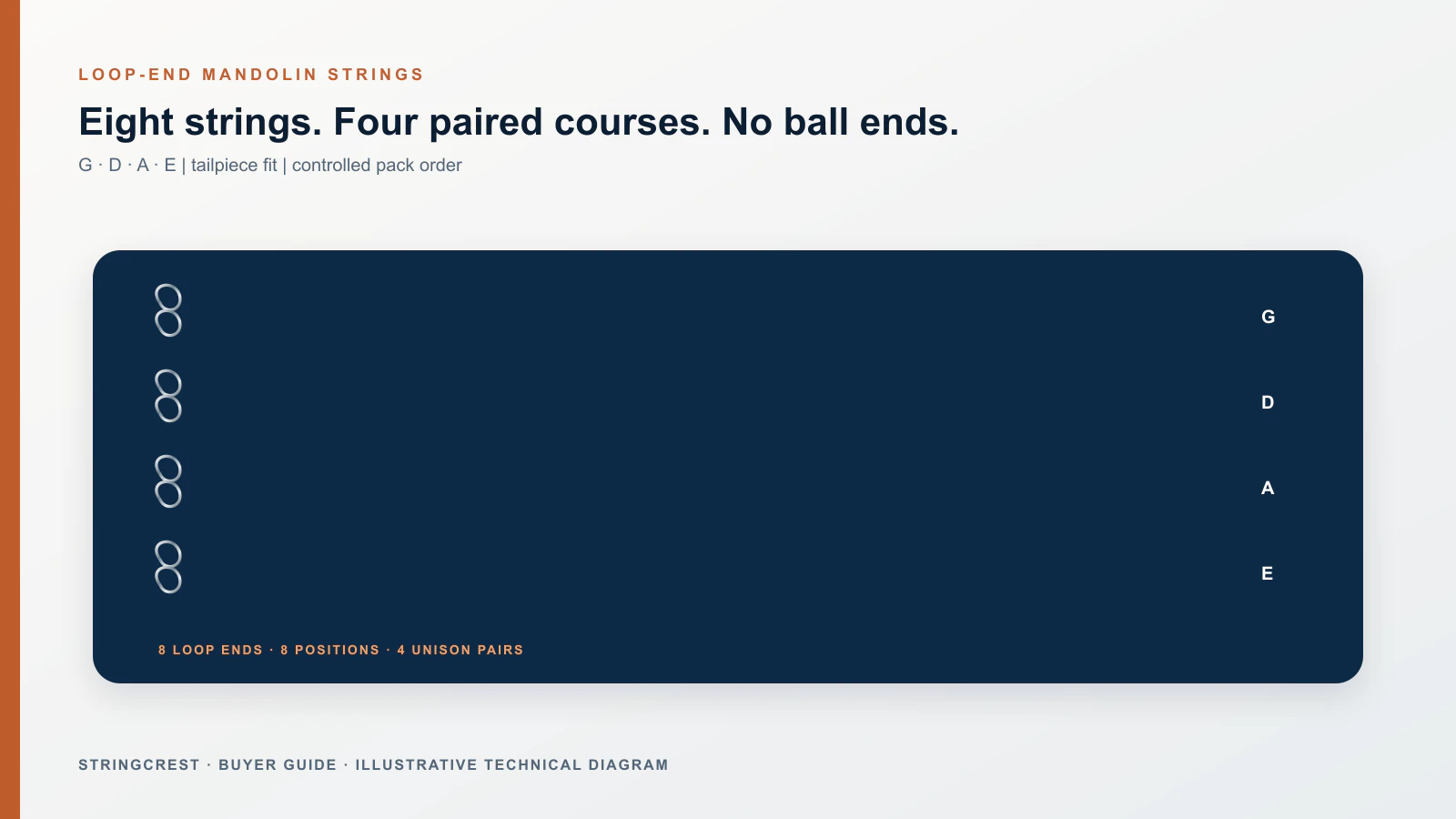
Most conventional mandolin strings are supplied as eight individual strings arranged in four paired courses. A wholesale specification must preserve that eight-string architecture and identify the end construction that connects each string to the mandolin tailpiece. For common loop-end designs, the string terminates in a small formed loop that hooks onto the appropriate tailpiece post. It does not use a guitar-style ball end.
That distinction is important in product development and imagery. A generated picture with ball ends, six strings or guitar tuning hardware can make an otherwise useful mandolin article technically misleading. Buyers also need more than a correct picture: the gauge sequence, pitch relationships, winding, loop geometry, usable length and package order must all agree with the approved sample.
This guide explains how brands, distributors and product managers can brief a loop-end mandolin set, compare materials and gauges, verify tailpiece and tuner fit, approve installed samples and control pack-out. It focuses on conventional eight-string, four-course mandolin applications. It does not claim that every mandolin uses the same hardware, and it does not publish StringCrest MOQ, lead time, capacity, proprietary gauges or universal compatibility. Those items require a project-specific quotation and sample review.
Define the instrument and four-course architecture
Write all eight positions into the brief
A conventional mandolin set contains two strings in each of four courses. Common tuning is G–D–A–E in fifths, with the two strings in each course tuned in unison, but the buyer should still record the exact pitch for all eight positions. Do not assume that the packer, artwork designer and end customer will interpret four gauge numbers in the same order.
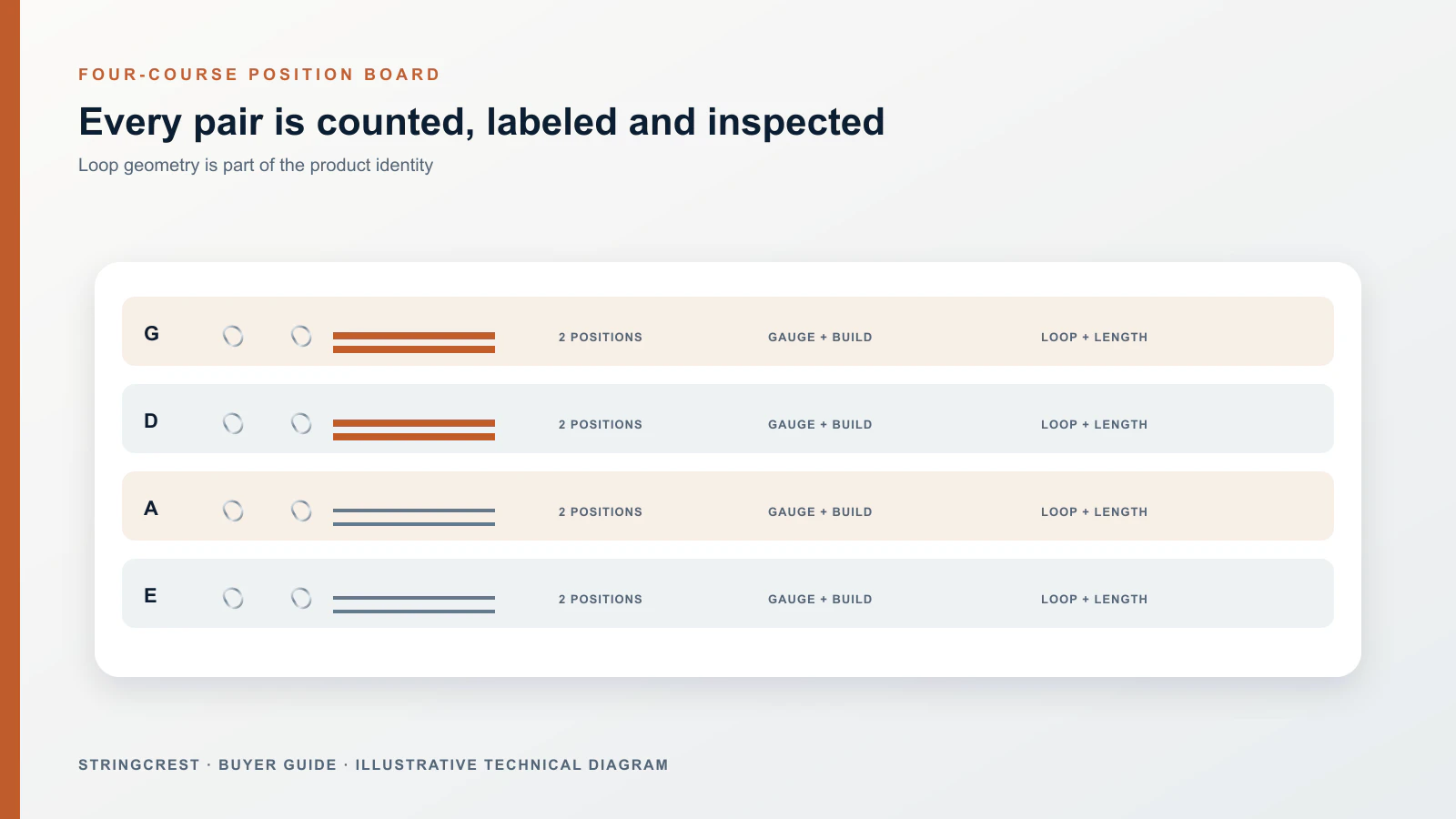
Build an eight-row position master. Give each string a course, partner number, target pitch, gauge, plain or wound status, material, loop construction and usable length. If two partners are intentionally identical, both rows should still appear. This allows receiving inspection to detect a missing or substituted component.
Record the mandolin family and reference instrument
State the intended mandolin type and measured scale. Note the tailpiece design, bridge, nut, tuner arrangement and setup state of the reference instrument. Mandolin-family instruments and alternative designs can vary, so a broad “fits all mandolins” claim is inappropriate without evidence.
Photograph the installed baseline at the tailpiece, bridge, nut and tuners. The tailpiece photograph should clearly show the loop attached to the post without a ball end. A neutral technical diagram is safer than a photorealistic instrument image when the exact hardware cannot be represented accurately.
| Specification field | What to record | Why it matters |
|---|---|---|
| Course | G, D, A or E | Preserves four-course order |
| Partner | 1 and 2 within each course | Confirms eight total strings |
| Pitch | Exact intended note | Prevents octave or course confusion |
| Gauge | Each of eight positions | Exposes missing or substituted strings |
| Construction | Plain or wound, core and wrap | Distinguishes strings beyond diameter |
| End | Loop dimensions and formation | Controls tailpiece attachment |
| Length | Loop to tuner path | Confirms usable installed reach |
Specify loop ends instead of assuming them
A loop end is a controlled component
The loop must attach securely to the intended tailpiece post and remain correctly formed during normal installation. Record loop inside dimension, overall formed area, twist or wrap direction, transition into the string and any protective or finishing requirement that has been verified for the project.
Avoid describing a loop merely as “standard.” Tailpiece hooks can differ in spacing, post shape and access. The approved sample should show that the loop can be installed without opening, slipping, interfering with its partner or forcing an unsuitable bend into the string.
Do not substitute ball-end imagery
Ball ends are familiar on many guitar and bass strings, which makes them a common error in generic visual generation. They should not appear in imagery for a conventional loop-end mandolin product. The image plan should explicitly require exactly eight strings, four paired courses and visible loop ends, with no guitar bridge, guitar headstock or unsupported tailpiece design.
The same control applies to product copy. “Loop end” belongs in the technical master, inner labeling and product description when that is the approved construction. If a future project uses another end type, it needs its own item code and sample evidence.
Map gauges and winding by course
Compare complete published sequences
Official D’Addario pages for EJ73, EJ75, EJ62 and EJ67 show real mandolin set examples using different published gauges and materials. They are useful for understanding how a complete eight-string set is presented. They are not StringCrest formulas and should not be copied as proof of an equivalent product.
When benchmarking, enter each example into the same eight-row worksheet. Show two G strings, two D strings, two A strings and two E strings. Record whether each position is plain or wound and note the declared material. This makes differences visible that a four-number shorthand may hide.
Treat paired identity as a quality requirement
Partners within one course are usually intended to match in gauge and construction for a conventional unison pair. The product master should say so explicitly. Pack-out inspection can then verify that both members of the course are present and correctly labeled.
Do not assume visual similarity proves identity. Two fine plain strings can be hard to distinguish without position labels, and two wound strings can look alike while using different gauges. Use envelopes, tags or an ordered packing method that keeps each pair controlled.
Select material direction without borrowed claims
Separate material from gauge and construction
Published mandolin sets can use phosphor-bronze, 80/20-bronze, nickel or other declared winding directions. Each material choice should be evaluated in the context of the final core, gauge sequence, instrument and playing task. A competitor’s description of its product does not establish the same tonal or durability result for another construction.
If the development question is material, keep gauges and other variables as consistent as practical between samples. Ask evaluators to compare identifiable tasks such as tremolo clarity, chord articulation, pick response and balance across courses. Record observations as sample-specific findings rather than universal claims.
Keep service-life language evidence-based
Corrosion, play time, hand chemistry, wiping habits, storage and environment all influence string condition. Avoid promising a fixed life or superiority multiplier unless the final product has suitable evidence under stated conditions. It is safer to identify the material and care guidance accurately.
If a coating or treatment is proposed, add it to every affected position in the product master and repeat the installed evaluation. A treatment is not merely an artwork claim; it is part of the approved construction.
Review scale, usable length and winding placement
Measure from the loop seating point
Define the length reference from the point where the loop bears on the tailpiece hook. Record distance to the bridge, nut and tuner posts. The string needs sufficient usable length for the intended route, while the wound section and any transition must sit appropriately at the bridge, nut and tuner.
Because the bridge on many mandolins is movable, document its installed location and scale measurement before comparing samples. A bridge that shifts during string change can alter intonation and make the sample evaluation unreliable.
Check wound strings at nut and tuner
Heavier wound courses should sit correctly in their nut slots and reach the tuner without an unintended bare-core or transition section entering the speaking length. At the tuner, record wraps and any sharp bends. Do not force a gauge through hardware that is unsuitable for it merely to complete a sample.
If a gauge change requires setup work, record the intervention. Packaging and dealer guidance should not promise that every mandolin can move to a materially different set without adjustment.
Use tension as a directional tool
Pitch, scale and unit weight work together
Tension calculations require the vibrating length, frequency and unit weight of the specific string construction. Gauge contributes to unit weight, but it cannot replace verified construction data. Two strings with the same finished diameter may have different core and wrap relationships.
Use a consistent scale and pitch for all positions. Inspect both members of each course and the progression from G through E. If the precise unit weight is unavailable, label the result as an estimate and rely on the installed sample for approval.
Evaluate the pair under real playing tasks
Paired strings are played together, so the course should be evaluated as a unit. Listen and feel for whether both partners speak consistently in tremolo, chord and single-note passages. Check whether one partner drifts, rattles or sits differently at the bridge or nut.
The purpose is a documented comparison on the reference mandolin. Do not convert one evaluator’s preference into a universal claim such as “perfect tension” or “best tone.”
Design a controlled sample ladder
Change one primary variable at a time
Begin with a complete, documented baseline set. A second sample might change the winding material while preserving gauges and fit. Another might adjust one course’s gauge. If every gauge, material and loop detail changes together, the team cannot identify the cause of a fit or playing difference.
Give each sample a unique revision code. Put the same code on the eight-position worksheet, inner separators, outer sample pack and photographs. Preserve the exact tailpiece and tuner images from installation.
Install all eight strings and record the process
Protect the instrument finish and keep tension changes gradual during installation. Attach each loop to the correct tailpiece post, route it over the bridge and nut, and wind it on the corresponding tuner. Confirm that the bridge remains correctly positioned and that pairs are not crossed.
Record loop seating, tailpiece clearance, bridge and nut contact, tuner wraps, tuning stability after normal settling, course balance, tremolo response and intonation. A sample should not be approved from loose-string appearance alone.
Make packaging preserve four-course order
Label every pair and every position
The outer pack should identify mandolin, eight-string/four-course architecture, complete gauge sequence, declared material and loop-end construction. Inner packaging should keep G, D, A and E pairs clear. If both strings in a pair are identical, state the quantity rather than relying on the packer to infer it.
A course table can show two positions on each row. Use text in addition to color coding. Avoid artwork that depicts six strings, ball ends or unrelated guitar hardware.
Link artwork to the approved component list
The product master should connect the eight strings, pack artwork, barcode, item code and case-pack information. A pack revision that changes a gauge table needs technical review, while a string revision may also require artwork updates. Do not let those records move independently.
Claims about material, treatment or fit must match the approved sample and documents. Generic phrases such as “professional quality” offer little selection value; course, gauge, material and end information help buyers make a real decision.
Plan sets, singles and dealer support
Decide how replacements will work
Mandolin players may need replacement singles or pairs. A wholesale program should decide whether it supports only complete sets, course pairs or individual positions. This affects SKU design, inventory and dealer guidance.
Shared components should be linked only when gauge, construction, material, loop and length are the same. An E string that looks similar to another product is not automatically an approved substitute.
Give dealers a fit checklist
Dealer material can ask the customer to confirm instrument type, scale, loop-end tailpiece, desired gauges and setup condition. It can also explain that bridge position and intonation may need attention during string changes. This is more useful than claiming that one set fits all mandolins.
Provide the course order and installation diagram in a format that can be viewed on mobile as well as printed. The customer should be able to identify the next string without opening every envelope.
Inspect incoming shipments by course
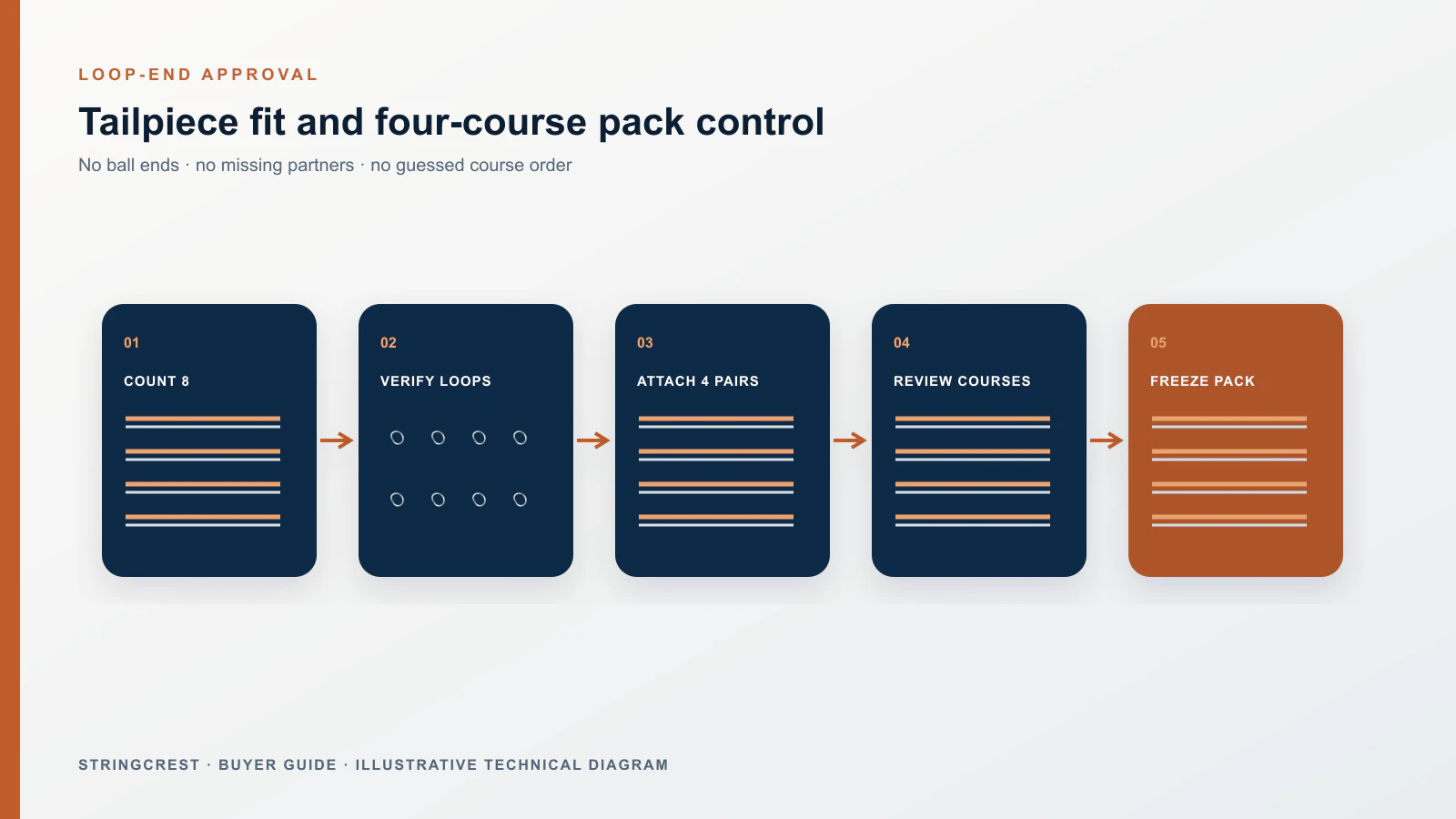
Count eight strings and verify four pairs
Receiving inspection should confirm item and lot codes, package condition, eight total strings, two positions per course, complete gauge sequence, loop-end presence and selected dimensions defined in the inspection plan. A simple eight-piece count will not detect two duplicated E strings and a missing G pair.
Open sampled packs in a controlled sequence and keep the components identified. Check that loop formation is consistent with the approved reference and that labels match the contents. If installed fit is part of receiving inspection, use the specified reference instrument and record the result.
Match evidence to the claim
Pack photos can show condition, count, labels and visible loop construction. They cannot prove alloy chemistry, internal core design, exact tension or durability. Use relevant documents or testing for claims that require them.
Receiving inspection is a conformance check, not a new development stage. Any material deviation should follow the agreed nonconformance and change-control process.
Prepare a complete mandolin-string RFQ
Include:
- conventional eight-string/four-course architecture or another clearly defined instrument;
- exact pitch and partner identity for every position;
- all eight gauges with units and plain/wound status;
- scale, loop-seat-to-bridge and loop-seat-to-tuner measurements;
- tailpiece photographs and required loop geometry;
- core, wrap, material, coating and length direction;
- baseline set, sample ladder and installed evaluation tasks;
- pack order, pair labels, artwork, barcode, traceability and case pack;
- complete-set, course-pair or single replacement plan;
- request for current sample terms, MOQ, lead time and quotation validity.
Mark unknown items as supplier proposals. They become requirements only after the buyer reviews the documentation and approves the correct physical sample.
FAQ
How many strings are in a conventional mandolin set?
Eight strings arranged as four paired courses. The specification and pack-out record should list all eight positions even when partners share the same gauge.
Do conventional loop-end mandolin strings use ball ends?
No. A loop-end string terminates in a formed loop that attaches to a suitable tailpiece post. Do not depict guitar-style balls in loop-end product imagery.
Can I order a mandolin set by four gauge numbers only?
Four numbers can summarize paired courses, but the production master should contain eight rows with pitch, partner, construction, end and length details.
Does one loop size fit every mandolin tailpiece?
Do not assume universal fit. Provide the reference tailpiece and approve the loop on the intended hardware.
Can published competitor gauges be copied directly?
They can inform market benchmarking, but they do not prove equivalent construction or performance. Develop and approve the actual proposed strings.
How should pairs be checked during receiving inspection?
Use a four-course checklist showing two identified strings per course. Verify labels, gauges or agreed dimensions, loop ends and total count against the approved master.
Conclusion
A credible mandolin-string product begins with the correct physical architecture: eight strings, four paired courses and the approved loop-end connection. From there, each position needs a gauge, construction, material and usable length tied to a reference instrument.
Installed samples are essential because tailpiece, bridge, nut and tuner fit cannot be confirmed by a loose coil or a generic image. Clear pair labeling and course-based inspection then preserve the approved design through pack-out and reorder.
Explore StringCrest folk and orchestral strings · Send your loop-end mandolin set brief
Sources and interpretation limits
- D’Addario EJ73 phosphor-bronze light mandolin set
- D’Addario EJ75 phosphor-bronze medium/heavy mandolin set
- D’Addario EJ62 80/20-bronze mandolin set
- D’Addario EJ67 nickel mandolin set
These official pages document examples from one manufacturer, including published materials, gauges and loop-end construction. They do not confirm StringCrest specifications, equivalence, compatibility, availability, performance, MOQ, capacity or delivery time. The project specification, quotation and approved sample remain the controlling references.
FROM GUIDE TO PRODUCT
Connect this guide to Folk & Orchestral Strings.
Review the relevant range, then bring the instrument, complete specification and open questions into one project brief.
YOUR PRODUCT · YOUR BRAND
Discuss your next string project with Frank.
Share your instrument category, target market, gauge or material direction and private-label packaging requirements.

ABOUT THE AUTHOR
Frank Zou
Frank works directly with musical-instrument brands, importers and distributors on string specifications, product selection and private-label project requirements.
Meet Frank