
Wholesale Planning
Wholesale Planning
Violin String Ball End vs Loop End: A Tailpiece-Fit Guide for Wholesale Buyers
Specify violin E-string ball or loop ends by tailpiece and fine-tuner fit, sample identity, installation checks, packaging and receiving control.
Introduction
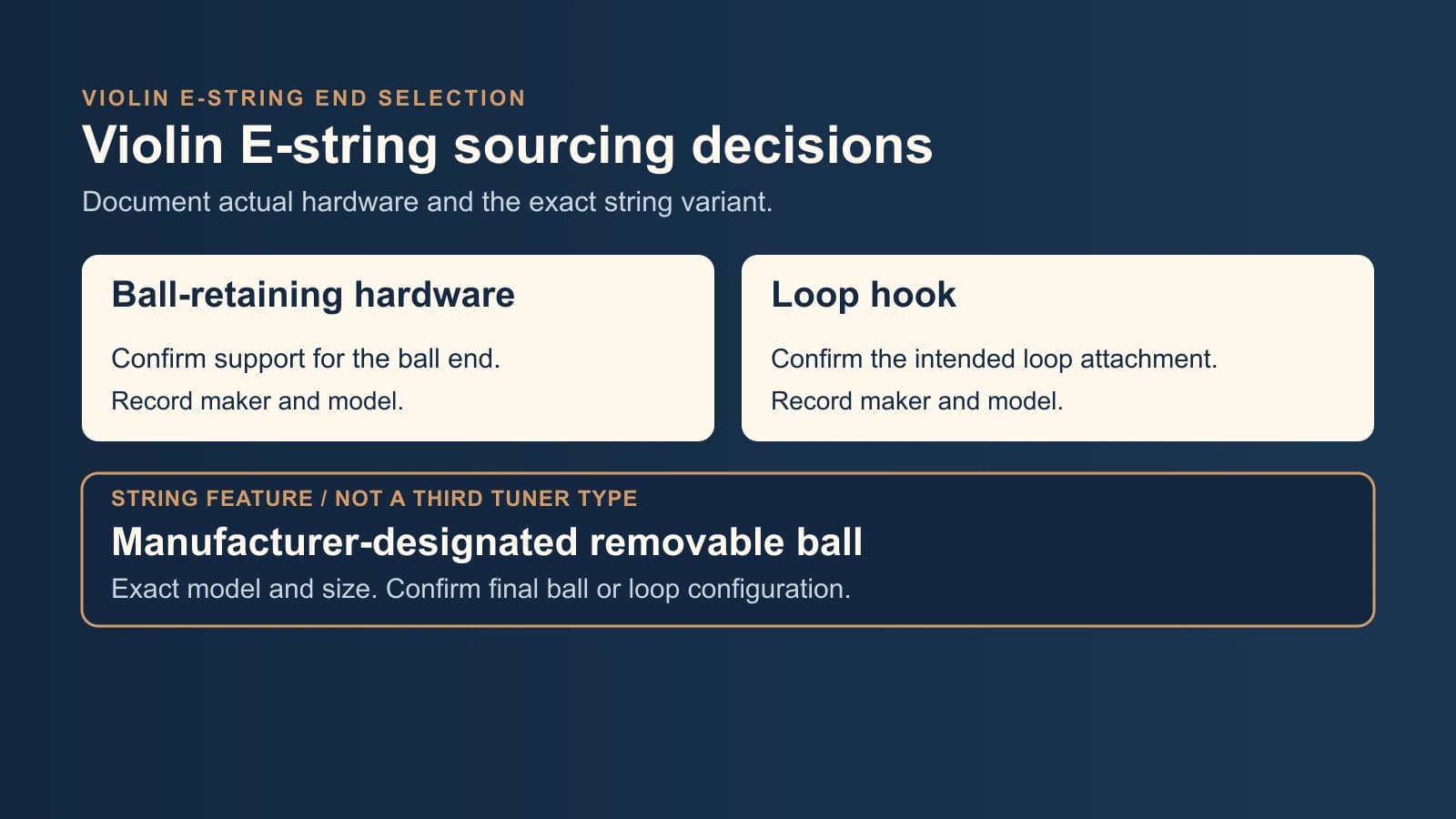
For the ball- and loop-end violin E-string variants discussed here, choose the tailpiece end to match the actual retaining hardware: a ball end needs a suitable ball-retaining seat, while a loop end needs the intended loop hook. A manufacturer-designated removable ball offers a further product choice, but only for the exact model that carries that designation.
For a wholesale range, record the E string separately from A, D and G. Identify the instrument size, tailpiece, any fine tuner and proposed string variant before treating a combination as compatible. A “4/4 violin” label alone does not identify the attachment. This guide helps buyers define that match and the evidence needed to confirm it; it does not provide a hardware modification or string-conversion procedure.
Match the retaining interface
For these E-string variants, start with what holds the string at the tailpiece end. An integrated tuner, a separate fine tuner and a direct tailpiece attachment must each be identified from the actual hardware and its instructions.
| Sourcing decision | What must be established | What to record |
|---|---|---|
| Ball end for a ball-retaining interface | The hardware is intended to support and retain the specified ball end. | Hardware maker/model, string variant and the relevant maker reference. |
| Loop end for a loop hook | The attachment is intended for that string loop, with suitable contact at the hook. | Hook/tuner model, loop-end SKU and any model-specific accessory requirement. |
| Manufacturer-designated removable ball | The exact string is expressly designated removable, and the intended final attachment is confirmed. | Named SKU, size, manufacturer designation and intended ball or loop configuration. |
The third row is a product feature to verify, not a universal third type of fine tuner.
Pirastro's manual makes the contact distinction explicit: the ball rests against suitable retaining hardware; a tuner must not be hooked through the ball's hole. For loop E strings, it identifies sharp contact at the fine tuner as a concern. A photograph showing that an end can be placed on a hook does not establish correct support. See the manufacturer's E-string guidance.
Pirastro also catalogs separate fine tuners for ball and loop ends. That distinction is useful when identifying hardware. It is not a reason to guess an opening size, change a hook or assume that two similar-looking tuners accept the same end.
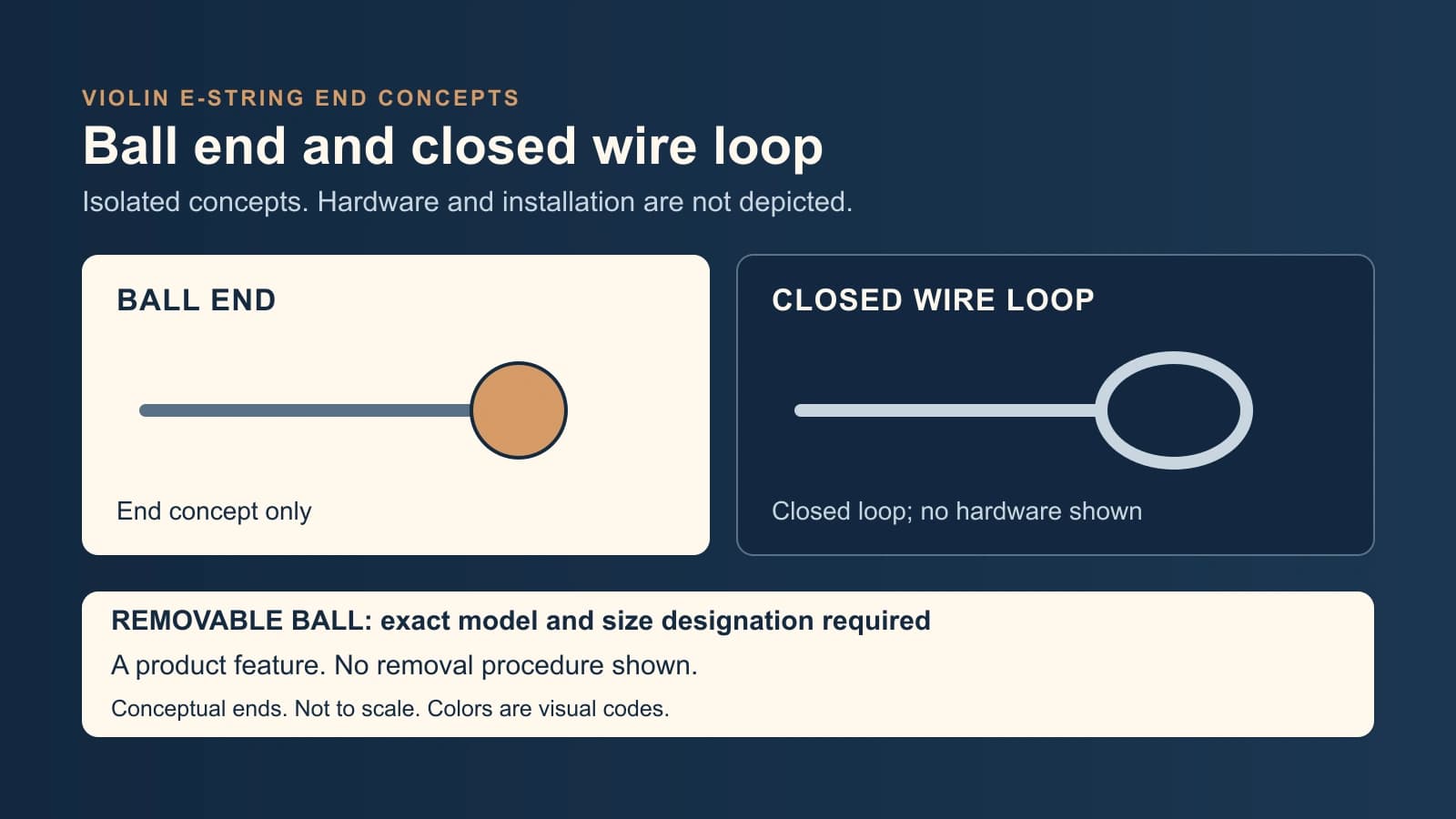
A removable ball is a named product feature
Do not turn “ball end” into an instruction to remove the ball. Look for an explicit designation for the proposed string.
For example, Pirastro lists its Insula E string, article 31C121, in 4/4 size, as a removable-ball model. The same page lists the family's A, D and G strings with ball ends. This is a specific manufacturer's construction choice within a named family; it is not permission to remove balls from other violin strings. See Insula's tailpiece options and product table.
For a proposed removable-ball item, keep three questions together:
- Does the exact SKU and size carry the manufacturer's removable-ball designation?
- Is the intended final configuration ball or loop?
- Do the maker's instructions support that configuration with the identified hardware?
If one answer is missing, keep the proposed match open. An included or separately sold adapter also needs its own product instructions; the word “adapter” does not establish that the string's ball can be removed. This guide does not recommend pulling out a ball, forcing an end into a slot, bending a hook or filing hardware to make a sample fit.
Keep the E-string decision separate
An order described only as “violin set, ball end” can leave the E-string choice unclear. Record the physical end for each position, even when the set family stays the same.
D'Addario's Kaplan Gold-Plated E page provides a useful example: the displayed K311GL 4/4M is a loop-end, medium-tension 4/4 E string, and the item selector separately lists a ball-end version. The product family name alone does not replace that variant choice. This example establishes D'Addario's listed selection, not a StringCrest specification or conversion permission. See the official Kaplan Gold-Plated E page.
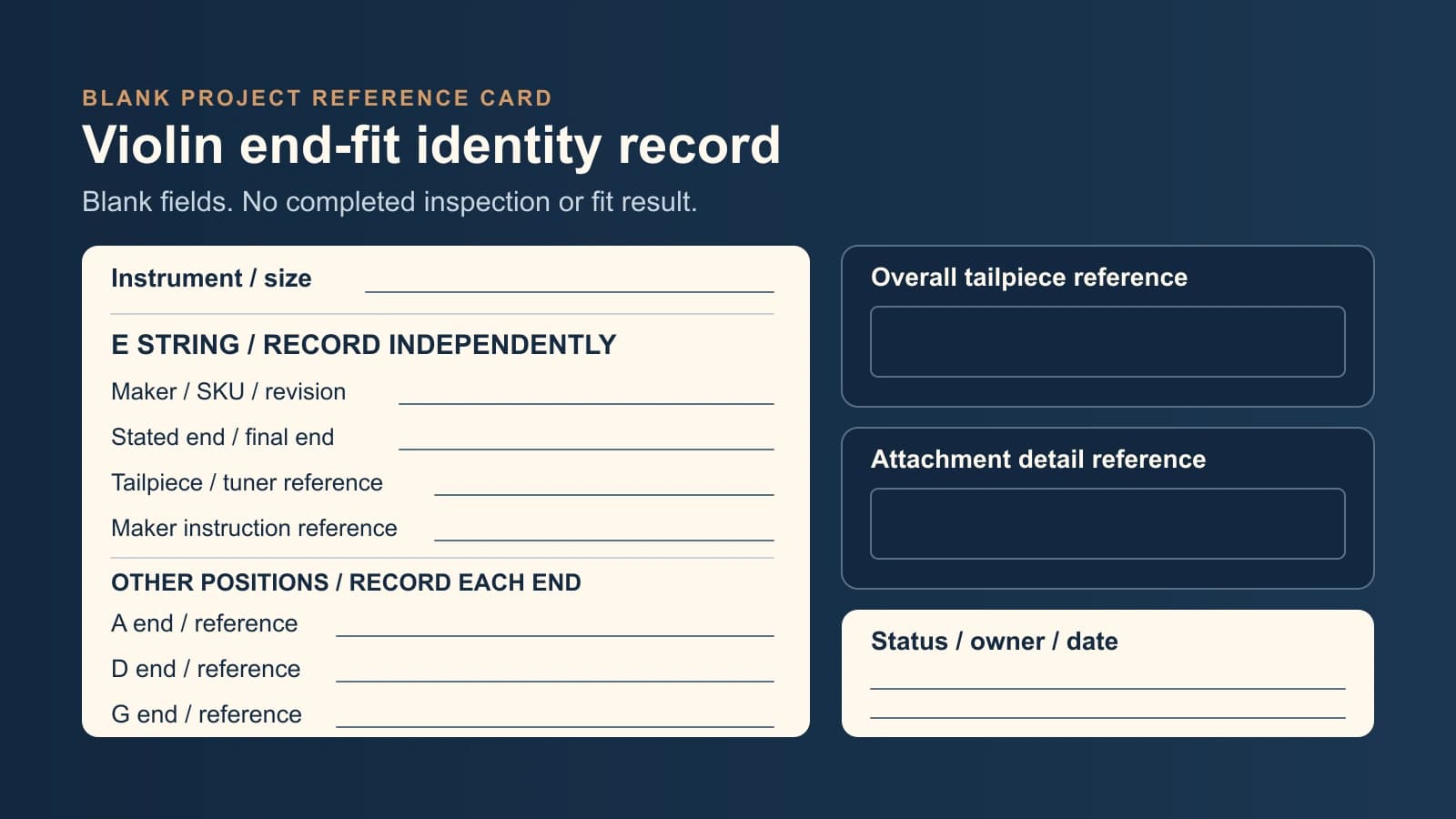
Use a short position record to prevent a replacement E from inheriting an unsupported set-level assumption. The table below is blank; it does not prescribe an end for A, D or G.
| String position | Proposed maker / SKU / revision | Stated end type | Tailpiece or tuner reference | Confirmation reference |
|---|---|---|---|---|
| E — record independently | ______ | ______ | ______ | ______ |
| A | ______ | ______ | ______ | ______ |
| D | ______ | ______ | ______ | ______ |
| G | ______ | ______ | ______ | ______ |
Give the E replacement code and its end variant enough detail to distinguish it in the order and on the individual envelope. If both ball- and loop-end E strings are stocked, the code and label should identify which is inside. How many sets and replacement singles to carry is a separate decision covered in the violin sets-versus-singles inventory guide.
To discuss a proposed end variant, describe your instrument, size, E-string item and tailpiece or fine-tuner reference. In the requirements message, list any relevant photo or document references you already have so the project discussion starts with identifiable hardware.
Build a fit record from identifiable evidence
“Standard fine tuner” is a weak purchasing description. A maker and model are more useful; when these are unavailable, a clear reference image and an unresolved identification field make the uncertainty visible.
Use existing manufacturer material or safely available photographs showing the overall tailpiece and a close view of the retaining point. Keep the E-string envelope or proposed product listing identifiable in a separate reference. A general view can show where a tuner is located, while a detail may help identify its attachment. Neither view substitutes for a model-specific instruction when the contact is obscured or uncertain. Do not dismantle or release strings just to obtain a purchasing photo; ask an instrument technician for any inspection that requires intervention.
The record below ties the proposed end to one instrument and one hardware configuration. Complete it for each materially different size or attachment used in the range.
| Confirmation field | Blank record |
|---|---|
| Instrument identifier and stated size | ______ |
| Tailpiece maker/model; integrated tuner if present | ______ |
| Separate E fine-tuner maker/model, or confirmed absence | ______ |
| String position; maker; exact SKU and revision | ______ |
| Manufacturer-stated end; intended final configuration | ______ |
| Maker's hardware/string instruction or drawing reference and date | ______ |
| Overall tailpiece photo reference; attachment-detail reference | ______ |
| String-envelope or product-identity reference | ______ |
| Proposed match status and unresolved question | ______ |
| Person responsible for confirmation; date | ______ |
Use identified when the documents establish the proposed end and intended attachment. Use needs confirmation when the model, contact or maker permission is missing. Use mismatch when the documented string end and hardware requirement differ. These are working-file statuses, not installation test results.
Where a physical fit check is required, have a qualified instrument technician follow the relevant makers' instructions and record the exact sample and hardware used. Keep that result distinct from a document-only identification. A later hardware replacement or a different string variant requires review of the affected match; an old photo should not silently approve the new combination.
A useful completed record lets the buyer say what was checked and what remains unknown. It should not claim that a single installation proves fit across every violin of the same nominal size.
FAQ
Can the ball be removed from any violin E string?
No. Use only the exact product's explicit removable-ball designation and applicable instructions. The Insula example above is limited to the named 4/4 E model; it does not authorize a procedure for another string.
How can we check a fine tuner if its maker is unknown?
Keep it unidentified while gathering a clear overall view, attachment detail and any instrument or hardware purchase record. Ask the hardware maker, supplier or an instrument technician to resolve the intended end interface. A similar shape in a catalog is a lead to investigate, not a confirmed model.
Does a 4/4 string label establish fit on every full-size violin?
No. It identifies the stated string size, while the actual tailpiece, tuner and end variant still need confirmation. A 4/4 product example also supplies no evidence for a fractional-size instrument or a differently specified attachment.
Conclusion
The next useful step is to identify the intended instrument, actual retaining hardware and exact E-string variant, then close the remaining questions in the fit record.
StringCrest's Folk & Orchestral range is a starting point for an instrument-specific discussion. The violin full-set page is a specification example with size, construction and end requirements to confirm; it is not an approved end-variant or universal-fit data sheet.
Outline your proposed violin end requirements in the requirements message, including the instrument size, relevant position, hardware identity and references to available photos or maker documents. The actual product variant and fit scope must be confirmed for the proposal.
FROM GUIDE TO PRODUCT
Connect this guide to Folk & Orchestral Strings.
Review the relevant range, then bring the instrument, complete specification and open questions into one project brief.
YOUR PRODUCT · YOUR BRAND
Discuss your next string project with Frank.
Share your instrument category, target market, gauge or material direction and private-label packaging requirements.

ABOUT THE AUTHOR
Frank Zou
Frank works directly with musical-instrument brands, importers and distributors on string specifications, product selection and private-label project requirements.
Meet Frank