
Wholesale Planning
Wholesale Planning
Octave Violin Strings: A Register and Fit Guide for Dealers
The same G, D, A and E letters can describe different violin registers. Identify purpose-made octave components, then assess the actual setup and trial scope.
Introduction
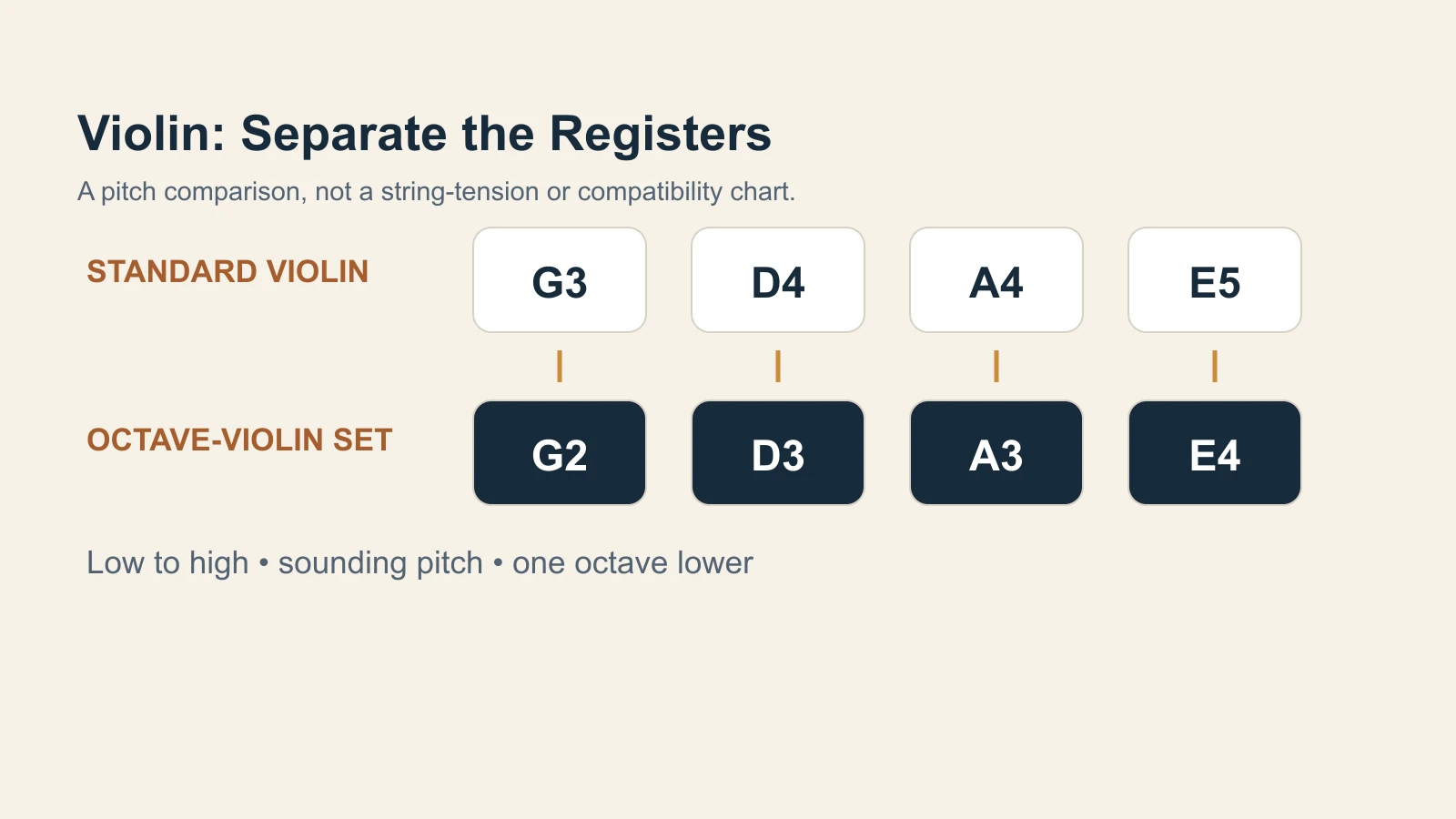
Octave violin strings are purpose-made strings for playing one octave below ordinary violin tuning. For the four-string configuration discussed here, the sounding pitches run G2–D3–A3–E4, low to high, compared with G3–D4–A4–E5 on a standard violin. The note letters and physical positions stay recognizable, but the register changes.
For a dealer, that distinction belongs in the item identity before any discussion of tone. “Violin G,” “4/4” or a familiar family name is not enough to identify an octave replacement. Establish the intended sounding pitch, the exact component and the violin on which it will be used.
A purpose-made octave set also needs an assessment of the actual instrument and setup. This guide provides a register map and blank selection and trial records. It does not establish a StringCrest octave-violin SKU, available supply or successful conversion of a particular violin.
Read the register, not just the note letter
Yamaha's violin and viola comparison gives standard violin tuning as E5, A4, D4 and G3 from highest to lowest. Reversing that order gives the standard reference in the table below.
D'Addario describes its Helicore Octave H350 4/4M set as intended for an octave below traditional violin tuning. Applying that stated relationship gives the octave column. The octave numbers here identify sounding register; they are not string gauges or instrument sizes.
| Physical position, low to high | Standard violin sounding pitch | Octave configuration sounding pitch |
|---|---|---|
| 4 — G | G3 | G2 |
| 3 — D | D4 | D3 |
| 2 — A | A4 | A3 |
| 1 — E | E5 | E4 |
Physical string 1 remains the highest string in each configuration. A request for “low E” should therefore be clarified: in this octave configuration, E4 is still the highest of its four open strings.
Keep written notes separate from sounding pitches. If a player uses a part with ordinary violin notation while intending the music to sound an octave lower, record that instruction explicitly. Do not assume every arrangement follows the same notation convention. A staff note, packet letter or tuner display without a clear octave can leave the actual target unresolved.
For the trial, write down the intended sounding notes and reference pitch. Confirm how the tuner displays octaves and whether it applies an instrument-specific mode or transposition. This avoids approving a familiar letter while checking the wrong register.
Identify the purpose-made component
The current D'Addario example is H350 4/4M. Its ordinary Helicore 4/4 medium set is H310 4/4M. Retain the full reference: the shared Helicore name does not make the two sets interchangeable.
Construction also needs its own record. The official H350 chart linked from its product page identifies an aluminum-wound steel E and stranded-steel A, D and G with position-specific windings. The set page lists ball ends. These details describe that named product, not every octave string or a proposed StringCrest specification.
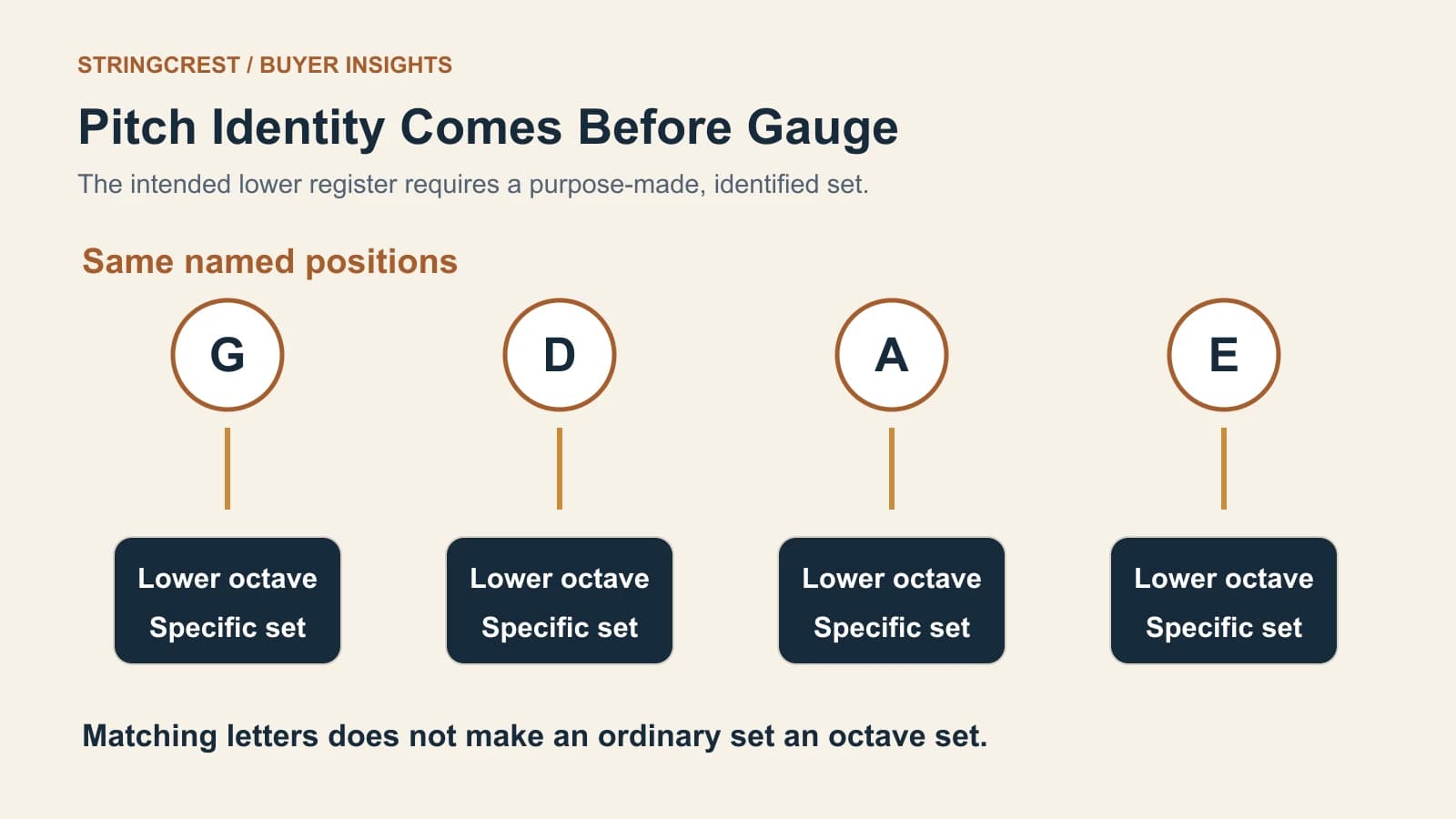
Do not treat an ordinary set tuned down as a documented substitute for a purpose-made octave set. Nor should an unidentified octave component be tuned to the ordinary violin register merely because its packet says E, A, D or G. Resolve the product instructions and target pitch first.
When selecting a single replacement, match the documented octave component, size, variant and end. If any of those change, describe the request as a proposed substitution. A matching letter alone does not establish the replacement.
Check the actual violin before the playing trial
D'Addario specifically warns that its H350 set is thicker than traditional violin strings and needs extra installation care. That is a reason to examine the intended instrument; it is not permission to force a string through an unsuitable contact or opening.
Have a qualified violin technician assess unresolved fit questions. Relevant observations include the nut and bridge contacts, peg installation path, tailpiece or fine-tuner interface, and clearance in the intended setup. The technician should determine whether any adjustment is appropriate for that violin and candidate. This article supplies no groove dimensions, filing instructions or conversion procedure.
Record the violin's identity, nominal size and measured speaking length, with the unit and measurement method. Speaking length runs between the nut and bridge speaking contacts; it is different from the complete installed route to the tail-end seat and peg. Retain the candidate's applicable length and transition information where provided. A 4/4 label alone does not resolve those fields.
The existing violin string size guide covers nominal size and measured-length planning. Here, the additional question is whether this particular octave component and its register are suitable for the actual setup.
Pause if the component identity, intended pitch, seating or contact suitability remains unresolved, or if installation would require an unconfirmed modification. Seek the string maker's applicable guidance and a technician's assessment before continuing.
Keep a four-position identity record
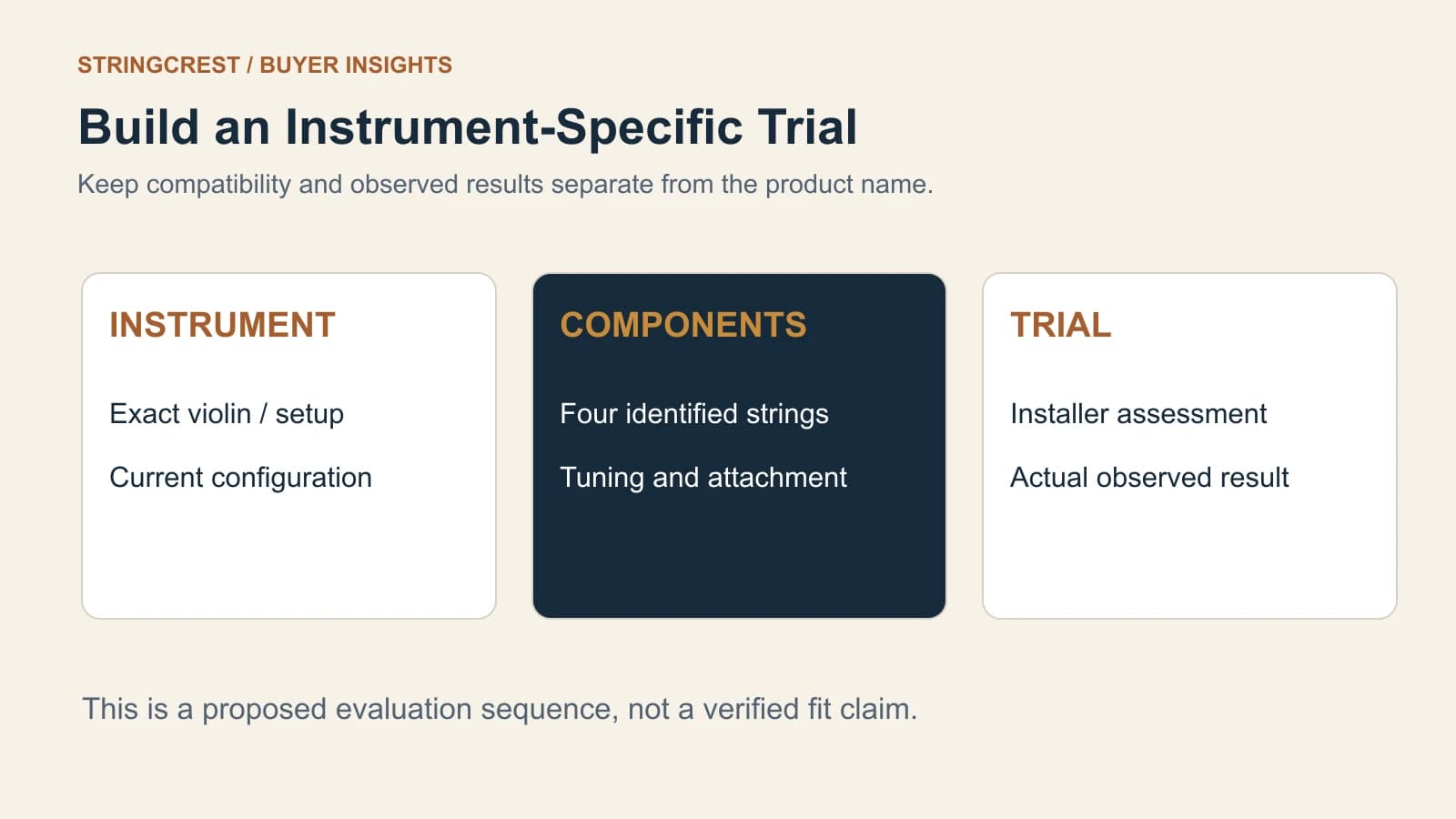
Use the following blank record for one proposed configuration. The target pitches are the reference configuration above, not evidence that a sample has been installed or tuned successfully.
Violin ID / nominal size / setup reference: ______
Speaking length / unit / method: ______
Intended reference pitch / tuner display or mode: ______
Proposed set reference / document revision / source date: ______
| Physical position, low to high | Target sounding pitch | Current component / sounding pitch | Proposed octave component / variant | End and installed-path reference | Identity status / source |
|---|---|---|---|---|---|
| 4 — G | G2 | ______ | ______ | ______ | ______ |
| 3 — D | D3 | ______ | ______ | ______ | ______ |
| 2 — A | A3 | ______ | ______ | ______ | ______ |
| 1 — E | E4 | ______ | ______ | ______ | ______ |
Link each proposed row to its actual product information, including the declared construction and gauge or tension designation when available. Leave missing information unconfirmed; do not populate it with another maker's values.
Use documentary statuses such as exact component identified, substitution proposed or identity unresolved. Keep physical-fit findings and playing observations elsewhere. Even a correctly identified replacement needs attention to the current instrument condition; a document match is not an installation result.
For a mixed configuration, list all four actual components. Do not label an entire instrument “octave tuned” if only one position has been changed without stating the remaining pitches.
Evaluate the lower register on the stated setup
Agree on the purpose of the trial before playing: for example, whether the player can obtain the required lower-register passages with acceptable response and control on this instrument. Leave the acceptance criteria to the actual player, technician and purchasing decision. No response time, settling period or universal tonal outcome is assumed here.
Keep a short record that separates findings from preference:
| Review area | Criterion and method agreed before trial | Actual observation / time | Status or follow-up |
|---|---|---|---|
| Installation and contact fit | ______ | ______ | ______ |
| Four open sounding pitches | ______ | ______ | ______ |
| Tuning checks under stated conditions | ______ | ______ | ______ |
| Open and stopped-note response | ______ | ______ | ______ |
| Crossings and balance between positions | ______ | ______ | ______ |
| Player preference for intended passages | ______ | ______ | ______ |
Record the installer or reviewing technician, player, date, bow, room conditions where known and any setup changes. Note the actual tuning-check times rather than imposing a generic deadline. “Not checked” remains distinct from an acceptable result.
Use passages that exercise the intended register, including open and stopped notes and crossings between adjacent strings. A player's difficulty on one position deserves a position-specific observation, not an immediate conclusion that every octave set behaves that way.
An ordinary-to-octave comparison changes the target register and the string configuration together. If the setup also changes, record that as another variable. The comparison can answer whether the proposed arrangement serves the player's use, but it cannot attribute every difference to a core or winding material.
For an amplified or recorded trial, document the pickup or microphone arrangement, gain and processing. Keep an unprocessed reference when appropriate. An electronically lowered recording of ordinary strings is not evidence of how a physical octave-string installation performs.
Make replacements and customer descriptions unambiguous
A useful dealer description includes octave violin, intended sounding register, maker/item reference, size, variant and set or single-position identity. Keep ordinary and octave components distinguishable in stock records even when both packets carry the same note letter.
Consider a hypothetical request for “a Helicore E.” An ordinary H310-set E reference and an H350 octave E reference lead to different component identities and intended registers. Ask which one is needed before recommending a replacement. This is a teaching example, not a StringCrest customer case or trial result.
For a return or fit question, retain the packet reference, affected position, intended and observed sounding pitch, violin/setup record and the installation issue reported. Distinguish a wrong component from an unresolved setup or playing concern; the same complaint wording can conceal different questions.
The folk and orchestral strings category is a discussion entry point. It does not confirm an octave-violin product, replacement availability or an approved setup.
FAQ
Can an ordinary violin set simply be tuned down one octave?
Do not assume it is a suitable replacement for a purpose-made octave set. Identify a product intended for the target register and assess it on the actual violin. A lower tuner reading alone does not establish component suitability, fit or usable playing response.
Does a 4/4 octave set fit every full-size violin without adjustment?
No universal fit follows from the size label. Check the exact string's instructions and the actual instrument's contacts, hardware, path and setup. Obtain qualified help where suitability or adjustment is unresolved.
Conclusion
For an octave-violin request, establish the sounding register first, then identify all four components and assess the intended instrument. Keep documentary identity, physical fit, playing observations and player preference separate. That gives a dealer a clear basis for a recommendation or follow-up without promising an untested conversion.
FROM GUIDE TO PRODUCT
Connect this guide to Folk & Orchestral Strings.
Review the relevant range, then bring the instrument, complete specification and open questions into one project brief.
YOUR PRODUCT · YOUR BRAND
Discuss your next string project with Frank.
Share your instrument category, target market, gauge or material direction and private-label packaging requirements.

ABOUT THE AUTHOR
Frank Zou
Frank works directly with musical-instrument brands, importers and distributors on string specifications, product selection and private-label project requirements.
Meet Frank