
Wholesale Planning
Wholesale Planning
Violin String Sets vs Singles: A Wholesale Replacement-Inventory Guide
Plan violin string sets and replacement singles by position, size, construction, end type, service demand, SKU identity, reorder rules and receiving checks.
Introduction
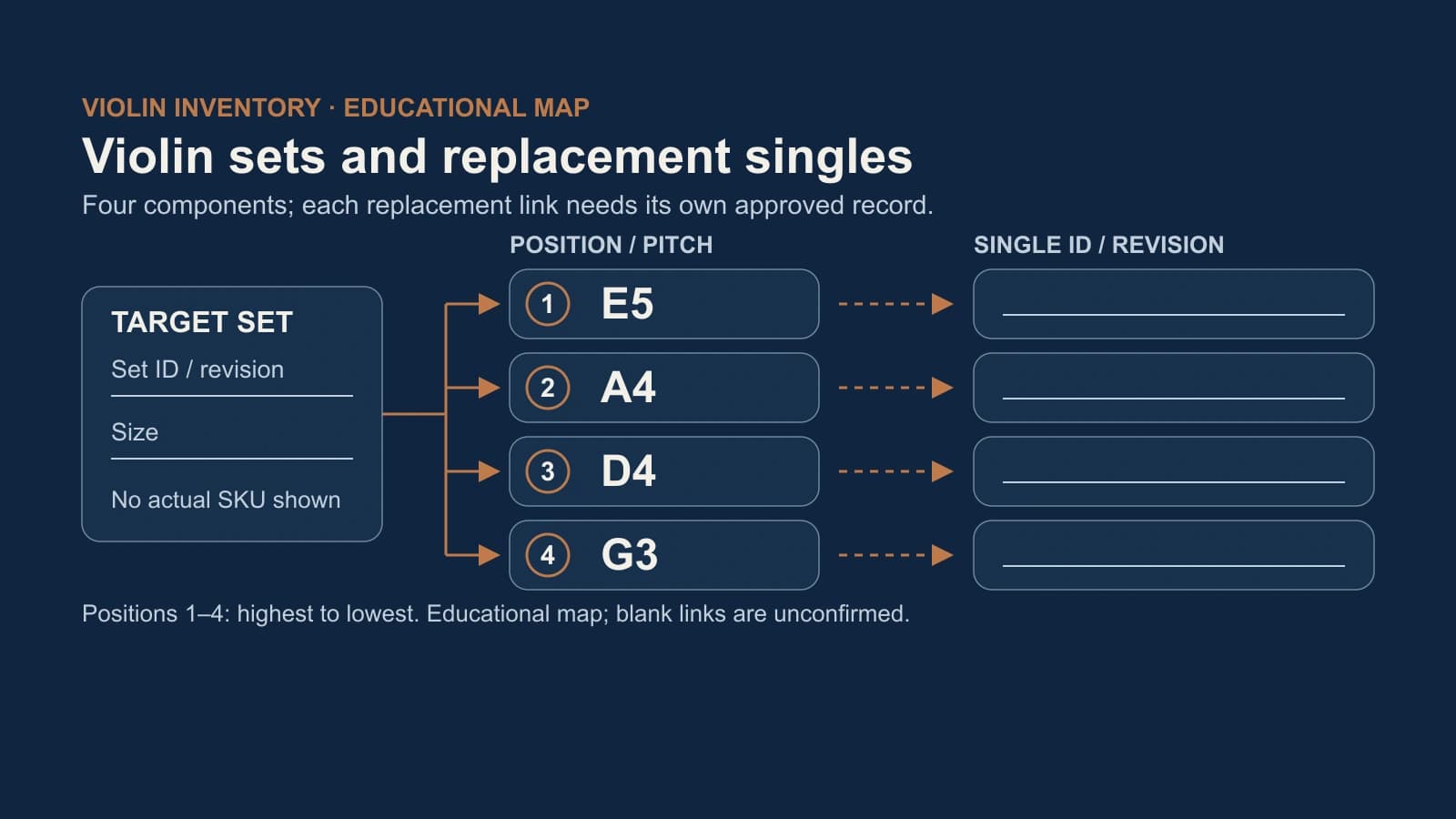
Plan violin sets and replacement singles as separate stock items linked by an approved component map. Start with instrument size and the four positions—1: E5, 2: A4, 3: D4 and 4: G3—then identify which single, revision and end variant may serve each set position. A matching note name does not establish compatibility.
For a U.S. brand, importer, distributor or music store, complete-set sales and position-level service requests answer different replenishment questions. Keep those demand records separate, and record opened sets as component transfers. Otherwise a shortage at one position can consume saleable sets while leaving unidentified components on the shelf.
The worksheets below are planning tools. They do not identify currently offered StringCrest SKUs, approved component relationships or stock quantities. Confirm the actual set and single-string options for the proposed range.
Start with size and four clearly numbered positions
Use position 1 for the highest-pitched string and position 4 for the lowest. The standard four-string violin reference is:
| Physical position | Open-string pitch | Instrument size | Target set ID / revision |
|---|---|---|---|
| 1 | E5 | ||
| 2 | A4 | ||
| 3 | D4 | ||
| 4 | G3 |
Yamaha's violin explanation gives E5, A4, D4 and G3 from highest to lowest. The pitch reference does not supply a construction or size specification. Create a separate working map for each proposed size and set revision, with the intended tuning confirmed for any nonstandard configuration.
Manufacturer catalogs illustrate why the other identifiers matter. D’Addario's Prelude page separately identifies scale size and tension and presents a set alongside E, A, D and G singles. These are D’Addario product options. StringCrest availability and the compatibility of a proposed single still need their own confirmation.
Keep the supplier's exact size and tension designations in the record. Do not pool fractional sizes under “student violin,” or use “medium” without its identified product family and revision. The approved component record must also resolve construction, usable length and end requirements for the target configuration.
Link each single to a specific set component
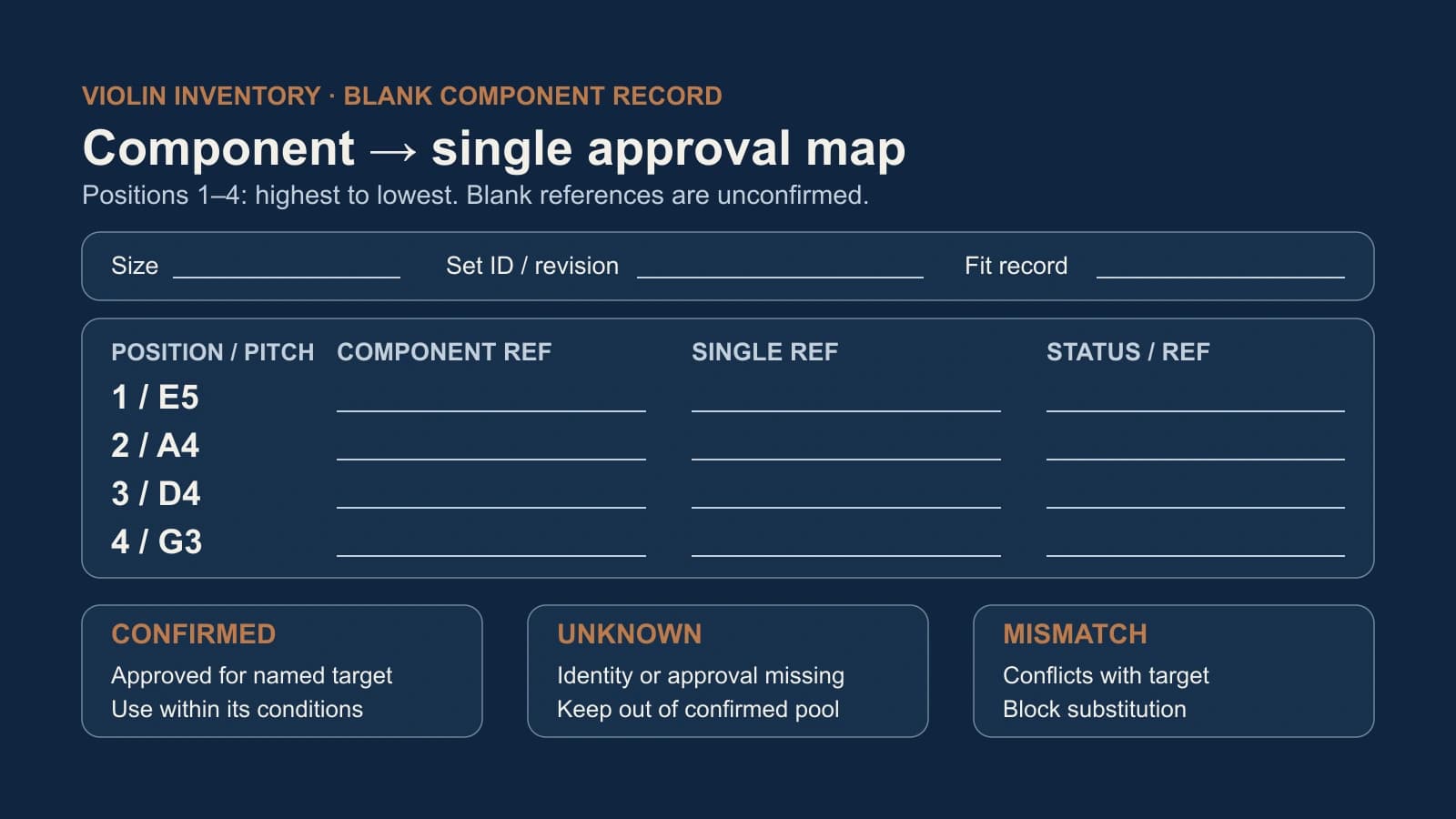
A set-to-single map should connect a target set revision to the actual component it contains, then to an accepted replacement SKU. Copy this blank map for each size and set revision. Only the position and reference pitch are supplied; unfilled business fields remain unknown.
| Position / pitch | Set component ID / revision | Replacement single SKU / revision | End variant / fit-record reference | Mapping status / approval reference |
|---|---|---|---|---|
| 1 / E5 | ||||
| 2 / A4 | ||||
| 3 / D4 | ||||
| 4 / G3 |
Put the set ID, set revision and size at the top of the working sheet. Its supporting record should identify the required plain or wound construction, core and wrap materials where relevant, treatment, tension designation and usable length. Similar envelope colors or a matching gauge cannot replace that record.
Give the E-string end its own field, and identify the actual ends of A, D and G as well. If the tailpiece or fine tuner is unresolved, use the violin ball-end and loop-end fit guide to collect the interface information. This inventory map records the resulting fit decision; it does not establish that a ball and a loop are interchangeable.
Use three explicit mapping states:
| State | What the record establishes | Stock action for the target set |
|---|---|---|
| Confirmed | A named owner has approved the single SKU/revision for this set component, size and stated fit conditions, with a dated reference. | Staff may use the link within that approved scope. Keep any sale or repacking restrictions visible. |
| Unknown | The component identity, required field or approval is missing or unresolved. | Keep it out of the confirmed replacement pool. Request the missing record; do not fill a blank with a guessed match. |
| Mismatch | A documented difference conflicts with the target requirement or approved mapping. | Block that substitution and identify the affected stock. Any alternative use needs its own decision. |
A known mismatch for one set does not prove that the string is defective or unsuitable for every application. An unknown mapping is also different from a measured failure. Record the reason and owner so staff can resolve the correct problem.
An intentionally mixed-family set needs its own approved component list. The map can identify those different components explicitly; a shared family name is neither required in every designed assortment nor sufficient to approve a replacement. Without approved master data for the proposed combination, leave the link unknown.
Separate complete-set sales from service demand
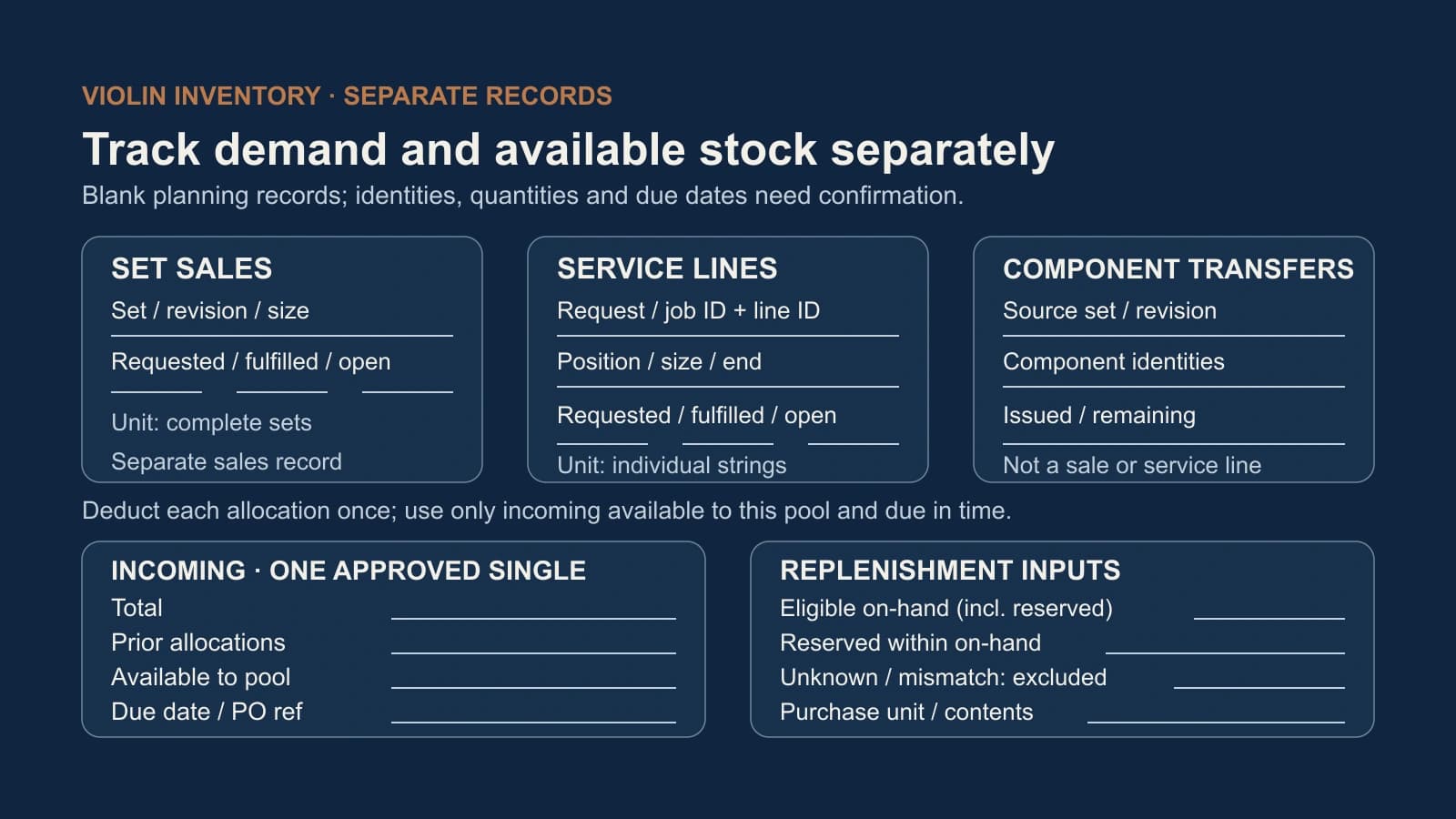
Keep two operational demand records by size and approved identity:
- Complete-set sales: the complete-set SKU/revision, units requested and fulfilled, and valid requests left unfilled at the review date.
- Position-level service demand: the request/job ID and line ID, requested position and pitch, size, target set where known, required end and single supplied. Record requested, fulfilled and still-open quantities in individual strings for each line. Distinguish retail replacements from workshop issues when those channels use the same stock.
Use a request or job ID to prevent repeated calls about one shortage becoming several demand events. If an unfilled request line is later supplied, update its fulfilled and still-open quantities rather than counting a second request. Keep different positions or units under their own line identities. Preserve genuine unfilled requests: sales alone can hide the need for an item that was unavailable.
Opening a set is a stock movement, not another complete-set sale or four single-string service requests. Record the conversion separately and retain the identity of every component.
Educational example: a store opens one fully identified violin set to meet one E-string service request. It removes one unopened set from saleable-set stock, records the four components, and issues the E against that request. The A, D and G remain identified opened-set components. They are not three additional service demands, and they do not become saleable packaged singles unless their identity and permitted sale conditions are established.
Do not leave that opened pack counted as a complete set. If staff later propose rebuilding it, confirm the replacement component, final contents and permission to use the intended set identity. A technical component match does not alone settle retail packaging or labeling permission.
The sets-versus-singles inventory guide explains purchase-unit conversions and a generic reorder calculation. For violin replenishment, retain the size, position, end and component-revision distinctions in every input.
Keep revisions and unresolved stock out of the same pick pool
Label each bin or traceable sub-bin with the single SKU, revision, size, position, end variant and stock status. Keep lot references available. The picker should be able to distinguish confirmed replacement stock, identified opened-set components and unresolved items without relying on string color.
When a delivery label or component differs from the expected revision, place the affected units in a separate hold location. Record what differs, the quantity, lot and target mapping. Do not relabel the new stock to the old code simply to make the receiving entry agree.
Keep old and new revisions separately identifiable while an owner decides whether they are interchangeable for the stated set. A revision change does not automatically make old stock unusable. It also does not authorize pooling the revisions. Record the accepted relationship, restrictions and effective date before updating the pick instructions.
For a proposed range, describe the sizes, replacement positions, target set revisions and intended purchase units for discussion with StringCrest. Identify any mapping or end-fit questions that remain open; evidence references can be included in the requirements description.
Fill a replenishment record for each approved single
Use one working record per single SKU/revision, size and end variant. Link it to its approved set mappings instead of aggregating all E strings or all fractional-size strings into one demand total. The blank fields below require actual business inputs; an unknown quantity is not zero.
| Replenishment field | Entry |
|---|---|
| Review date and observation period | |
| Single SKU/revision, position/pitch, size and end | |
| Target set revisions and confirmed mapping references | |
| Service lines: request/job ID, line ID; requested / fulfilled / still-open quantities in strings | |
| Complete-set sales record for the same period, kept separately | |
| Eligible on-hand quantity, including any allocated units | |
| Allocated/reserved quantity within that eligible stock | |
| Excluded unknown/mismatch quantities and bin references | |
| Confirmed incoming: total / prior allocations / available-to-pool quantity; due date and PO reference | |
| Replenishment lead time, source and date checked | |
| Review interval and selected reorder trigger/target | |
| Purchase unit, contents per unit and any confirmed order increment | |
| Order decision, quantity/unit, owner and next review date |
For a consistent stock view, eligible on-hand means identified stock approved for this use; it excludes the unknown or mismatched units listed separately. It includes reserved units, so subtract allocations once when finding what remains available. For incoming stock, record the confirmed total and any prior allocations separately, then include only the quantity available to this planning pool and due within the period being assessed. Deduct each allocation once; a supplier delivery commitment does not establish that the full incoming quantity is unallocated. A later arrival does not cover an earlier service gap.
Keep all quantities in a consistent unit. If demand is counted in individual strings and purchasing uses a pack, record the confirmed pack contents before converting the order. A proposed order increment is not a universal supplier policy.
Choose the trigger and order quantity from the recorded demand, review interval, reliable lead-time information and the business's stock policy. Keep those assumptions dated. A review trigger calls for a decision; it does not by itself determine how much to buy. No fixed ratio of E, A, D and G singles to complete sets follows from the four-position layout.
FAQ
Can one single-string SKU serve more than one set?
It can be linked to several sets only when the approved mapping identifies each target set revision and its conditions. Do not extend an approval to another size, end variant or assortment because the product names look similar. Keep those relationships visible to staff even when the physical single stock is shared.
What if a new range has little service history?
Mark the demand assumption as provisional and choose a limited pilot whose items staff can identify reliably. Record requests, workshop issues, shortages and opened sets by size and position from the start. Review the range when those observations become available; a blank history does not establish either zero demand or a reliable stocking ratio.
Conclusion
Build the first replenishment plan around a small, identifiable set of size-and-position records, then update it from actual service requests and stock movements. Keep unresolved component links outside the confirmed replacement pool until their scope is approved.
The folk and orchestral category provides the broader instrument-family context. To discuss a violin range, outline the set revisions, sizes, replacement positions, stock questions and order units you need to resolve.
FROM GUIDE TO PRODUCT
Connect this guide to Folk & Orchestral Strings.
Review the relevant range, then bring the instrument, complete specification and open questions into one project brief.
YOUR PRODUCT · YOUR BRAND
Discuss your next string project with Frank.
Share your instrument category, target market, gauge or material direction and private-label packaging requirements.

ABOUT THE AUTHOR
Frank Zou
Frank works directly with musical-instrument brands, importers and distributors on string specifications, product selection and private-label project requirements.
Meet Frank