
Product Selection
Product Selection
Violin String Sizes for Wholesale: A Guide to 4/4, 3/4, 1/2 and 1/4 Sets
A wholesale framework for fractional violin sizes, measured fit, four-position construction, packaging identity and shipment checks.
Introduction
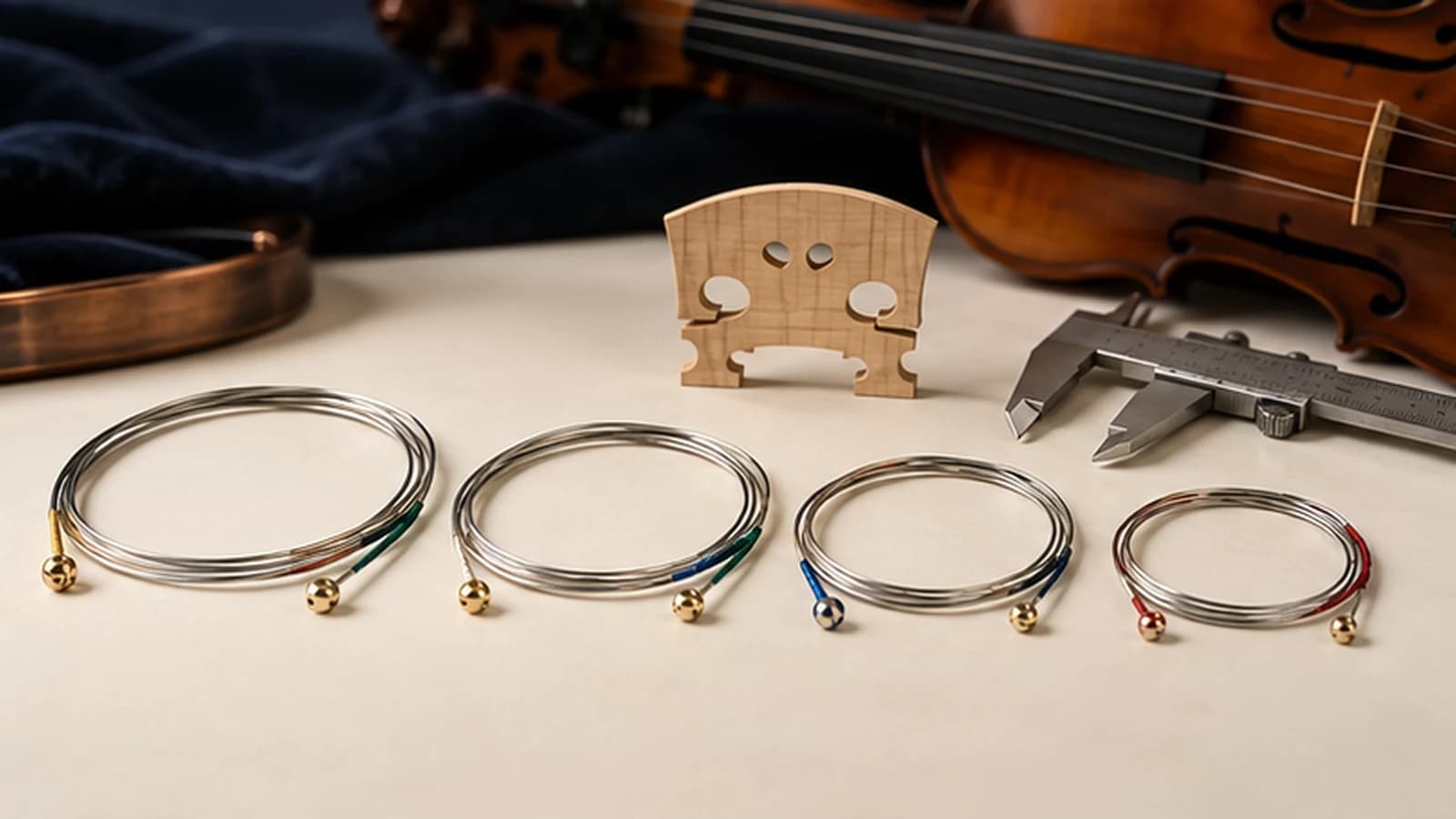
For a distributor, school supplier or private-label buyer, a fractional violin string is not simply a full-size string in a smaller packet. The set must match the instrument’s playing length, the intended position of each string and the expected installation hardware. A size label such as 4/4, 3/4, 1/2 or 1/4 is therefore the beginning of a specification, not the entire specification.
The practical buying rule is straightforward: define the instrument size and vibrating string length first, then specify the four positions, core and winding construction, tension designation, tailpiece end, overall length, packaging identity and sample-approval method. Never assume that a supplier’s fractional label is numerically identical to another supplier’s label. Public product ranges show common market conventions, but the buyer should approve the actual proposed dimensions and fit.
D’Addario’s current violin string collection tells players to match the string size to the violin and lists 4/4, 3/4, 1/2 and smaller options. Its 1/2-scale Helicore set also publishes a playing length for that specific product. Thomastik-Infeld’s violin technical catalogue publishes product-specific vibrating lengths, available sizes and construction details. These are useful examples of what buyers should document; they are not dimensions to copy into a StringCrest project without confirmation.
Start with the instrument, not the carton label
Fractional violin terminology describes an instrument-size family. It does not guarantee one universal string length across every maker, bridge position or product construction. A useful request for quotation should identify both the nominal instrument size and a measured playing length or other agreed fit reference.
Record the vibrating string length
Measure from the nut contact point to the bridge contact point along the string path. Record the unit and method. If a school or dealer network serves mixed instruments, measure representative examples rather than one convenient violin. Note unusual tailpieces, fine tuners or bridge positions that change the non-speaking length.
Also record the path from bridge to tailpiece and from nut to peg. The string needs enough usable length for secure installation, while winding transitions and silk should not land in the vibrating area or at an unintended contact point. A nominally correct size can still fit poorly if these zones are not defined.
Keep size, tension and core separate
Size identifies fit. Tension identifies the force direction under stated conditions. Core construction affects response, feel and stabilization. These fields interact, but they are not interchangeable. “3/4 medium” still needs a core, winding, E-string construction, tailpiece end and complete four-position matrix.
For octave-register requests, use the octave violin register and component-fit guide alongside the size record.
Build a four-position size matrix
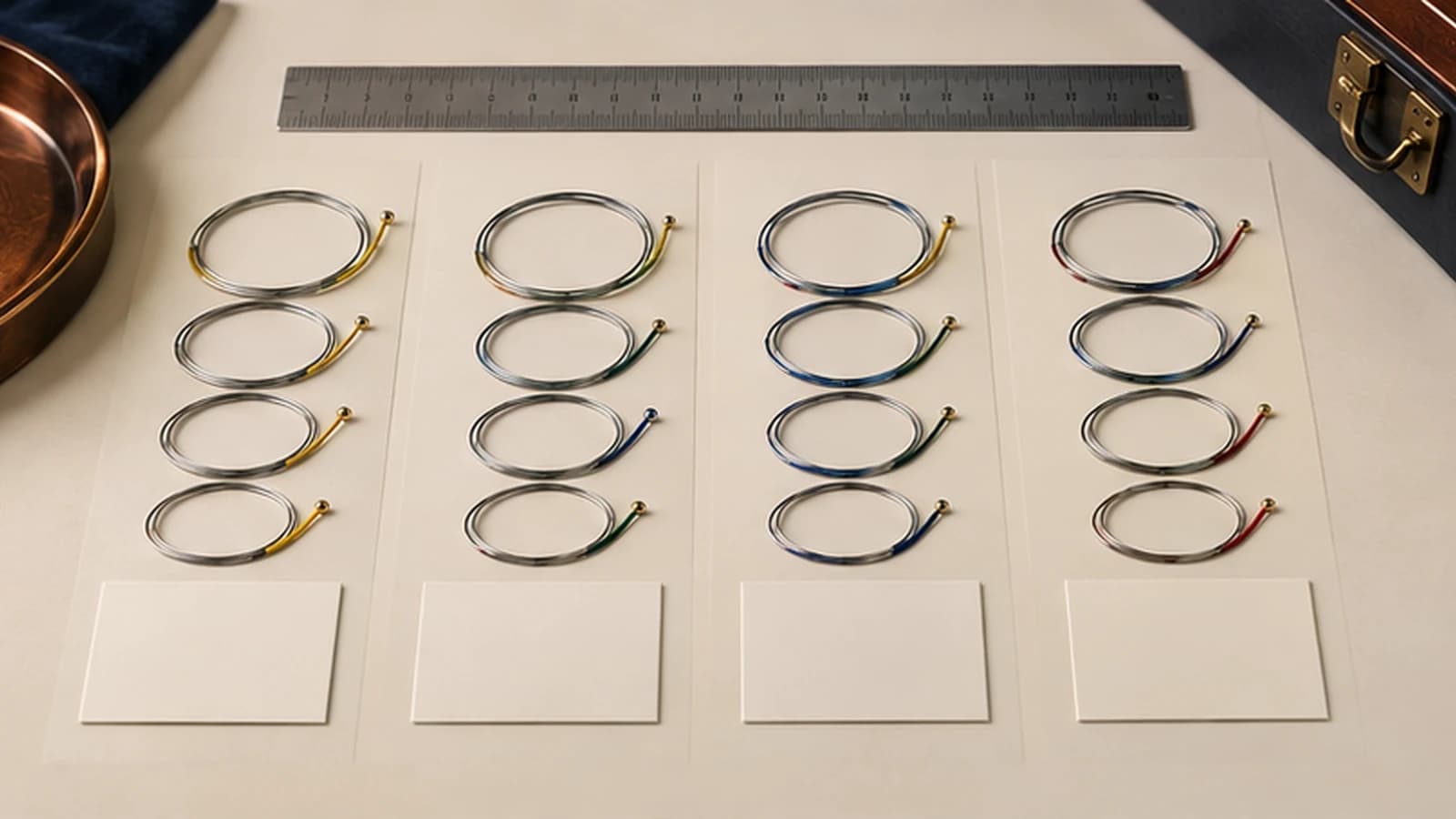
Every set should be specified as E, A, D and G rather than as one generic line item. The matrix makes omissions visible and lets the buyer connect the physical set to artwork, inspection and replacement-stock planning.
| Field | What to record | Why it matters |
|---|---|---|
| Instrument family | Violin | Prevents viola or other orchestral specifications entering the brief |
| Nominal size | 4/4, 3/4, 1/2, 1/4 or other approved size | Controls assortment and packaging identity |
| Vibrating length | Measured reference and method | Anchors physical fit |
| Position | E, A, D, G | Prevents mixed or missing strings |
| Core | Solid steel, stranded steel, synthetic or other approved construction | Defines a major construction variable |
| Outer material | Position-specific winding or plating | Supports identity and sample comparison |
| Diameter or gauge | Nominal value and tolerance when agreed | Supports repeatable production and inspection |
| Tension label | Light, medium, heavy or project term | Keeps the range language consistent |
| Tailpiece end | Ball, loop or other approved format | Must match the intended installation method |
| Overall and wound length | Position-specific values | Keeps transitions out of critical contact zones |
Do not fill unknown cells with a competitor’s published data. Mark them open and request a supplier proposal. When a proposal arrives, assign a revision number and keep the complete matrix with the sample.
Decide which sizes belong in the launch range
A broad catalogue can look impressive while creating slow stock, duplicated artwork and replacement complexity. The first range should reflect the buyer’s real channel: general music retail, school programmes, rental fleets, repair workshops or specialist orchestral dealers.
Use channel evidence, not assumptions
Review current instrument-size sales, rental-fleet composition, replacement requests, teacher recommendations, search terms inside the buyer’s own store and returned-item reasons. If there is no history, label the plan as a launch hypothesis and set a review date. Do not call a size a bestseller without sales evidence.
A practical starting architecture might use one clearly defined core family across several priority sizes, or a full-size reference plus selected fractional sizes for the education channel. The right answer depends on the channel. More sizes also multiply inner envelopes, barcodes, carton labels and retained samples.
Treat replacement strings as a separate inventory decision
Schools and repair shops may need single E, A, D or G strings in addition to complete sets. That decision affects minimum stock, packaging and traceability. A complete set and a single replacement should share the same position specification and revision, but they require distinct SKU identities.
Compare samples for fit before tone language
Fit is the first gate. Install coded samples on representative instruments for each claimed size. Confirm that the usable length is adequate, the winding transitions sit in the intended zones, the tailpiece end works with the hardware and the string reaches the peg without an unsafe or excessive arrangement.
Only after fit passes should the review move to playing response. Keep the instrument, bow, room and task sequence as consistent as practical. Record tuning stabilization, response by position, bow feel and any observable installation issue. Avoid combining feedback from different sizes into one conclusion.
Use a coded review form
The form should include project code, sample code, date, violin size, measured playing length, instrument identifier, installer, tailpiece system, four-position matrix, installation notes, tuning checks, playing observations, open points and decision. A change in size, core, winding, diameter or end format creates a new revision.
Keep a retained approved sample when feasible. Store it with its code and conditions so a later shipment can be compared against the same physical reference. Photographs help record layout and appearance, but they do not replace measurements or the retained sample.
Keep fractional-size packaging unmistakable
Size errors are costly because the string may look plausible until installation. Put the nominal violin size in a clear, consistent location on the front, back, inner envelope and carton. Do not rely only on a small suffix in the SKU.
The pack should also identify instrument, set or single position, tension designation, core family when useful, E–A–D–G order, end type, barcode and artwork revision. Installation and care instructions should be written for the intended user and language. Any performance or durability claim requires product-specific evidence.

Separate protective packaging from artwork
The graphic design identifies the product. The protective system manages handling and storage. Define inner sleeves, sealing method, position separation, retail pack and export carton independently. A premium-looking packet does not prove moisture protection or shelf life.
When several sizes share a visual family, use a deliberate color or label system but retain readable text. Color alone is unreliable for warehouse picking, accessibility and monochrome paperwork. The SKU and size should remain visible without opening the packet.
Compare quotations on an identical scope
Send every supplier the same revision. Ask them to separate string construction, set assembly, single-position options, inner sleeves, printing, tooling, samples, inspection documentation and logistics. MOQ, sample cost and schedule depend on the number of sizes, materials, artwork versions and order quantities; request project-specific values with a validity date rather than assuming a universal number.
The quotation should state which dimensions and tolerances are proposed, which remain open and how samples will be identified. If the supplier proposes a different length architecture, compare it with the measured instrument data and document the decision.
Inspect the shipment by size and position
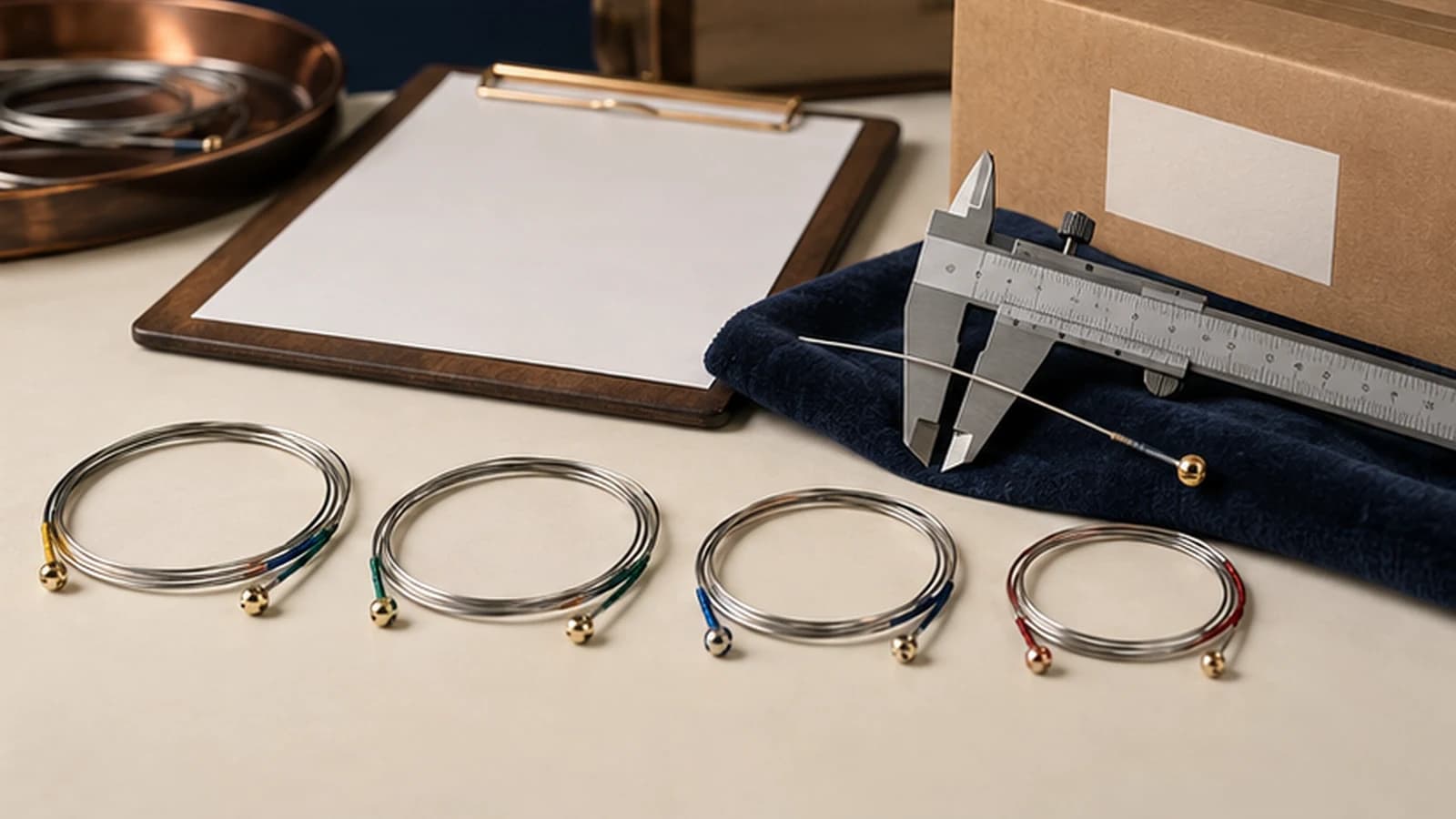
The final inspection should verify purchase order, SKU, revision, nominal size, position sequence, core and winding identity, tailpiece end, appearance, length checks, packaging version, barcode and carton count. Use an agreed sampling plan. Open enough sets to confirm that labels and contents match; do not inspect only closed cartons.
Record lot identity, sample selection, results, photographs, deviations and disposition. A deviation report should identify the affected SKU, carton, set and string position. This makes corrective action more useful than a general statement that a shipment “does not fit.”
Shipment record checklist
- Purchase order, SKU and approved revision
- Nominal violin size and measured reference
- E, A, D and G sequence
- Core, winding and tailpiece-end identity
- Overall length and transition-zone checks
- Set count and single-string count
- Inner envelope, artwork and barcode revision
- Carton label and quantity
- Lot, sample, deviation and disposition records
Internal links and buyer next steps
This sizing decision connects to the broader Folk & Orchestral string category and the existing violin strings wholesale specification guide. Use the general guide to frame supplier evaluation, then use this page to define the fractional-size matrix.
Manage size changes and complaints with evidence
Fractional ranges create a special service problem: the packet size, instrument label and actual installation may not agree. A used violin can have a moved bridge, a replacement tailpiece or an uncertain fractional label. Customer support should therefore ask for more than “the 1/2 string did not fit.”
Collect a fit record before assigning cause
Request the product SKU and lot, nominal violin size, measured nut-to-bridge length, tailpiece type, photographs of the installed path and the exact point of failure. Ask whether the transition reached the nut, bridge, tailpiece or peg area incorrectly. Preserve the string and packet when possible.
Compare that record with the approved sample and revision. The cause may be a wrong string in the pack, an incorrect pack label, an out-of-spec length, an unexpected instrument setup or a size selection error. These possibilities require different corrective actions. Avoid telling the customer that every instrument of the same fractional label is identical.
For repeated reports, group evidence by SKU, lot, instrument size and failure point. This can reveal whether the issue is isolated, instrument-specific or systematic. Do not publish the case as a quality statistic unless the dataset and method are suitable for that claim.
Control substitutions
When a size is temporarily unavailable, do not substitute another fractional size without written technical approval. A longer string may appear usable but place silk or winding transitions in the wrong area. A shorter string may not reach the peg securely. Any approved alternative should state the instruments and measurements it covers and receive its own documentation.
Forecast the range without pretending to know demand
Create a forecast by SKU and position using the buyer’s available history. Separate complete sets from single replacements and education contracts from ordinary retail. Note school-season timing or tender dates only when the buyer has evidence for them.
If data are limited, begin with smaller reviewable assumptions: expected account count, planned display quantity, service stock and reorder point. Mark them as planning inputs, then compare them with actual sell-through and replacement use. A fractional-size range should expand because evidence supports it, not because a competitor lists every size.
Use the same revision in purchasing, warehouse records and the product page. When the construction changes, decide whether remaining stock can coexist, needs a clear transition label or must stay separated. This protects dealers from receiving two physically different products under one unchanged SKU.
FAQ
Can a 4/4 violin string set be used on a 3/4 violin?
Do not assume it can. The string may have different usable length, transition positions and tension behaviour on the shorter playing length. Use a set specified and sampled for the intended instrument size.
Is the size label the same across every supplier?
No universal label alone proves identical dimensions. Ask for the product-specific playing-length reference, overall length, wound length and transition details, then approve samples on representative instruments.
Should every fractional size use the same core material?
Not automatically. A shared core family can simplify the range, but each size needs its own fit and response review. The channel role and available construction may differ.
Do I need single replacement strings?
That depends on the buyer’s channel. Rental fleets, schools and repair shops may value position-specific replacements. Plan those SKUs, envelopes and stock levels separately from complete sets.
What information is required for a useful quotation?
Provide instrument, nominal sizes, measured playing lengths, E–A–D–G construction, tension direction, tailpiece ends, lengths, packaging, quantities, destination and sample-approval method.
Can competitor size charts become my specification?
They can help identify fields and market conventions, but they describe the publisher’s products. Your private-label specification should use approved project data and samples.
Conclusion
A reliable fractional violin string range begins with measured instruments and a four-position specification. Nominal size, vibrating length, core, winding, tension, end format, overall length, packaging and inspection must remain connected through one controlled revision. This reduces fit errors and gives dealers, schools and repair teams a clearer product choice.
The same records also make reorders, replacement-stock decisions and customer-support investigations easier to explain and verify.
Review the StringCrest Folk & Orchestral range, then send your violin sizing brief with target sizes, instrument measurements, four-position construction and packaging requirements.
FROM GUIDE TO PRODUCT
Connect this guide to Folk & Orchestral Strings.
Review the relevant range, then bring the instrument, complete specification and open questions into one project brief.
YOUR PRODUCT · YOUR BRAND
Discuss your next string project with Frank.
Share your instrument category, target market, gauge or material direction and private-label packaging requirements.

ABOUT THE AUTHOR
Frank Zou
Frank works directly with musical-instrument brands, importers and distributors on string specifications, product selection and private-label project requirements.
Meet Frank