
Product Selection
Product Selection
Violin E Strings: A Wholesale Selection and Whistling-Review Guide
Separate component fit, pairing preference and product claims when selecting violin E-string singles or reviewing complete-set applications.
Introduction
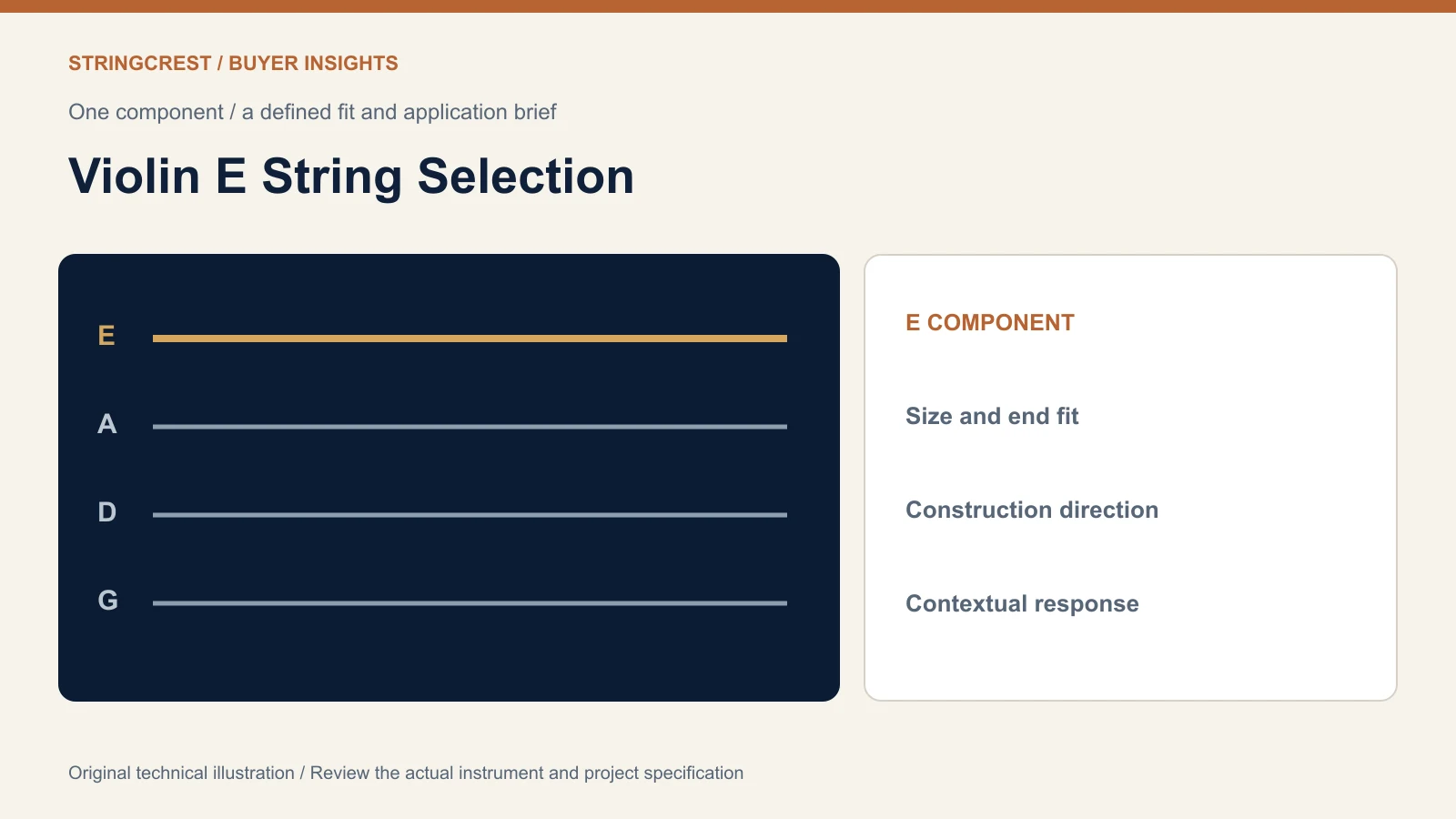
Choose a violin E string by checking size, construction, supplier tension designation and attachment fit, then compare its response with the other strings on the intended violin. For a whistle complaint, ask the player to demonstrate the passage and review suitable samples under comparable conditions. A wound construction is a possible direction to investigate, not a guarantee that every such string will prevent whistling.
A retailer may be replacing a known component or helping a player consider an alternative. A private-label importer needs a reproducible component brief and evidence for any wording on the packet. The buying decision should distinguish those tasks, particularly when similar variants differ in end construction or size.
Begin with the folk and orchestral string category and the instrument requirements. Confirm final construction and available options against the project brief. The application review below supports selection; instrument diagnosis requires appropriate specialist input.
Identify the replacement question accurately
Decide whether the request is a like-for-like replacement, a preferred change in response or an investigation of a reported whistle. A known replacement begins with the packet and exact component code. An alternative needs both the reference specification and a description of what the player wants to change.
Retain the packet and supplier references where available. An unfamiliar installed string should stay unidentified until its details are established. Our violin identification guide explains how packet information and both ends contribute to identity.
For an illustrative replacement request, a dealer with the old envelope can confirm the size, end variant and tension designation before selecting the same component. For an illustrative whistle review, the dealer also needs the passage, the reference violin and the other strings. These are proposed purchasing situations, not StringCrest customer cases.
List the other three strings and their condition where known. If the whole set is replaced during the comparison, record it as a whole-set review. That result cannot isolate the effect of the E string. State the intended improvement clearly enough that the reviewer can assess it during the agreed task.
Separate plain, wound and surface-finish descriptions
Plain construction
A plain E-string specification should identify the actual material, finish and supplier designation. The word “steel” alone may not distinguish every variant offered within a range. Confirm which physical component the description represents.
Wound construction
A wound E string has additional construction fields, including the relevant core and outer winding. Ask for the complete description rather than assuming that every wound option shares the same response. Its installation and application should be evaluated as the proposed product.
Surface treatment or finish
A finish is not automatically equivalent to a winding or a performance result. Record it separately where relevant. Avoid treating a decorative color or a marketing name as a complete explanation of construction.
Pirastro's E-string overview presents different plain and wound products with distinct specifications. It supports investigating construction options; its particular gauges, materials and sound claims are not a StringCrest product master.
Treat whistling as an application observation
Ask the player to demonstrate the unwanted sound and identify the musical task. It may be reported on an open E, during a crossing from another string, in a double stop or elsewhere in a passage. Write down the task in the player's terms before choosing a replacement candidate.
Have an appropriate teacher or instrument specialist distinguish the reported whistle from a scratchy, unstable or generally unclear tone. That distinction changes what the comparison should examine. A message describing a high-pitched sound is not enough to establish the mechanism or select a guaranteed remedy.
Keep a short reference recording with the sample and instrument identity. Repeat the reported task under comparable conditions, alongside appropriate sustained tones and stopped notes. If another set or a setup intervention is introduced, document it before evaluating the later result.
The review should lead to a decision. If the sound can be reproduced, compare an appropriately fitted alternative and record what changes. If it cannot be reproduced, keep the player's account and request the missing context. If attachment or instrument condition is uncertain, resolve that question before judging the candidate's response.
A preference observed during the comparison can support a sample choice for that application. It does not establish a universal non-whistling claim. Keep the selected component, task and limits together so purchasing and marketing use the result within its actual scope.
Understand manufacturer claims without copying them
Some manufacturers publish wound E-string variants specifically associated with reducing or avoiding whistling. D’Addario's Kaplan example describes a particular product and construction. It demonstrates that the application is addressed through specific product development, not that every wound E string shares its result.
A private-label buyer should ask what evidence supports a proposed statement for the actual sample. The claim's scope should identify the product and evaluation conditions. A familiar adjective on another packet cannot establish performance for an unverified component.
Do not use an artist's preference or a retail ranking as a universal guarantee. Those may provide context for a question, but an OEM project still needs its own confirmed construction and relevant sample evaluation.
This distinction also applies to a supplier's proposed substitute. Matching the general material name does not prove it reproduces a competitor's patented, proprietary or otherwise specific design. Keep procurement specifications independent of another brand's reputation.
Confirm physical attachment before comparing sound
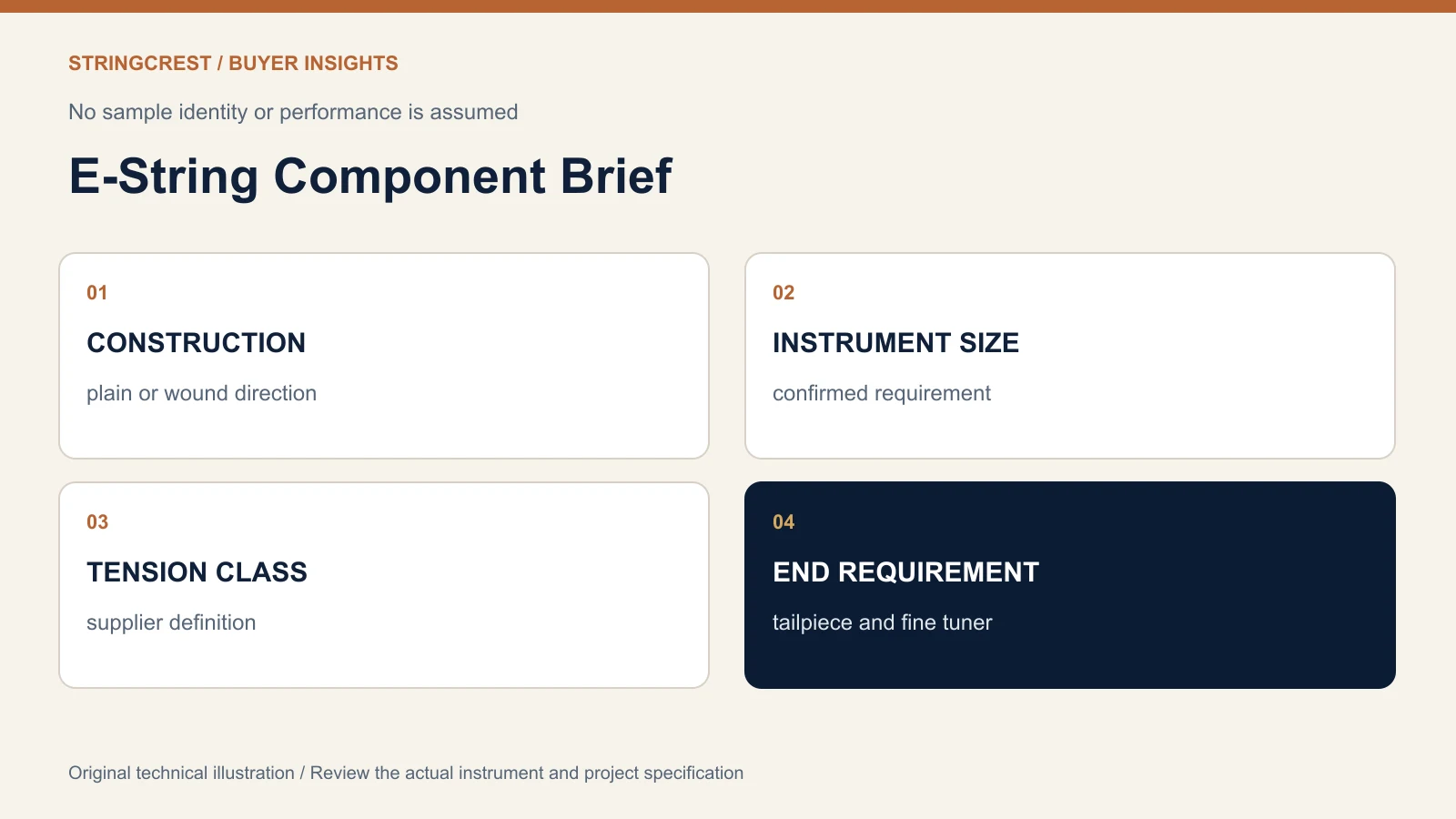
Identify the instrument's tailpiece and fine-tuner requirements. Then confirm whether the actual proposed component has the appropriate end and any relevant supplied accessory. A family name can include several variants that are not interchangeable in a particular attachment.
Ask for clear component documentation when the supplied end is uncertain. Do not infer fit from silk color or the description “violin E.” The end-type compatibility guide provides a separate framework for that review.
Avoid improvising a modification to make a sample fit. If the attachment is unclear, seek appropriate product confirmation and competent instrument assistance. A sound comparison based on an uncertain installation can produce misleading conclusions and damage the sample.
Record the confirmed end variant beside the sample code. When a later order is placed, purchasing should be able to select the component that was actually evaluated, not merely another item sharing its name.
Keep size and tension designations explicit
Specify the instrument size and relevant supplier sizing information. Do not assume a fractional instrument can use any string intended for the same pitch. The correct component and installed conditions should be confirmed before approval.
Record the supplier's tension class in its own terms and identify the product. A word such as medium is not a numerical force value shared by all manufacturers. If numerical tension matters, request relevant data with the method and conditions.
Diameter is also not a complete substitute for tension or feel information. Different constructions can behave differently despite similar external dimensions. Use the actual specification rather than filling a missing field from another manufacturer's table.
Plan a comparison around the reported task
Choose a reference violin with an appropriately assessed condition and identify the relevant bow and other setup context. Establish which E-string candidates can be installed correctly. Leave instrument-service questions visible rather than treating every problem as a string-selection issue.
Agree a short playing sequence with a competent reviewer. If the concern involves crossing onto an open E, the review can include that task alongside sustained tones and stopped notes where appropriate. The chosen sequence should represent the actual application without forcing unsafe or exaggerated conditions.
Record the other strings, intended tuning and interventions. If the complete set or instrument setup changes during comparison, explain that difference. Do not assign a result entirely to the E string when several variables changed together.
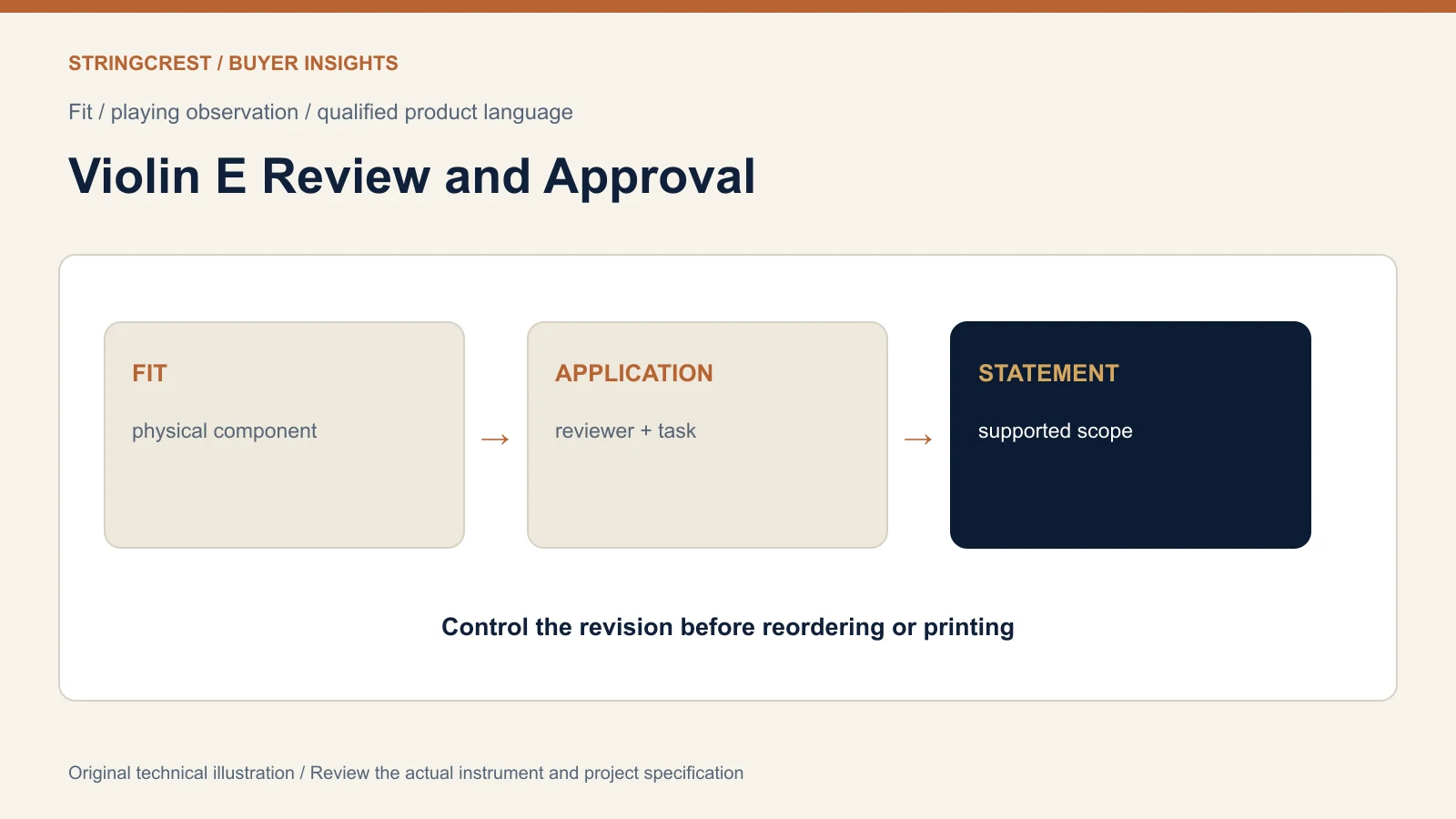
Use separate fit and application assessments
Fit record
Confirm size, end construction and attachment requirements beside the supplier code. Resolve a fit question before judging sound. A reviewer who prefers the response still needs to identify which physical variant was installed.
Response record
Describe the starting behavior and the relevant passage, including transition to neighboring strings where useful. Identify the reviewer, instrument and other strings. Keep a player's preference in those terms unless an appropriate measurement was actually made.
Approval decision
Give each candidate a clear outcome: suitable to continue the application review, preferred for the reviewed use, rejected for that use, or unresolved pending information. Keep a packet claim as a separate decision. Correct fit and a favorable playing observation do not answer every performance question.
| Review question | Record needed | Appropriate interpretation |
|---|---|---|
| Does it attach correctly? | Confirmed component and instrument requirements | Fit under the specified installation |
| Does it suit the intended size? | Product sizing data and reference instrument | Defined size coverage |
| What happened in the passage? | Identified sample, task and reviewer | Application observation under those conditions |
| Is it preferred with the existing set? | Other string identities and condition | Contextual pairing preference |
| Can a claim be published? | Relevant evidence and defined scope | Only the statement actually supported |
For an illustrative outcome, purchasing might approve an identified candidate for the reviewed pairing while leaving whistling-related artwork unapproved. It would order that same variant and retain the review sheet. This is a proposed decision example, not a test result or a claim about any StringCrest SKU.
Compare the E string within the intended set
Include transitions between the E and neighboring positions in the application review. A single isolated note may not represent how a player uses the instrument. Record whether the candidate's response is preferred for the intended musical tasks.
Describe the condition of the other strings. A fresh candidate paired with worn components can produce a different impression from a complete fresh set. This is not necessarily an invalid review, but its limits should be stated.
Avoid publishing that a component blends with all possible sets based on one pairing. A dealer description can identify a confirmed application direction and invite discussion of other combinations. A broader compatibility or sound statement needs broader evidence.
For wholesale assortment planning, distinguish a replacement that preserves the original specification from an alternative offered for a different preference. Those roles should remain visible in product codes and support information.
Preserve recordings as contextual evidence
Give each recording a sample reference, instrument identity, task and date. Retain the reference clip as well as the alternative, using comparable recording and playing conditions where practical. Note changes in gain or processing so listeners can interpret differences in the files.
Keep the full review record available when making a promotional excerpt. A selected passage may illustrate an application, but the technical assessment should still include unsuccessful starts or other relevant observations. A favorable clip alone documents only what it captured.
Ask for evidence that addresses the proposed product statement. A review for one pairing supports a narrower conclusion than a promise covering every violin or player. If factory testing is proposed, request the method and its relationship to the playing question. An equipment photograph does not supply those details.
Write private-label claims to match the evidence
Draft the packet from the approved physical identity first: instrument size, E position, construction description, necessary tension designation, end variant and product code. Verify any proposed color marking against the supplier's actual system. The written identity should remain usable when the component is sold as a single.
For example, “Violin E string” with the confirmed size, end variant and construction fields is a proposed label structure. Populate it only with approved product data. It tells the buyer what the packet contains without adding a performance result that has not been established.
A statement about whistling needs evidence for the actual product and the scope of the claim. Keep the desired outcome in the RFQ while that work is pending; it should not appear as an achieved result on finished artwork. Another maker's name, construction or product statement does not supply evidence for a generic alternative.
StringCrest strings and packaging can be made to customer specifications agreed for an order. Confirm the component revision and proposed claims together before releasing artwork. If the sample is preferred but the performance statement remains unsupported, keep the accurate construction description and defer that statement.
Manage replacement singles with reliable identity
Singles need enough labeling to identify the intended component without an outer complete-set packet. Keep variants separate in the picking record, particularly where end or size differences are easy to miss.
For receiving inspection, compare the component and envelope with the approved master. Record the inspected quantity and selection method. A mismatch is a useful observation, but it does not establish an error rate for an entire shipment without an appropriate basis.
Keep uncertain returns apart from verified stock. A used string with an unknown wrapper should not be assigned to a confirmed SKU simply because it resembles a shelf item. Preserve the available evidence and identify which fields remain unknown.
The sets and singles inventory guide addresses the wider replenishment decision. E-string application records add the necessary detail for this particular replacement position.
Reassess material or construction changes
If a supplier proposes a different core, winding, finish or end variant, identify the revision and assess which prior evidence remains applicable. Similar appearance does not establish unchanged response or a continued basis for the existing packet claim.
Retain the approved sample and its documentation where practical. Purchasing, dealer information and artwork should point to the same revision. If a replacement packet contains a changed product, staff need a clear way to identify it.
Use dealer feedback to decide whether another application review is useful. Separate a player's preference, an installation mismatch and a discrepancy against the agreed specification. Those records support different actions and should not be merged into one quality label.
FAQ
Are all violin E strings constructed the same way?
No. Manufacturers publish different plain and wound directions and variants. Confirm the actual component's size, material, tension designation and end requirements rather than relying only on the pitch name.
Does every wound E string prevent whistling?
Do not assume that result. A maker's claim describes its particular product. A proposed alternative needs relevant application evidence before a comparable statement is used.
Can a short recording diagnose a whistle?
It can document an observation under specified conditions, but interpretation may require a competent reviewer and additional context. Keep the task and instrument identity attached to the file.
Can an E string from another set be used as a replacement?
Confirm the physical specification and intended pairing first. A similar product name or color does not establish correct size, tension designation or attachment fit.
Should a private-label brand publish “non-whistling” immediately?
Only when the actual product and relevant evidence support the intended scope. A procurement aim or an uneventful sample recording is not automatically a universal guarantee.
What belongs in a wholesale E-string brief?
Include instrument size, intended pitch, construction direction, tension designation, end requirements, reference set and the musical task being reviewed. State the evidence needed for approval and packaging language.
Conclusion
Violin E-string selection combines component identity, correct installation and a contextual playing review. An unwanted whistle is a reason to document a specific application question, not a shortcut to a remote diagnosis or an inherited brand claim.
For retailers and private-label buyers, keep fit, response preference and performance language separate. Preserve the approved revision and label replacement singles clearly so the next order reproduces the product that was actually assessed.
Explore folk and orchestral string projects and Send Your Requirements with your violin size, end requirements and sample questions. Final construction and available options are confirmed against the project brief.
Sources and interpretation limits
- Pirastro E-string construction overview describes that manufacturer's plain and wound alternatives.
- D’Addario's whistling-related E-string example is product-specific information, not evidence about a StringCrest component.
The sample-review process and labeling suggestions are proposed buyer practices. No competitor measurements, guaranteed sound result or tested StringCrest non-whistling SKU is claimed here.
FROM GUIDE TO PRODUCT
Connect this guide to Folk & Orchestral Strings.
Review the relevant range, then bring the instrument, complete specification and open questions into one project brief.
YOUR PRODUCT · YOUR BRAND
Discuss your next string project with Frank.
Share your instrument category, target market, gauge or material direction and private-label packaging requirements.

ABOUT THE AUTHOR
Frank Zou
Frank works directly with musical-instrument brands, importers and distributors on string specifications, product selection and private-label project requirements.
Meet Frank