
Wholesale Planning
Product Selection
Steel vs Synthetic Core Violin Strings: A Wholesale Range Planning Guide
A wholesale comparison of steel and synthetic core roles, four-position construction, samples, packaging, replacements and inspection.
Introduction
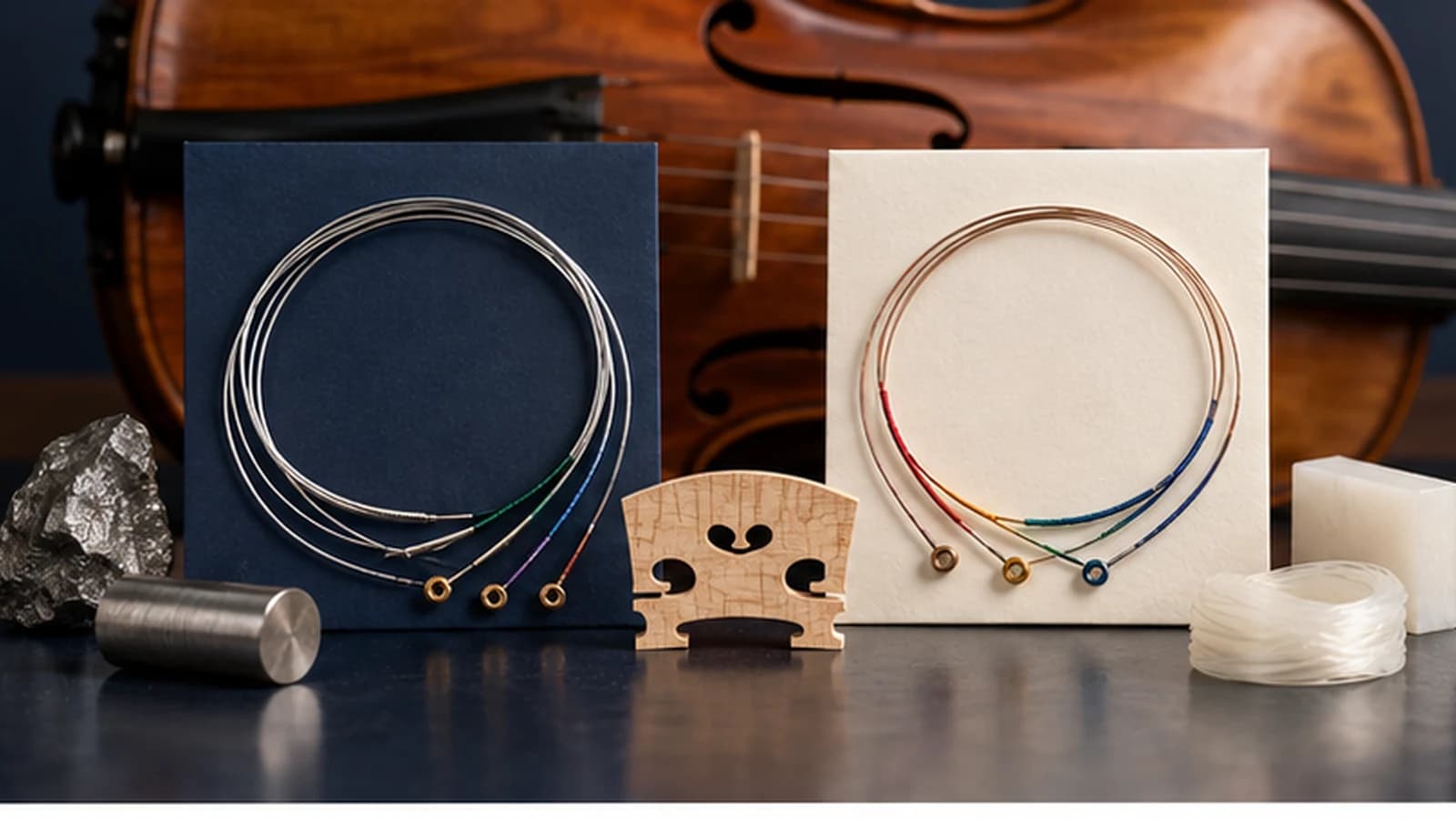
Steel core and synthetic core are construction families, not simple quality grades. A professional buyer should not ask which one is “better” in isolation. The useful question is which core direction gives each SKU a clear customer role, fits the intended violin sizes and can be controlled from the approved sample through packaging and shipment inspection.
Solid steel, stranded steel and synthetic cores behave differently because their internal structures differ. Those differences can influence response, stabilization, feel and the language retailers use to explain a set. They do not create one guaranteed tonal result across every violin. Outer winding, diameter, tension, instrument setup, bow, player and room also matter.
D’Addario’s official orchestral core guide separates solid steel, stranded steel, synthetic and gut as core categories. Its current violin string collection filters products by solid steel, stranded steel and synthetic core and notes that break-in varies by construction. These references clarify market terminology. They are not proof that a StringCrest project will reproduce another brand’s tone, lifetime or stabilization claim.
Define the construction precisely
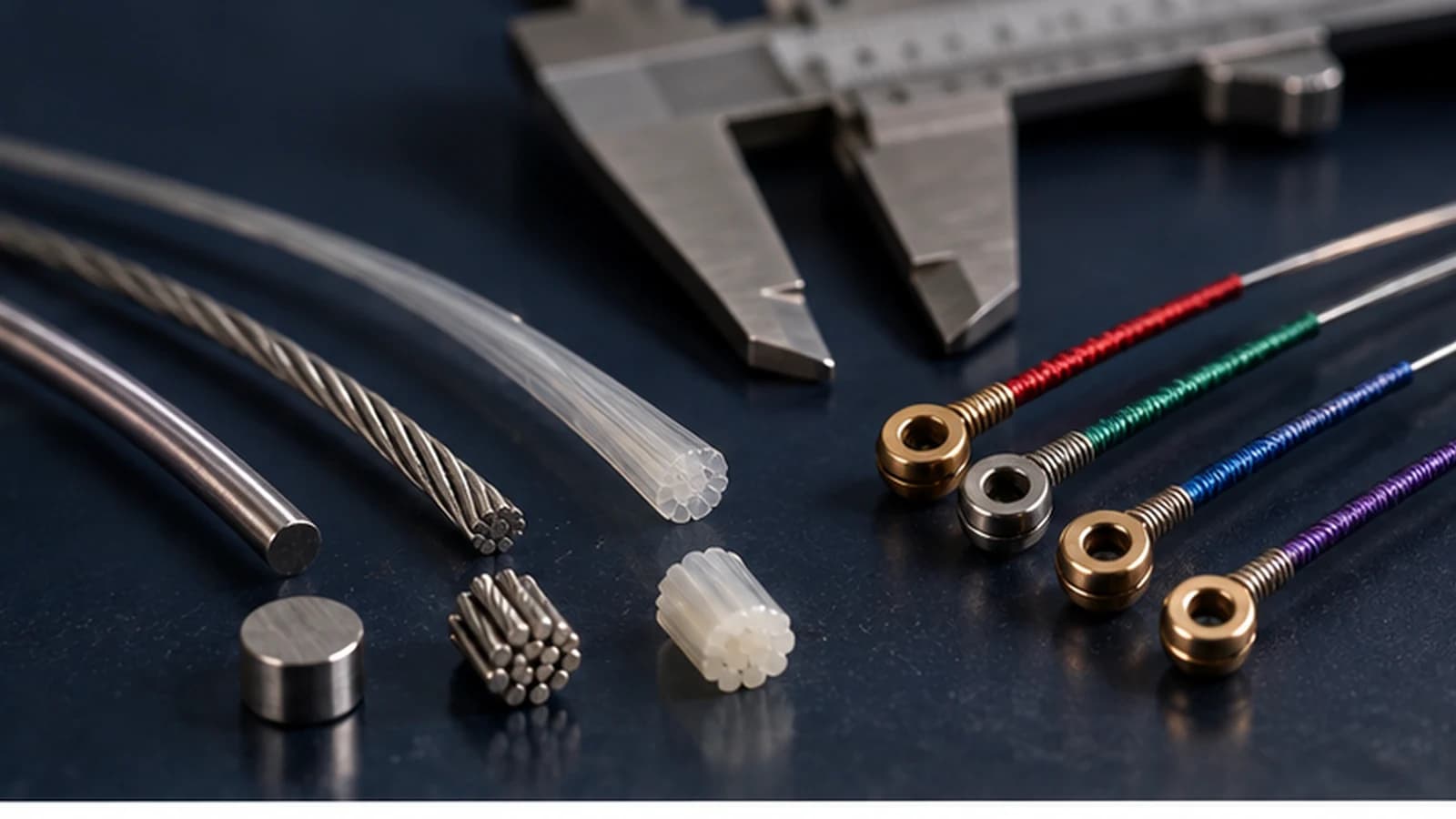
Calling a set “steel” can hide an important difference. A solid steel core uses a single steel wire. A stranded steel core uses multiple fine steel wires combined into a cable-like core. A synthetic core uses engineered fibre or polymer material. Each position may also have a different outer winding, plating or end construction.
Separate core from outer material
The core carries a central mechanical role, while the outer layer helps create mass, surface and playing characteristics. A buyer should record both. “Aluminum wound” alone does not reveal whether the underlying core is steel or synthetic. “Synthetic violin strings” alone does not identify the winding of A, D and G or the construction of the E string.
For gut-string comparisons, see the gut violin string core and winding guide.
Use a position-by-position matrix:
| Position | Core material and form | Outer material | Diameter/gauge | Tension label | Tailpiece end | Length data |
|---|---|---|---|---|---|---|
| E | Project-specific | Plating or winding if applicable | Proposed value | Approved term | Ball, loop or approved format | Overall and usable length |
| A | Project-specific | Proposed winding | Proposed value | Approved term | Approved format | Overall and wound length |
| D | Project-specific | Proposed winding | Proposed value | Approved term | Approved format | Overall and wound length |
| G | Project-specific | Proposed winding | Proposed value | Approved term | Approved format | Overall and wound length |
Do not turn tendencies into guarantees
Steel core families are often selected when buyers want quick response, focused articulation or shorter stabilization. Synthetic families are often selected for a more flexible feel or a different complexity of response. These are useful directions for sample planning, not universal promises. A solid steel set and a stranded steel set should not be combined under one unqualified “steel sound” claim.
Give each SKU a commercial role
A range becomes easier to sell when every set solves a recognizable customer need. The launch plan might include a durable, direct-response reference for education or rental channels and a synthetic-core alternative for players seeking another feel and response direction. That is a planning hypothesis; it needs channel data and coded sample review.
Review the real channel
Use the buyer’s own evidence: current string sales, violin sizes, school or rental requirements, teacher requests, replacement frequency, price bands, returns and staff ability to explain the difference. Without history, define a limited launch assortment and a review date. Do not invent demand or claim that one construction is universally preferred by students or professionals.
The range decision should answer:
- Who is the primary user for each SKU?
- Which violin sizes are required?
- Is the difference clear enough for retail staff to explain?
- Are single replacement strings needed?
- Does each SKU have a distinct packaging identity?
- Can the buyer hold enough stock without duplicating slow variants?
Prepare samples that can be compared fairly
Samples should be coded so testers are not guided by a finished marketing label. Use representative violins, document their size and setup, and install each set according to the same procedure. Allow an appropriate stabilization period for the construction before making a final decision, but do not publish a fixed break-in promise without product-specific evidence.
Use repeatable playing tasks
The review can include open strings, scales, repeated notes, crossings, soft and strong attacks, sustained notes, dynamic changes and tuning checks. Record each position separately. “Sample B responded more quickly on the D string of instrument 2” is more useful than “B sounds professional.”
Also record installation behaviour, tailpiece compatibility, peg length, surface condition and any winding transition issue. Fit problems should be resolved before tonal language is approved.
Convert the approved sample into measurable controls
Once a sample is approved, translate it into a revision-controlled specification. Depending on the project, documented fields may include material identity, core form, winding material, nominal diameter, wound length, overall length, end format, surface appearance, position order and packaging code. Tolerances and test methods must be agreed rather than added after production.
Do not rely on color alone to identify a construction. Silk, winding color and packet graphics can support recognition, but the SKU, written specification and lot records provide the traceable identity.
Handle mixed-construction sets carefully
A violin set can contain different position constructions. The E string may use a steel construction while lower strings use synthetic cores, for example. Therefore, a set should not be described from one position only. The approved matrix must show all four strings and their materials.
When a position changes, update the complete set revision, the single-string SKU when applicable, the artwork and the retained sample. Otherwise, a replacement string can silently diverge from the set it is meant to match.
Build packaging around clear explanations
Retail packaging should tell buyers enough to choose without reducing the product to unsupported adjectives. Identify violin size, tension designation, core family, four-string set or single position, end format and the essential installation information. Use a short, evidence-bounded description of the intended response direction.

Help dealers explain the comparison
A concise comparison card can separate construction facts from sample observations:
| Question | Steel-core direction | Synthetic-core direction |
|---|---|---|
| Core form | Solid or stranded steel, specified by SKU | Approved synthetic material or family |
| Range role | Direct-response or stability-oriented option when supported by samples | Alternative feel and response direction when supported by samples |
| What still varies | Winding, diameter, tension, size, setup | Winding, diameter, tension, size, setup |
| Evidence | Approved sample and project specification | Approved sample and project specification |
Avoid absolute wording such as “always louder,” “never whistles,” “lasts twice as long” or “works on every violin.” Those claims need defined methods and product-specific evidence.
Plan single-string and set inventory together
Dealers, schools and repair shops may replace one position rather than an entire set. If single strings are part of the range, connect each one to the same core, winding, size, tension and revision as the complete set. Use a distinct barcode and pack identity while retaining the construction link.
Inventory planning should account for different replacement rates by position without inventing a universal ratio. Start from the buyer’s records or a cautious launch quantity, then review actual demand. Mixing two revisions of the same position can create inconsistent customer experience and difficult complaints.
Compare quotations on the same matrix
Every supplier should receive the same instrument sizes, four-position construction, tension direction, end formats, length data, packaging scope, quantities, destination and sample procedure. Ask for product, set assembly, singles, sleeves, artwork, tooling, samples, inspection and logistics as separate items.
MOQ, sample cost and lead time depend on materials, sizes, number of positions, artwork variants and quantity. Request project-specific values and a validity date. Do not publish an unverified universal MOQ or delivery promise.
Inspect construction and identity before shipment
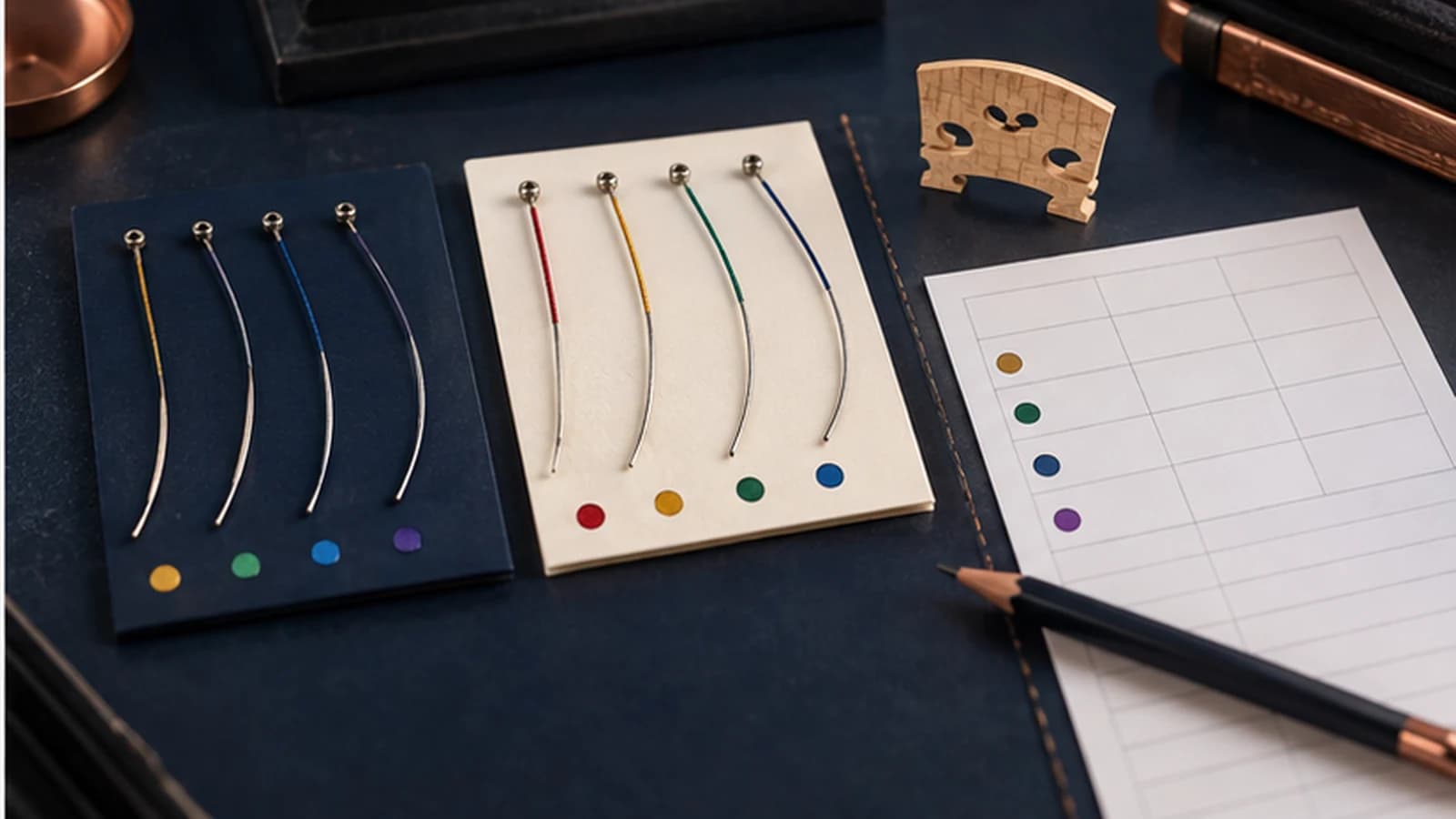
The shipment inspection should confirm purchase order, SKU, revision, size, E–A–D–G sequence, core and outer material identity, end type, appearance, key dimensions, set count, single-string count, packaging version, barcode and carton labels. Use an agreed sampling plan and open sets to compare contents with labels.
Retain photographs and measurements with the lot record. If a deviation appears, identify the affected SKU, carton, set and position. “Wrong core on D position in sampled sets” leads to clearer action than “strings are inconsistent.”
Shipment inspection checklist
- Purchase order, SKU and approved revision
- Violin size and tension designation
- E, A, D and G core construction
- Outer winding or plating identity
- Tailpiece end and usable length
- Diameter and wound-length checks where agreed
- Set and single-string counts
- Inner envelope, artwork and barcode
- Carton, lot, sample and deviation records
Compare core construction before selecting samples
For a sample shortlist, confirm the core construction: solid steel uses one steel wire, stranded steel uses multiple fine wires, and synthetic core uses engineered fibre or polymer material. Response depends on the full construction and instrument, so compare each proposed set with its complete specification.
For product options, see the Folk & Orchestral category. Use the violin wholesale specification guide to define the information needed for a supplier inquiry.
Keep tension, size and core claims separate
A buyer may be tempted to use core family as a shortcut for every other characteristic. That creates weak specifications. Tension must be stated for a defined size and tuning; size must be tied to playing length; the core must be documented by position. A “medium synthetic” set and a “medium steel” set do not become directly comparable because both use the same tension word.
Ask how a published tension value was obtained
If a proposal includes numerical tension, request the scale length, pitch, calculation or test method and relevant conditions. A number copied from another construction is not a project result. Keep units consistent and retain the source with the revision.
For sample comparison, the buyer can evaluate perceived resistance and response without publishing a numerical claim. Label observations by instrument and position. If numerical acceptance limits are later required, agree the method before production and confirm that the equipment and sampling plan are suitable.
Core choice also does not decide the tailpiece end automatically. Record ball, loop, removable ball or other approved format for each position. The E string may differ from A, D and G. Product images, replacement packs and instructions must match the physical configuration.
Diagnose market feedback instead of repeating adjectives
When dealers report that a set is “too bright,” “slow” or “unstable,” collect the surrounding facts: SKU, lot, violin size, setup, installation date, affected position, tuning history and comparison product. These words are useful signals, but they are not a root cause.
Compare the returned or retained string with the approved specification. Check position identity, diameter, winding appearance, end format and length. Review whether the customer expected solid steel, stranded steel or synthetic construction. A packaging description that hides the core family can create a selection problem even when the string matches specification.
Maintain claim records
For every marketing statement, keep the supporting source: construction definition, approved sample observation or formal test. State the scope. “Reviewers found sample B quicker on two documented violins” is not equivalent to “quickest response on any violin.” Public copy should use the level of certainty the evidence supports.
Translated packaging and product pages need the same limitation. Localize the technical meaning rather than intensifying the claim. Terms such as steel core, stranded steel and synthetic core should be consistent across the category page, article, packet and inquiry brief so customers and search systems receive one coherent description.
FAQ
Are synthetic core violin strings always warmer than steel core strings?
No. Core family influences the design, but winding, diameter, tension, violin, setup, bow and player also affect the result. Treat “warmer” as a sample direction, not a universal guarantee.
Is stranded steel the same as solid steel?
No. Solid steel uses one wire; stranded steel combines multiple fine wires. Record the exact core form in the SKU specification.
Do steel core strings always last longer?
Do not make a universal lifetime claim. Usage, corrosion exposure, winding, maintenance and construction all matter. Publish durability claims only with a defined product-specific test.
Can one set mix steel and synthetic positions?
Yes, mixed construction exists in the market. That makes a four-position matrix essential. Describe every string rather than labeling the complete set from one position.
Should a new brand launch both core families?
Only when each has a clear customer role and the channel can support the inventory. A smaller range with distinct, tested choices may be stronger than two poorly differentiated sets.
What should I send for a quotation?
Send violin sizes, four-position core and winding matrix, tension direction, ends, lengths, packaging, quantities, destination and sample-approval process.
Conclusion
Steel versus synthetic core is useful only when the buyer defines the complete construction and range role. Separate solid steel, stranded steel and synthetic cores; document E, A, D and G; compare coded samples; approve evidence-bounded language; and keep specification, packaging and shipment inspection on one revision.
This discipline also protects replacement-string compatibility and gives dealers a more accurate explanation for each SKU.
Explore the StringCrest Folk & Orchestral string category, then send your violin core brief with sizes, four-position materials, target response direction and packaging requirements.
FROM GUIDE TO PRODUCT
Connect this guide to Folk & Orchestral Strings.
Review the relevant range, then bring the instrument, complete specification and open questions into one project brief.
YOUR PRODUCT · YOUR BRAND
Discuss your next string project with Frank.
Share your instrument category, target market, gauge or material direction and private-label packaging requirements.

ABOUT THE AUTHOR
Frank Zou
Frank works directly with musical-instrument brands, importers and distributors on string specifications, product selection and private-label project requirements.
Meet Frank