
Wholesale Planning
Wholesale Planning
Gut Violin Strings: A Core and Replacement Guide for Dealers
A gut-string family can contain different constructions. Identify plain gut, wound gut core and the exact E before selecting a violin set or replacement.
Introduction
Gut violin strings can be plain gut or metal-wound strings with a gut core. A set sold within a gut-string family can also include a steel E. For a dealer or importer, the useful selection question is therefore: what is the construction of the exact string being requested, and does it match the customer's violin and intended configuration?
A family name cannot answer that for all four positions. Record the E, A, D and G separately, including any plain or wound construction, declared materials and tailpiece end. Then distinguish an exact replacement from a proposed construction change. The examples below explain those decisions; they do not establish a StringCrest gut-string SKU, available supply or tested result.
Separate plain gut, gut core and the complete set
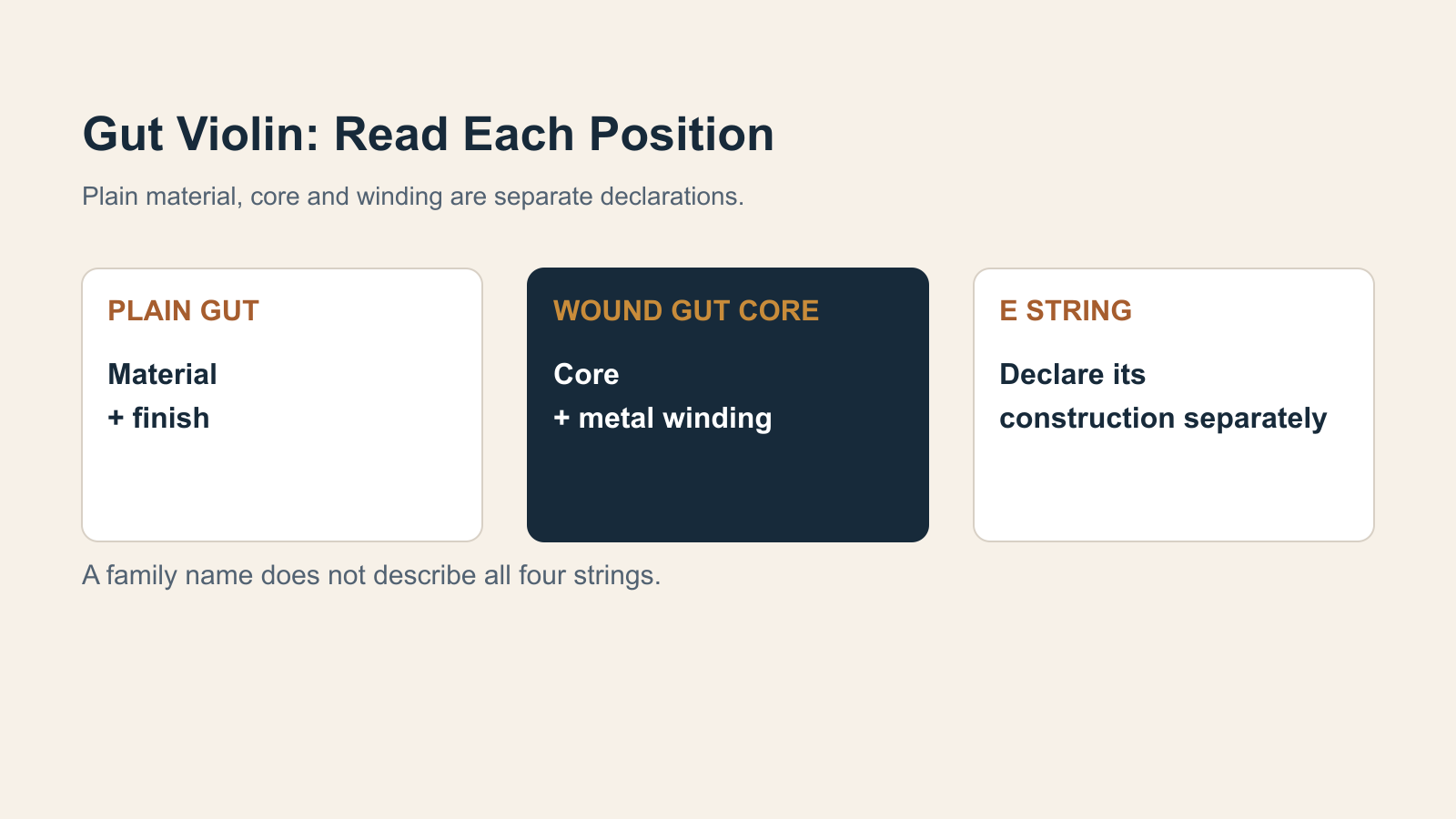
Plain gut identifies a string without a metal winding around the gut. It does not, by itself, describe every finish or treatment. Ask for those separately. Wound gut core identifies the underlying gut and the surrounding winding as different construction fields. The metal named on a packet may describe that winding rather than the core.
Neither description completes a set specification. A steel E can belong to a set whose other strings have gut cores. “Plain E” also needs a material: plain steel and plain gut are different constructions. Do not shorten either to an ambiguous “plain.”
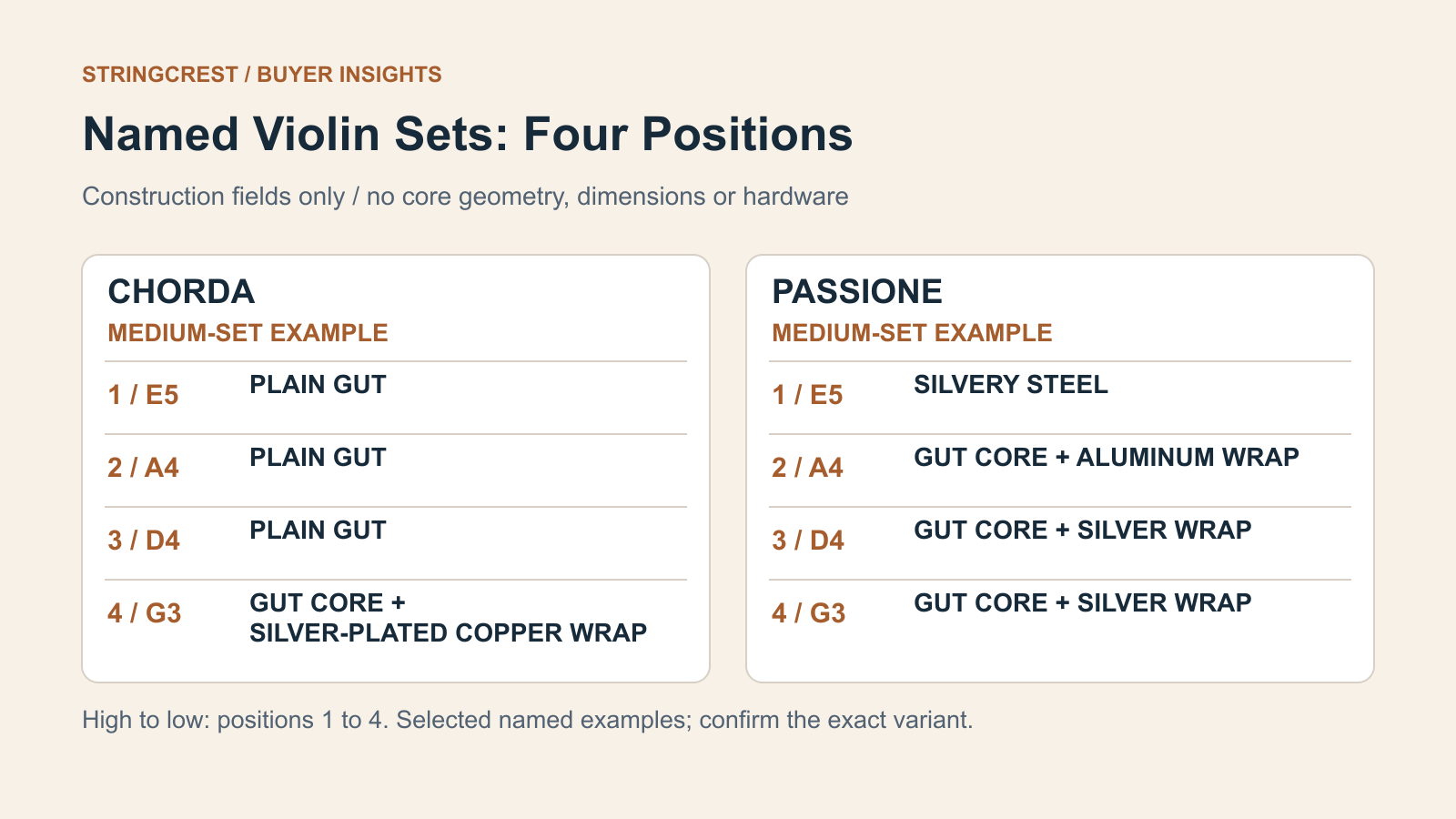
Pirastro provides two clear violin-specific examples. Its Chorda violin page identifies the medium set's E, A and D as plain gut, with a G wound in silver-plated copper wire. Its Passione violin page identifies a medium set containing a Silvery Steel E and gut-core A, D and G with different windings.
These are the selected configurations on those pages, not an instruction to combine components or assume every variant in either family is unchanged. Retain the actual item reference and current specification when selecting a replacement.
| Position | Chorda medium-set example | Passione medium-set example |
|---|---|---|
| E | Plain gut | Silvery Steel |
| A | Plain gut | Gut core / aluminum winding |
| D | Plain gut | Gut core / silver winding |
| G | Gut core / silver-plated copper winding | Gut core / silver winding |
This comparison shows why a request for “a gut E” deserves clarification. The customer may want a plain-gut E, or may mean the steel E supplied with a familiar gut-core set. Those requests should lead to different identified components.
Begin a replacement request with the current configuration
Ask for the violin, its stated size, the current set and the affected position. Keep the original envelope or an identifiable product reference where available. Establish whether the player wants the same component again, a different gauge or variant, or a move between plain gut, wound gut core and another construction.
For the standard four-string reference here, positions 1–4 run from highest to lowest: E5, A4, D4 and G3. Yamaha's violin and viola comparison gives those violin octave notes. They identify the positions; they do not select a gauge, reference pitch, material or end. Record any different intended tuning explicitly.
A proposed change should identify the three retained strings as well. Replacing one D may alter only that component, while a move to a different four-string configuration changes more of the comparison. A shop should be able to tell the player which decision is being made before promising a result.
Use three working descriptions:
| Request status | What the dealer can establish | What remains to resolve |
|---|---|---|
| Exact replacement identified | Same documented item/revision and selected size, gauge/variant and end | Actual instrument condition and any changed hardware or use |
| Construction or variant change proposed | The intended differences and retained components are written down | Suitability, installation requirements and evaluation scope |
| Identity unresolved | A position or family is known, but the exact component is not | Missing item, construction, variant or hardware information |
These are documentary selection states. “Exact replacement identified” is not an installation result or a diagnosis of the instrument. Do not turn a missing entry into an assumed match because two strings have the same note or printed diameter.
The existing steel-versus-synthetic violin guide covers those broader construction families. For this request, keep the distinction between plain gut and wound gut core visible rather than treating all non-steel choices as one alternative.
Record the end independently of the core
Gut does not specify a universal tailpiece end. In the Passione violin example, Pirastro lists ball ends for A, D and G, with ball or loop E options. Its Eudoxa violin page instead lists a ball on A, knots on D and G, and ball or loop E options. Chorda's page lists E, A and D without knots and G with a knot.
Those differences belong to the named products. A catalog entry saying “without knot” is not a dealer instruction for making one. Nor does a ball designation authorize removal or conversion. Obtain the exact product's instructions and identify the retaining hardware on the actual violin.
The violin end and tailpiece-fit guide explains the separate ball/loop retaining-interface question. Use that record when applicable, while keeping knot or other end requirements specific to the proposed string. A familiar core or family name cannot approve an unknown end-to-hardware match.
Record usable length and construction transitions separately from instrument size. The string must suit the actual route from its tail-end seating point, over the bridge and nut, to the peg. A nominal size label does not supply every path measurement or establish where winding and silk will lie. Follow the maker's applicable guidance rather than a universal trimming or winding rule.
Use a four-position construction and selection record
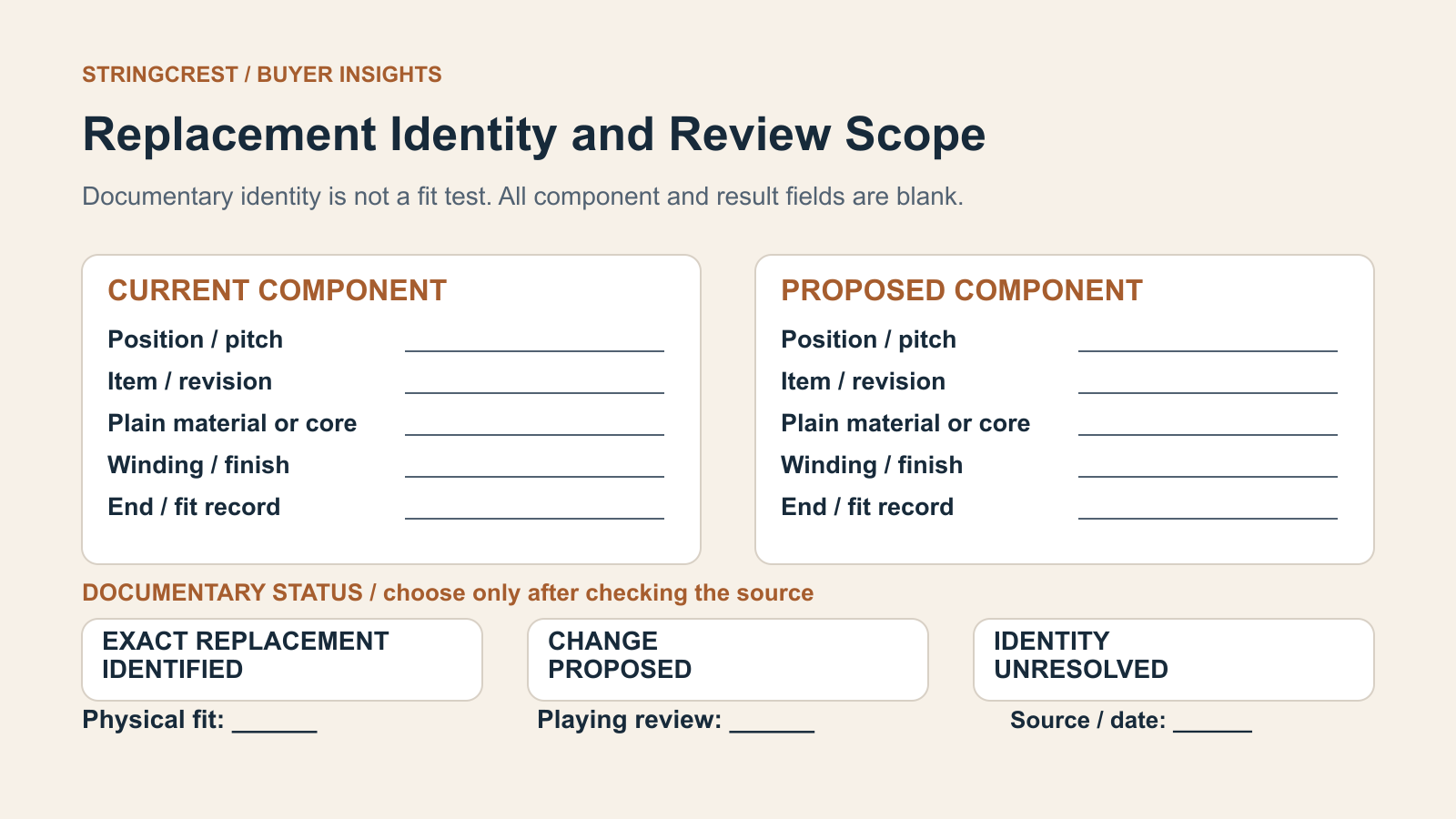
The following is a blank planning record for one proposed configuration. The pitch column is the standard reference above; all product fields need the actual supplier or maker information. It is not an approved product sheet or a completed sample trial.
Violin ID / stated size / setup reference: ______
Current four-component list: ______
Requested change and target tuning/reference pitch: ______
Proposed configuration / document revision: ______
| Position, high to low | Pitch | Exact component / variant | Plain material or core | Winding; finish/treatment | End and length/fit reference |
|---|---|---|---|---|---|
| 1 | E5 | ______ | ______ | ______ | ______ |
| 2 | A4 | ______ | ______ | ______ | ______ |
| 3 | D4 | ______ | ______ | ______ | ______ |
| 4 | G3 | ______ | ______ | ______ | ______ |
Keep the maker's gauge designation and unit, or its tension designation, with each component reference. Do not convert a family-specific gauge code into a presumed finished diameter, or treat two makers' “medium” labels as equal numerical tension. Obtain the applicable product data if that comparison is necessary.
For a confirmed plain string, enter “no metal winding” in the winding field. An unanswered field remains unknown. Finish and treatment need their own declaration; an unwound string should not automatically be described as untreated.
Link every row to its current specification source and any applicable fit record. Mark documentary identity, physical fit and playing review separately. A supplier page can identify construction without showing that anyone has installed the proposed combination on this violin.
Plan the trial around the actual change
Before moving between constructions, ask an appropriate violin technician to assess any relevant nut, bridge, peg or tailpiece issue. Pirastro's string manual identifies rough contact surfaces as potential sources of damage and refers necessary adjustments to a luthier. Do not file a groove, alter an end or force a string into place to make an unidentified replacement fit.
If strings are changed, follow the applicable maker and instrument guidance. Pirastro's manual instructs replacing one string completely before changing another to maintain tension. Uncertain bridge position, attachment support or setup work belongs with a qualified technician. This article supplies no knotting, bridge-adjustment or conversion procedure.
During an actual trial, record the component identities, violin, installer, date, setup changes and relevant conditions. Include temperature or humidity observations when available, together with the tuning-check times. Pirastro's manual advises avoiding dramatic environmental changes for its gut strings; that guidance does not establish a universal settling deadline, lifespan or storage claim for another product.
Choose tasks relevant to the requested change: open and stopped notes on the affected string, crossings to adjacent strings, and response under the player's intended bowing. Keep fit observations, tuning observations and player preference separate. If the whole set, bow, setup or room also changes, record that limitation rather than assigning every difference to the core.
The violin sample-approval guide provides the broader trial record. Here, its purpose is to keep the actual plain/wound/gut/steel identities and the scope of this particular change traceable. It does not supply gut-string test results.
Keep the retail description within the evidence
For an importer or dealer, a useful item description combines violin size, position or complete-set identity, exact variant and end. A mixed set should have all four constructions available to staff, so its category name does not become a claim that every member is plain gut.
Suppose a customer asks for “the same gut D,” but the reference describes a silver-wound gut-core D and the proposed replacement is plain gut. That is a hypothetical construction change, not an exact replacement established by the shared D label. Resolve the proposed use and installation requirements before recommending it. This is an educational example, not a StringCrest service case or sample finding.
The folk and orchestral strings category is a discussion entry point. It does not confirm a StringCrest gut-string range, replacement availability or proposed material specification. Keep any actual supply decision tied to the project confirmation.
FAQ
Does a historical or Baroque label establish the tuning reference?
Record the intended tuning and reference pitch with the exact components. A historical application label alone does not select those conditions. Chorda publishes product-specific tuning guidance on its violin page; follow the current instructions for the selected variant and seek maker or technician advice about a different setup. Do not retune an unidentified existing string to discover whether it is suitable.
Conclusion
A gut-string selection becomes useful when each position has a clear material and construction identity. Establish whether the request is an exact replacement or a change, then resolve the end, fit and review scope for the actual violin. Leave unknown fields open until the appropriate source or assessment answers them.
FROM GUIDE TO PRODUCT
Connect this guide to Folk & Orchestral Strings.
Review the relevant range, then bring the instrument, complete specification and open questions into one project brief.
YOUR PRODUCT · YOUR BRAND
Discuss your next string project with Frank.
Share your instrument category, target market, gauge or material direction and private-label packaging requirements.

ABOUT THE AUTHOR
Frank Zou
Frank works directly with musical-instrument brands, importers and distributors on string specifications, product selection and private-label project requirements.
Meet Frank