
Wholesale Planning
Specifications & Fit
Violin String Identification: A Wholesale Color-Code and Labeling Guide
A wholesale identity-control guide for complete sets, replacement singles and uncertain returns, with manufacturer-specific color-code boundaries.
Introduction
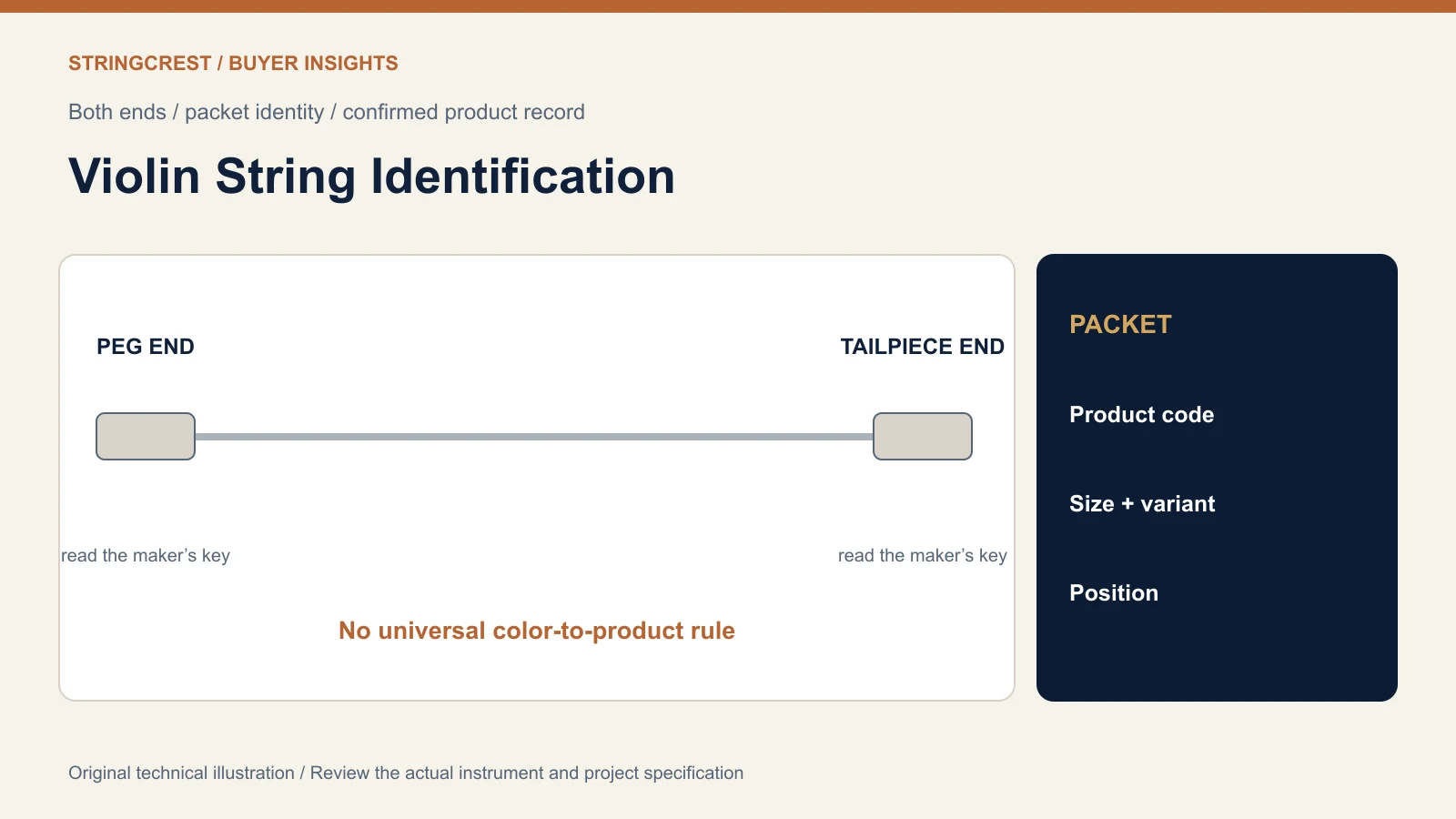
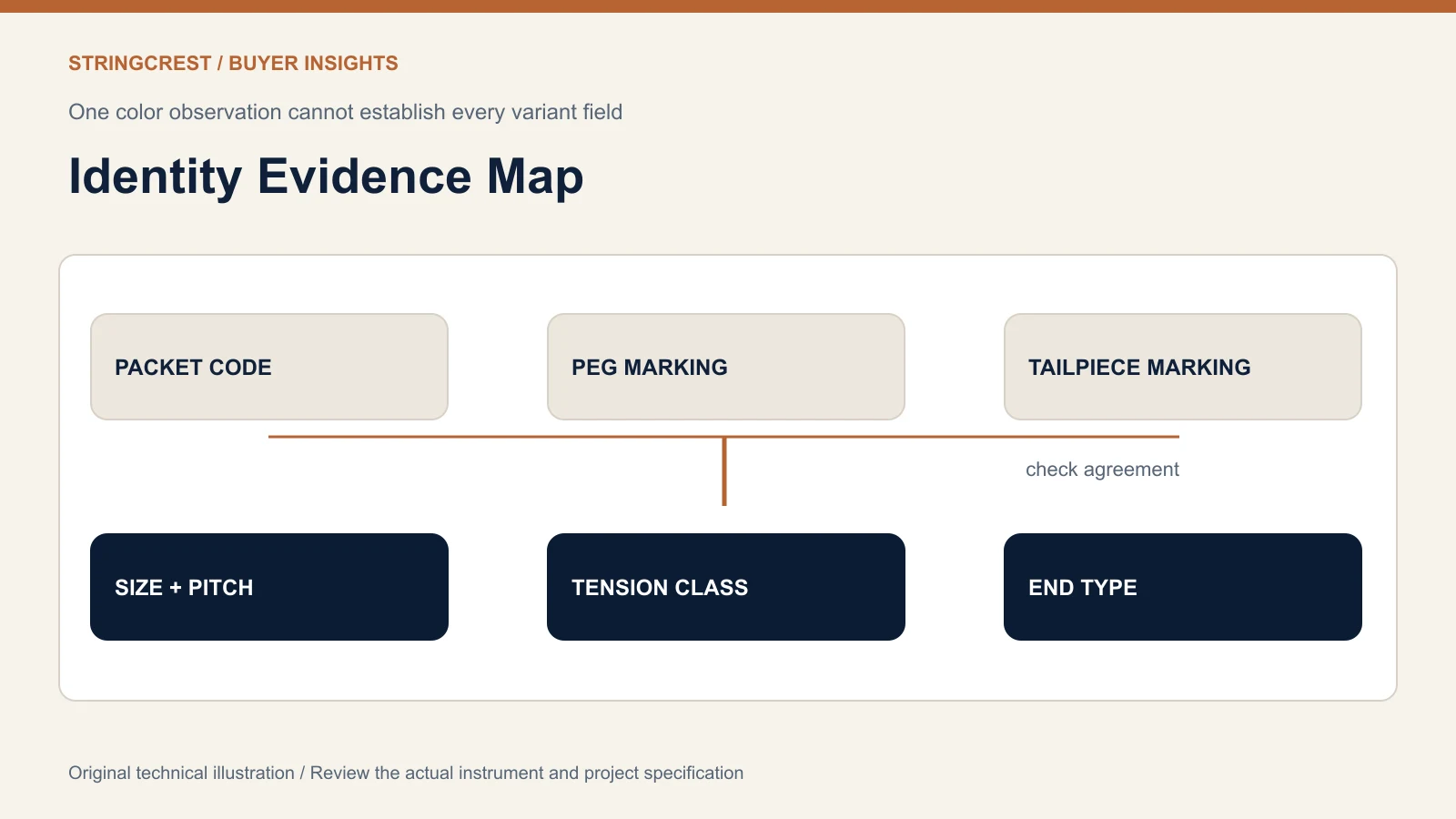
Identify a violin string by combining its packet or product code, instrument size, intended pitch, construction, end type and the manufacturer's current identification chart. Silk color can help, but there is no universal color-to-pitch or color-to-product rule that should be applied across all makers. An unknown loose string should remain unverified when the available evidence cannot establish its identity.
For distributors and music retailers, identification affects more than an installation question. It determines whether a single-string replacement belongs to the intended product, whether mixed stock has been repacked correctly and whether a customer receives the right size or end construction. A mistaken assumption can survive into shelf labels and reorder records.
This guide explains how to organize identification evidence and build clearer private-label labeling. It covers the two ends of the string, packet information, variants, receiving checks and uncertain returns. It does not reproduce competitors' color charts or invent a color system for StringCrest products.
Use the folk and orchestral string category to begin an instrument-specific inquiry. Final violin size, materials, tension designation, string positions and supplied end construction need confirmation. A generic illustration cannot establish those product facts.
Establish the identification question first
Ask whether you are identifying an installed string, a loose unused component, a single-string packet or a complete set. These provide different evidence. A sealed packet with a traceable product code is not equivalent to a used string whose outer wrapper has been discarded.
Also clarify what the customer needs to know. Identifying pitch is different from confirming the manufacturer and model, and neither necessarily confirms tension class or instrument size. A support answer can be partly known without resolving every field.
Record each question separately. If the intended position is known but the product line is uncertain, do not report the whole identity as confirmed. If a packet identifies a model but the component inside has an unexpected end, hold the mismatch for review.
For a retailer's replacement request, capture the instrument and the existing set where possible. The objective is the correct component for the intended application, not a confident name assigned to an ambiguous photograph.
Look at both ends of the string
Peg-end information
A maker may use silk near the peg to indicate pitch, tension or another distinction. Its location and any bands or patterns can matter. Record what is visible without transferring the interpretation from another brand's chart.
Tailpiece-end information
The other end may provide product-line information, construction details or a different part of the coding system. Distinguish the colored wrapping from the physical anchor. A silk color and a ball or loop are separate observations.
The manufacturer-specific key
D’Addario's orchestral silk chart explains its own use of peg-end pitch and tension information and tailpiece-end product identification. It demonstrates why both ends matter. It does not establish a shared industry code or tell buyers how a StringCrest set is marked.
A photograph showing only one end may omit the field needed to distinguish variants. Request the second end and packet information before guessing. If a wrapping is worn or incomplete, record that limitation instead of selecting the nearest-looking color in a chart.
Describe color and pattern as observations
Use neutral descriptions such as a solid color, a banded section or a repeated pattern. Include where the feature occurs relative to the end. Do not make the color description carry an interpretation before the applicable reference has been found.
Photograph under neutral, consistent lighting. Warm illumination, reflections and automatic image processing can change apparent color. Keep unedited originals alongside any annotated copies. A support collage should identify which views belong to the same component.
Ask for enough detail to distinguish a narrow band from the main wrapping. A blurred image can make two patterns look alike. Additional views may improve the observation, but even a sharp photograph cannot provide every product fact.
Avoid forcing a match when a chart and photograph disagree. Possible reasons include an incorrect reference, an unlisted variant, worn markings, repackaging or a different product. The disagreement is a review item, not permission to choose the closest commercial model.
Treat the packet as a structured identity record
Check the instrument family, size, product or set code, string position, tension designation and end type. Retain any supplier or lot reference provided. An attractive front label can identify the brand while leaving a replacement buyer without essential variant information.
For a complete set, compare inner envelopes with the outer packet. The same product family may contain component variants that need position-specific identification. Keep the envelope and string connected during receiving inspection.
If a packet has been opened, consider its history. A dealer or player may have inserted another string for storage. The packet is valuable evidence, but an uncertain repacking history limits what it proves about the loose component inside.
| Identity field | Preferred evidence | Common limitation |
|---|---|---|
| Product line | Traceable packet or manufacturer code | Similar wrapping across unrelated products |
| Position and pitch | Component label plus applicable chart | Note assumed from one color |
| Instrument size | Confirmed SKU specification | Size guessed from a loose coil |
| Tension designation | Current product record or maker's coding key | Descriptive term treated as a measured force |
| End construction | Clear component view and agreed specification | Color mistaken for anchor compatibility |
| Revision or lot | Supplied reference and purchasing record | Mixed stock without original envelopes |
The purpose of the table is to identify evidence sources, not to rank every packet as sufficient. Confirm that the physical component and its document refer to the same item.
Separate pitch identity from size and tension
A string intended for one pitch can be supplied in different instrument sizes or tension classes. Knowing the pitch therefore does not complete a replacement specification. Capture the other required fields before purchasing or fitting a component.
Do not estimate size from the diameter or coil appearance. Installed length, construction and supplier naming conventions need appropriate product information. The violin size guide provides a separate framework for specifying the intended instrument.
Likewise, a tension-class word is not a measured tension value. Confirm how the supplier defines the class and which product it describes. A color band interpreted correctly within one manufacturer's chart should not become a numerical force claim without supporting data.
Confirm end construction independently
A tailpiece or fine-tuner system has physical requirements that color does not establish. Record the supplied end and the intended instrument's attachment needs. An identification answer is incomplete when the named product still has an unresolved fit question.
Pay particular attention to component variants that share a product family while differing in end type or construction. Request clear photographs and supplier documentation. Do not assume every option in a named range is interchangeable.
The ball-end versus loop-end guide addresses that compatibility issue separately. Use it with the identity record so the buyer does not confuse “we know which position” with “this is the correct component for this tailpiece.”
Never improvise an anchor modification to make an unidentified string fit. Seek appropriate product confirmation and competent instrument assistance when the attachment is unclear. Preserving the component also keeps the supplier review possible.
Make private-label identification independent of memory
Written position information
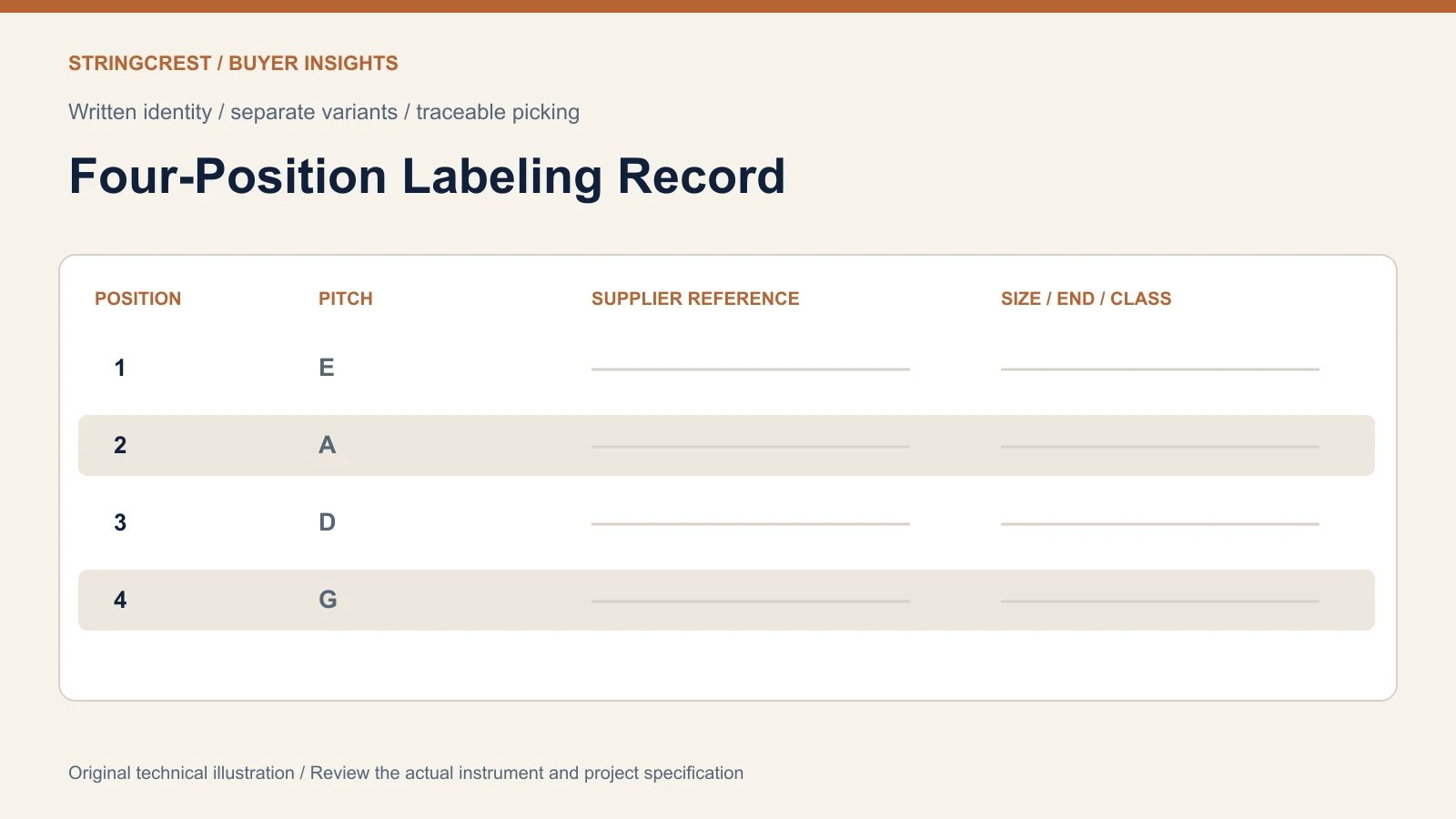
Use a clear position number and intended pitch in the agreed labeling system. State the orientation where misunderstanding is likely. A dealer should not need to remember a color rule to find the intended component.
A controlled product code
Tie the inner envelope to a product code that resolves to size, construction and other necessary variants. If the same short label is used for several sizes, provide the additional field that distinguishes them. Avoid creating different products with indistinguishable shelf identities.
Color as a supporting signal
If the project adopts colors or patterns, agree their meaning, location and scope. Confirm how they will be checked and how changes are communicated. The code is project-specific until the responsible supplier documents it; this article supplies no universal assignments.
These layers should reinforce one another. Written identity helps when color is hard to distinguish, while an agreed visual marker can make a handling error easier to notice. Neither should contradict the component master.
Prepare a controlled identification reference
Create a reference linked to the approved SKU revision, not merely a picture of a mixed assortment. Include both ends, packet views and the fields the viewer is expected to identify. Describe any variants that require additional information.
Use sample photographs from the actual approved product when they are available. A diagram can explain where to look, but it should be labeled illustrative and should not pretend to be a verified sample image. Keep conceptual artwork separate from the approved identity record.
Date or revision the reference and give dealers a stable way to access it. A QR code on a packet is useful only if its destination remains available and clearly identifies the applicable version. Retain superseded references for historical claims without using them to approve current stock.
Review translations of the identity fields as part of packaging development where multilingual labels are needed. Pitch symbols and codes should not change accidentally during language adaptation. This article itself is an English buyer guide and does not imply a translated product reference has been approved.
Check complete sets and single-string stock differently
For a complete set, verify that every expected position is present and that all envelopes correspond to the intended set. Opening several packets at once can make position mixing easier, so keep the inspection arrangement controlled.
For singles, the shelf code must identify the component without relying on an outer set packet. Include the relevant size, tension designation and end variant in the picking record. Staff should be able to resolve those fields before a customer opens the product.
Do not combine leftovers from different revisions to make a set that appears complete. If a repacking process is permitted, define the requirements and preserve component identity. A new outer label does not create traceability for unidentified contents.
The sets versus singles inventory guide explains the broader stock-planning decision. Identification control is what lets that assortment work reliably at receiving and picking.
Handle unidentified returns as a separate status
Keep an uncertain return apart from saleable, verified stock. Record the available packet, photographs and customer account. An unknown component should not be assigned to a product code simply to complete an inventory entry.
Ask for the missing evidence that could resolve the question. The relevant manufacturer chart may be useful when the maker and product family are plausible, but it is not a substitute for all missing history. Communicate what remains uncertain.
If identity cannot be established, retain that status in the review. Commercial support can be discussed separately without inventing a technical match. This protects later analysis from treating a guessed return as a confirmed report about a particular SKU.
Also distinguish identification from authenticity. Matching a color scheme can help describe a component but cannot prove its origin on its own. Supply-chain records and authorized product documentation remain important when provenance is the actual concern.
Use receiving inspection to catch contradictions
Compare component identity, inner envelopes and outer labeling against the approved master. Record the inspected quantity and selection method. One mismatched packet is an observation requiring action; it is not automatically a shipment-wide error rate.
If a visual marker changes, check whether the supplier notified the buyer and whether the reference was updated. The change may be intentional, but the delivered item and its current documents still need to agree. A color substitution should not be approved solely because the product name stayed the same.
Keep photographs and supplied lot information connected to the inspected packets. If a mismatch is found, hold the affected selection and agree the review scope. Avoid removing all labels and then asking the supplier to identify an untraceable pile of components.
For shipment inspection, the most useful check is often consistency between the physical string, packet and controlled specification. A sophisticated identification diagram cannot compensate for inconsistent pack-out or an unresolved SKU definition.
Review changes before the next artwork run
A changed size, end variant, tension designation or component construction may need revised packet information. Determine which fields, photographs and picking references must change together. Treat color assignments as part of that controlled system if the project uses them.
Ask dealers to review the practical clarity of the draft. Can staff distinguish the two most easily confused variants? Can a customer identify the intended replacement without opening every envelope? These questions are more useful than adding decorative color for its own sake.
Retain a proof showing the complete label sequence and product references. StringCrest packaging specifications can be customized to customer requirements, but the identity details must be agreed for the actual order. The current site states order lead time within two months of confirmation; MOQ and product availability remain order-specific matters.
FAQ
Is there one universal violin string color chart?
No. Use the relevant manufacturer's current chart and product record. The same apparent color can carry different meanings across makers or product families, and a single end may not show every identifying feature.
Can silk color identify instrument size?
Do not assume so. Confirm how the actual maker codes size and obtain the SKU specification. A pitch marker does not automatically establish the size, tension class or end variant.
Should a retailer identify a loose string from a photo?
The photo can support a review, especially when it shows both ends clearly. State the confidence and missing information. If the evidence does not establish identity, keep the component unverified rather than choosing the closest match.
Does a matching color prove a string is authentic?
No. A visual match is not complete provenance evidence. Retain purchasing and supply-chain records and use appropriate manufacturer information where authenticity, rather than position, is the question.
What should a private-label packet include?
Use the agreed product code, instrument size, position or pitch, necessary tension designation and end variant. The exact fields depend on the product master. Color can supplement written identity but should not replace it.
Can a dealer combine unidentified singles into a set?
Not as verified stock. A complete set needs confirmed component identities and an approved specification. Permitted repacking requires a controlled process, suitable labels and retained traceability.
Conclusion
Violin string identification is strongest when several evidence fields agree. A color observation should connect to the applicable reference, while packet code, size, position and end construction complete the replacement or purchasing decision.
For a wholesale range, build identity into the product master, envelopes and picking record from the start. Keep uncertain returns separate, update references when variants change and avoid converting a convenient visual guess into a confirmed SKU.
Explore folk and orchestral string requirements and Send Your Requirements. Include the instrument size, component positions, end requirements and labeling questions so the project can begin with a clear identity brief.
Sources and interpretation limits
- D’Addario orchestral silk color chart describes that manufacturer's identification scheme.
- D’Addario silking support explanation provides product-specific context for model, pitch and tension markings.
No competitor chart is reproduced or adopted as a StringCrest code. The reference and inspection recommendations are proposed buyer controls; they do not identify an unknown component or confirm an unapproved product specification.
FROM GUIDE TO PRODUCT
Connect this guide to Folk & Orchestral Strings.
Review the relevant range, then bring the instrument, complete specification and open questions into one project brief.
YOUR PRODUCT · YOUR BRAND
Discuss your next string project with Frank.
Share your instrument category, target market, gauge or material direction and private-label packaging requirements.

ABOUT THE AUTHOR
Frank Zou
Frank works directly with musical-instrument brands, importers and distributors on string specifications, product selection and private-label project requirements.
Meet Frank