
Folk & Orchestral
Specifications & Fit
Octave Mandolin Strings: A Course, Register and Fit Guide for Buyers
A dealer and importer guide to lower-register family identity, complete course-member records and fit enquiries.
Introduction
An octave-mandolin string enquiry needs the actual instrument model, intended register, course arrangement and complete position specification. A conventional example uses eight individual strings in four paired courses, but the word “octave” does not by itself instruct the buyer to order different octaves within each pair. Confirm the intended pitches for both strings in every course.
For a folk-instrument dealer, the practical decision is whether the customer is ordering an identified replacement or proposing a new configuration. For an importer, it is whether the sample, packet and replenishment code all describe the same instrument application. A standard mandolin packet or a familiar family name leaves that decision incomplete.
This guide explains how to build a useful octave-mandolin enquiry without assuming that every related instrument shares its tuning, length or end requirements. Manufacturer examples are attributed references. StringCrest feasibility and availability for a proposed specialist construction require separate confirmation.
Confirm which instrument the customer means
Ask for the maker, model and current configuration before selecting a string packet. Use the customer's instrument name as the beginning of the enquiry, then obtain the details needed to resolve it. Regional naming and related instrument families can otherwise make a short order description ambiguous.
Record string count, course arrangement and intended notes. If the customer is describing a mandola, bouzouki or another related instrument, verify its requirements individually rather than relabeling an octave-mandolin set. Similar appearance does not supply a complete application specification.
A photograph and an identified previous packet can help. Neither establishes every internal construction detail or the suitability of a proposed change. Keep the actual instrument record and the product identity linked throughout the enquiry.
The standard mandolin specification guide introduces an eight-string buying brief. The additional task here is to identify the lower-register application and prevent a family label from standing in for its complete requirements.
Separate register from the pairing inside a course
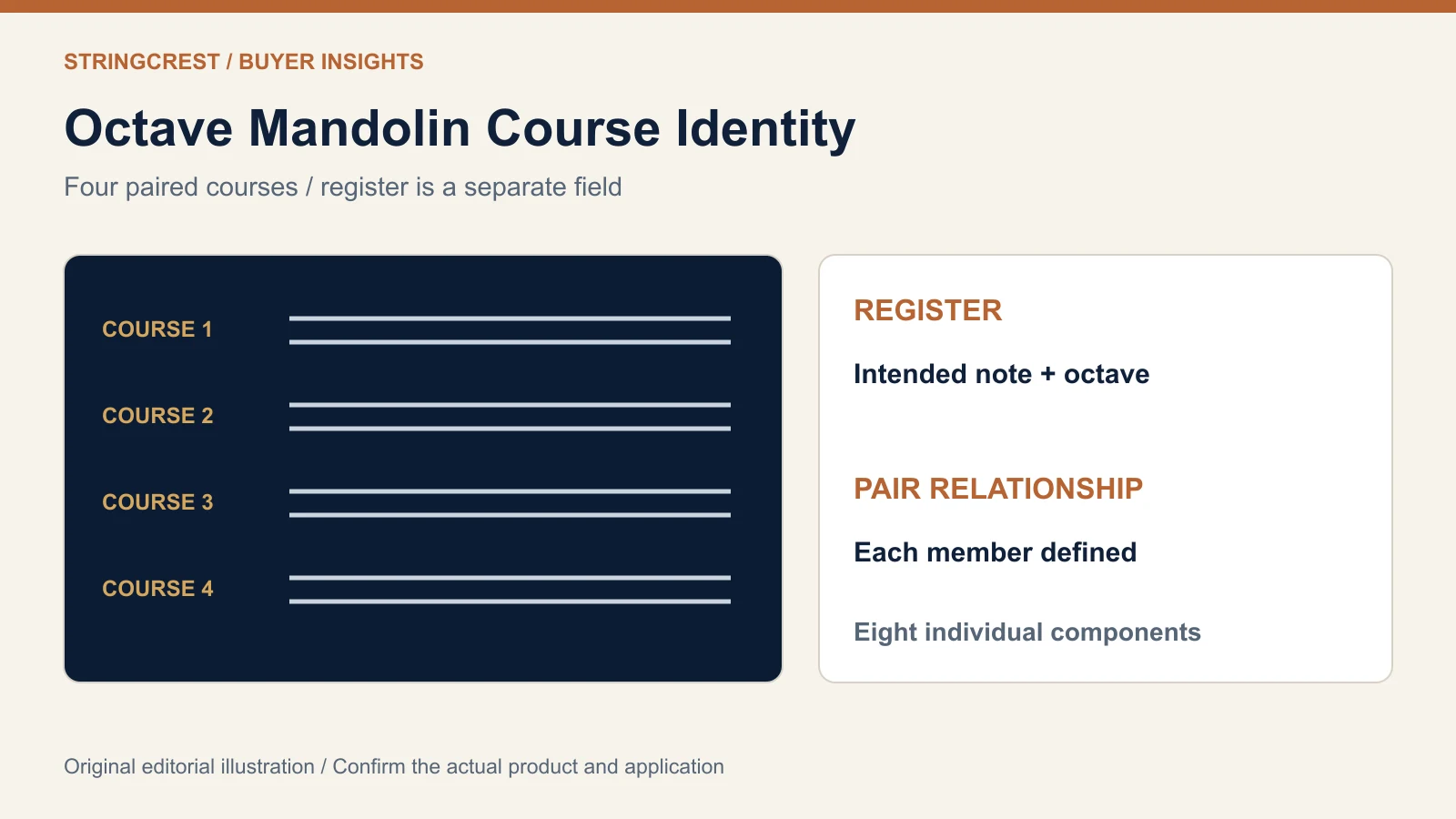
A course is a group of strings used together. The buyer needs to record the pitch and construction of each individual member rather than treating the course as one unspecified component. An instrument's register and the relationship between the strings in a pair are separate pieces of information.
D’Addario's octave-mandolin example lists eight strings. Its note entries show matched pairs at E4, A3, D3 and G2. Written low to high by course, that example is G2/G2, D3/D3, A3/A3 and E4/E4. It illustrates unison pairs within a named octave-mandolin set.
For a named register comparison, D’Addario's standard mandolin example lists G3/G3 at its low course, while the named octave example lists G2/G2. That illustrates a lower register with a matched pair, not an octave difference between the two members of the pair. The comparison identifies those products; it is not a retuning instruction for a customer's existing instrument.
Do not replace that information with a guess that each pair should contain one higher-octave string. If the customer wants an alternative pairing, document it as a proposed configuration and seek appropriate instrument and product review. The packet name alone cannot approve the change.
Write the ordering direction
State whether the position table runs from lowest to highest pitch or the reverse. Use consistent course and member identifiers across the specification, sample record and packet. Reversing an unexplained list can create a picking mistake even when all eight components are present.
Keep note and construction fields distinct
A note label identifies the pitch target, while gauge, core and winding describe the proposed component. A duplicated note within a pair does not prove that any two strings carrying that note are equivalent replacements. The actual component specification remains necessary.
Use an eight-position purchase record
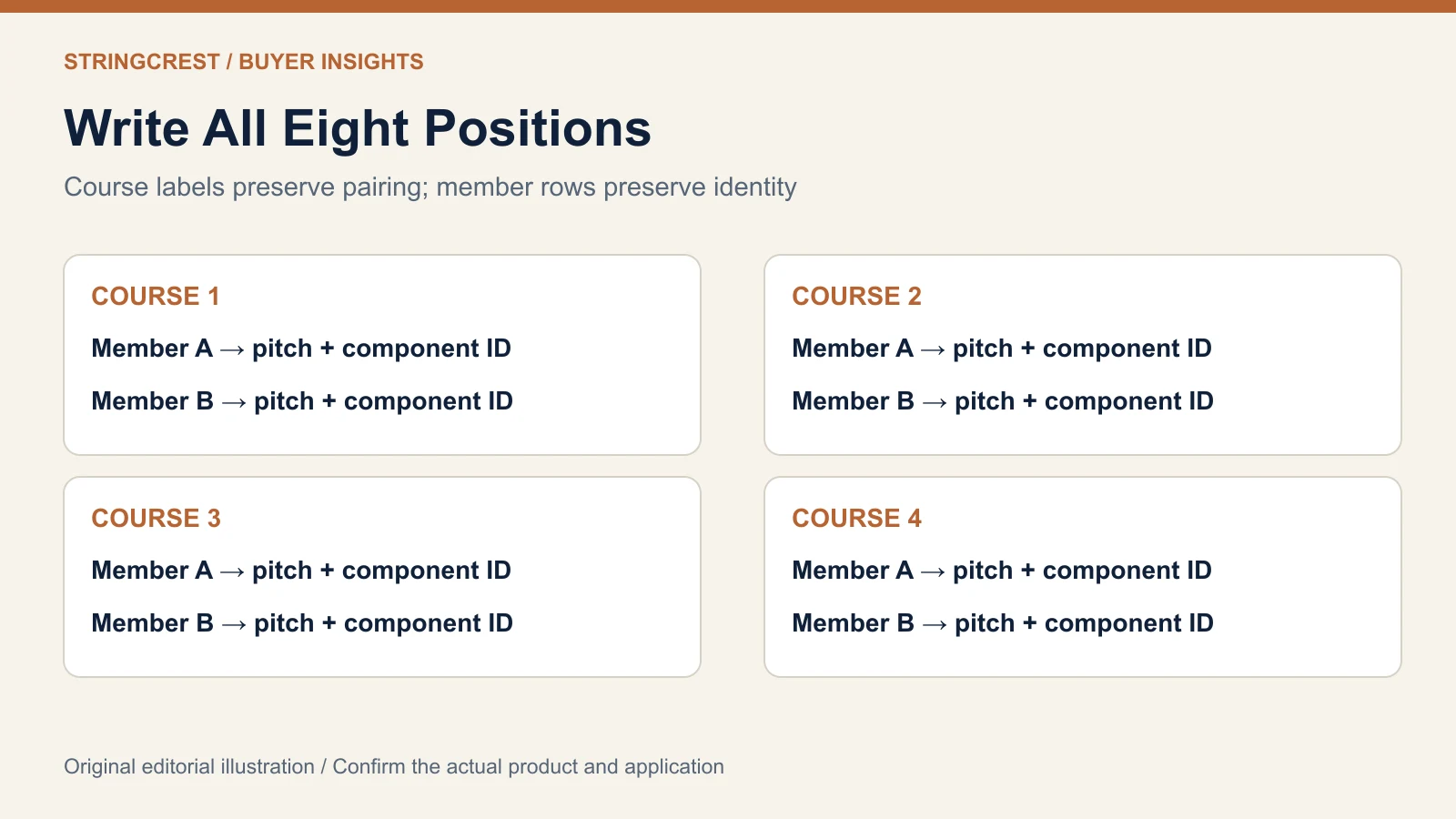
For the conventional four-pair example, keep eight individual rows. Each row should identify course, member, target note, gauge, plain or wound construction, material direction, end type and relevant lengths. The paired arrangement can be shown visually while retaining all individual identities.
A buyer should be able to compare the record with the actual packet contents. If two components are intended to match, specify that relationship rather than relying on staff to infer it from similar appearance. If the proposed construction differs within a pair, explain the reason and review its application explicitly.
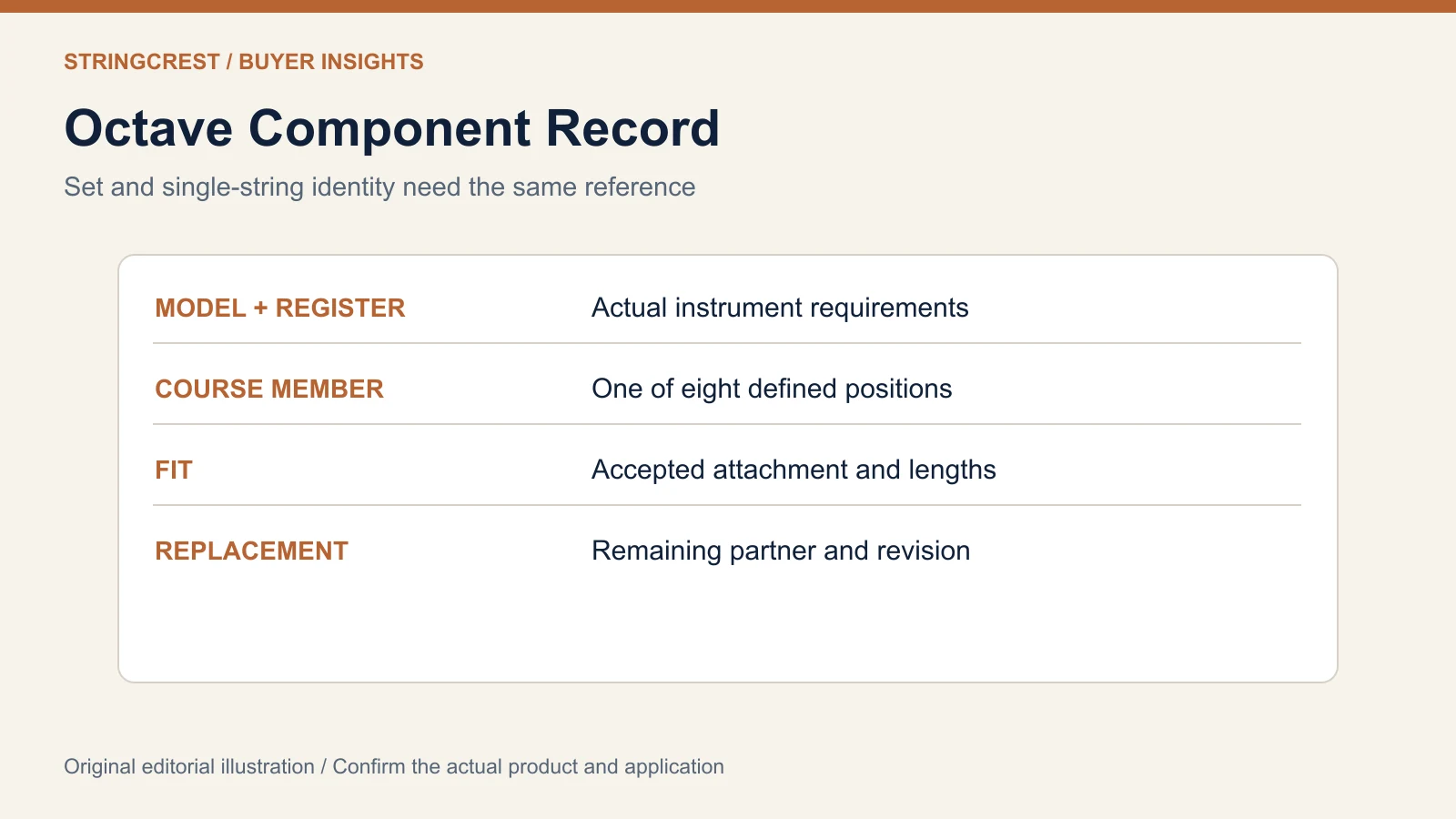
| Purchase field | What it controls | Why a course name is insufficient |
|---|---|---|
| Course and member | Each individual position | A paired course contains more than one component |
| Target pitch | Note and register | The instrument name does not identify every alternative tuning |
| Construction | Gauge, plain/wound and material direction | A note target is not a finished-string specification |
| Attachment | Required end and installation path | Related instruments can have different fitting requirements |
| Product revision | Accepted sample and artwork identity | A later substitute must remain visible |
Keep the internal enquiry clear about missing information. Ask for unknown instrument requirements before approving the specification instead of filling the gaps with another maker's product data.
Check speaking scale and the full installed path
The speaking scale is not the same as the supplied string length. The string still needs to follow the instrument's attachment route and reach its intended tuner with the allowance required by that hardware. Any relevant winding transition also needs a defined position in the installed path.
Eastman's octave-mandolin specification is an example of model-specific instrument information. Its published scale, hardware and named string reference describe that model. They are useful evidence to request comparable information, not universal dimensions for every octave mandolin.
For a wholesale sample, agree where each length is measured and include the reference points in the fit record. A total-length number without those definitions may be difficult to compare with the instrument or another supplier's declaration.
Check every position
The route to each tuner can differ. Verify the complete set rather than using one long component as proof that all eight positions fit. Preserve any position that fails the agreed installation requirement as a distinct fit concern.
Resolve fit before playing preference
A sample that requires an improvised attachment or uncertain winding placement is not ready for an ordinary response comparison. Obtain the appropriate installation assessment first. Keep that decision separate from the buyer's desired tone or feel.
Define the end construction without assuming universal fit
Confirm the actual tailpiece and end requirement. D’Addario's named octave-mandolin example uses loop ends, but that feature is information about the product. It does not prove that every loop design fits every tailpiece or that all related instruments need the same end.
The mandolin loop-end fit guide explains why the connection needs its own definition. For an octave project, use the intended instrument's geometry and installation procedure rather than copying the standard mandolin assumption.
Request clear instrument information when the fitting detail is unfamiliar. A close-up can document the connection, while a qualified installation assessment may still be needed to resolve condition or compatibility. Do not ask staff to bend an end into an improvised shape to complete a sample demonstration.
The finished packet should preserve the accepted end identity. A supplier's later substitution deserves review when it changes that interface, even if the course notes and first/last gauges remain familiar.
Keep gauge and tension questions product-specific
A printed gauge does not identify every internal construction feature or the conditions used for a tension value. When numerical tension is needed, request the proposed product's data with its defined pitch and scale assumptions. Another manufacturer's chart describes its own declared example.
The named octave set may provide a useful reference for a question or comparison. It does not establish the forces of a StringCrest sample, and it does not authorize changing a customer's instrument to the reference tuning. Verify the intended configuration with the appropriate maker information.
If a proposed sample changes gauge, material or pairing, record those changes together. The result may be a preferred finished configuration without isolating which change produced the observation. That limitation belongs in the development record before anyone turns it into promotional wording.
Avoid describing a set as appropriate for “all scales” without an actual application basis. A supplier may describe a range of intended uses, but the buyer still needs the instrument and installed-fit evidence for the application being ordered.
Plan a demonstration around the buyer's real question
Define whether the review concerns an equivalent replacement, a different playing response or a proposed new specification. Those aims can require different comparisons. An identified reference helps keep the sample discussion anchored to the actual question.
Use the intended instrument and relevant playing task after fit and setup are approved. Ask the reviewer about the complete set and the paired courses involved in the task. A favorable comment on one isolated component cannot establish the response of all four courses.
Keep the listening arrangement and interventions in the notes. If the instrument was adjusted or several construction features changed, say so. A later reviewer should be able to distinguish the original sample identity from the final installed configuration.
Preserve a disagreement usefully
If one reviewer prefers the reference and another prefers the candidate, record the tasks and reasons. An importer may then narrow the intended range role or request a more specific comparison. A disagreement does not need to be converted into a fictional average score.
Answer a common replacement enquiry
An illustrative customer asks for “mandolin strings, but an octave lower,” while presenting a packet for another instrument. The dealer confirms the actual model, intended notes and pairing before offering a candidate. The phrase explains the customer's goal but does not establish a component specification.
If the customer is replenishing a known approved set, staff verify its product revision and complete position identity. If the customer wants to alter the current instrument's register, that is a new application question requiring the appropriate maker or technician guidance. Keep those requests separate even when they use similar words.
A useful counter response is: “Please show us the instrument model and the complete tuning you want. We can then check the course arrangement and the correct replacement reference.” This is suggested service wording, not a report of a completed StringCrest transaction.
For an online enquiry, request the same information in a concise form. A product photograph without the full course list may not resolve the intended register. Give the buyer a clear reason for the requested details rather than asking for an unexplained collection of measurements.
Plan sets and singles without losing pair identity
A replacement single needs the accepted component identity and its relationship to the paired member. The customer should know which course and position the replacement serves. A broadly labeled “mandolin G” single may leave the register, construction or instrument family unresolved.
An illustrative picking check records the intended course and member, accepted set revision, remaining installed partner and proposed replacement decision. Staff first match the component record, then resolve whether the proposal answers the customer's application. A matching packet color or shared note letter leaves that check incomplete. This is a recommended record format, not a claimed improvement in warehouse accuracy.
If one member is replaced, record what remains installed beside it. Assess the relevant application before promising that any same-gauge component will behave like the existing partner. The supplier can define a proposed component, while the instrument and customer task define the comparison needed.
For stock planning, connect every approved single to the corresponding set revision. Keep changes visible when a construction is updated. Staff should be able to find the current reference without guessing from packet color or a remembered family name.
The sets and singles inventory guide explains general stock-control choices. An octave-mandolin range adds the specific need to preserve course-member and register identity through picking and replacement enquiries.
Make the packet distinguish the instrument family
Use an explicit application name supported by the accepted brief. Put the complete course arrangement and relevant end description where the buyer can find them. A standard mandolin packet design can share the brand's visual system while clearly describing a different instrument application.
Do not make a color change the only distinction. A photographed packet, online listing or stockroom label needs written identity. Keep the same application wording in the product master, carton and customer-facing description.
Have someone unfamiliar with the development samples use the packet to select the correct component record. Check whether they can identify the intended register, course member and product revision. This is an illustrative artwork check, not a formal consumer study or a measured improvement in picking accuracy.
If the instrument naming convention needs explanation for the intended market, provide that explanation in the guide. Do not declare regional aliases universally equivalent without verified instrument requirements. The actual model and complete specification remain the deciding references.
Confirm the commercial brief and receiving requirements
StringCrest strings are made to customer specifications agreed for an order, and packaging can be customized to customer requirements. Availability, minimum order requirements and feasibility of a particular specialist application need confirmation against the actual brief. This educational page does not declare a stocked octave-mandolin SKU.
Send the accepted instrument information and proposed component record to the team before planning a private-label project. Confirm which parts of the enquiry are established requirements and which are questions to investigate through an identified sample.
After a project is approved, receiving staff can compare packet identity, component count, course labels and the agreed construction requirements with the order. Shipment inspection does not independently create a new register or instrument compatibility claim.
If a supplier proposes a substitute, record every relevant difference and the review decision. A nominally similar eight-string set may leave construction, end fit or usable-length questions unresolved. Preserve the accepted sample identity until the substitute is approved.
FAQ
Are octave-mandolin strings the same as standard mandolin strings?
Do not assume equivalence. Identify the actual instrument, register, course arrangement and complete component specification. A related family name or common string count does not establish the right replacement.
Does “octave” mean two different octaves within every pair?
The named D’Addario example uses matched note pairs. The instrument's register and the pairing within a course are separate fields. Confirm every member's intended pitch before ordering an alternative configuration.
Is an eight-string count enough to place an order?
The count establishes only part of the architecture. The buyer still needs course/member identity, target pitches, construction, end fit and relevant lengths. Several different instrument applications can share the same count.
Can a loop-end string fit every octave-mandolin tailpiece?
Verify the actual connection and applicable installation requirements. A manufacturer's loop-end description concerns its stated product; it should not be turned into proof that every loop geometry fits every instrument.
Can a retailer replace one member of a pair?
Use an identified compatible component and keep the remaining member's specification visible. Assess the intended application rather than selecting only by a similar gauge. Link the approved replacement to the set revision.
Does this article confirm StringCrest's octave-mandolin availability?
No. It provides a purchasing method and attributed industry examples. Contact the team with the exact specification and application to confirm feasibility, availability and commercial requirements before planning an order.
Conclusion
A dependable octave-mandolin enquiry identifies the instrument and register, then every individual member of the paired courses. Complete construction and installed fit make that enquiry usable; a family name or string count leaves important purchasing questions open.
For dealers and importers, keep the accepted identity visible through samples, singles, packet wording and receiving records. The dealer can then identify the correct replacement record or explain which instrument requirement still needs confirmation.
Sources and interpretation limits
D’Addario's octave-mandolin product example and Eastman's model specification were checked on 12 October 2026. Their notes, construction and instrument references belong to the stated products. They do not verify StringCrest component data, stock or universal instrument compatibility. Course worksheets, retail scenarios and receiving checks here are proposed practices.
FROM GUIDE TO PRODUCT
Connect this guide to Folk & Orchestral Strings.
Review the relevant range, then bring the instrument, complete specification and open questions into one project brief.
YOUR PRODUCT · YOUR BRAND
Discuss your next string project with Frank.
Share your instrument category, target market, gauge or material direction and private-label packaging requirements.

ABOUT THE AUTHOR
Frank Zou
Frank works directly with musical-instrument brands, importers and distributors on string specifications, product selection and private-label project requirements.
Meet Frank